For legal research, compare the authorities and jurisdictions a product can retrieve. For contract drafting, compare redlining and precedent use. For contract operations, compare intake, approvals and repository workflows. These are different buying decisions, even when vendors use the same “legal AI” label.
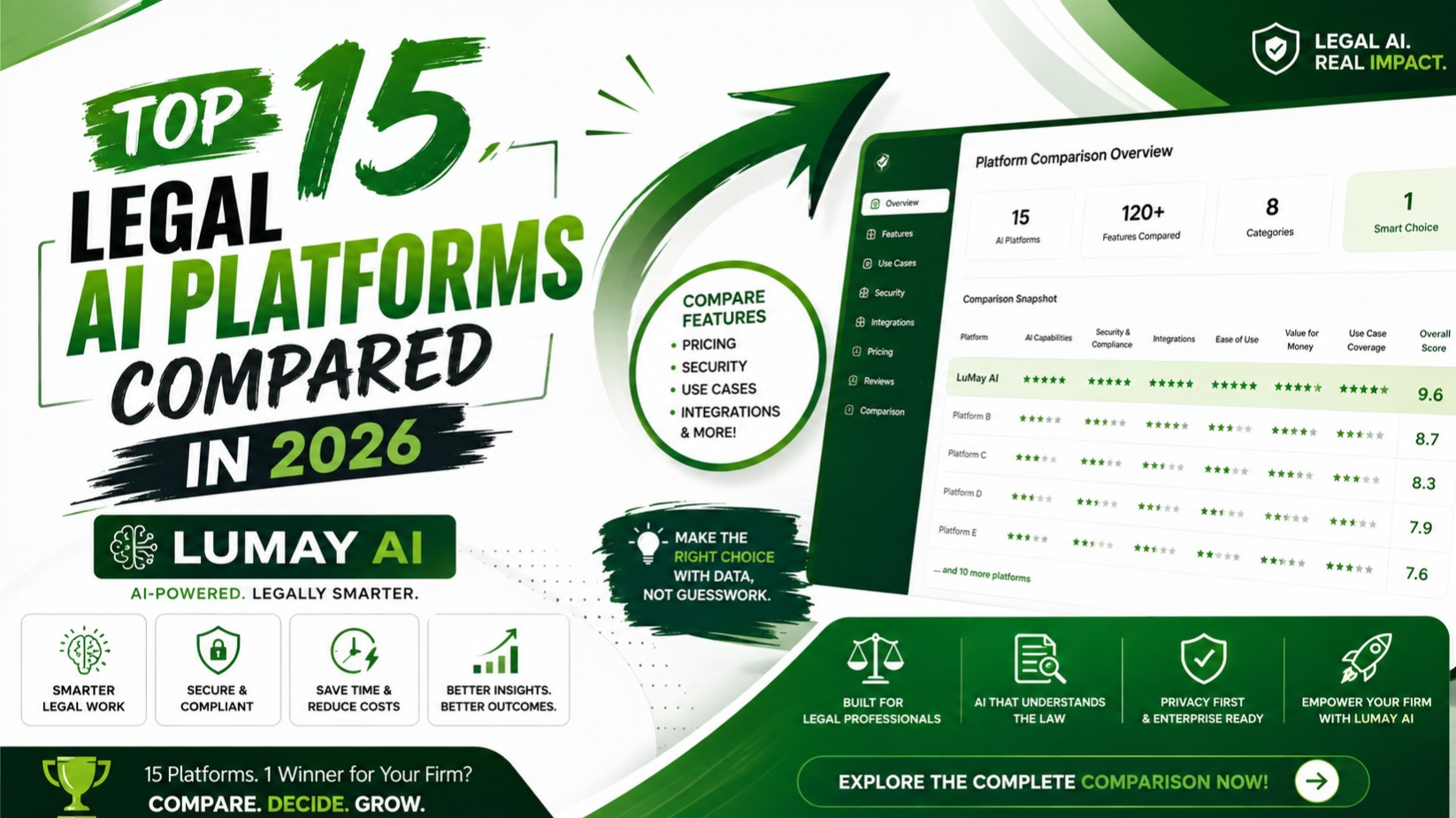
This guide compares 15 named legal AI products: 14 evaluation candidates and one Robin AI entry on an availability hold. The list is unranked. It is based on published vendor information reviewed on 6 November 2026, not hands-on performance testing. LuMay sells Lexintis; its disclosure remains separate below.
Compare legal AI platforms by workflow
Use the table to choose a category, then check the evidence and pilot conditions for each option. Intended users are editorial fit assessments, not vendor eligibility rules. Product pages show advertised capabilities, not a guarantee of outcomes or availability in every jurisdiction.
| Platform / official source | Primary evaluation task | Intended users | Pricing evidence as of 6 November 2026 |
|---|---|---|---|
| Harvey | Multi-document work and legal workflows | Law firms and in-house teams | Custom pricing described by the vendor; obtain a scoped quote. |
| CoCounsel (Thomson Reuters) | Research, drafting and document analysis | Teams evaluating Westlaw and Practical Law content | Plan and buyer details affect pricing; use the official configurator or sales quote. |
| Legora | Collaborative analysis and drafting | Teams sharing review work and producing documents | Comparable price not established in this review; request current terms. |
| Spellbook | Contract drafting and review | Transactional teams working in Word | Custom pricing based on licensed team size. |
| Lexis+ with Protégé | Legal research, drafting and analysis | Teams evaluating LexisNexis legal content | No comparable price verified here; obtain a regional subscription quote. |
| CASUS | Document work and DACH-focused research | Teams needing Swiss/German/Austrian workflow fit | Standard displayed at CHF 120/user/month with CHF 1,440 billed annually; Advanced by quote. Confirm tax and selected billing settings. |
| Luminance | Contract negotiation and portfolio intelligence | Corporate teams managing contract review and obligations | Comparable current price not established here; request a scoped proposal. |
| Ironclad | Contract lifecycle management | In-house teams coordinating contracting across departments | Custom quote; product scope, implementation and add-ons affect the comparison. |
| LEGALFLY | Review and drafting with anonymisation | Teams evaluating sensitive-document processing | Comparable current price not established here; confirm licensing and deployment scope. |
| Draftwise | Precedent-based drafting | Transactional teams using their firm’s deal history | Comparable current price not established here; request a deployment-specific quote. |
| GenieAI | Document drafting, review and negotiation | Business and legal teams comparing tiered subscriptions | US page: Pro $75/month or $708/year for one user; Business $320/month or $3,108/year for five users. Confirm taxes and allowances. |
| Clearbrief | Evidence-linked legal writing | Litigation teams reviewing factual and legal citations | Vendor lists Solo at $300/user/month under an annual licence; enterprise pricing is custom. |
| Andri | Matter analysis, research and drafting | UK and European legal teams checking jurisdiction fit | Business documentation lists £300, €350 or CHF 400/seat/month excluding VAT, by region; annual terms differ. |
| Robin AI — availability hold | Legacy contract review entry | Not eligible for an active shortlist without supplier confirmation | Current standalone pricing and availability unverified; do not use historical pricing. |
| Kira (Litera) | Contract extraction and due diligence | Deal teams reviewing large contract sets | Comparable current price not established here; request a quote for the required review scope. |
Additional pricing sources: CASUS plans; Harvey pricing explanation. Prices are not normalized because seat counts, usage, content rights, currencies and billing commitments differ. “Not established” means this review did not verify a comparable price; it does not mean the vendor has no public pricing.
How We Evaluated These Platforms
The starting set is the 15 products already named in this article. Inclusion is not an award or an exhaustive market survey. We compared official product descriptions and available pricing or security documents using the same questions:
- Task fit: research, drafting, document analysis, due diligence or contract operations?
- Evidence: can a reviewer inspect the authority, source passage or precedent behind an answer?
- Workflow: where does review happen, and how are edits and approvals handed off?
- Data handling: where are storage and inference, and what do retention, training and access terms say?
- Cost and availability: what is included for this region, licence, document volume and billing period?
- Supervision: can a lawyer find, correct and record errors before work leaves the team?
No common test corpus or scored benchmark was run. General NLP benchmarks do not establish the accuracy of these vendor products on client matters. The checks below are proposed evaluation steps, not observed product failures.
Platform differences and limitations
1. Harvey
Consider for: Law firms and in-house teams.
Harvey describes document analysis in Vault, legal research in Knowledge, and shared workspaces. Its breadth makes it a candidate when several practice groups need a common environment.
Evaluation boundary: Run the same matter through document retrieval, drafting and permissions checks. Confirm the source collection and licensed content available for your jurisdiction; broad workflow coverage does not establish answer accuracy.
Evidence: Official product or transaction source · Supporting documentation
2. CoCounsel (Thomson Reuters)
Consider for: Teams evaluating Westlaw and Practical Law content.
CoCounsel Legal combines research with drafting and analysis. CoCounsel Essentials has a different feature scope, including document work and Word tools.
Evaluation boundary: Compare the exact plan rather than the CoCounsel name alone. The official plan matrix distinguishes research access from drafting and analysis. Verify authorities and quotations before relying on output.
Evidence: Official product or transaction source · Supporting documentation
3. Legora
Consider for: Teams sharing review work and producing documents.
Legora’s Editor turns platform analysis into editable documents with source context and collaborative refinement. A Word add-in supports drafting, review and redlining.
Evaluation boundary: Test source traceability, document handoff and the boundary between internal and external collaborators. Confirm content entitlements and commercial terms; this review establishes no minimum annual commitment.
Evidence: Official product or transaction source · Supporting documentation
4. Spellbook
Consider for: Transactional teams working in Word.
Spellbook’s Word add-in supports review, drafting and playbooks. Associate handles multi-document matters, so evaluating only the add-in would understate the suite.
Evaluation boundary: Pilot the surface you intend to buy. Check tracked changes, cross-document consistency and document limits. Do not treat a drafting tool as proof that a legal proposition is correct.
Evidence: Official product or transaction source · Supporting documentation
5. Lexis+ with Protégé
Consider for: Teams evaluating LexisNexis legal content.
The current US product name is Lexis+ with Protégé, formerly Lexis+ AI. Its research offering connects legal sources and Shepard’s citation signals.
Evaluation boundary: Confirm the regional product, source coverage and subscription scope. A linked citation and a treatment signal help review, but the lawyer still needs to check relevance and the resulting legal argument.
Evidence: Official product or transaction source · Supporting documentation
6. CASUS
Consider for: Teams needing Swiss/German/Austrian workflow fit.
CASUS offers a browser workspace and Word add-in for drafting and review, alongside research and data-room features. Its security page distinguishes Swiss storage from inference processing elsewhere in Europe.
Evaluation boundary: Validate the exact source coverage and processing locations. Swiss document storage alone does not establish Switzerland-only processing or satisfaction of a client’s confidentiality requirements.
Evidence: Official product or transaction source · Supporting documentation
7. Luminance
Consider for: Corporate teams managing contract review and obligations.
Luminance describes a platform connecting negotiation, workflows and contract intelligence. Its published hosted terms describe a vendor-managed AWS cloud application.
Evaluation boundary: Test approval paths and extraction on your own agreements. Confirm available hosting regions and the contracted configuration before assuming private-cloud isolation.
Evidence: Official product or transaction source · Supporting documentation
8. Ironclad
Consider for: In-house teams coordinating contracting across departments.
Ironclad combines contract workflows, a repository and AI capabilities. Its pricing page separates products, implementation support and optional additions.
Evaluation boundary: Choose it for a contracting process you can define and govern. Confirm configuration ownership, integration charges and applicable AI usage charges before comparing total cost.
Evidence: Official product or transaction source · Supporting documentation
9. LEGALFLY
Consider for: Teams evaluating sensitive-document processing.
LEGALFLY describes anonymisation before analysis and a Word add-in for review and redlining. It advertises deployment choices for its anonymisation capability.
Evaluation boundary: Map the actual data flow, including re-identification, model providers and support access. Confirm which components run on-premises; anonymisation is not an assurance that every confidentiality obligation is met.
Evidence: Official product or transaction source · Supporting documentation
10. Draftwise
Consider for: Transactional teams using their firm’s deal history.
Draftwise connects drafting in Word with the firm’s prior documents and clauses. Its FAQ describes several deployment configurations.
Evaluation boundary: Check DMS permission inheritance, retrieval relevance and the quality of the precedent set. A useful pilot should include restricted matters and documents that should never be retrieved for a given user.
Evidence: Official product or transaction source · Supporting documentation
11. GenieAI
Consider for: Business and legal teams comparing tiered subscriptions.
GenieAI lists document drafting and review tools and tiered plans. Template access does not make the commercial platform open-source; this review makes no open-source claim.
Evaluation boundary: Compare usage allowances, team permissions and regional suitability. The pricing page contains differing enterprise descriptions, so obtain written enterprise terms rather than using an inferred starting price.
Evidence: Official product or transaction source
12. Clearbrief
Consider for: Litigation teams reviewing factual and legal citations.
Clearbrief works inside Word to connect legal writing with supporting material and citation review. This is a different evaluation task from running an enterprise contract lifecycle.
Evaluation boundary: Test whether suggested evidence actually supports each proposition, including omissions and contradictory records. Hyperlinking is a review aid, not a guarantee that every factual assertion is supported.
Evidence: Official product or transaction source · Supporting documentation
13. Andri
Consider for: UK and European legal teams checking jurisdiction fit.
Andri describes matter-file analysis, timelines, research and document generation. Assess its matter-level workflow separately from any specific court-form or filing requirement.
Evaluation boundary: Verify the jurisdictions, authorities and available workflows using representative matters. Treat simulations and generated documents as material requiring lawyer review, not predictions of court outcomes.
Evidence: Official product or transaction source · Supporting documentation
14. Robin AI — availability hold
Consider for: Not eligible for an active shortlist without supplier confirmation.
Current standalone product availability was not established from an accessible official Robin product source. The transaction adviser confirms that Scissero acquired Robin’s managed-services team; that does not establish acquisition or availability of the technology platform.
Evaluation boundary: Confirm the current contracting entity, product access, support, data obligations and migration arrangements before any procurement decision. Do not assume legacy product descriptions establish a current offer.
Evidence: Official product or transaction source · Supporting documentation
15. Kira (Litera)
Consider for: Deal teams reviewing large contract sets.
Litera describes Kira’s provision extraction, review grids and source-linked contract analysis. Its product page lists more than 1,400 pre-built smart fields.
Evaluation boundary: Pilot scanned documents, amendments and unusual clauses separately. Field coverage does not prove extraction quality on your files; review missed provisions and wrong extractions before accepting a report.
Evidence: Official product or transaction source
How to Choose
| Your main need | Start the evaluation with | Decisive pilot question |
|---|---|---|
| Authority-backed research | CoCounsel and Lexis+ with Protégé; assess other research offerings for your jurisdiction | Can reviewers trace propositions to current, relevant authority? |
| Word-based contract review | Spellbook, Draftwise, LEGALFLY; consider CASUS or Legora where their workflows fit | Do redlines preserve meaning, preferred positions and document formatting? |
| Cross-document work | Harvey, Legora, Kira; assess the appropriate multi-document surface of other tools | Can reviewers find both supporting and conflicting passages across amendments? |
| Contract process management | Ironclad or Luminance, according to workflow requirements | Do intake, approvals and repository responsibilities work end to end? |
| Evidence-linked litigation writing | Clearbrief; compare research and matter tools for separate needs | Does the cited evidence actually support the drafted sentence? |
| Regional or smaller-team requirements | CASUS, Andri or GenieAI where coverage and terms fit | Does the specific subscription cover your users, jurisdiction and usage? |
Shortlist two or three relevant candidates and pilot the same permitted documents and tasks. Record wrong answers, missed issues, reviewer corrections and total review time. A fast first draft is useful only if the final work can be checked efficiently.
Enterprise Requirements Checklist
• Single sign-on and role-based access.
• Audit logs that admins can export.
• Data-residency options that match client requirements.
• Integrations with your document management system.
• Contract terms on training, retention and sub-processors.
Procurement and Security Review
➤ Requirements: agree tasks, users and success measures.
➤ Security review: storage, encryption, retention and incident response.
➤ Pilot: one practice group, two or three tasks, fixed period.
➤ Legal review of terms, then phased rollout.
Enterprise Deployment Steps
➤ Appoint a sponsor and a legal operations lead.
➤ Publish an AI use policy before rollout.
➤ Train each group on its own matters.
➤ Track adoption, time saved and errors found in review.
These are procurement requirements to verify, not features established for every vendor in the table. Separate customer-data storage, model inference, logs, backups and support access. A vendor security page or certificate alone does not establish suitability for your client’s matter.
For example, CASUS’s security page describes storage in Switzerland and inference processing in Belgium, Switzerland and Sweden. Legora’s security page describes configurable enterprise controls; confirm package scope and executed terms. Read the actual data-processing agreement and subprocessor list before approving confidential uploads.
Costs and procurement questions
Ask every shortlisted vendor for the same scoped proposal: named users, research content, AI allowances, document limits, integrations, onboarding, support, renewal and exit. Check whether annual billing is a commitment rather than a monthly cancellation option. Obtain the applicable currency, taxes and region in writing.
For products with separate modules, require a line-by-line feature matrix. For Ironclad’s eligible AI agents, confirm included credits and overage settings; not every AI feature consumes those credits. Do not infer total cost from a starting seat price.
Our Own Product: Lexintis (LuMay Legal Agent)
Disclosure: LuMay AI publishes this guide and sells Lexintis. It is outside the comparison and is not ranked. Review the Lexintis product page against the same workflow, evidence, data and cost criteria. This comparison makes no independent performance or compliance claim for LuMay’s product.
Frequently Asked Questions
Which legal AI platform should an enterprise shortlist first?
Start with the task: authority-backed research, contract drafting, due diligence or contract operations. Select candidates from the relevant category and compare their exact regional subscriptions on the same pilot tasks.
Can source citations eliminate hallucinations?
No. Source links and citation signals help a lawyer check output. Review the authority, quoted passage, relevance, currency and reasoning; a linked source does not guarantee a correct conclusion.
Does Swiss hosting mean all AI processing stays in Switzerland?
Not necessarily. Storage, inference, logs and support access can involve different locations. Review the vendor’s current processing documentation and executed terms rather than relying on a hosting label.
How should we compare prices?
Use the same users, content rights, AI usage, documents, integrations, support and billing commitment. Public prices in this guide have different scopes and are not directly comparable total-cost estimates.
What is a realistic pilot scope?
One practice group, two or three tasks, and a fixed period with agreed measures. Track errors and reviewer correction time alongside adoption and completion time.
What should the security review cover?
Data storage and inference locations, encryption, access controls, retention, model training terms, subprocessors, audit exports, incident response and deletion. Confirm the features and contractual scope of the selected plan.
How do we handle professional obligations?
Have the responsible legal team assess the rules and court requirements applicable to its jurisdictions and matters. Address supervision, confidentiality, any required client consent or disclosure, and billing in the organization’s policy.
Why is Robin AI on an availability hold?
This review did not establish current standalone product access or terms from an accessible official Robin source. The managed-services transaction does not prove availability of the technology platform. Verify the supplier and current offering before shortlisting.
Why is Lexintis outside the comparison?
LuMay sells Lexintis and publishes this guide. It is disclosed separately and receives no ranking or independently tested performance claim here.
Related LuMay guides
Use these existing guides for a narrower follow-up task. They are related reading, not the evidence for vendor claims in this comparison.
- best legal AI agent platforms guide
- Best Agentic AI for Law Firms
- Best Autonomous Legal AI Systems
- Best AI Tools Lawyers Should Use
- Which Legal AI Platform Is Best?
- Legal Research to AI Research Platforms
- Best AI-Powered Legal Automation Platform
- Legal AI for Multi-Office Law Firms
- Secure AI Agents for Legal Teams
- best law firm revenue operations AI platforms
- Harvey AI alternatives for law firms
- best CoCounsel alternatives for lawyers
- best Legora alternatives
- best law firm intake automation software
- best AI legal assistants
- best AI contract review software
- top 15 best legal agents for finance
Before you buy, ask the shortlisted vendors to demonstrate your workflow and document the remaining gaps. Keep the pilot scorecard with the procurement decision.