An AI system can produce a polished summary of a regulation in seconds. That does not prove the rule applies to your company—or even that the text was in force on the date that matters.
Legal compliance research AI is valuable when it helps lawyers and compliance teams find relevant authorities, trace requirements to their sources, compare jurisdictions, and prepare reviewable evidence. The risk begins when a plausible answer is mistaken for a verified legal conclusion.
A fast answer is useful. A source-backed, date-aware answer is defensible.
What is legal compliance research AI?
Legal compliance research AI refers to AI-assisted tools and workflows used to identify laws and regulations, summarize relevant provisions, compare changes, organize obligations, and prepare supporting citations. It may use keyword search, legal databases, permissioned retrieval, and language models.
Its proper role is to support legal research and decision preparation, not to independently certify an organization's compliance. Applicability depends on jurisdiction, industry, regulated activity, facts, exceptions, and timing.
The American Bar Association's Formal Opinion 512 discusses lawyers' competence, confidentiality, supervision, and verification responsibilities when using generative AI. That reinforces the need for meaningful human review rather than assuming an AI answer is authoritative.
Why legal compliance research is harder than ordinary search
1. Search results do not establish legal authority
A blog summary, agency FAQ, enacted statute, binding regulation, enforcement notice, and court opinion can carry different legal weight. Research must identify the type of authority and what it actually supports.
2. Effective dates change the answer
Some rules apply on one date, are amended later, or include transitional periods. An AI summary without a source version and effective date may be misleading. The EU AI Act record on EUR-Lex illustrates why researchers should distinguish an original act, its consolidated text, and staged application dates. A consolidated text can be useful for navigation, while the authentic published legal acts remain authoritative.
3. Scope depends on facts
A rule may depend on company size, regulated activity, geographic reach, data categories, or whether an entity acts as provider, deployer, controller, or processor. A legal research AI should report assumptions rather than fill missing facts silently.
4. Sources can conflict
Different agencies, courts, and statutory instruments may address related subjects. A defensible research note records the conflict and escalates interpretation instead of combining incompatible statements into one confident answer.
5. Confidential facts must remain protected
Client records, internal investigations, contracts, and incident facts may be sensitive or privileged. Verify tool approval, retention, access control, and vendor handling before submitting them for processing.
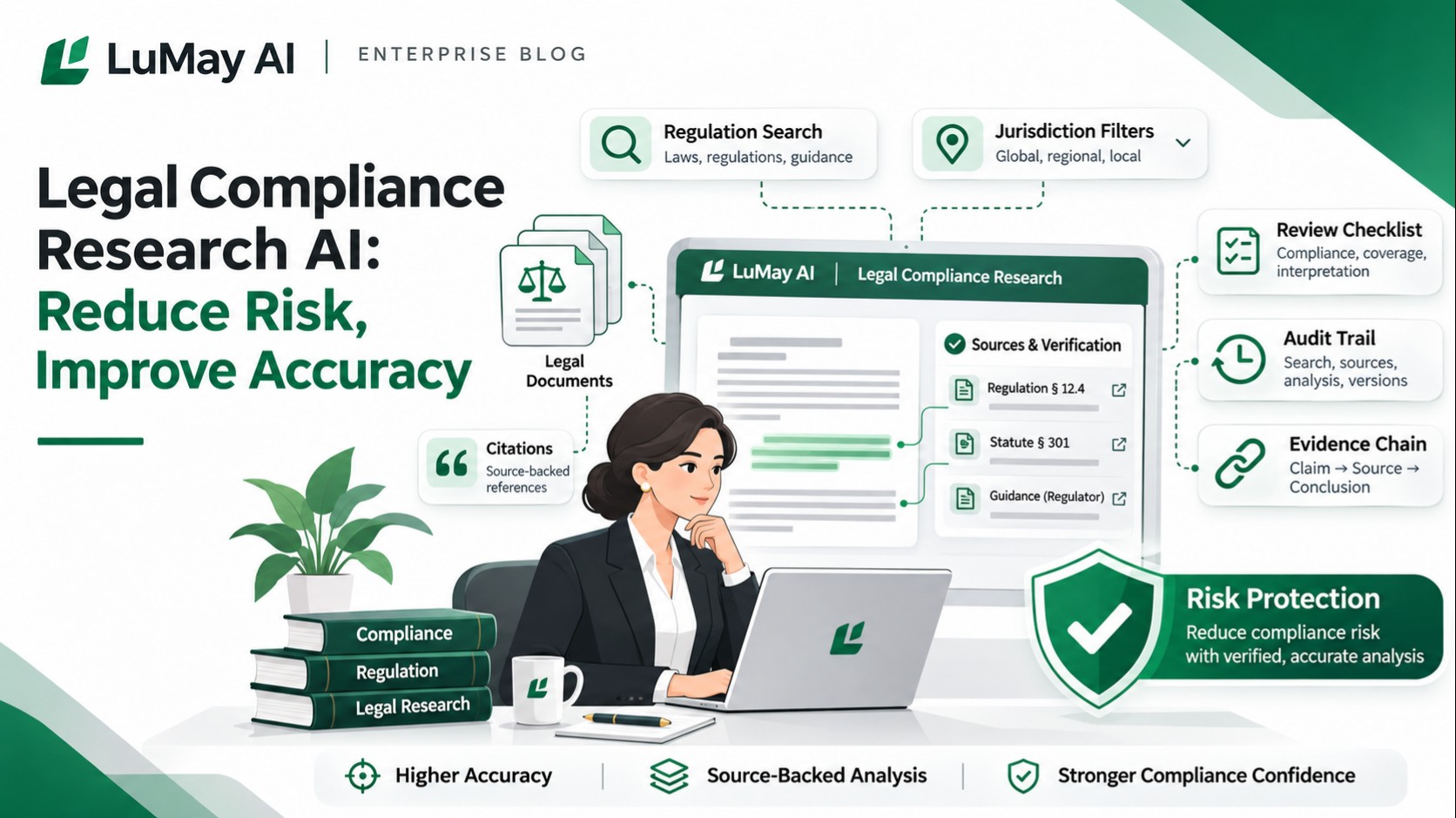
The source-to-conclusion evidence chain
A useful AI-assisted research system should let a reviewer follow each conclusion through an evidence chain:
| Element | Question for the reviewer | Expected evidence |
|---|---|---|
| Research question | What activity and entity are in scope? | Defined facts and assumptions |
| Jurisdiction | Which legal system applies? | Geography and authority scope |
| Source authority | Statute, rule, guidance, or case? | Official citation and source type |
| Time | Which version is relevant? | Effective date, amendment and status |
| Interpretation | What does the text require? | Quoted or pinpointed support plus caveats |
| Application | Do the facts meet the conditions? | Qualified legal reviewer decision |
| Record | Can the work be reconstructed? | Source snapshot, changes, sign-off |
Missing evidence should be reported as missing. An unsupported compliance conclusion should never be made to look certain.
A seven-step legal compliance research AI workflow
- Define the exact legal question. Specify entity, activity, jurisdiction, relevant dates, and desired decision.
- Prioritize primary authorities. Locate official legislation, regulatory text, agency issuances, and relevant case law where appropriate.
- Check status and currency. Confirm amendments, repeal, transition rules, and the legal version applicable to the facts.
- Extract requirements with pinpoint support. Tie each proposed obligation to a passage and its conditions.
- Map facts and exceptions. State which facts are known, disputed, missing, or outside scope.
- Escalate interpretation. Qualified lawyers or compliance experts validate disputed, consequential, or unclear questions.
- Record and monitor changes. Retain the review record and define how material source updates trigger reassessment.
Worked example: researching AI governance obligations
Hypothetical scenario, not legal advice or a LuMay customer case. A software company asks: “Do the EU AI Act's high-risk obligations apply to our internal AI system?”
An unreliable assistant might answer yes or no based on a product label. A better workflow identifies the company's role, intended purpose, actual use, applicable classification provisions, exemptions, and deployment timing. It retrieves relevant provisions from the official EUR-Lex record, records the text version and legal dates, and flags uncertain classifications for counsel.
The output should be an issue-and-evidence memo: likely relevant provisions, facts needed, source links, possible interpretations, and reviewer sign-off status—not an unsupported “compliant” badge.
How to evaluate accuracy without hiding risk
Generic answer accuracy is too broad for legal research. Use a test set of real-shaped questions with approved reference answers and inspect:
- Citation existence: does the authority actually exist?
- Pinpoint support: does the cited passage support the proposition?
- Currency: is the relevant legal version correctly identified?
- Applicability: does the summary preserve jurisdiction and scope?
- Unsupported claims: does the assistant abstain when evidence is missing?
- Reviewer correction: how much work is required to reach a legally defensible result?
The NIST Generative AI Profile provides a broader risk-management reference; it is not a substitute for jurisdiction-specific legal analysis.
When should AI research escalate to a human?
Escalate when a source appears superseded, authority conflicts, applicability turns on contested facts, a regulatory exception is unclear, an enforcement consequence is material, or the system cannot find directly supporting text. Human legal judgment is also required before giving formal advice or final regulatory sign-off.
For related controls, see LuMay's guide to verifying AI-generated legal citations and enterprise data governance register guide.
What to ask a legal compliance research AI provider
Ask whether the product links to official source text, distinguishes binding rules from commentary, captures effective dates and amendments, supports jurisdiction filters, limits confidential data access, records review decisions, and exposes uncertainty rather than generating unsupported answers. Verify how corrections propagate to previous research notes and whether the organization can export an evidence package.
Do not compare providers solely by how many jurisdictions or regulations they claim to cover. Ask for a documented evaluation on the exact jurisdictions, legal questions, and source classes relevant to your team.
How legal teams can start responsibly
Begin with a narrow research category and a supervised pilot. Use questions for which qualified reviewers can establish a reference answer. Require source citations, dates, and abstention when evidence is inadequate. Measure reviewer effort and material missed-authority errors before expanding.
The right goal is not to eliminate the legal review. It is to spend less effort collecting routine evidence and more effort applying informed legal judgment.
Frequently Asked Questions
Q1: What is legal compliance research AI?
A: AI-assisted discovery, organization, comparison, and citation of potentially relevant legal and regulatory sources, subject to qualified human verification.
Q2: Can AI determine whether a company is legally compliant?
A: It can support evidence collection and gap analysis, but a confident output is not a legal determination; qualified professionals must assess applicability and facts.
Q3: Why must AI legal compliance findings include citations?
A: Citations allow reviewers to verify the actual source text, authority, version, scope, and effective date.
Q4: How does jurisdiction change AI compliance research?
A: The governing law and relevant agencies differ by geography, entity, activity, and regulatory scope.
Q5: Can AI use outdated regulations?
A: Yes. Teams must verify source currency, amendments, effective dates, transition rules, and superseded guidance.
Q6: What is the difference between law and agency guidance?
A: Enacted statutes and binding regulations may impose obligations; guidance may describe interpretation or enforcement expectations without equivalent legal force.
Q7: What should a compliance research audit trail include?
A: Question, source snapshot, legal citations, effective-date check, analyst notes, assumptions, reviewer decision, and change history.
Q8: Can an AI assistant summarize multiple jurisdictions?
A: It can organize a comparison, but must preserve jurisdiction-specific conditions and avoid implying the same rule applies everywhere.
Q9: Should lawyers verify AI-generated citations?
A: Yes. Lawyers must exercise appropriate independent verification and professional judgment under applicable ethical duties.
Q10: How should AI handle conflicting regulatory sources?
A: Flag the conflict, preserve both sources and their authority, identify effective dates, and escalate interpretation to qualified legal reviewers.
Q11: What measures show compliance research AI is working?
A: Supported citation rate, currency checks, missed-authority rate, reviewer correction time, and completeness for scoped test questions.
Q12: Can AI replace legal compliance counsel?
A: No. It can assist research and evidence preparation; legal interpretation, privileged advice, and final responsibility remain with qualified professionals.
Sources and further reading
Official and primary references: ABA Formal Opinion 512, EUR-Lex AI Act record, and NIST Generative AI Risk Management Profile. This article is educational and does not constitute legal advice.