Employment-law work is full of documents that look repetitive until one sentence changes the legal or business risk.
Employee handbooks, offer letters, policies, investigation notes, accommodation records, performance material, agency guidance and case law all require context. AI can help organize and compare that material, but it should not flatten jurisdiction, effective date or factual nuance into one generic answer.
What is legal AI for employment law?
Legal AI for employment law uses AI-assisted research, document analysis, extraction and workflow tools to help attorneys and legal teams review employment-related material while retaining human legal judgment and source verification.
The American Bar Association has highlighted growing use of AI in labor and employment practice while stressing verification, firm policies, confidentiality and human oversight. See AI in Labor and Employment Law.
Six practical employment-law workflows
1. Policy comparison
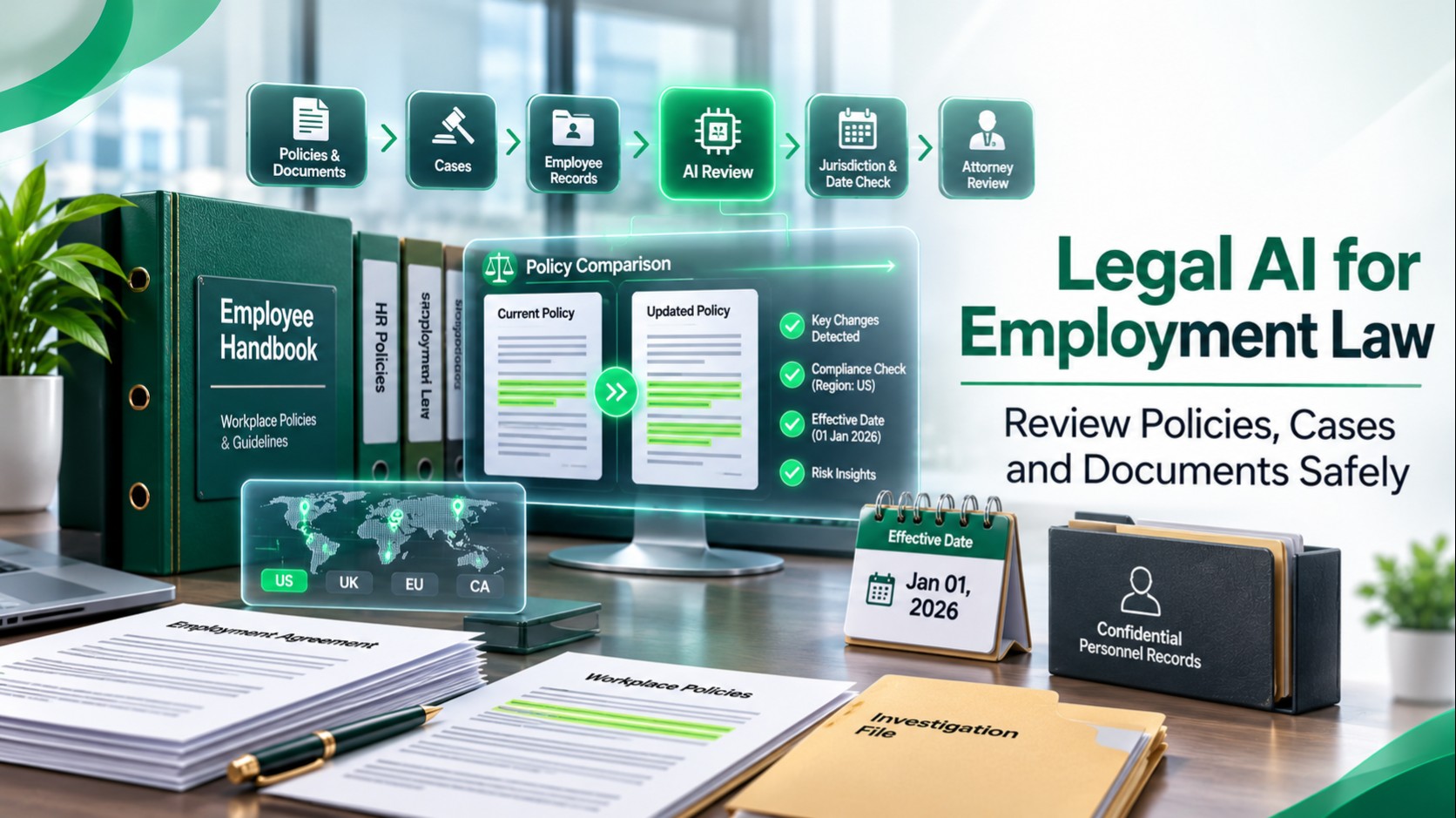
AI can compare versions of a handbook or policy and identify changes to leave, conduct, remote work, reporting, privacy or discipline language. The attorney can then review whether the change creates jurisdiction-specific consequences.
2. Multi-jurisdiction issue spotting
A workflow can organize applicable jurisdictions and surface potentially relevant statutes, regulations or guidance for attorney research. It should preserve source, date and jurisdiction instead of presenting one universal rule.
3. Investigation document organization
AI can cluster interview notes, messages, timelines and policy references by issue or participant, while flagging inconsistent dates or statements for human review.
4. Employment agreement extraction
AI can extract structured fields such as role, compensation terms, notice, restrictive covenants, governing law and dispute provisions into a review table.
5. Case and authority preparation
AI can help frame research questions and summarize retrieved authorities, but attorneys should verify the original authority, subsequent treatment and factual fit.
6. Draft preparation
AI can prepare first-pass internal summaries, issue lists, policy comparison tables or correspondence from verified source material. Final legal advice remains attorney work.
The most important metadata: jurisdiction and effective date
Employment requirements change across federal, state and local levels. A legally accurate statement can still be wrong for the reader if the jurisdiction or effective date is missing.
| Source field | Why preserve it |
|---|---|
| Jurisdiction | Separates federal, state, local and other authority. |
| Effective date | Helps determine whether the rule applies to the time period at issue. |
| Authority type | Distinguishes statute, regulation, case, agency guidance or policy. |
| Source URL or document | Lets the attorney verify the original material. |
| Treatment or status | Signals whether further legal validation is needed. |
This is why an employment-law AI workflow should behave more like a source-aware research assistant than a general chatbot.
Policy review should compare obligations, not just wording
A redline can show text changes. AI can add a second layer by organizing the effect of those changes:
- Who is covered?
- What event triggers the policy?
- Who must approve or respond?
- What deadline applies?
- What record must be retained?
- What employee notice is required?
- Where does the policy conflict with another internal document?
The output should be treated as a review aid, not a legal conclusion.
Employment investigations need separation between fact and inference
When reviewing investigation material, the system should distinguish:
| Layer | Example |
|---|---|
| Observed source fact | Email sent on a stated date. |
| Witness statement | A person reports that an event occurred. |
| Conflict | Two accounts differ on timing or conduct. |
| AI inference | System suggests that two events may be connected. |
| Attorney conclusion | Legal team determines relevance or legal significance. |
Blending these layers can make a generated summary sound more certain than the underlying record supports.
Confidentiality and access control are part of the workflow
Employment matters can include medical, compensation, performance, complaint and investigation information. Access should be restricted by matter, role and document type where appropriate.
The ABA’s Formal Opinion 512 reminds lawyers to consider confidentiality and supervision obligations when using generative AI.
Do not confuse legal AI with automated employment decision systems
There is an important distinction between AI used by lawyers to assist legal work and AI used by employers to make or recommend employment decisions.
A legal-research or policy-review assistant can help counsel analyze an issue. A system that screens candidates, scores workers or recommends employment actions may trigger separate legal, fairness, notice, audit or governance questions. The legal team should identify which category a proposed system belongs to before advising on controls.
A safe review workflow
- Define the legal question and jurisdiction.
- Load only approved matter sources.
- Retrieve relevant material with source metadata.
- Generate structured findings, not just prose.
- Separate facts, conflicts and AI inferences.
- Verify primary authorities and important quotations.
- Route unresolved issues to counsel.
- Record review status before downstream use.
For source-first compliance research, see LuMay’s Legal Compliance Research AI.
How to evaluate an employment-law AI tool
- Can it restrict access by matter and role?
- Can it preserve jurisdiction and effective date?
- Does it link conclusions to source documents?
- Can reviewers inspect exact quoted text?
- Does it distinguish missing evidence from negative evidence?
- Can it compare document versions structurally?
- Can administrators control retention and approved use?
- Can attorney review be recorded?
A strong tool should make verification easier, not merely generation faster.
Final perspective
The value of AI in employment law is not that it can produce an answer instantly. It is that it can organize a changing body of policies, facts and authorities so the attorney can reach a verified answer with less mechanical work and more visibility into what still needs judgment.