Litigation teams do not need an AI that sounds confident. They need an AI workflow that can show exactly where every important statement came from.
A litigation matter can contain pleadings, discovery responses, deposition transcripts, exhibits, correspondence, expert material, authorities and internal work product. The opportunity for AI is not simply faster summarization. It is structured preparation: finding relevant material, organizing it, connecting it to the question at hand and presenting evidence for attorney review.
What is an AI legal agent for litigation support?
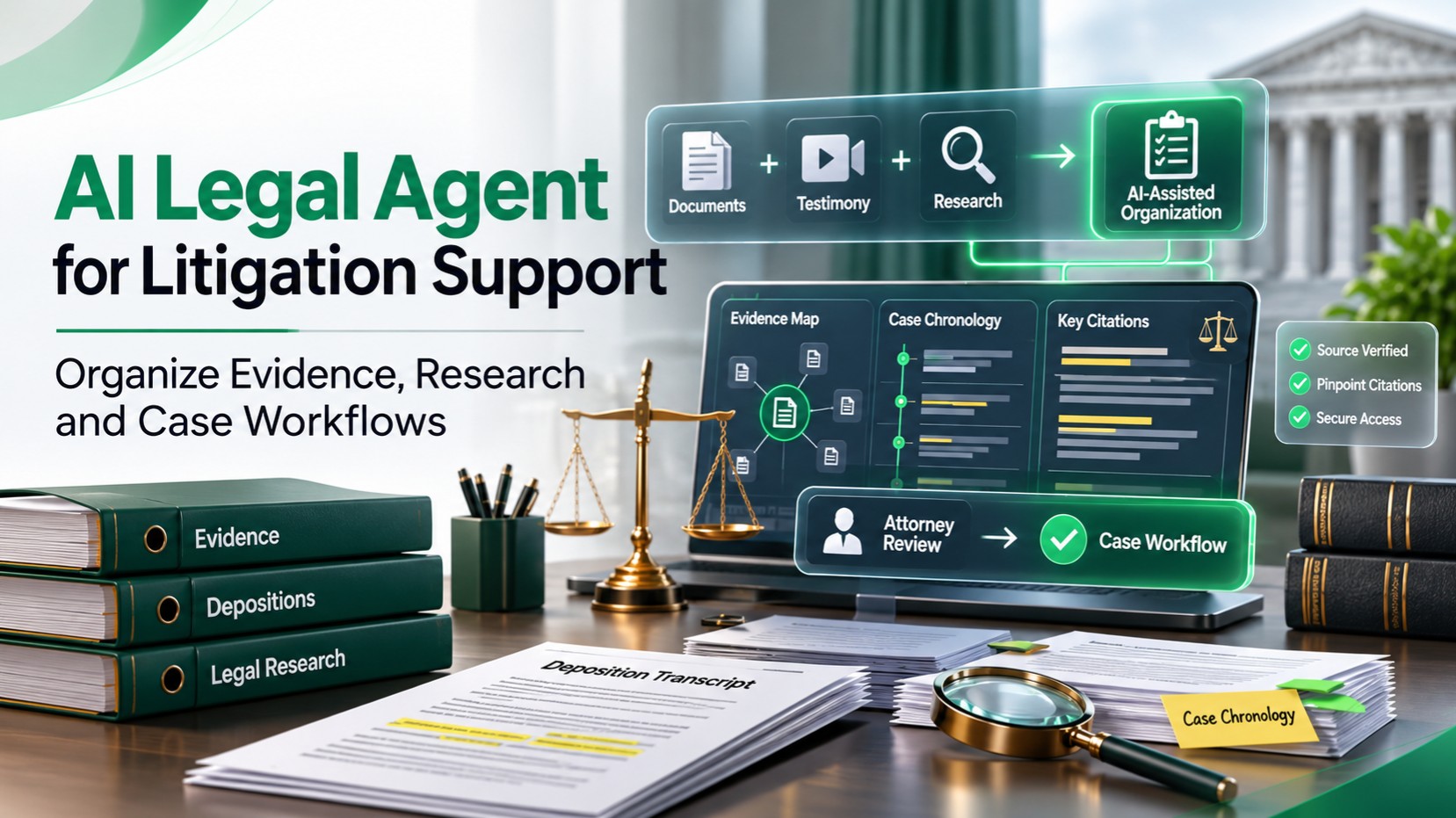
An AI legal agent for litigation support is a controlled workflow that can assist with tasks such as document organization, chronology building, evidence retrieval, transcript review, legal research preparation and drafting while preserving source links and attorney review.
It should not be treated as an autonomous lawyer. The American Bar Association’s Formal Opinion 512 reinforces lawyers’ continuing duties around competence, confidentiality, supervision and review when using generative AI.
The central design principle: every material proposition needs a path back to evidence
For litigation work, a useful AI output should let the reviewer move from conclusion to evidence without starting the search again.
A source-first record can include:
- proposition or issue;
- source document;
- page or paragraph reference;
- quoted or extracted supporting text;
- AI interpretation;
- confidence or unresolved conflict;
- review status;
- reviewer notes.
This is more useful than a polished narrative with no transparent evidentiary path.
Seven litigation workflows where AI can assist
1. Matter intake and document inventory
AI can classify incoming files by type, date, custodian, party or issue and flag documents that cannot be parsed, are duplicated or appear to be missing from a sequence.
2. Chronology preparation
The system can propose events from emails, contracts, records and testimony, then link each event to its supporting source. Attorneys should review conflicts instead of receiving one blended “truth.”
3. Deposition and transcript review
AI can locate testimony by issue, compare statements across witnesses and prepare candidate excerpts with page references. The attorney should verify the transcript before relying on the excerpt in work product or a filing.
4. Evidence-to-issue mapping
For each claim, defense or disputed fact, the workflow can gather supporting and contrary material into an issue matrix rather than merely summarizing the entire production.
5. Legal research preparation
AI can help frame research questions, identify terms and organize authorities. Final citations and propositions should be validated against authoritative legal sources.
6. Draft preparation
An AI agent can prepare first-pass factual sections, discovery summaries or internal memos from approved sources. The output should retain citations to the underlying evidence so review is efficient.
7. Review queues and case workflow
AI can route unresolved conflicts, missing evidence, low-confidence extractions and proposed filing language to the correct attorney instead of forcing a full reread of every document.
Why discovery review needs a different standard from ordinary summarization
The ABA has warned that generative AI discovery results can be wrong in ways that appear plausible, including fabricated facts or incomplete retrieval. Its 2026 discussion of risks in generative AI discovery review emphasizes verification and understanding what relevant material may have been missed.
That suggests two evaluation questions:
- Precision: Are the items the system returned actually relevant and correctly interpreted?
- Recall: Did the system miss material the legal team needed to see?
A good demo should test both.
Build an evidence ledger, not a chatbot transcript
| Field | Purpose |
|---|---|
| Issue | Connect the evidence to a litigation question. |
| Source ID | Identify the originating document or transcript. |
| Pinpoint | Preserve page, paragraph or line reference. |
| Evidence type | Testimony, document, authority, correspondence or other. |
| Proposition | State what the evidence may support. |
| Contrary evidence | Expose conflicts rather than hiding them. |
| Review status | Unreviewed, verified, rejected or needs follow-up. |
This design supports attorney review and later audit far better than a single generated answer.
Preservation and AI-generated matter records are becoming litigation issues themselves
AI prompts, outputs and logs can become relevant to discovery depending on the facts and jurisdiction. ABA commentary in 2026 has discussed the discoverability and preservation of AI research and expert AI interactions. See When Is a Litigant’s AI Research Discoverable? and Experts in the Age of AI.
That means litigation teams should define retention and logging deliberately rather than allowing matter-related AI activity to accumulate in uncontrolled consumer tools.
Privilege and confidentiality need matter-level controls
Legal AI should enforce matter access before retrieval, not after generation. A user who cannot access a document in the document management system should not be able to retrieve its contents through an AI layer.
For implementation guidance, see LuMay’s Legal AI Ethical Walls.
Teams should also understand the data handling terms of every AI product used for confidential matter information.
A practical litigation AI review ladder
| AI-assisted task | Recommended review intensity |
|---|---|
| File classification | Sampling plus exception review. |
| Internal document summary | Source-linked attorney spot review based on risk. |
| Chronology event | Verify source and date; inspect conflicts. |
| Deposition quotation | Verify exact transcript text and pinpoint. |
| Legal proposition | Verify authority, jurisdiction, treatment and quotation. |
| Filing-ready factual statement | Full attorney verification against the record. |
The review standard should rise with the consequence of error.
How to evaluate a litigation AI agent
- Use a representative matter subset, not only clean sample documents.
- Include scanned files, long transcripts, inconsistent names and conflicting dates.
- Create attorney-verified questions and expected evidence.
- Measure retrieval misses, unsupported assertions and citation errors.
- Test matter permissions and ethical walls.
- Test exportable evidence records and review status.
- Verify how the system behaves when no responsive evidence exists.
For a related source-verification pattern, see AI Legal Summaries: Build a Source Evidence Ledger Before Review.
Final perspective
The highest-value litigation AI is not the system that generates the longest answer. It is the system that shortens the distance between a legal question and the verified evidence an attorney needs to make the next decision.