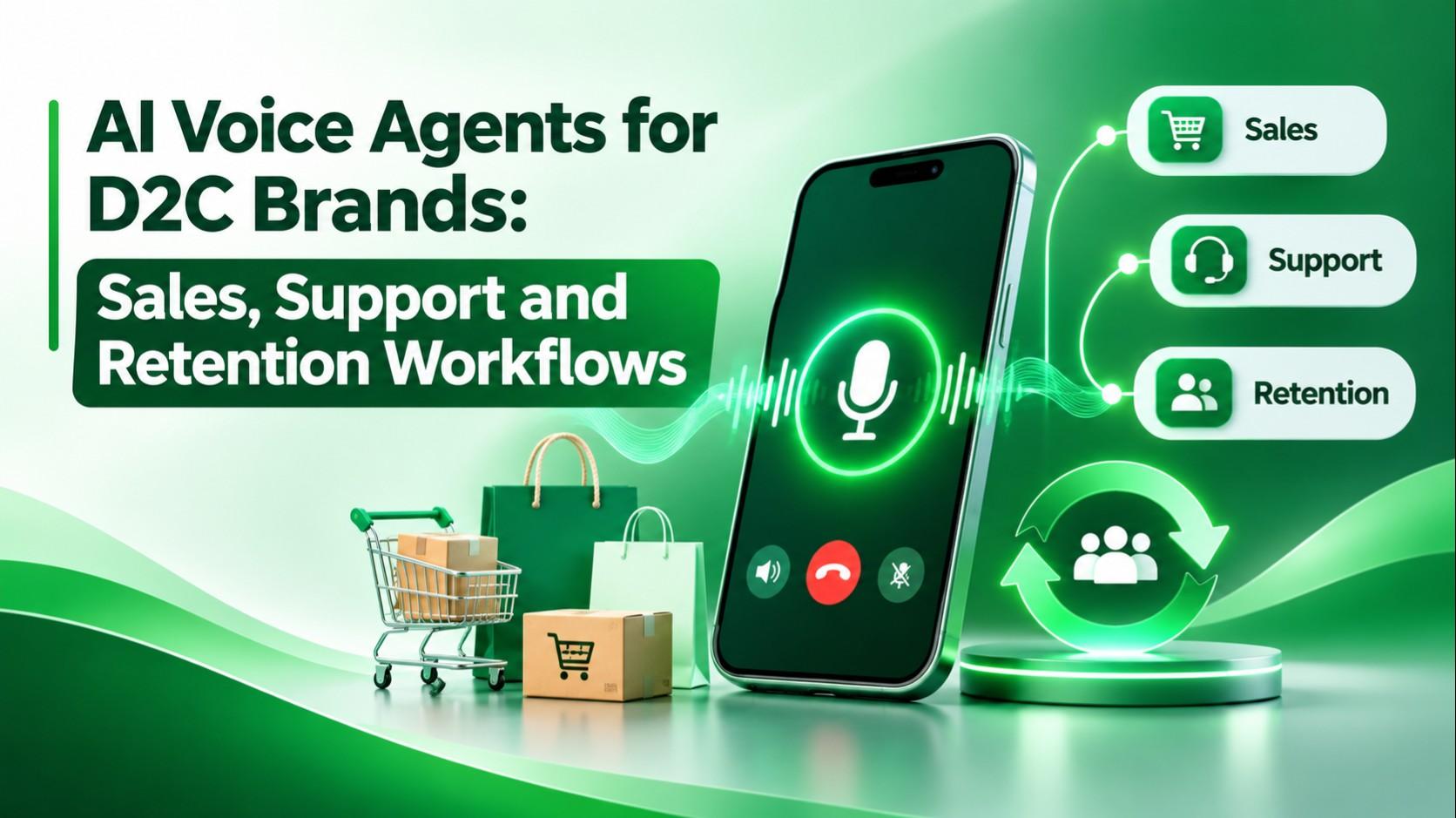
AI Voice Agents for D2C Brands: Sales, Support and Retention Workflows
D2C brands should not evaluate voice AI as another call-center channel. They should evaluate it as a customer-lifecycle workflow.
- A shopper may call before buying because product information is unclear.
- A customer may call after buying because an order is late.
- A returning customer may call because they want to exchange, reorder or change a subscription.
- A frustrated customer may call because chat and email have already failed.
- The value of an AI voice agent comes from recognizing which stage the customer is in and moving that customer to the correct next state.
What is an AI voice agent for D2C brands?
- An AI voice agent is a conversational phone system that can understand spoken requests, retrieve approved customer or order context, answer supported questions, capture intent, trigger approved workflows and transfer complex cases to people.
- For a D2C brand, that means the same voice layer can support pre-purchase, purchase, post-purchase and retention use cases.
- The agent should not operate as an isolated chatbot. It should connect to ecommerce, CRM, order-management, shipping, helpdesk and approved payment or account systems.
Why D2C brands are a strong fit for voice AI
- Shopify’s 2026 ecommerce customer-experience guidance says AI is increasingly serving as both a support tool and a shopping assistant.
- Shopify also notes that AI customer service can handle routine questions such as order status and returns while handing more complex cases to human agents.
- The opportunity for D2C brands is therefore broader than reducing support tickets: voice can help connect product discovery, order support and retention into one controlled customer journey.
Where voice AI fits across the D2C customer lifecycle
- Pre-purchase: product questions, availability, sizing, product comparison and store-policy questions.
- Purchase: checkout assistance, address clarification, order confirmation and approved payment handoff.
- Post-purchase: order status, delivery questions, returns, exchanges, damaged-item reporting and replacement workflows.
- Retention: reorder reminders, subscription questions, loyalty support, win-back and escalation for high-value customers.
- Operations: structured call summaries, CRM updates, callback tasks and quality monitoring.
10 high-value D2C voice AI workflows
1. Product discovery calls
- Ask the customer what they are trying to solve.
- Retrieve approved product attributes from the catalog.
- Compare products using verified specifications.
- Recommend only products that meet the stated need.
- Transfer to a specialist when advice requires expertise the agent does not have.
2. Product availability
- Check current inventory or availability from the ecommerce system.
- Avoid promising stock based on cached data.
- Offer approved alternatives when the requested item is unavailable.
- Capture back-in-stock interest where the brand supports it.
3. Size, fit and compatibility questions
- Use approved sizing charts, compatibility tables or product rules.
- Ask clarifying questions before recommending a size or version.
- State uncertainty when the information is incomplete.
- Avoid presenting a generated guess as a guaranteed fit.
4. Order-status calls
- Verify the customer before exposing account-specific details.
- Retrieve the current order state.
- Explain shipment status in plain language.
- Differentiate “label created,” “in transit,” “out for delivery” and “delayed.”
- Escalate when carrier data conflicts with the order system.
5. Delivery exception handling
- Capture missing-package, failed-delivery or damaged-package intent.
- Check the brand’s approved policy.
- Create the correct support case instead of a generic ticket.
- Route high-value or repeat exceptions to a human support queue.
6. Returns and exchanges
- Check return eligibility using the actual order date and product rules.
- Explain the approved return or exchange process.
- Capture the reason in a structured field.
- Trigger a return workflow only when required conditions are met.
- Escalate policy exceptions instead of improvising.
7. Reorder and replenishment calls
- Identify products with a predictable replacement or replenishment cycle.
- Confirm that the customer wants to reorder before triggering any action.
- Use current pricing and availability.
- Keep payment handling in an approved secure workflow.
8. Subscription support
- Explain the customer’s current renewal state.
- Handle approved requests such as pause, change, cancel or callback.
- Route billing disputes to the correct team.
- Write a verified structured outcome back to the CRM or subscription platform.
9. Win-back and retention
- Use only customers and campaigns that are eligible for outreach.
- Open with a clear reason for the call.
- Use approved offers rather than model-generated discounts.
- Stop persuasion when the customer clearly requests cancellation or opt-out.
- Measure retained customers, not simply completed conversations.
10. VIP and high-value customer escalation
- Recognize approved customer-service tiers from CRM data.
- Route high-value exceptions to a specialist faster.
- Transfer the context already collected.
- Avoid making the customer repeat the problem after handoff.
What makes a D2C voice agent trustworthy?
- Current product data: product names, specifications, pricing and availability should come from an authoritative source.
- Current order data: the agent should retrieve the actual order state before answering.
- Policy grounding: return, exchange, shipping and warranty answers should come from approved brand policies.
- Customer verification: account-specific information should be disclosed only after risk-appropriate verification.
- Action boundaries: the system should know which actions it may complete and which require a person.
- Structured outcomes: calls should end with a verified status, not a vague transcript summary.
Do not let voice AI invent commercial policy
- Do not let the model invent a discount because a customer sounds unhappy.
- Do not let the model promise a refund outside the approved return policy.
- Do not let the model guarantee delivery dates that the shipping system does not support.
- Do not let the model create product claims that are absent from approved product data.
- Do not let the model classify every frustrated caller as a retention opportunity.
Use human escalation deliberately
- Escalate payment disputes.
- Escalate suspected fraud.
- Escalate repeated delivery failures.
- Escalate policy exceptions.
- Escalate unsupported product questions.
- Escalate high-value customers according to brand policy.
- Escalate whenever the customer explicitly asks for a person.
Outbound D2C calls need stronger controls
- Check whether the customer is eligible to receive the call before dialing.
- Apply consent, suppression-list, calling-window and opt-out rules outside the language model.
- Use approved scripts and offers for marketing or retention campaigns.
- Capture opt-outs immediately and propagate them to the relevant systems.
- Obtain legal guidance for the exact campaign and jurisdiction before launching automated outreach.
What should be written back after every call?
- Customer verified or not verified.
- Primary intent.
- Order or account involved.
- Action completed.
- Action requested but not completed.
- Human escalation required.
- Callback date and time when applicable.
- Opt-out status.
- Final verified outcome.
See LuMay’s AI Call Summarization: Verify Outcomes Before Updating the CRM.
Metrics D2C teams should track
- Calls answered.
- Verified-customer rate.
- Self-service resolution rate.
- Human transfer rate.
- Order-status resolution rate.
- Return or exchange completion rate.
- Repeat-contact rate.
- Average time to resolution.
- Outcome-write accuracy.
- Opt-out rate for outbound campaigns.
- Revenue or retention impact only when attribution is defensible.
For production monitoring, see LuMay’s AI Voice Agent Monitoring guide.
A practical D2C pilot
- Step 1: Start with one narrow workflow such as order status or returns.
- Step 2: Connect the agent to live order data and approved policies.
- Step 3: Build a test set with normal requests and edge cases.
- Step 4: Define exactly when a human takes over.
- Step 5: Verify CRM or helpdesk outcomes after each call.
- Step 6: Measure repeat contacts and incorrect resolutions before expanding.
- Step 7: Add sales or retention workflows only after support accuracy is stable.
Sources
- Shopify: AI Customer Service for Ecommerce
- Shopify: Customer Experience Trends for Ecommerce in 2026
- Shopify: Virtual Shopping Assistant
- Shopify Enterprise: Generative AI Use Cases for Ecommerce
Final perspective
- The best D2C voice agent is not the one that sounds the most human.
- It is the one that understands the customer’s lifecycle stage, uses current commerce data, follows approved policy and completes the correct next action.
- That is what turns voice AI from a call-handling tool into part of the customer experience operating system.
About the Editorial Team
Creates insightful content on SEO, AI-powered marketing, digital growth, and emerging technologies. He simplifies complex topics into practical, research-backed guidance.