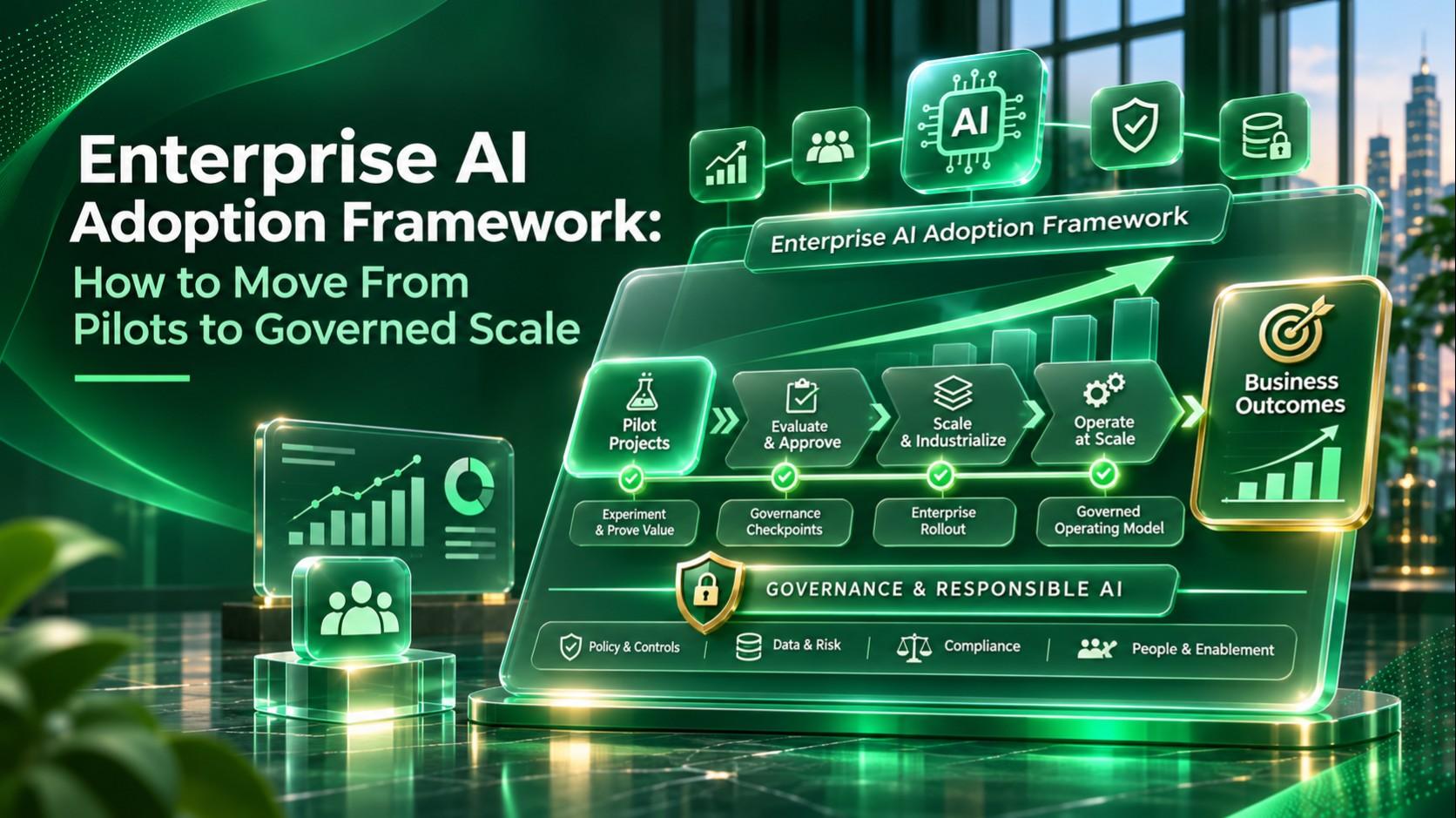
Enterprise AI Adoption Framework: How to Move From Pilots to Governed Scale
Most enterprise AI programs do not fail because the model is weak. They stall because the organization never turns the pilot into an operating system.
- A pilot can prove that AI can generate an answer.
- Production requires ownership, data access, controls, integrations, review, measurement and support.
- Scaling requires even more: a repeatable way to decide which workflows deserve investment and which should stop.
- An enterprise AI adoption framework should therefore connect strategy, workflow selection, governance, operating model and measurable outcomes.
What is an enterprise AI adoption framework?
- An enterprise AI adoption framework is a structured way to move AI from experimentation into repeatable business use.
- It helps teams decide where AI should be used, who owns the outcome, what controls are required and how success will be measured.
- It also prevents every department from creating disconnected pilots with different vendors, security assumptions and metrics.
- The framework should support both generative AI and agentic workflows without assuming every use case needs full autonomy.
Why enterprise AI adoption needs more than a technology roadmap
- Technology selection is only one part of adoption.
- Enterprises also need data ownership, process clarity, policy controls, training, change management and executive sponsorship.
- NIST’s AI Risk Management Framework organizes AI risk work around four functions: Govern, Map, Measure and Manage.
- Microsoft’s AI adoption guidance emphasizes leadership, strategy, responsible AI, skilling and organizational change as core parts of enterprise adoption.
- The practical implication is simple: production AI needs an operating model, not only a model endpoint.
Sources: NIST AI Risk Management Framework and Microsoft Cloud Adoption Framework for AI.
The six layers of enterprise AI adoption
1. Business-value layer
- Identify workflows where AI can change a measurable business outcome.
- Avoid starting with broad goals such as “use AI across operations.”
- Define the target outcome before defining the technical architecture.
- Examples include reducing manual review time, shortening response cycles, improving first-pass accuracy or reducing exception backlog.
2. Workflow layer
- Map the current process step by step.
- Identify decisions, handoffs, approvals, system reads and system writes.
- Separate deterministic rules from tasks that benefit from AI reasoning.
- Define what the AI may do and what must remain human-controlled.
3. Data and integration layer
- Identify the systems of record.
- Define which data the AI can read.
- Define which systems the AI can write to.
- Use least-privilege access.
- Document data freshness and source-of-truth rules.
- Design failure behavior when integrations are unavailable.
4. Governance layer
- Define acceptable and unacceptable use.
- Define review requirements.
- Define logging and audit requirements.
- Define escalation paths.
- Define privacy, security and compliance responsibilities.
- Version important policies instead of embedding them only in prompts.
5. Operating-model layer
- Assign a business owner.
- Assign a technical owner.
- Assign risk, security or compliance reviewers where required.
- Define who monitors the workflow after launch.
- Define who approves changes.
- Define who can stop or roll back the system.
6. Measurement layer
- Measure the business outcome, not just model accuracy.
- Track time saved only when the denominator is clear.
- Track error rate and rework.
- Track exceptions and human escalations.
- Track user adoption.
- Track whether downstream systems were updated correctly.
Step 1: Build an AI use-case portfolio
- Collect candidate workflows from business teams.
- Score each workflow using the same criteria.
- Avoid selecting use cases only because a senior leader requested them.
- Avoid selecting use cases only because a vendor demo looked impressive.
A practical use-case scoring model
- Business value: What measurable outcome could improve?
- Frequency: How often does the workflow occur?
- Process clarity: Is the current workflow understood?
- Data readiness: Are the necessary inputs available?
- Integration effort: How many systems must connect?
- Risk: What happens if the AI is wrong?
- Reviewability: Can a person verify the result quickly?
- Change burden: How much behavior must users change?
- Scale potential: Can the same pattern be reused elsewhere?
Step 2: Choose one bounded workflow for the first production pilot
- Pick a workflow with clear inputs and outputs.
- Pick a workflow with a known owner.
- Pick a workflow where errors can be detected.
- Pick a workflow with a measurable baseline.
- Pick a workflow where success can be judged within a reasonable operating period.
- Do not begin with the most autonomous use case available.
Step 3: Define autonomy levels before implementation
- Assist: AI suggests; a human decides.
- Draft: AI prepares work; a human approves.
- Recommend: AI proposes the next action; a human authorizes it.
- Execute with guardrails: AI completes predefined low-risk actions.
- Escalate: AI recognizes exceptions and routes them to people.
Autonomy should be assigned per action, not per application.
Step 4: Build governance into the workflow
- Define identity and access controls.
- Define data boundaries.
- Define allowed tools and actions.
- Define approval gates.
- Define audit logging.
- Define exception routing.
- Define retention rules.
- Define rollback behavior.
See LuMay’s AI Agent Policy Enforcement guide and Human-in-the-Loop AI Agent Approval Design.
Step 5: Build an enterprise AI operating model
- Executive sponsor: Connects the program to business priorities.
- Business owner: Owns the workflow outcome.
- Product or program lead: Coordinates delivery and adoption.
- Engineering: Owns architecture, integrations and reliability.
- Security: Reviews access, threat model and controls.
- Legal/compliance: Reviews applicable obligations.
- Operations: Owns day-to-day workflow behavior.
- Users: Provide practical feedback and identify exceptions.
Centralize standards, decentralize workflow ownership
- A central AI team can define approved platforms, architecture patterns, evaluation methods and governance standards.
- Business teams should still own their actual workflows and outcomes.
- Centralizing every AI decision can slow adoption.
- Decentralizing every technical and governance decision can create inconsistency.
- A federated model often works better: shared standards with business-owned implementation.
Step 6: Define a production-readiness gate
- The workflow has a named business owner.
- The baseline metric is documented.
- Data sources are approved.
- Access is least privilege.
- Failure states are tested.
- Human escalation is defined.
- Logging is enabled.
- Security review is complete.
- Support ownership is defined.
- Rollback is possible.
Step 7: Measure business outcomes, not AI activity
- Number of prompts is not a business outcome.
- Number of generated documents is not a business outcome by itself.
- Number of agents deployed is not a business outcome.
- Measure what changed in the workflow.
Useful enterprise AI metrics
- Cycle-time reduction.
- Manual effort reduction.
- Rework rate.
- Exception rate.
- Human-review time.
- Resolution rate.
- Accuracy of system updates.
- User adoption.
- Business-value realization.
- Risk incidents.
Step 8: Create a scale decision, not an automatic rollout
- Scale only when the workflow meets its business target.
- Scale only when operational controls are stable.
- Scale only when support costs are understood.
- Scale only when users adopt the workflow.
- Stop or redesign pilots that do not show measurable value.
What enterprises should standardize before scaling
- Identity and access patterns.
- Model-provider evaluation.
- Prompt and policy versioning.
- RAG and grounding patterns.
- Evaluation datasets.
- Observability.
- Human approval patterns.
- Audit logging.
- Data-retention rules.
- Incident response.
Common reasons enterprise AI pilots stall
- No business owner.
- No baseline metric.
- No integration with the real workflow.
- Unclear data access.
- No review model.
- No support owner.
- No change-management plan.
- No production monitoring.
- No agreement on acceptable risk.
- The pilot solved a demo problem rather than an operational problem.
Change management is part of AI architecture
- Users need to understand what the system can and cannot do.
- Managers need to know when human review is required.
- Teams need examples of good and bad outputs.
- Training should be embedded into real workflows.
- Feedback should feed back into the system design.
A 90-day enterprise AI adoption plan
- Days 1–30: Select the workflow, baseline the current process, define ownership and governance.
- Days 31–60: Build integrations, test edge cases and run a controlled pilot.
- Days 61–90: Measure outcomes, fix operational gaps and decide whether to scale, redesign or stop.
- After 90 days: Reuse the successful architecture and governance pattern for adjacent workflows.
Final perspective
- Enterprise AI adoption is not the process of launching more pilots.
- It is the process of turning selected workflows into governed, measurable production systems.
- The strongest framework connects business value, workflow design, governance, ownership and scale decisions from the beginning.
Sources
Frequently Asked Questions
Everything you need to know about Engineering Services
1. What is an enterprise AI adoption framework?
It is a structured approach for selecting, governing, implementing and scaling AI workflows across an organization.
2. Why do enterprise AI pilots fail to scale?
Common reasons include unclear ownership, weak integrations, missing governance, poor measurement and lack of operational support.
3. What should enterprises automate first?
Start with a bounded, high-frequency workflow that has clear inputs, measurable outcomes and manageable risk.
4. How should enterprises prioritize AI use cases?
Score them on business value, frequency, process clarity, data readiness, integration effort, risk, reviewability and scale potential.
5. What is the role of governance in AI adoption?
Governance defines acceptable use, access, review, logging, escalation, privacy, security and accountability.
6. Should every AI workflow be fully autonomous?
No. Autonomy should be assigned per action, with human approval retained where risk or uncertainty is high.
7. How do enterprises measure AI ROI?
Compare workflow cycle time, manual effort, rework, exceptions, review time and business outcomes against the pre-AI baseline.
8. What operating model works best for enterprise AI?
Many organizations benefit from a federated model with centralized standards and business-owned workflows.
9. When should an AI pilot be scaled?
Scale when business value, operational reliability, user adoption and governance controls are all demonstrated.
10. When should an AI pilot be stopped?
Stop or redesign it when the workflow does not produce measurable value, creates excessive risk or requires more manual effort than it removes.
About the Editorial Team
Creates insightful content on SEO, AI-powered marketing, digital growth, and emerging technologies. He simplifies complex topics into practical, research-backed guidance.