Legal teams do not struggle only because contracts are long. They struggle because important obligations are buried in inconsistent clauses, scanned documents, amendments, and spreadsheets that nobody fully trusts.
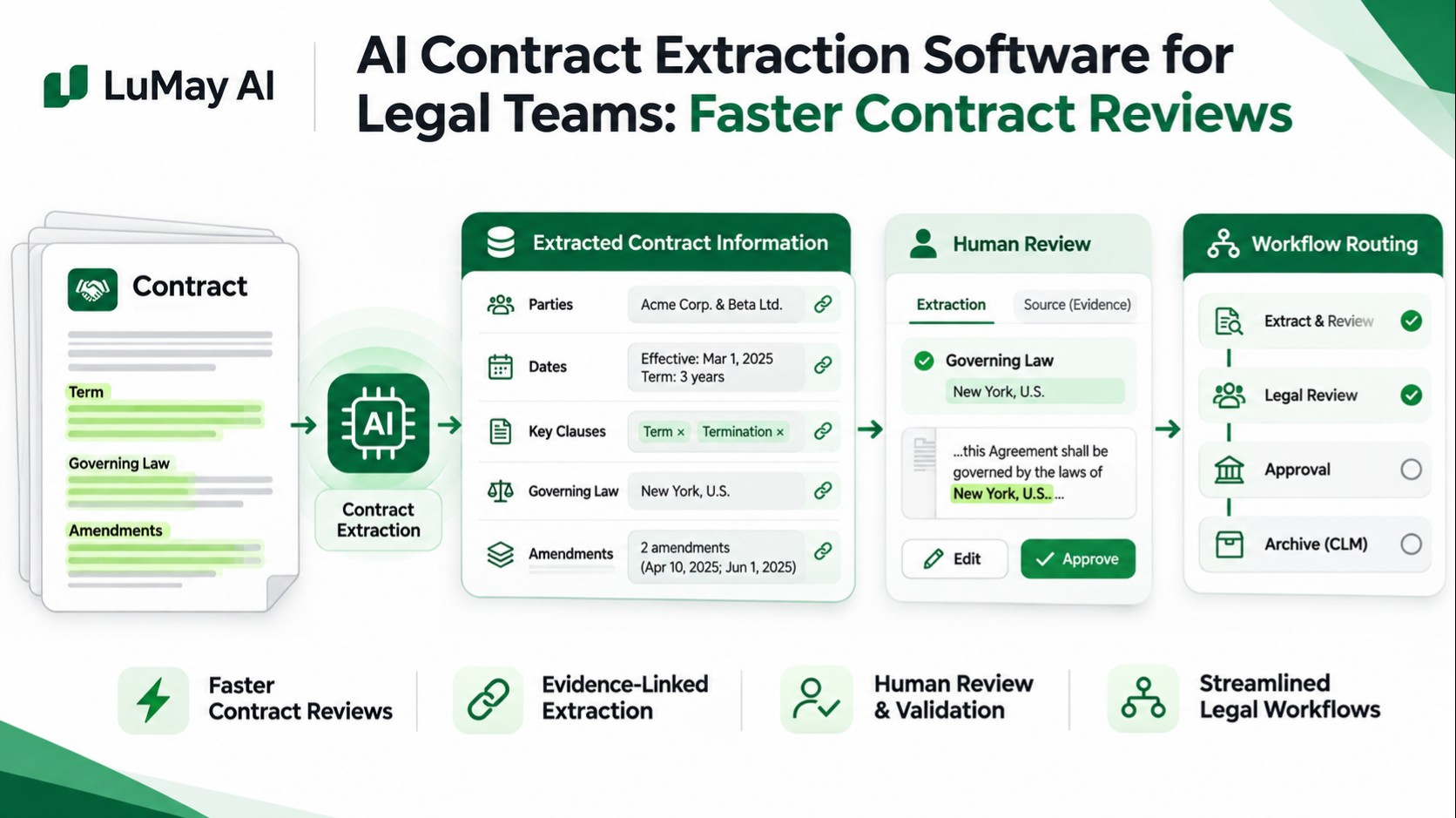
AI contract extraction software for legal teams turns agreement text into structured, reviewable data. It can identify parties, dates, renewal provisions, governing law, and other important fields—but extraction is not the same as legal interpretation.
The useful question is not “How many fields did the AI find?” It is “Can a reviewer trace every field back to the right contract language?”
What is AI contract extraction software?
AI contract extraction software processes contracts to identify predefined data fields, clause categories, dates, and other entities. Depending on the tool, it combines OCR, layout analysis, classification, and language models to produce structured data for legal review, search, reporting, or contract lifecycle management.
For example, Microsoft's Document Intelligence contract model documentation describes extraction of fields including parties, jurisdictions, contract identifiers, and titles from supported documents. Google Cloud's custom extractor guidance describes approaches for extracting entities from varied document types, including contracts.
Those technical capabilities do not guarantee correct interpretation of a negotiated obligation. Legal teams still need source evidence and an appropriate review workflow.
Contract extraction versus AI contract review
| Work | Primary question | Output |
|---|---|---|
| Document classification | What agreement is this? | Contract type and document relationships |
| Data extraction | What fields and clauses appear? | Structured values with source passages |
| Contract review | What do those terms mean or risk? | Qualified interpretation and deviations |
| Contract administration | What action follows? | Assigned obligations, alerts and approvals |
A tool that extracts “renewal: 12 months” may miss that termination requires notice 90 days before expiration or that an amendment replaced the original renewal clause. The source relationship matters as much as the field value.
Which contract fields should legal teams extract?
| Field group | Example fields | Risk to review |
|---|---|---|
| Parties and identity | Legal entities, affiliates, signatories | Wrong contracting entity |
| Dates | Effective, execution, expiration, renewal | Confused or conditional dates |
| Commercial terms | Fees, caps, currency, payment terms | Schedule or amendment overrides |
| Termination | Notice period, cause, convenience | Conditions omitted from summary |
| Liability | Cap, carve-outs, indemnities | Negation and cross-reference errors |
| Security and privacy | Data handling, breach notice, audit | Separate DPA or exhibit |
| Dispute and governing law | Venue, arbitration, governing law | Different rules across documents |
The six-step evidence-first contract extraction process
- Ingest and inventory. Capture document type, version, format, language, and relationships to exhibits or amendments.
- Define a schema. Specify exact field meanings, allowed formats, and what counts as missing or ambiguous.
- Extract text and candidates. Use OCR or native-text reading as appropriate; preserve page and section references.
- Validate. Apply format, date, consistency, entity, and relationship checks before using the result.
- Review exceptions. Route ambiguous, low-evidence, high-consequence, or conflicting fields to a qualified legal reviewer.
- Publish authorized data. Write approved values to a CLM or matter system and verify the committed result.
Worked example: automatic renewal with an amendment
Hypothetical scenario, not measured LuMay performance. A master services agreement signed in 2023 states that it renews automatically for one-year terms unless either party gives written notice at least 60 days before expiry. A 2025 amendment changes notice to 90 days for a specified subsidiary.
A simple extraction may return “60 days” because it finds the original clause. A reliable legal workflow must link the amendment to the governing agreement, identify whether the subsidiary is in scope, retain both source passages, and flag the controlling notice requirement for review. It should never silently overwrite evidence without recording which document superseded which term.
This is why a contract repository needs more than a convenient spreadsheet of extracted values.
How to evaluate contract extraction accuracy
Create a representative labeled sample across templates, counterparties, scans, document lengths, languages, and amendments. Evaluate:
- Field-level precision: how often extracted values are correct when a value is returned.
- Field-level recall: how often relevant values are found.
- Source-location accuracy: whether highlighted text actually supports each value.
- Missing-value honesty: whether the tool distinguishes absent, illegible, ambiguous and not-applicable fields.
- Critical-clause failures: whether it misses or misinterprets high-impact obligations.
- Reviewer effort: time spent correcting each contract after extraction.
A vendor-provided confidence score is not proof of legal accuracy. Validate it on your own data and review higher-risk fields individually. The ABA's Formal Opinion 512
How should extraction connect to legal workflows?
A useful system should preserve permissions, source documents, clause snippets, corrected values, reviewer identities, and change history. It should send approved fields to existing CLM, matter management, or reporting systems—not write unverified obligations directly into a system of record.
For broader context, LuMay has separate guides to AI contract review for law firms and document automation with approved templates. These cover downstream legal interpretation and document creation, distinct from field extraction.
What to compare when choosing extraction software
| Criterion | Vendor demonstration to request |
|---|---|
| Document coverage | Native PDF, scan, DOCX, annexes, amendments |
| Clause flexibility | Standard and negotiated wording |
| Evidence | Highlight and jump to exact text |
| Review | Correct a value, preserve reason and reviewer |
| Governance | Permission filters, retention, audit, tenancy |
| Integration | Validated CLM/API updates and rollback |
| Economics | Cost per usable reviewed contract, not only pages |
Ask providers to process an anonymized but realistic sample. Include a document with a missing signature, an amendment, a cross-reference, an unusual renewal condition, and a low-quality scan. Compare the resulting evidence and correction effort rather than ranking products by demo speed alone.
Where extraction creates value—and where it stops
Extraction may reduce manual indexing and improve the ability to search for dates or clause families. But it should not automatically decide whether a limitation of liability clause is acceptable, whether an indemnity is enforceable, or whether a renewal notice must be sent. Those are legal and operational judgments requiring context.
Start with a narrow field set and clear review rules, measure the quality of approved data, and expand only when the process is reliable. The strongest implementation produces faster preparation with traceable evidence, not unsupported claims of completely automated legal review.
Sources and further reading
Technical references: Microsoft contract data extraction documentation and Google Cloud custom extraction guidance. Professional guidance: ABA Formal Opinion 512.