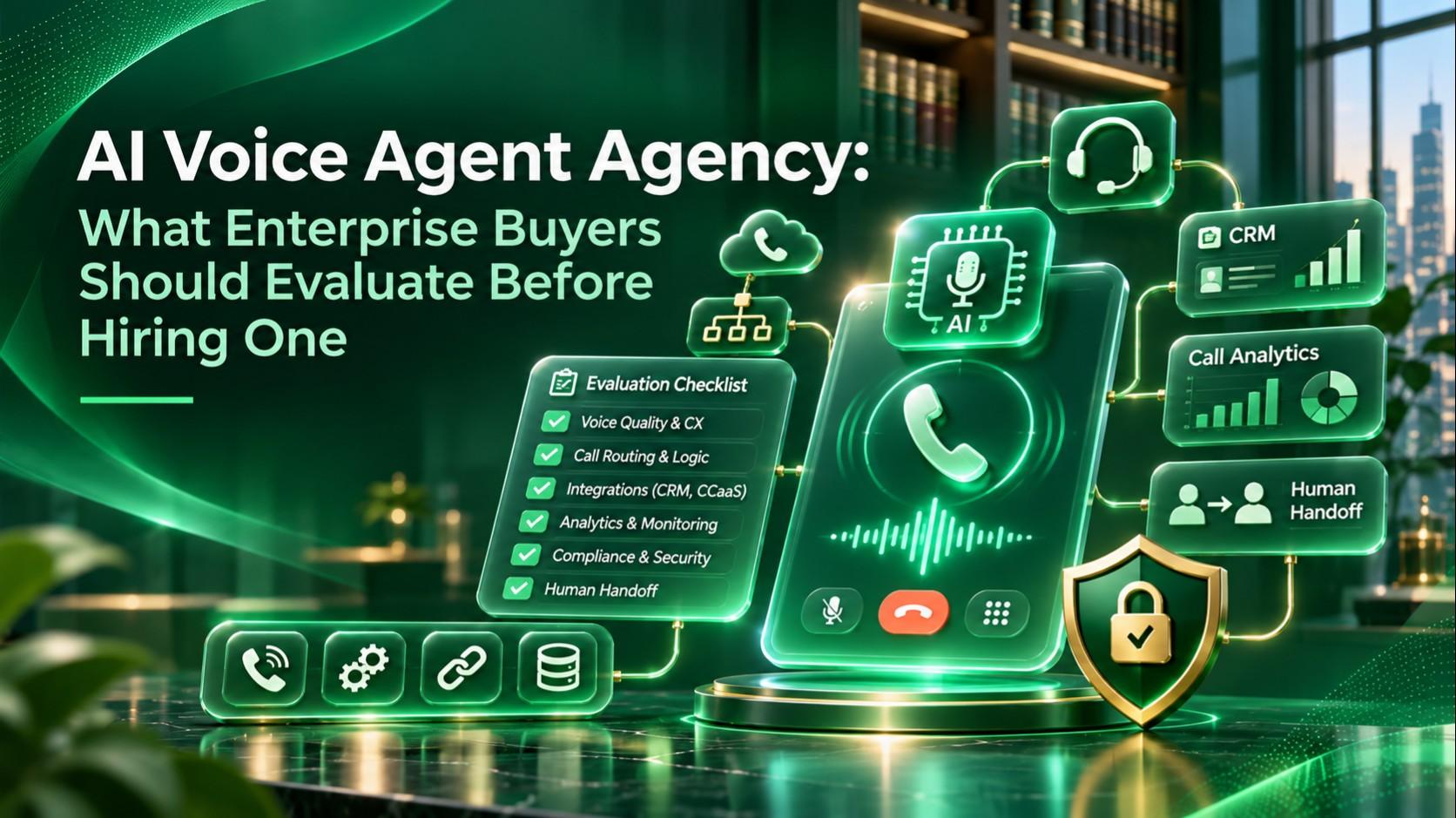
AI Voice Agent Agency: What Enterprise Buyers Should Evaluate Before Hiring One
An AI voice agent demo can sound excellent and still fail in production.
- The real enterprise challenge is not only speech quality.
- It is telephony reliability, latency, integrations, authentication, policy enforcement, human handoff, observability and support after launch.
- That is why choosing an AI voice agent agency should be treated as an implementation decision, not a creative-services decision.
- Enterprise buyers should evaluate whether the agency can operate the full production workflow, not just build a conversational prototype.
What is an AI voice agent agency?
- An AI voice agent agency designs, integrates, tests and deploys voice agents that can handle inbound or outbound calls.
- The agency may combine speech-to-text, text-to-speech, large language models, telephony providers, CRM integrations and workflow logic.
- Some agencies focus on rapid prototypes.
- Others provide production engineering, compliance controls, monitoring and ongoing optimization.
- The buyer should determine which model they are actually purchasing before signing a contract.
Why enterprise buyers need a different evaluation framework
- Enterprise voice AI has more failure modes than a web chatbot.
- A dropped call, authentication error or incorrect system update can affect customers immediately.
- Latency affects whether the conversation feels natural.
- Telephony infrastructure affects call quality, routing and failover.
- Compliance requirements may differ by call purpose, jurisdiction and data type.
- Production success depends on how the agency handles these operational constraints together.
12 things enterprise buyers should evaluate before hiring an AI voice agent agency
1. Telephony architecture
- Ask which carriers, SIP providers or contact-center platforms the agency supports.
- Ask whether the architecture supports existing PBX, SIP trunking or cloud contact-center systems.
- Ask how inbound and outbound numbers are provisioned.
- Ask how call routing, transfer and failover work.
- Ask whether the business can change telephony providers without rebuilding the entire agent.
For related architecture decisions, see LuMay’s BYO SIP trunk vs managed telephony guide.
2. Latency and turn-taking
- Voice AI must respond quickly enough to avoid awkward pauses.
- Ask how the agency measures end-to-end latency.
- Ask how interruptions and barge-in are handled.
- Ask how partial speech recognition affects response timing.
- Ask whether the system can recover when the caller speaks over the agent.
3. Integration depth
- Ask which systems the agent must read from and write to.
- Typical systems include CRM, booking, ticketing, payment, ERP, helpdesk and identity platforms.
- Ask whether the agency uses APIs, webhooks, middleware or direct connectors.
- Ask how failed writes are retried.
- Ask how duplicate actions are prevented.
- Ask what happens when a downstream system is unavailable.
See LuMay’s AI Voice Agent CRM Integration guide.
4. Authentication and verification
- Customer-specific information should not be exposed without appropriate verification.
- Ask how the agency supports PINs, OTPs, account identifiers or other verification methods.
- Ask what happens when verification fails.
- Ask whether sensitive workflows can require a human or secondary approval step.
5. Policy enforcement
- Do not rely on the model prompt alone for critical business rules.
- Ask whether rate limits, offer eligibility, refund rules, appointment rules and escalation conditions are enforced outside the language model.
- Ask whether policies can be versioned and audited.
- Ask whether unauthorized actions are blocked before execution.
See LuMay’s AI Agent Policy Enforcement guide.
6. Human handoff
- Ask exactly when the AI should transfer to a person.
- Ask whether the transfer preserves caller context.
- Ask whether the agent can pass structured notes to the human team.
- Ask how failed transfers are handled.
- Ask whether callback tasks can be created when no human is available.
7. Compliance controls
- Outbound calling rules may depend on the jurisdiction, call purpose and consent status.
- Ask how calling windows, suppression lists and opt-outs are enforced.
- Ask how recordings and transcripts are handled.
- Ask how payment workflows avoid exposing sensitive card data to the model or transcript.
- Ask for legal review of the specific campaign rather than relying on generic compliance claims.
See LuMay’s TCPA Compliance for AI Voice Agents and PCI-Compliant Phone Payments with AI Voice Agents.
8. Security architecture
- Ask how credentials are stored.
- Ask how API access is scoped.
- Ask whether the agent uses least-privilege permissions.
- Ask how webhook requests are verified.
- Ask whether logs contain sensitive data.
- Ask how secrets and keys are rotated.
9. Observability and monitoring
- Ask what the agency monitors after launch.
- Key areas include call completion, latency, transfer rate, failed actions, intent accuracy and downstream write failures.
- Ask whether individual calls can be replayed or traced through the workflow.
- Ask whether business outcomes are verified before CRM updates are written.
See LuMay’s AI Voice Agent Monitoring guide and AI Call Summarization: Verify Outcomes Before Updating the CRM.
10. Testing discipline
- Ask whether the agency tests normal calls, edge cases and failure conditions.
- Test accents, background noise, interruptions and silence.
- Test incorrect identifiers.
- Test failed integrations.
- Test unavailable staff.
- Test provider outages.
- Test repeated retries and duplicate actions.
11. Production support
- Ask who owns incidents after launch.
- Ask what response times are included.
- Ask whether monitoring is proactive or only reactive.
- Ask how changes are tested before release.
- Ask whether the agency provides rollback and incident review procedures.
12. Exitability
- Ask who owns phone numbers, prompts, workflow code and integration assets.
- Ask whether data and call logs can be exported.
- Ask whether the business can move to another provider.
- Ask whether the agency uses proprietary components that create lock-in.
Agency versus platform versus in-house build
- Agency: Best when the organization needs implementation help, integration work and ongoing optimization.
- Platform: Best when the internal team can configure, test and operate the system themselves.
- In-house: Best when voice AI is strategic enough to justify dedicated engineering and operations capacity.
- Hybrid: Common when the enterprise owns the architecture and data while an agency accelerates delivery.
What should be included in the agency proposal?
- Business workflow in scope.
- Inbound or outbound call volume assumptions.
- Telephony architecture.
- Speech and model providers.
- Integration list.
- Authentication requirements.
- Human handoff design.
- Compliance responsibilities.
- Testing plan.
- Monitoring plan.
- Support model.
- Change-request process.
- Pricing assumptions.
- Ownership and exit terms.
Red flags to avoid
- The agency talks only about how natural the voice sounds.
- The agency cannot explain failure handling.
- The agency relies on one large prompt for business rules.
- The agency does not test downstream system failures.
- The agency cannot explain how opt-outs are handled.
- The agency has no clear human-transfer strategy.
- The agency cannot provide production monitoring.
- The agency promises “100% automation.”
- The agency cannot explain data retention or access control.
- The agency has no clear incident-response process.
A practical enterprise pilot
- Step 1: Choose one bounded call workflow.
- Step 2: Define allowed actions and disallowed actions.
- Step 3: Connect the minimum required systems.
- Step 4: Build a test set with normal calls and edge cases.
- Step 5: Run controlled traffic.
- Step 6: Review failures manually.
- Step 7: Measure verified outcomes before expanding.
Metrics enterprise buyers should track
- Call completion rate.
- Average response latency.
- Intent recognition accuracy.
- Verified resolution rate.
- Human transfer rate.
- Transfer success rate.
- Failed action rate.
- Duplicate action rate.
- CRM write accuracy.
- Opt-out handling accuracy.
- Repeat-call rate.
- Incident volume after launch.
Final perspective
- Enterprise voice AI is not just a conversation layer.
- It is a production system connected to telephony, data and business actions.
- The best agency is the one that can operate that full system safely, not just make the voice sound impressive.
Sources
Frequently Asked Questions
Everything you need to know about Voice Agent
1. What does an AI voice agent agency do?
It designs, integrates, tests and deploys voice agents that can handle calls and execute approved business workflows.
2. How is an AI voice agent agency different from a voice AI platform?
A platform provides the technology, while an agency typically adds implementation, integration, testing and operational support.
3. What should enterprises evaluate first?
Start with telephony architecture, integrations, security, policy enforcement, human handoff and production support.
4. How long does an enterprise voice AI implementation take?
Timelines depend on workflow complexity, integrations, compliance requirements and testing. Buyers should ask for a scope-based plan rather than a generic promise.
5. Can an AI voice agent integrate with CRM systems?
Yes, when the CRM provides suitable APIs or connectors. Buyers should verify read/write permissions, retry behavior and duplicate prevention.
6. How should enterprises handle human escalation?
Define explicit transfer conditions and preserve caller context so the human agent receives the relevant information.
7. What security questions should buyers ask?
Ask about identity, least-privilege permissions, encryption, secret storage, webhook verification, logging and data retention.
8. Can an AI voice agent take payments?
It can support payment workflows, but the architecture should keep sensitive card data inside approved payment systems rather than exposing it to the AI model or transcript.
9. What should be tested before launch?
Test noise, interruptions, silence, incorrect identifiers, system outages, failed transfers, duplicate actions and policy exceptions.
10. What is the biggest mistake when hiring an AI voice agent agency?
Choosing based on demo quality without evaluating production architecture, monitoring, compliance and failure handling.
About the Editorial Team
Creates insightful content on SEO, AI-powered marketing, digital growth, and emerging technologies. He simplifies complex topics into practical, research-backed guidance.