Most renewal teams do not lose a customer because the customer explicitly says no.
They lose the renewal earlier.
The reminder goes out too late. The agent reads an outdated price. The wrong person answers. A cancellation request is treated like an objection. A payment issue gets recorded as “not interested.” Or the customer agrees to renew, but the CRM never receives a verified outcome.
That is where voice AI for subscription renewals becomes useful.
The goal is not to create a robot that can hold a longer conversation. The goal is to create a controlled renewal workflow that knows the current account state, verifies the customer when needed, captures the real decision, escalates exceptions, and writes a reliable outcome back to the business system.
What is voice AI for subscription renewals?
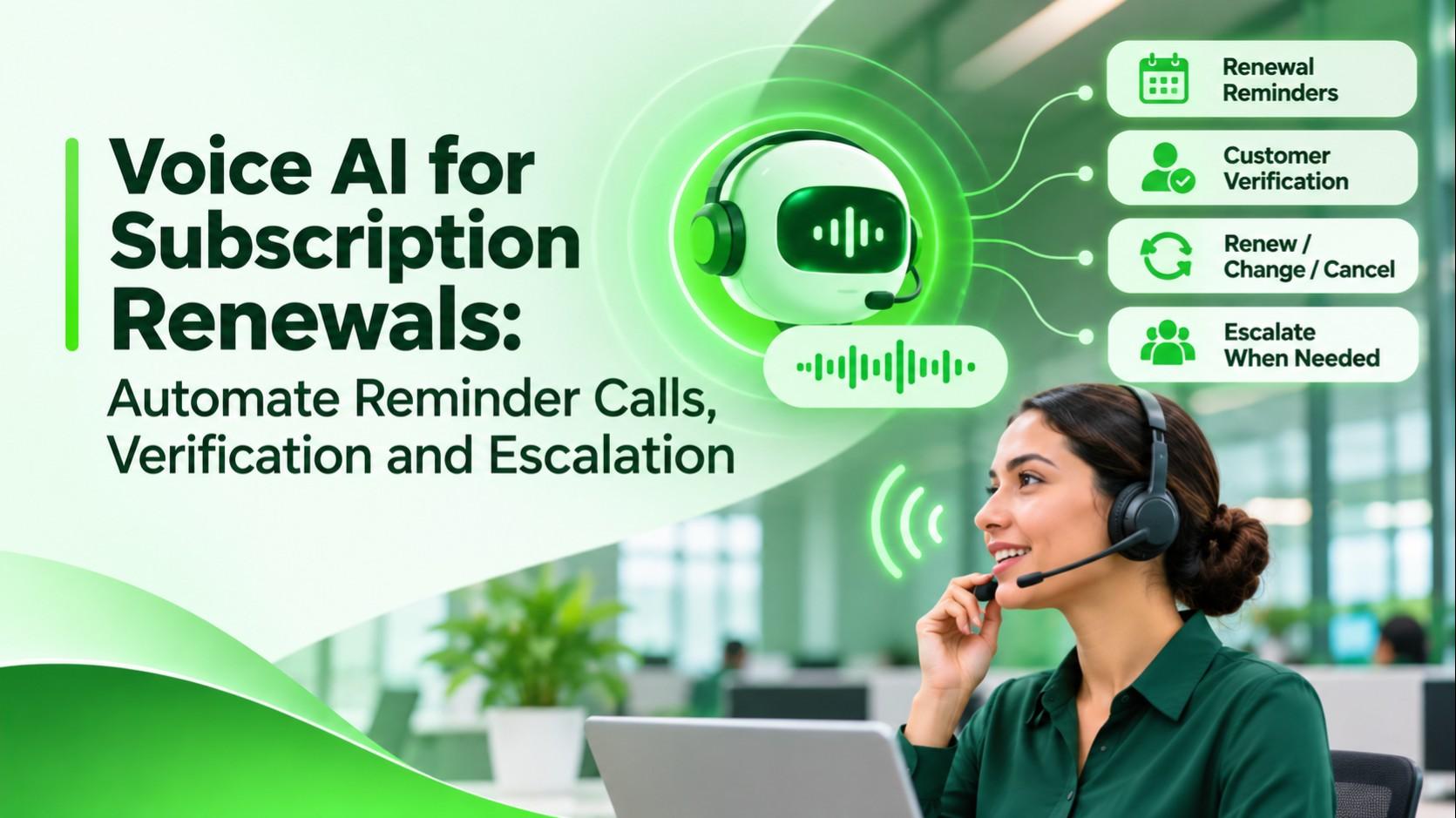
Voice AI for subscription renewals uses conversational AI to handle selected parts of the renewal workflow, including renewal reminders, account verification, approved renewal explanations, intent capture, callback scheduling, plan-change requests, cancellation routing, payment-safe handoff, human escalation and CRM outcome updates.
The important word is workflow.
A renewal agent should not operate from a static call list and generic script. It should make decisions from the live subscription state.
The renewal state should control the conversation
A strong system first asks: What is true about this subscription right now?
| Subscription state | Appropriate voice action |
|---|---|
| Renewal approaching | Explain renewal date and approved options. |
| Auto-renew already enabled | Confirm status rather than asking an unnecessary renewal question. |
| Payment method problem | Route to approved payment-resolution workflow. |
| Customer requests cancellation | Start cancellation or approved retention route. |
| Account is disputed | Escalate to billing or customer support. |
| Customer asks for a different plan | Route into plan-change workflow. |
| Renewal already completed | Do not continue renewal outreach. |
| Contact is ineligible | Do not place the outbound call. |
The conversation should be generated from account state. Account state should never be inferred from the conversation.
Think of the agent as a renewal state machine with a voice interface
A useful production flow looks like: Eligibility → Contact → Verification → Renewal context → Intent → Approved action → Outcome verification → CRM update.
Each transition should have a pass condition.
1. Confirm that the call is allowed
Before a call starts, check consent status, campaign type, suppression lists, customer-specific opt-outs, calling window, jurisdiction, previous call attempts and current subscription state.
Compliance should live in application logic or campaign controls, not inside a prompt saying, “Please follow applicable law.”
For U.S. calls, this matters especially because the FCC has confirmed that AI-generated voices fall within TCPA restrictions applying to artificial or prerecorded voices. See the FCC Declaratory Ruling.
The FTC's Telemarketing Sales Rule guidance also addresses covered prerecorded telemarketing messages, Do Not Call requests, calling practices and opt-out mechanisms.
The exact requirements depend on the nature of the call and jurisdiction, so organizations should obtain appropriate legal guidance before deployment.
2. Open with the real reason for the call
The first few seconds determine whether the interaction feels useful or suspicious.
The agent should quickly establish who is calling, why the customer is being contacted, which subscription is involved, and what action, if any, is currently required.
Avoid vague openings such as “I'm calling regarding your account.” A customer should understand the purpose before being asked to make a decision.
3. Verify identity before exposing sensitive account information
Not every renewal reminder needs the same level of verification. The verification level should depend on what the agent is about to reveal or change.
| Action | Verification level |
|---|---|
| General renewal reminder | Low |
| Quote account-specific renewal price | Moderate |
| Change plan | Higher |
| Update billing information | Higher |
| Cancel subscription | Higher |
| Discuss disputed charges | Human or specialized workflow |
Do not use more customer information than the conversation requires.
4. Retrieve renewal information in real time
The agent should obtain renewal data from the billing, subscription or CRM platform when the call begins.
Useful fields include plan, renewal date, current renewal status, approved price, available plan options, payment status, customer eligibility, current discounts, cancellation state and previous renewal contact.
5. Capture intent before trying to persuade
A renewal conversation can produce several legitimate outcomes: renew, renew later, change plan, cancel, payment problem, pricing objection, service complaint, callback requested, wrong contact, no decision or speak to a person.
The agent should classify the outcome before selecting the next action. That prevents a serious design mistake: treating every non-renewal response as an objection to overcome.
Build an objection router, not an unlimited persuasion agent
| Customer says | System interpretation | Next step |
|---|---|---|
| “I forgot this was renewing.” | Information request | Explain approved renewal state. |
| “Why has the price changed?” | Pricing question | Give approved explanation or escalate. |
| “I want to cancel.” | Cancellation intent | Follow cancellation workflow. |
| “That charge is wrong.” | Billing dispute | Escalate. |
| “Call me Friday.” | Callback request | Record exact date/time. |
| “I need a smaller plan.” | Plan-change intent | Route to approved options. |
| “Stop calling me.” | Opt-out request | Record immediately and suppress future outreach. |
The agent should not improvise discounts or retention offers that do not exist in the billing system.
6. Separate payment conversation from payment handling
An agent may explain the amount due, the payment deadline and available approved payment methods. But raw card or banking credentials should not simply be sent through a general-purpose language model.
Use an approved secure payment flow. See LuMay’s PCI-Compliant Phone Payments with AI Voice Agents.
The voice agent can coordinate the workflow without becoming the payment processor.
7. Human escalation should preserve the conversation state
A bad escalation sounds like: “Please explain the issue again to the next representative.”
A better handoff transfers verified customer identity, subscription, renewal state, customer intent, objection or problem, actions already attempted, relevant transcript segment and recommended next queue.
That makes the human escalation part of the workflow rather than an escape hatch.
See LuMay’s AI Call Summarization: Verify Outcomes Before Updating the CRM.
What should renewal teams actually measure?
Do not optimize for call duration. A longer conversation is not necessarily a better one.
| Metric | What it answers |
|---|---|
| Eligible accounts | How many accounts could legitimately be contacted? |
| Calls attempted | Did the workflow execute? |
| Connections | Did anyone answer? |
| Verified contacts | Did we reach the correct person? |
| Decision conversations | Did the conversation reach a renewal decision point? |
| Renewals confirmed | How many customers confirmed renewal? |
| Callbacks requested | How much work remains open? |
| Human escalations | Where does AI stop being sufficient? |
| Cancellation requests | What churn signal appeared? |
| Opt-outs | Is outreach frequency or targeting creating friction? |
| CRM outcome accuracy | Did the system write the correct result? |
The denominator matters. “70% successful calls” tells you almost nothing unless you know what counted as success.
A practical pilot design
Start with one renewal segment: one product, one renewal window, one language, one customer type and one permitted set of actions.
- Was the correct customer contacted?
- Was the account state accurate?
- Was identity handled correctly?
- Was customer intent classified correctly?
- Was escalation triggered when required?
- Were opt-outs respected?
- Did the CRM receive the correct outcome?
- Did the same customer receive duplicate or conflicting calls?
Only expand after these workflow controls are reliable.
Final perspective
The best renewal voice agent is not the one that can talk the longest. It is the one that knows when to call, knows the customer's real renewal state, knows what it is authorized to do, recognizes when the customer wants something different, and leaves every system in the correct state when the conversation ends.
That is the standard subscription teams should evaluate.