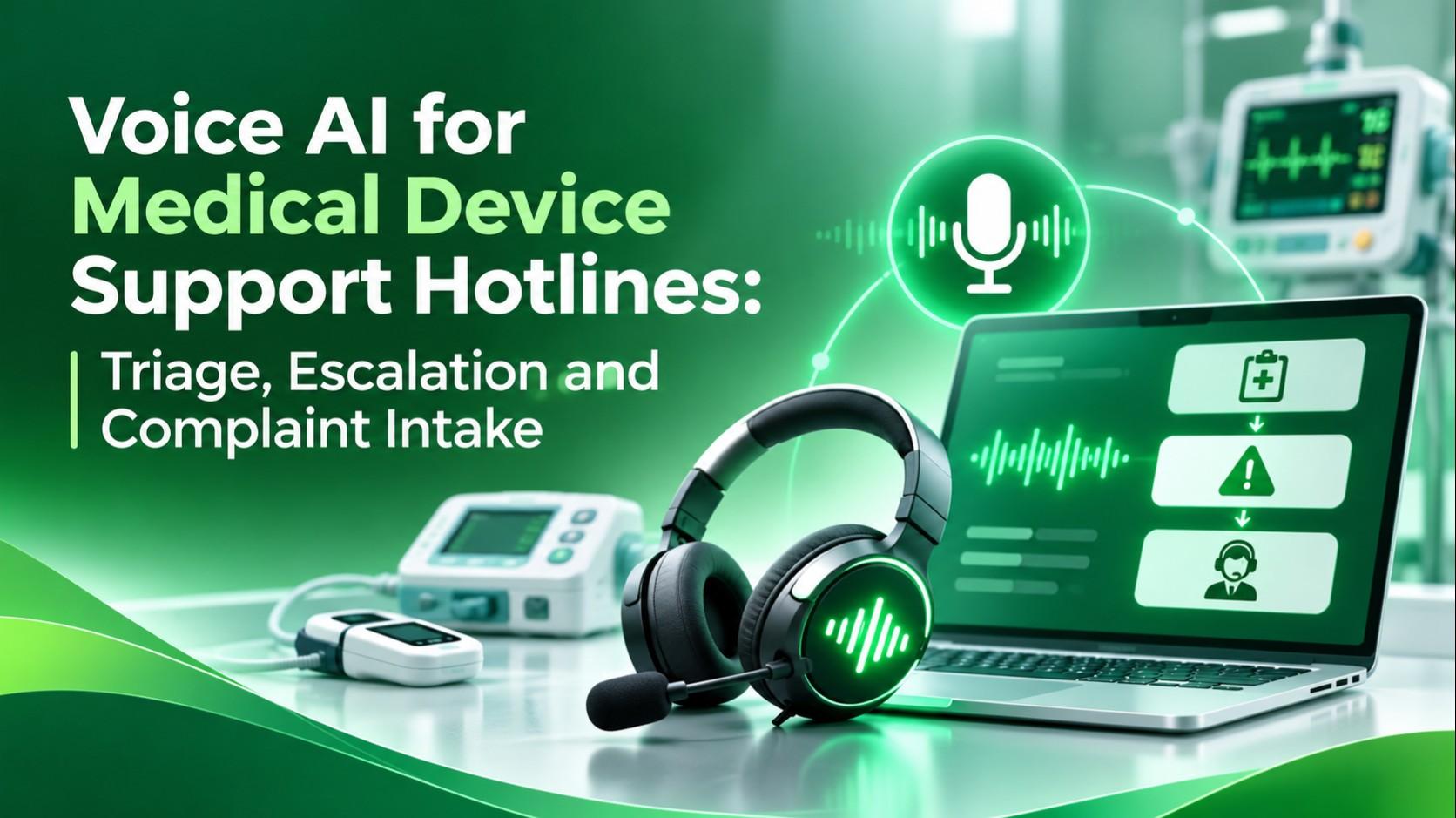
Voice AI for Medical Device Support Hotlines: Triage, Escalation and Complaint Intake
A medical-device support hotline is not just a customer-service channel.
- A caller may be asking for setup help.
- A caller may be reporting a device malfunction.
- A caller may be describing a patient-safety concern.
- A caller may be making a complaint that must enter the manufacturer’s quality process.
- A caller may be providing information that needs medical-device reporting evaluation.
- That means voice AI cannot simply optimize for call containment. It must recognize when a support conversation becomes a regulated quality or safety workflow.
What is voice AI for medical device support hotlines?
- Voice AI can answer approved technical questions, collect structured device information, guide low-risk troubleshooting, create service cases and route callers to specialists.
- It can also help structure complaint intake by capturing the caller’s words, device details, event context and escalation triggers.
- The AI should not decide on its own whether a complaint is reportable to FDA, whether a device is safe to continue using, or whether a clinical intervention is appropriate.
- Those decisions should follow the manufacturer’s approved procedures and qualified human review.
Why complaint recognition matters
- FDA states that a medical-device complaint can be a written, electronic or oral communication alleging deficiencies related to a device’s identity, quality, durability, reliability, safety, effectiveness or performance after release for distribution.
- That means a phone call can contain complaint information even when the caller never uses the word “complaint.”
- Manufacturers need procedures for receiving, reviewing and evaluating complaints.
- Complaint information may also need evaluation for Medical Device Reporting requirements.
2026 regulatory context
- FDA’s Quality Management System Regulation became effective on February 2, 2026.
- The QMSR incorporates ISO 13485:2016 by reference and includes additional FDA requirements.
- FDA states that complaint records remain required under the revised framework.
- For a voice-AI hotline, the practical implication is that automation must fit the manufacturer’s quality-management process rather than create a parallel support record that quality teams cannot see.
The right architecture: support first, quality escalation when required
- Step 1 — Identify the caller’s purpose: setup, technical support, service request, complaint, adverse event, replacement, training or unknown.
- Step 2 — Capture the device context: model, serial or lot information when available, software version, accessories and usage environment.
- Step 3 — Capture the event: what happened, when it happened, what the device was doing and whether the issue is continuing.
- Step 4 — Screen for safety triggers: injury, death, malfunction, unexpected performance, repeat failure or urgent risk indicators.
- Step 5 — Route the case: technical support, service, complaint handling, quality, regulatory or emergency/human escalation.
- Step 6 — Preserve the evidence: store the structured record and relevant call evidence according to approved procedures.
Do not use a general support disposition for every call
- “Issue resolved” is not enough when the conversation contains a possible complaint.
- “Caller needs replacement” is not enough when the reason for replacement may involve device performance.
- “Transferred to support” is not enough when quality or regulatory review is required.
- The final disposition should reflect the real workflow state.
10 high-value hotline workflows for voice AI
1. Product setup assistance
- Verify the exact product or model.
- Use approved instructions for use and support content.
- Guide the caller through supported setup steps.
- Escalate when the issue falls outside approved instructions.
2. Basic troubleshooting
- Ask structured diagnostic questions.
- Retrieve only approved troubleshooting guidance.
- Record which steps were attempted.
- Stop automated troubleshooting when safety or complaint triggers appear.
3. Device identification
- Capture model, serial number, lot number or other identifiers when applicable.
- Repeat critical identifiers back for confirmation.
- Use structured validation instead of relying only on free-form transcription.
- Route unreadable or uncertain identifiers for human review.
4. Service-request intake
- Capture device issue, location and contact information.
- Create a structured service case.
- Route by device family, region, severity or support tier.
- Keep service workflow separate from complaint disposition when both apply.
5. Complaint intake
- Capture the caller’s description in their own words.
- Capture device identifiers and event date when available.
- Capture whether the issue affected safety, effectiveness or performance.
- Flag the record for the manufacturer’s complaint-handling process.
- Avoid having the model decide that a concern is “not a complaint” without the approved quality workflow.
6. Potential adverse-event escalation
- Detect statements involving death, serious injury, malfunction or clinically significant consequences.
- Transfer promptly according to the company’s safety and regulatory procedures.
- Preserve the caller’s original language rather than replacing it with only an AI summary.
- Route the event for qualified MDR evaluation.
7. Replacement or return requests
- Check the approved replacement or return policy.
- Capture the reason for the request.
- Do not treat replacement as a purely commercial transaction if the reason indicates a device-performance complaint.
- Link the replacement case to the relevant quality record when required.
8. Field-service coordination
- Capture site, device and service context.
- Determine whether the issue qualifies for remote support or field service.
- Route to the correct engineering or service team.
- Preserve quality escalation separately when the service issue also represents a complaint.
9. Training and usage questions
- Use approved training materials.
- Identify when the caller is asking for clinical judgment rather than product instructions.
- Keep the AI within the manufacturer’s approved support scope.
- Escalate questions that require a healthcare professional or specialized expert.
10. After-hours intake
- Collect structured information when human support is unavailable.
- Apply predefined urgent-escalation rules.
- Route safety-critical calls immediately according to policy.
- Create a high-priority callback task when immediate transfer is unavailable.
- Do not create a false impression that a critical issue has been clinically assessed when it has only been recorded.
Complaint intake should preserve the caller’s evidence
- Store the caller’s original description or an approved transcript record where policy allows.
- Store the AI-generated structured summary separately from the source evidence.
- Record which fields came directly from the caller and which were inferred or normalized by the system.
- Allow a quality reviewer to trace the final complaint record back to the original communication.
- Do not silently rewrite uncertain information into definite facts.
Build a safety-trigger layer outside the model
- Use deterministic rules for critical keywords or structured responses where appropriate.
- Define mandatory escalation for death, serious injury, malfunction and other company-defined safety triggers.
- Define what happens when the model is uncertain.
- Fail toward human review when the consequence of missing the issue is high.
- Version and audit the escalation rules.
For a broader control-layer pattern, see LuMay’s AI Agent Policy Enforcement guide.
Do not let the voice agent make unsupported medical judgments
- Do not diagnose the patient.
- Do not recommend treatment outside approved support content.
- Do not tell the caller a device is safe to continue using unless that instruction is explicitly supported by approved procedures.
- Do not downgrade a safety concern because the conversation sounds calm.
- Do not classify an event as non-reportable without the manufacturer’s qualified regulatory process.
Human escalation should preserve context
- Transfer caller identity and contact details when appropriate.
- Transfer device identifiers.
- Transfer the caller’s primary issue.
- Transfer troubleshooting steps already completed.
- Transfer detected safety or complaint triggers.
- Transfer the relevant transcript segment or structured evidence.
- Do not force the caller to repeat a long safety event from the beginning.
What should the final structured record contain?
- Caller and contact information when collected.
- Device model and identifiers.
- Event date and location when relevant.
- Original caller description.
- Structured issue category.
- Troubleshooting already performed.
- Possible complaint flag.
- Possible safety-event flag.
- Human escalation status.
- Quality or regulatory review status.
- Service or replacement action.
- Final verified outcome.
See LuMay’s AI Call Summarization: Verify Outcomes Before Updating the CRM for a general pattern on separating summaries from verified system outcomes.
Metrics that matter for a medical-device hotline
- Call-answer rate.
- Correct routing rate.
- Complaint-capture rate.
- Safety-escalation accuracy.
- False-negative escalation rate.
- Human transfer rate.
- Average time to qualified human review.
- Device-identifier capture accuracy.
- Repeat-contact rate.
- Record-completeness rate.
- Outcome-write accuracy.
- Quality-review correction rate.
For operational monitoring patterns, see LuMay’s AI Voice Agent Monitoring guide.
A safer pilot approach
- Step 1: Start with a low-risk bounded support workflow.
- Step 2: Map every phrase or structured response that should trigger complaint or safety review.
- Step 3: Build a representative test set including routine support, complaints, malfunctions and ambiguous cases.
- Step 4: Run the AI in shadow mode against historical or controlled examples where appropriate.
- Step 5: Compare AI routing with qualified human disposition.
- Step 6: Test incomplete identifiers, noisy calls, interruptions and callers who describe the same issue in different language.
- Step 7: Expand only after complaint capture and escalation behavior are reliable.
Sources
- FDA: Quality Management System Regulation
- FDA: Mandatory Reporting Requirements and Complaint Files
- FDA: Medical Device Reporting for Manufacturers Guidance
Final perspective
- A medical-device hotline cannot be optimized only for speed or containment.
- The system must preserve the distinction between routine support, complaint intake, safety escalation and regulatory review.
- The best voice AI does not replace the quality system.
- It helps the right information enter the quality system faster, more completely and with a clear evidence trail.
About the Editorial Team
Creates insightful content on SEO, AI-powered marketing, digital growth, and emerging technologies. He simplifies complex topics into practical, research-backed guidance.