AI Data Engineering Services: 7 Firms Compared (2026)
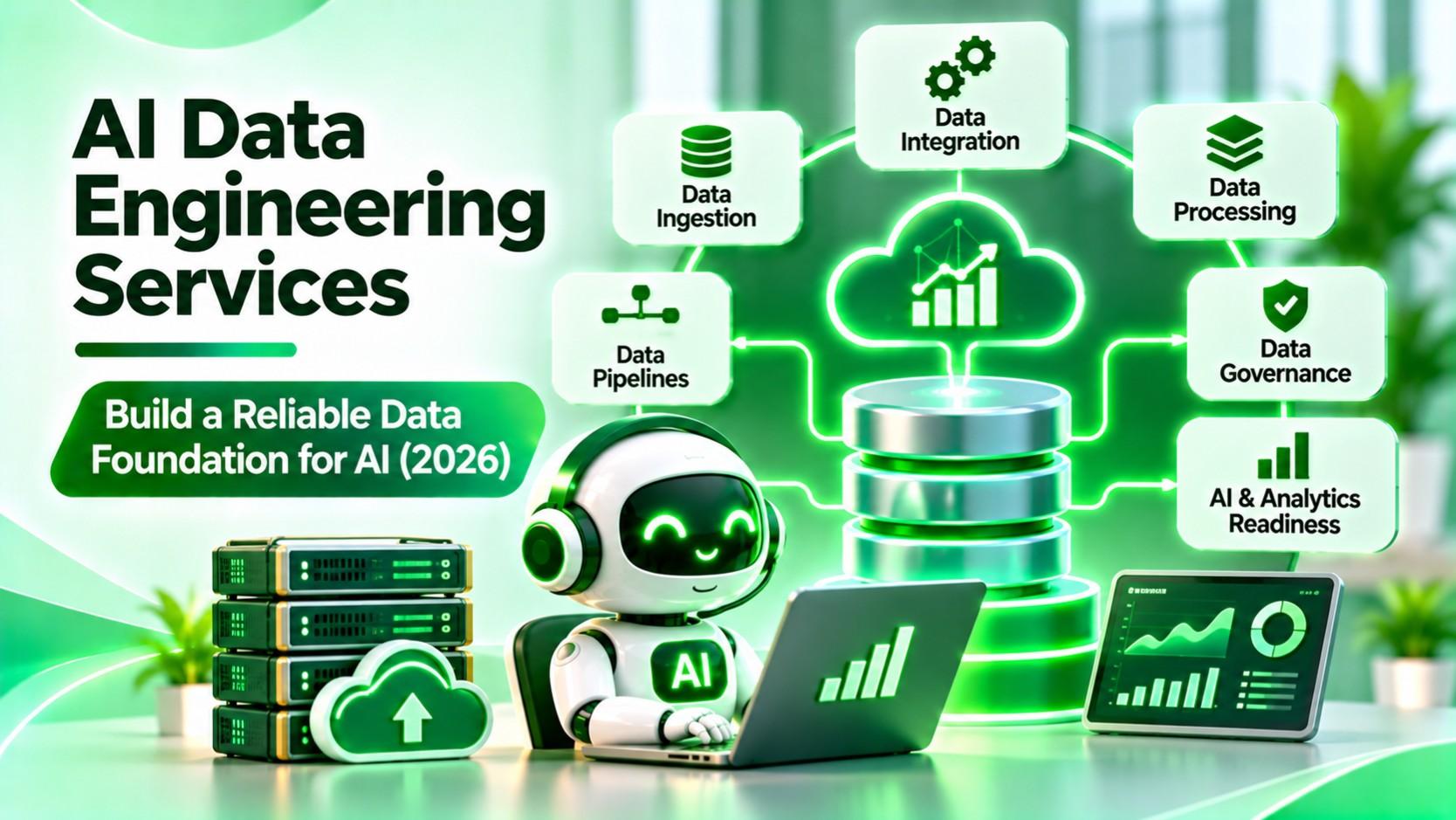
Production AI fails more often on late, inconsistent or unowned data than on model choice. That is why US teams look for AI data engineering services: partners who can build pipelines, lakehouses and feature stores that models can actually use.
This guide compares 7 firms that sell that work. It is a partner shortlist, not a careers article and not a remake of an MLOps vendor list. Autocomplete for this term often shows jobs. The buying job here is selecting a firm.
Model deployment, monitoring and retraining are a related but different retainer. For that path, use our MLOps consulting companies guide.
➤ Quick answer: choose the firm that already lives in your cloud and warehouse, and that will leave you a documented platform, not a pile of notebooks. Ask what a first engagement hands back: pipelines, tests, access rules and a feature store, with named owners.
What AI data engineering services should leave behind
Data engineering for analytics and data engineering for AI overlap, but they are not the same purchase.
• Pipelines that land and test the data production models need, on a schedule you can trust.
• A lakehouse or warehouse design that can serve training, features and reporting without silent copies.
• Feature stores or feature pipelines so training and serving do not drift apart.
• Contracts and quality checks for late, missing or surprising fields.
• Access, lineage and retention rules that a security team can review.
If a proposal only promises dashboards, it is a business-intelligence project wearing an AI label. If it only promises model ops, it belongs on the MLOps consulting shortlist instead.
Adjacent LuMay guides cover agentic AI consulting and custom agent work. Those are later steps. This page stays on the data platform those agents need.
How this shortlist was chosen
A firm is in this list if, on 28 November 2026, its own site described data-platform, data-engineering or data-modernization services that support AI or advanced analytics, with a US delivery presence.
• The page had to be about client services, not a job posting.
• We favored firms whose public pages talk about warehouses, lakehouses, pipelines or modernization for AI, not only generic strategy.
• Seven is the count because recent market notes and comparison pages often use a set of seven or ten. A set of 7 is large enough to show contrast and small enough to compare on the same dimensions.
The 7 firms are listed alphabetically, not ranked. “Best for” is a fit note.
Three firms here — phData, Thoughtworks and Tiger Analytics — also appear on our MLOps guide. They are included only for their data-platform work. Do not treat this page as a new ranking of those firms.
How we tested
How we tested: no firm was hired or audited for this draft. Facts come from each firm’s public pages, read on 28 Nov 2026.
Comparison table: stack, first-engagement outcome and fit
Disclosure: LuMay publishes this guide and offers enterprise data engineering for AI. It is not part of this list. The 7 firms are listed alphabetically, not ranked.
| Firm | What the public page emphasizes | Typical stack signals on that page | Best treated as |
|---|---|---|---|
| Aimpoint Digital | Data and AI consultancy work across modern data platforms | Public materials emphasize modern cloud data and AI delivery; confirm current warehouse partners in a call | A specialist partner when you already have a platform direction |
| Infinite Lambda | Modern data platforms ready for AI, including legacy ETL migration | Public pages highlight modern data platforms, ETL modernization and AI-ready foundations | A build partner for platform rebuilds and pipeline modernization |
| Lovelytics | Data and analytics delivery on modern cloud platforms | Public site positions the firm in the modern data-and-AI services market; confirm current stack partners in diligence | A delivery partner for analytics platforms that must also feed AI |
| phData | Dedicated data-engineering services | The data-engineering services page is the primary source; confirm current warehouse and pipeline tools with the firm | A data-engineering-led partner, especially if you already run a modern warehouse |
| Slalom | Data services that include engineering and architecture | The US data services page lists engineering and architecture, management and governance, and literacy and analytics | A regional consulting partner when change management sits beside the platform |
| Thoughtworks | Data modernization services | The US data-and-AI page frames modernization work that supports later AI use | A modernization partner when legacy estates and engineering practice are the constraint |
| Tiger Analytics | Data-engineering services as a named offer | The data-engineering services page is the primary source; confirm cloud and lakehouse tooling in diligence | A services firm when you want a named data-engineering workstream, not only a model team |
The 7 firms, listed alphabetically
Aimpoint Digital
Best for: US mid-market and enterprise teams that want a specialist data-and-AI consultancy rather than a full-scale systems integrator.
• Aimpoint Digital’s site, read 28 November 2026, presents the firm as a data and AI consultancy.
• In diligence, ask which warehouse, lakehouse and orchestration tools the named team has shipped in the last year.
• Limitation: a specialist bench can be excellent and still be small for a multi-year, multi-region rebuild. Check capacity early.
Infinite Lambda
Best for: teams stuck on legacy ETL who need a modern data platform that later AI work can use.
• Infinite Lambda’s site describes a modern data platform ready for AI, legacy ETL migration, and related data-and-AI consulting.
• That is close to the buying job on this page: leave behind a platform, not a one-off notebook.
• Limitation: confirm US delivery hours, security review paperwork and who supports the platform after the first release.
Lovelytics
Best for: organizations whose AI plans still depend on a trusted analytics platform and clean semantic layers.
• Lovelytics positions itself as a data and analytics firm on modern cloud platforms. Read the current partner badges on its site during diligence; they change.
• A good first engagement should make the same tables usable for analysts and for features, not create a private AI copy.
• Limitation: if you only need model deployment, this is the wrong shortlist. Use the MLOps guide.
phData
Best for: teams that want a firm with a named data-engineering service line, especially around a modern warehouse.
• phData publishes a dedicated data-engineering services page, which is why it belongs here as a data-platform partner.
• It also appears on our MLOps shortlist. Ask for a statement of work that is about pipelines, tests and features, not only model operations.
• Limitation: strong warehouse specialists can still under-scope lineage, access reviews or mid-contract knowledge transfer. Put those in the acceptance criteria.
Slalom
Best for: US enterprises that want data engineering and architecture alongside governance and local delivery.
• Slalom’s US data services page, read 28 November 2026, lists engineering and architecture, management and governance, and literacy and analytics.
• That mix helps when the constraint is not only Spark jobs, but also owners, funding and training.
• Limitation: a broad consultancy can staff a mixed team. Ask for the actual architects and engineers, not only the brand.
Thoughtworks
Best for: organizations modernizing a messy data estate and wanting a strong engineering practice around that work.
• Thoughtworks’ US data-and-AI page frames data modernization services.
• This is useful when you need platform patterns, quality practices and a path to later AI, not a single dashboard project.
• Limitation: Thoughtworks also appears on our MLOps guide. Keep the statement of work on data modernization if that is the job you are buying.
Tiger Analytics
Best for: teams that want a named data-engineering workstream next to analytics or AI delivery.
• Tiger Analytics publishes a dedicated data-engineering services page.
• As with phData, the firm also appears in MLOps conversations. Separate the data-platform scope from model operations in the contract.
• Limitation: confirm who owns pipeline operations after handover, including on-call, cost controls and schema-change process.
What a first engagement should include
A useful first phase is short, dated and easy to inspect.
• A current-state map of sources, copies and owners, including the unofficial spreadsheets models already use.
• A target path for one or two production AI use cases, not a 40-domain enterprise model.
• Working pipelines with tests, alerts and a rollback path.
• A feature or training dataset with a documented contract.
• Access, retention and lineage notes your security team can read.
• A written handover: runbooks, cost baseline and named internal owners.
Illustrative example: a US mid-market insurer might ask a firm to rebuild claims-feature pipelines into a warehouse, with tests for late repairs and a documented handover in 90 days. That is a design sketch, not a measured result.
Ask for commercial terms in writing. Public pages rarely list pricing for this kind of work, and this guide does not invent rates. Compare a fixed first phase against an open time-and-materials bench.
Who should skip this shortlist
Skip it if you are looking for a data-engineering job. This page is for buyers hiring a firm.
Skip it if you already have reliable pipelines and only need model deployment or LLM operations. Use the MLOps consulting guide.
Skip a broad platform rebuild if you cannot name the first two production AI jobs. Firms will fill the vacuum with a generic lakehouse that no team owns.
Our own product
LuMay is not one of the 7 firms above and is not ranked against them.
The AI engineering services page, read 28 November 2026, includes a capability named Enterprise Data Engineering for AI. The page describes pipelines, feature stores and the data infrastructure production AI depends on.
That is a custom engineering path, not a claim of a named lakehouse case study. If you want to walk through a first data-platform job, use the demo booking page. For current service pricing, see that page rather than this guide.
Sources
Firm and LuMay pages below were read on 28 November 2026. Descriptions reflect what those pages said on that date.
• Thoughtworks data modernization
• Tiger Analytics data engineering
• LuMay AI engineering services
• MLOps consulting companies for US enterprises (LuMay)
Next step
If you already know the first two production AI jobs, bring a source inventory and the warehouse or cloud you plan to keep. Book a working session on the demo booking page.
Tags:
Frequently Asked Questions
Everything you need to know about Engineering Services
1. What are AI data engineering services?
They are partner services that design and build the pipelines, lakehouses or warehouses, and feature stores production AI needs. The output should be a platform your team can run, not only a slide deck or a notebook.
2. How is this different from hiring a data engineer?
Hiring adds a permanent role. A services firm is for a defined build, a migration or a gap in architecture. Many US teams do both: a firm leaves the platform, and internal engineers operate it.
3. Why is this not a jobs guide?
Search suggestions for this term often point to careers. This article is written for buyers comparing firms. Job seekers should use career sites, not a vendor shortlist.
4. How do these services differ from MLOps consulting?
Data engineering gets trustworthy data into a usable platform. MLOps puts models into production and keeps them there. If you already trust the data, start with our MLOps consulting guide.
5. Which cloud or warehouse should we standardize on first?
Standardize on the platform your security, cost and talent plans already support. Then shortlist firms with recent delivery in that stack. Do not switch clouds only because a single pitch deck looks modern.
6. What should we budget for a first phase?
This guide does not invent rates. Ask each firm for a fixed first phase with acceptance tests. Use written proposals, and treat public pricing pages as relevant only for LuMay services.
7. How do we judge quality before a long contract?
Give every finalist the same source sample, including one messy late-arriving field. Score documentation, tests, lineage and the clarity of handover, not only a polished workshop.
8. Should a systems integrator and a specialist both be in the final two?
Yes, if the work could go either way. Compare the named team, the artifacts they will leave, and who stays after go-live. Brand size is not a quality score.
9. What does a feature store actually add?
It gives training and serving a shared, documented definition of a feature. Without that, models quietly drift as analysts and data scientists calculate the same field in different ways.
10. How long should a first platform engagement last?
Long enough to ship one or two production-ready pipelines and a handover, often a single quarter. Multi-year transformations should start only after that first slice has an owner.
11. Can we reuse an analytics warehouse for AI as-is?
Sometimes, if quality, latency and access already meet the model’s needs. More often you need new tests, features and serving paths. A partner should prove the gap with your data, not assume a rebuild.
12. What security questions belong in the RFP?
Ask where data is processed, who can see it, how secrets are stored, how access is reviewed, and what remains in the firm’s tools after the contract. Require written answers, not only a marketing appendix.
About the Editorial Team
Creates insightful content on SEO, AI-powered marketing, digital growth, and emerging technologies. He simplifies complex topics into practical, research-backed guidance.