


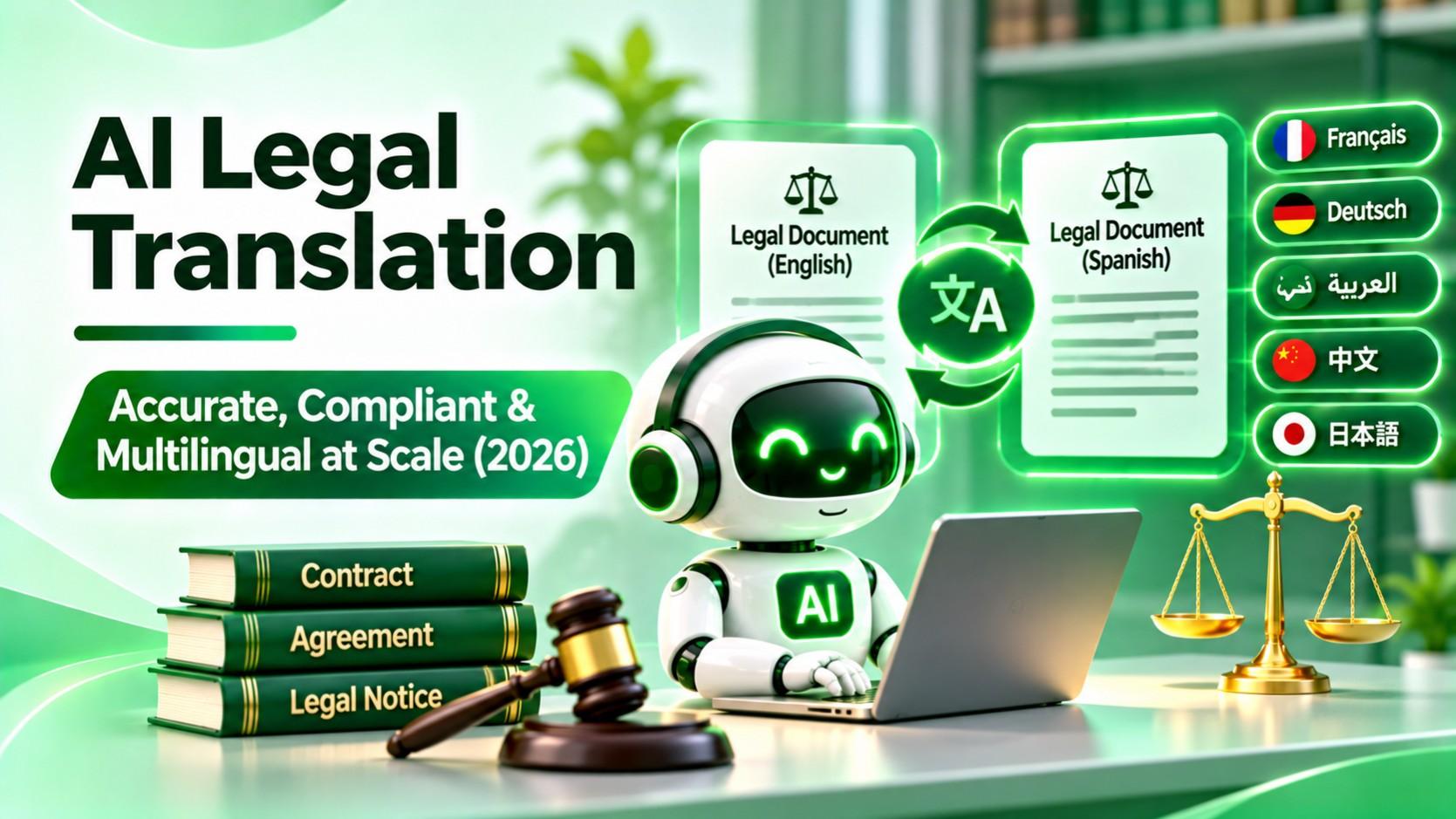
AI Legal Translation: 8 Tools for Law Firms (2026)
Law firms translate contracts, exhibits, discovery and client papers under time pressure. Generic machine translation is fast, but legal work also needs terminology control, a review path and a record of who approved the English text.
This guide compares 8 tools used for AI legal translation in US law-firm document work. It is an unranked shortlist. It is not legal advice and it does not promise that any tool will be accepted by a court, agency or counterparty.
For a broader enterprise buying path that is not law-firm specific, see How to Choose Enterprise AI Translation Software. After a translation is in English, review may still need a legal document review agent.
➤ Quick answer: use AI translation to draft, then have a qualified human review anything that could be filed, signed or sent as advice. USCIS filings still need a certified English translation under federal rules. Machine output alone is not that certificate.
What “AI legal translation” should mean inside a firm
In a firm, translation is a document job, not a website-localization job. The source may be a scanned PDF, a Word contract, or a set of exhibits with defined terms that must stay stable.
• Terminology: the same defined term should not become three English variants.
• Format: tables, stamps, signatures and exhibit labels should survive the pass.
• Review: a named person checks the output against the source.
• Record: you can later show what was translated, by which system, and who approved it.
• Confidentiality: client text should not be used to train a public model unless counsel has accepted that risk.
Those tests come from professional duties, not from marketing copy. ABA Formal Opinion 512 (29 July 2024) reminds lawyers that generative AI tools still sit under duties of competence, confidentiality, communication, supervision and candor.
Model Rule 1.6 still governs client information when a translation tool is in the workflow. If the vendor can see, retain or train on the text, treat that as a confidentiality question, not a feature footnote.
Filing limits you should not blur
For immigration filings, 8 C.F.R. § 103.2(b)(3) is clear. A foreign-language document sent to USCIS needs a full English translation, certified as complete and accurate.
The translator must also certify competence to translate from that language into English.
The Cornell Legal Information Institute text of 8 C.F.R. § 103.2, read 28 November 2026, is the source for that summary. Court and agency rules outside USCIS vary by jurisdiction. This article does not map every local rule.
The practical point is simple. An AI system can produce a draft. It does not, by itself, become a certified translation because a tool is accurate most of the time. A competent human still has to certify, where a certificate is required.
Do not treat this guide as a promise of acceptance, privilege protection or ethical compliance. Those questions belong with the firm’s counsel and, where needed, a qualified translator.
How this shortlist was chosen
A tool is in this list if, on 28 November 2026, its own site described machine or AI translation, a translation workspace, or a translation-management platform that law firms or legal teams can use on documents.
• Eight is the count because current comparison pages use lists of six, ten or twelve. A set of 8 leaves room for both standalone engines and professional translation environments.
• Generic consumer apps with no document or professional controls are out.
• We did not require a vendor to use the words “legal translation” if the product is widely used on legal documents and offers glossary or memory controls.
The 8 tools are listed alphabetically, not ranked.
How we tested
How we tested: no tool was installed or tested for this draft. Facts come from each vendor’s public pages and from the legal sources cited below, read on 28 Nov 2026.
Comparison table: document fit, controls and review
Disclosure: LuMay publishes this guide and offers a translation agent. It is not part of this list. The 8 tools are listed alphabetically, not ranked.
| Tool | What the public page emphasizes | Controls a firm should ask about | Best treated as |
|---|---|---|---|
| Bluente | Legal-oriented document translation | Document formats, review workflow and data handling | A legal-document specialist option to trial on your own contracts |
| DeepL Pro | Pro-tier machine translation, including glossary and API options | Glossary enforcement, document formats and the vendor’s data terms | A high-quality draft engine, still behind a human reviewer |
| Google Cloud Translation | Document translation for files such as PDFs and Word documents | Project-level glossary, batch documents and cloud security settings | A cloud document pipeline for teams already on Google Cloud |
| Lilt | Enterprise translation with contextual AI | Memory, reviewer workflow and legal-content handling | An enterprise translation system, not a one-click widget |
| memoQ | Professional translation environment with memory and term bases | Term base, translation memory and role-based review | A linguist-centered workspace for repeat legal terminology |
| Pairaphrase | Business and legal translation workspace | Document security terms, memory and legal-use claims on the current site | A document workspace; verify security terms in writing |
| Phrase | Translation management with machine translation and quality tooling | Glossaries, quality steps and connector scope | A TMS when volume, roles and workflow matter as much as the engine |
| Trados | Professional desktop and studio translation environment | Translation memory, terminology and linguist workflow | A linguist standard in many firms; confirm the current cloud or studio edition |
The 8 tools, listed alphabetically
Bluente
Best for: firms that want a legal-document angle rather than a general website-localization suite.
• Bluente’s site, read 28 November 2026, presents document translation in a legal context.
• Trial it on a contract and an exhibit set, then score defined-term consistency and formatting, not only fluency.
• Limitation: a legal marketing angle is not a court certificate. Keep a human reviewer and, where required, a competent certifier.
DeepL Pro
Best for: teams that need a strong general engine, a glossary and an API, then will add their own review path.
• DeepL’s Pro page, read 28 November 2026, describes the paid product line, including professional and API options.
• Glossary control is the feature to test on defined terms. Fluency alone is not enough for operative clauses.
• Limitation: confirm document-file behavior and data-use terms for client matter text before any live matter is pasted into the tool.
Google Cloud Translation
Best for: firms or legal departments already operating in Google Cloud that need document-level translation, including PDFs.
• Google’s Document Translation documentation, read 28 November 2026, describes translation of document files, not only raw strings.
• This is infrastructure. You still have to design review, logging and access around it.
• Limitation: cloud document translation is not, by itself, a certified filing package.
Lilt
Best for: enterprises and firms that want contextual AI inside a managed translation process, with reviewers in the loop.
• Lilt’s site presents enterprise translation with contextual AI. Ask for the legal-content workflow and where data is stored.
• Limitation: it is a heavier system than a browser plugin. Budget time for onboarding, not only a one-hour demo.
memoQ
Best for: firms that already work with professional linguists and need translation memory and term bases.
• memoQ’s site describes a professional translation environment. For legal work, the term base is often the real asset: it keeps “Indemnifying Party” from drifting.
• Limitation: a TMS is only as good as the linguists and reviewers you assign. The software does not replace that role.
Pairaphrase
Best for: teams that want a document-centric workspace and will verify security terms in writing.
• Pairaphrase markets business and legal translation. Read the current security and data-use terms yourself; do not rely on a summary.
• Limitation: marketing language about professional or legal use is not an ethics opinion and not a filing certificate.
Phrase
Best for: groups managing high volume, multiple languages and multiple reviewers, not only a single partner’s contract.
• Phrase’s site, read 28 November 2026, presents a translation management platform with machine translation and quality tooling.
• This is closer to an operating system for translation than to a single engine.
• Limitation: a TMS will not help if the firm has no glossary owner and no review standard.
Trados
Best for: firms whose linguists already work in a Trados environment and need memory and terminology discipline.
• RWS Trados, via trados.com, remains a standard professional environment. Confirm which current Studio or cloud edition your linguists will actually use.
• Limitation: a desktop or studio license is not an evidence trail unless you also define how files, versions and approvals are stored.
A review path that holds up under scrutiny
Illustrative example: a US firm receives a Spanish share-purchase agreement and needs an English working copy tonight, then a filing-ready translation later. Those are two different outputs.
The overnight draft can come from an engine plus a lawyer’s review. The filing copy, if a certificate is required, still needs a competent human certifier.
A defensible path usually looks like this.
• Classify the document: working copy, client communication, or filing and signature.
• Lock a glossary of defined terms and captions before the first pass.
• Run the engine or TMS, then compare operative clauses against the source.
• Record the model or memory version, the reviewer, and the time of approval.
• Keep client text out of tools whose data terms you have not accepted.
Related firm-level questions sit in law firm AI governance and in the legal AI implementation plan. This page does not repeat those playbooks.
Who should skip this shortlist
Skip it if you only need website or intranet localization. Use the enterprise translation chooser instead.
Skip any tool whose data terms you cannot accept for client matter. Speed does not outrank confidentiality.
Skip a “file it as-is” plan for USCIS or other certificate-required submissions. Draft with AI if you wish; certify with a competent human when the rule requires it.
Our own product
LuMay is not one of the 8 tools above and is not ranked against them.
The translation agent page, read 28 November 2026, describes a product aimed at regulated document work.
The page names an evidence trail for each translation, including a source hash, model version, reviewer and timestamp. It also describes chain-of-custody and reviewer-accountability language, glossary control and 100+ languages.
That page does not, on the reading used for this draft, describe certified or sworn translation. This article does not claim that the product meets any filing, court or agency translation rule.
If you want to walk through a law-firm document workflow, use the demo booking page. For current service pricing, see that page rather than this guide.
Sources
The following pages and authorities were read on 28 November 2026, except Formal Opinion 512, which is dated 29 July 2024 and was reviewed from the official opinion text.
• 8 C.F.R. § 103.2 (Cornell LII)
• ABA Formal Opinion 512 (29 July 2024), Standing Committee on Ethics and Professional Responsibility, official PDF: aba-formal-opinion-512.pdf
• ABA Model Rule 1.6, confidentiality (Cornell ethics copy)
• Bluente
• Google Cloud Document Translation
• Lilt
• memoQ
• Phrase
• Trados
• How to choose enterprise AI translation software (LuMay)
Next step
If you have a sample contract and an exhibit set, bring those and the review standard you want to keep. Book a working session on the demo booking page.
Tags:
Frequently Asked Questions
Everything you need to know about Legal AI
1. Is AI legal translation good enough to file with a court or agency?
Not by itself. Some filings, including many USCIS submissions, require a certified English translation by a competent human. AI can draft. A person still has to review, and, where required, certify. Check the rule that applies to your filing.
2. Does 8 C.F.R. § 103.2(b)(3) accept a machine-only translation?
The rule requires a full English translation certified as complete and accurate, plus the translator’s certification of competence. A model output without that human certification does not meet the text of the rule, as read on 28 November 2026.
3. How does ABA Formal Opinion 512 affect translation tools?
The opinion, dated 29 July 2024, says lawyers using generative AI must still meet duties such as competence, confidentiality, communication, supervision and candor. Translation tools are not an exception to those duties.
4. Can we paste client contracts into a free translation website?
Only if counsel has accepted the data terms, including training, retention and access. In many firms, that answer is no. Use a contracted tool with written terms, or a process your confidentiality policy already allows.
5. What is the difference between a glossary and translation memory?
A glossary or term base locks approved equivalents for defined terms. Translation memory reuses prior reviewed segments. Legal teams usually need both, plus a person who owns term changes.
6. Should a bilingual lawyer review every page?
Someone competent in the source and target legal language should review anything that will be relied on, signed or filed. A lighter pass may be enough for an internal working copy, if that limit is clear to the team.
7. How should we test tools on our own matters?
Use a retired contract, a defined-term list and a scanned exhibit. Score term consistency, omissions, number errors and formatting. Then test the export your reviewers will actually use.
8. Do these tools replace professional legal translators?
No. They can speed a first pass and help with volume. Professional translators and reviewing lawyers still own quality, and a competent certifier is still required where a certificate is required.
9. How is this different from enterprise translation software buying?
Enterprise guides often start with website, help-center or knowledge-base volume. This page starts with law-firm documents, review, evidence and filing limits. Use the enterprise chooser for the broader path.
10. What record should we keep after a translation is approved?
Keep the source file, the output, the tool and version or memory used, the glossary version, the reviewer name and the approval time. That record helps later questions. It is not a substitute for a required certificate.
11. Can we use one engine for every language pair?
You can start there, but quality varies by language and legal domain. Test the pairs you actually see, including one lower-resource language, before you standardize.
12. Does this article guarantee compliance with ethics or filing rules?
No. It summarizes public sources as of 28 November 2026 and compares tools. It is not legal advice and not a guarantee of compliance, privilege protection or official acceptance.
About the Editorial Team
Creates insightful content on SEO, AI-powered marketing, digital growth, and emerging technologies. He simplifies complex topics into practical, research-backed guidance.