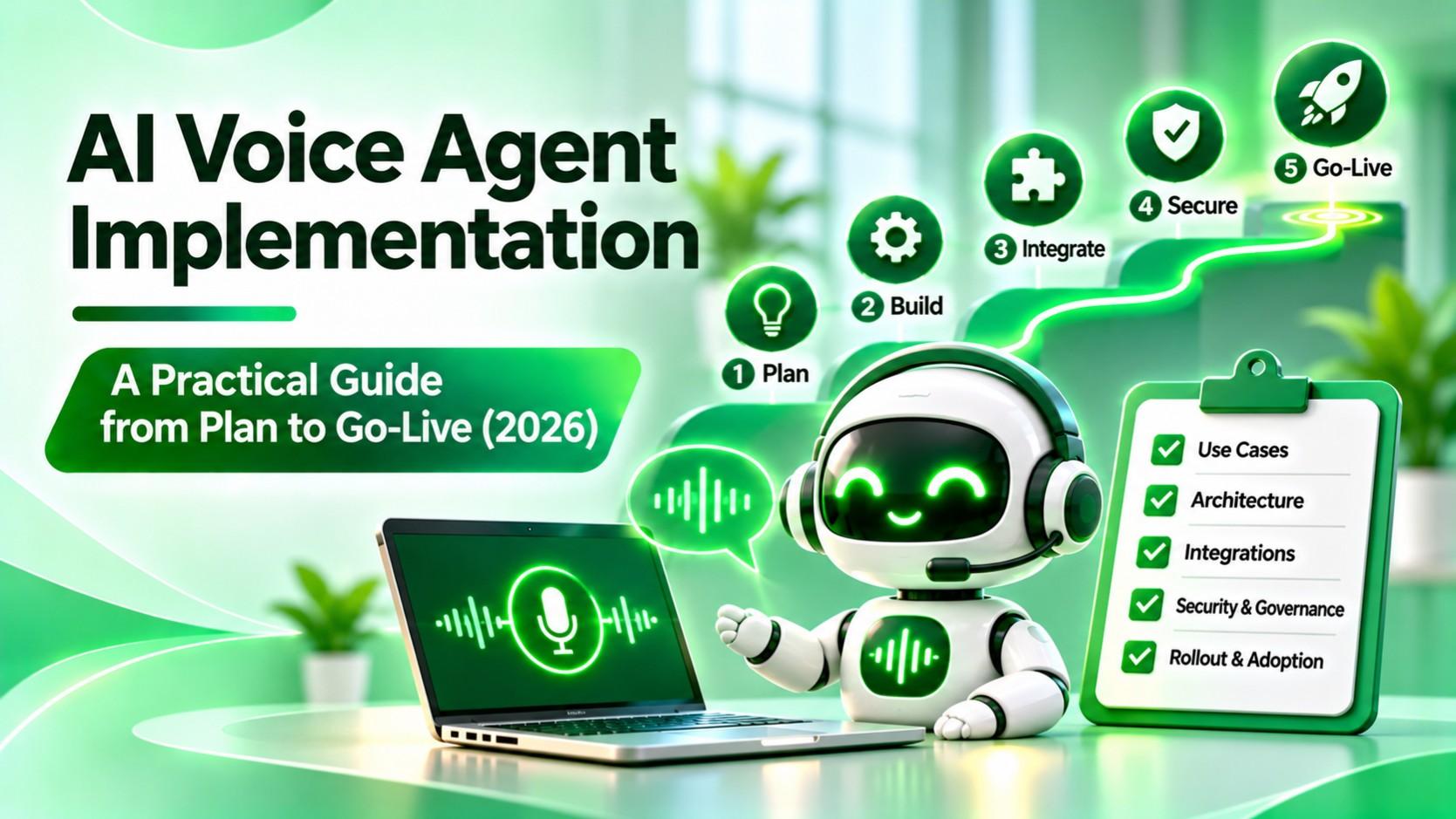
AI Voice Agent Implementation: 9 Buyer Checks (2026)
Buying a voice platform is not the same as putting it on a live number. Most stalled programs fail between those two points: the job was vague, the agent could do too much, or no one owned rollback.
This guide is a nine-point plan for AI voice agent implementation in US teams. It is not a vendor list and not a ranking. If you still need to shortlist suppliers, use top US companies offering AI voice agent solutions.
Law firms have a separate, matter-intake-specific checklist. Use Law Firm AI Voice Agent Implementation Checklist when the workflow is legal intake. This page stays cross-industry.
➤ Quick answer: start with one job, one success metric and a written permission line. Prove identity, handoff and failure paths in staging. Go live on a limited number of calls, with a rollback trigger someone can actually pull.
What “implemented” should mean
A voice agent is implemented when a real caller can finish a defined job, the systems behind the call are updated correctly, and a person can take over without the caller starting again.
It is not implemented when a demo sounds fluent on a happy-path script. It is also not implemented when a number is live but no one watches transcripts, failures or cost.
• The first job is written in one sentence, with a metric.
• The agent has a permission line: what it may do, say and never do.
• Staging has already seen noisy audio, interruptions and a forced failure.
• A named person can roll the number back in minutes, not days.
• The live team knows what they will hear when a call is handed off.
Build versus buy can still change the plan. If that decision is open, read our 2026 build-or-buy voice strategy first, then come back to these nine checks.
How we tested
How we tested: this draft is a buyer plan, not a lab evaluation of named platforms. Facts come from public pages and related guides, reviewed on 28 Nov 2026.
The 9 buyer checks, in rollout order
Disclosure: LuMay publishes this guide and offers voice agents. The nine checks are a plan, not a ranked list of vendors, and LuMay is not placed in any vendor order here.
1. Pick one job and one success metric
Write the first job in one sentence a supervisor could repeat. “Handle after-hours calls better” is not a job. “Confirm an appointment and log the result in the scheduling system” is a job.
Choose one primary metric, such as completed bookings, first-call resolution for a narrow intent, or a clean handoff rate. Secondary metrics can wait.
If you cannot name the system that must be updated for the job to count, you are not ready to implement. You are still in discovery.
2. Inventory the systems the agent must use
List every system the call will read or write: CRM, scheduling, billing, identity, help desk, knowledge base and telephony.
For each system, write whether the agent may read, may draft, or may write. Include who owns access and what a failed write should do.
Illustrative example: a US regional clinic might let the agent read tomorrow’s schedule and write a confirmed slot, but only create a ticket when a payment question appears. That is a design sketch, not a measured result.
If this inventory is still a slide with logos, stop. Implementation starts when the fields and permissions are real.
3. Write the permission line: what it may do, say and never do
A permission line is a short policy the prompt, the tools and the supervisors all share.
• May do: complete the first job, collect the minimum facts, and hand off with a summary.
• May say: confirmed facts from the system of record, plus a plain-language limit when it cannot help.
• Must never do: invent a balance, a legal conclusion, a diagnosis, a guaranteed date, or a promise your policy forbids.
Review this line with operations, legal and security, not only with the vendor. If those teams disagree, the live call will show it.
4. Plan numbers, routing and hours of operation
Decide which numbers the agent will answer, which overflow to people, and what happens after hours or on holidays.
Keep your existing numbers if you can. Number changes confuse callers and hide the real implementation quality behind a new-line effect.
Document the carrier, the session initiation path, and who can change routing. A weekend failure is often a routing problem, not a model problem.
5. Set consent, recording and retention rules for US calls
US teams should decide, with counsel, how they will announce recording, how they will treat outbound campaigns, and how long audio and transcripts will be kept.
Telephone marketing and autodialed calls can raise issues under 47 U.S.C. § 227. Federal intercept rules, including 18 U.S.C. § 2511, and state recording-consent laws can also apply.
This article is not legal advice and not a map of every state rule. Get counsel’s view before you record or run outbound campaigns.
Write the announcement text, the retention period and the access list before staging, not after the first complaint. For a deeper buyer checklist, see Voice AI Compliance.
6. Design the human handoff before the first test call
Handoff is part of the product, not a fallback you add later.
The person who receives the call needs the caller’s intent, the facts already collected, and the reason for the transfer. The caller should not have to repeat an account number that the agent just took.
Set a time limit for a silent or looping agent. A polite, fast transfer is better than a long, confident error.
Practice the handoff with the live team. If supervisors have never heard a transferred call, the launch is not an implementation. It is a surprise.
7. Run a failure script, not only a happy-path demo
A useful staging script includes interruptions, background noise, a wrong account, a changed mind, a second question mid-call, and a forced system outage.
Score each run on whether the agent stopped, told the truth about the failure, and handed off with context. Do not score only fluency.
The NIST AI Risk Management Framework is a useful, non-binding reference for identifying and measuring those risks in staging.
Keep a regression set. When someone changes a prompt or a tool, replay the failure script before the change meets a live number.
Security questions about transcripts, access and tool permissions belong in this stage. Use AI Voice Agent Security as the deeper checklist.
8. Stage the rollout and write the rollback trigger
Do not start with every skill and every hour. Start with one job, limited hours or a subset of calls, and a named owner on the floor.
Write a rollback trigger in advance: for example, a handoff failure rate, a repeated wrong-data event, or an incident the supervisor cannot explain.
The trigger is useless if only the vendor can change routing. Make sure an internal owner can move the number back to people the same day.
9. Brief the live team and watch the first weeks
Tell the live team what the agent is allowed to do, how a transferred call will sound, and how to flag a bad transcript.
In the first weeks, review a sample of completed calls, all serious failures, and any call where the caller asked for a person immediately.
Watch cost as well as quality. A cheap-looking minute can become expensive if the agent causes repeat calls or after-the-fact corrections.
Set a date to decide whether the first job should expand, stay, or be rolled back. Implementation without that date becomes an unpaid experiment.
How these checks fit with other buying work
Vendor shopping is a different page. Use the US companies shortlist when you still need names.
Law-firm intake, conflict language and matter systems are a different page. Use the law firm implementation checklist rather than stretching this cross-industry plan.
Pharmacy, bank, fintech and retail voice jobs also have their own shortlists on this site. Use those when the vertical, not the rollout plan, is the open question.
Who should wait
Wait if you cannot name the first job, the system of record, or the person who will own rollback.
Wait if counsel has not reviewed outbound campaigns or recording announcements you already plan to use.
Wait if the live team has not heard a handoff. Software can be ready while the organization is not.
Our own product
LuMay is not ranked here, because this page is a rollout plan rather than a vendor list.
The voice agent page, read 28 November 2026, describes inbound and outbound conversations, multiple languages, enterprise telephony integrations and configured business workflows, with flexible deployment options.
Those product facts can support a staged rollout. They are not a substitute for the nine checks above, and they are not a claim about a named implementation result.
If you want to walk through a first job, a permission line and a staging plan, use the demo booking page. For current service pricing, see that page rather than this guide.
Sources
Pages and authorities below were read or reviewed on 28 November 2026, except where a source carries its own date.
• 47 U.S.C. § 227 (Cornell LII)
• 18 U.S.C. § 2511 (Cornell LII)
• NIST AI Risk Management Framework
• Top US companies offering AI voice agent solutions (LuMay)
• Law firm AI voice agent implementation checklist (LuMay)
• AI voice agent security (LuMay)
• Build or buy voice strategy (LuMay)
Next step
If the first job and the permission line are already clear, bring those and the system inventory. Book a working session on the demo booking page.
Tags:
Frequently Asked Questions
Everything you need to know about Voice Agent
1. What does AI voice agent implementation include, besides picking a vendor?
It includes the first job, system permissions, telephony routing, consent and recording rules, handoff, failure tests, a staged go-live, rollback and the first weeks of monitoring. A signed contract is only the start.
2. How is this different from a law-firm implementation checklist?
The law-firm checklist is built around legal intake and firm systems. This page is a cross-industry buyer plan. Use the law firm checklist when the workflow is firm intake.
3. Why is this not a list of platforms?
Platform shortlists already exist, including our US companies guide. Repeating vendor names here would hide the rollout work that usually determines success.
4. How long should a first implementation take?
Long enough to finish the nine checks for one job, which may be a few weeks or a quarter depending on integrations. A date without a failure script and a rollback owner is not a plan.
5. What is a permission line?
It is a short statement of what the agent may do, may say and must never do. The prompt, the tools and the supervisors should all use the same line.
6. When should we involve counsel?
Before outbound campaigns, recording announcements and retention rules are set, and before the agent is allowed to discuss regulated products. This guide is not legal advice.
7. How many calls should we put on the agent at launch?
Start with a subset: one job, limited hours or a share of traffic. Expand only after the failure script stays clean and the live team can handle handoffs.
8. What should trigger a rollback?
A pre-agreed event, such as repeated wrong data, a handoff failure spike, or an incident the supervisor cannot explain. The internal owner must be able to move the number back the same day.
9. Do we need a staging environment?
Yes. Happy-path demos miss noisy audio, interruptions and outages. Staging is where those scripts should fail safely, before a customer is on the line.
10. How should we brief the live team?
Show them the permission line, play a sample handoff, and give them a fast way to flag a bad call. If they first meet the agent on launch day, they will not trust it.
11. Where do security and compliance details go?
Use the nine checks for the rollout sequence, then use our security and compliance guides for the deeper questionnaires.
12. Does following these nine checks guarantee a successful launch?
No. They reduce common failure points. They do not guarantee call quality, legal compliance or a particular return. Treat them as a buyer plan, not a warranty.
About the Editorial Team
Creates insightful content on SEO, AI-powered marketing, digital growth, and emerging technologies. He simplifies complex topics into practical, research-backed guidance.