


AI Agents for Retail: 11 Platforms Compared (2026)
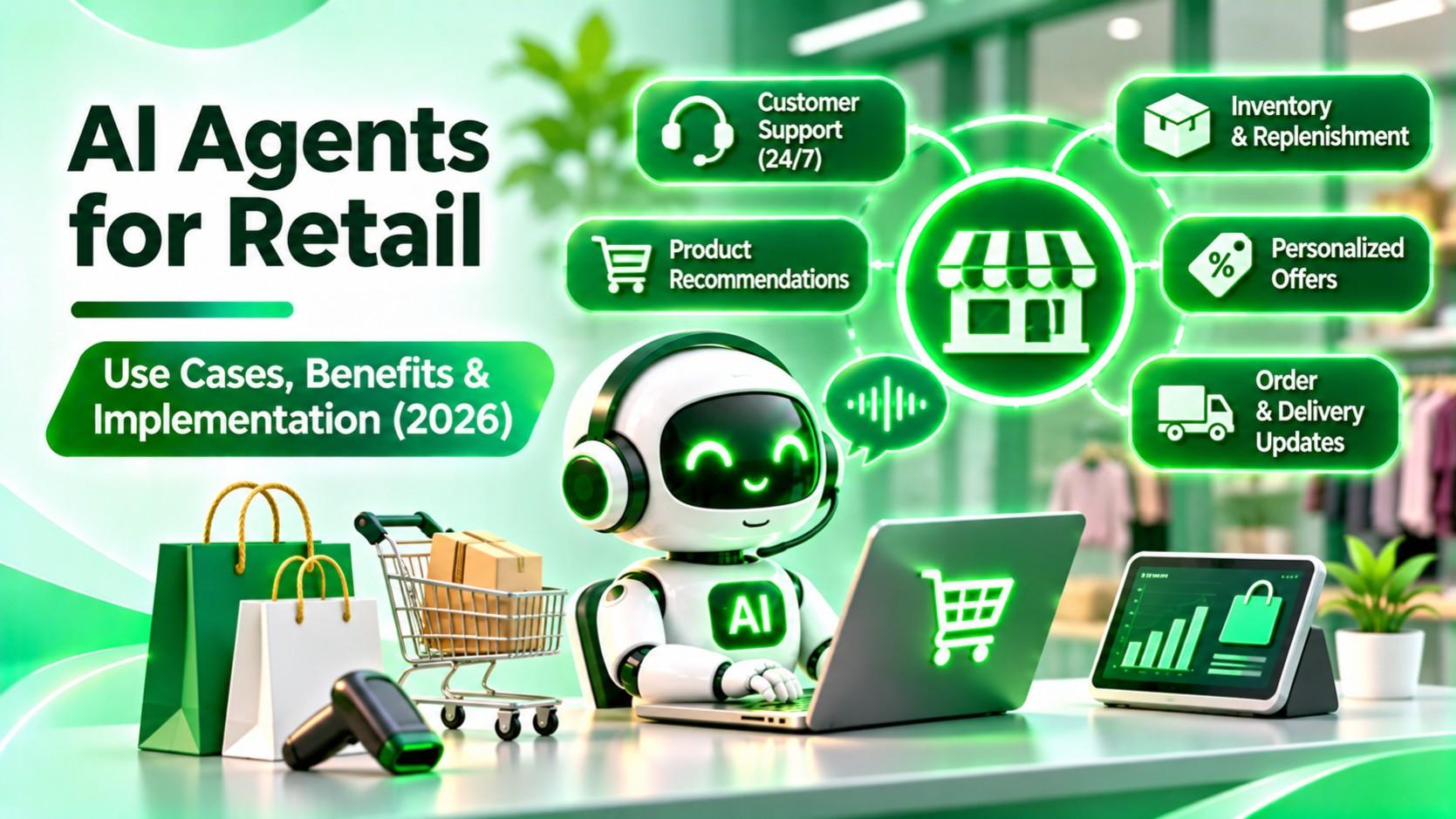
Retail teams do not only answer shopper chats. They also set prices, fill shelves, tidy product data and decide what appears in search. Many “best AI agent” lists talk only about storefront messaging.
This guide compares 11 platforms that offer AI agents for retail work in merchandising, inventory, discovery, product data, price intelligence or digital shopper messaging. It is an unranked shortlist for US retailers.
Voice and phone agents for stores are a separate job. For that path, use our Voice AI for Retail guide, which covers call use cases, costs and eight voice platforms.
➤ Quick answer: choose by the system the agent must change. Search and merchandising agents need catalog and traffic data. Inventory agents need forecasts and replenishment rules. Messaging agents need order and policy data. Keep a person on price, markdown and allocation changes.
What AI agents for retail do in the store and the back office
An AI agent is more than a dashboard. It reads data, works toward a goal, and can propose or take a step in another system. In retail that work sits in several places at once.
• Merchandising and discovery: decide what a shopper sees in search, browse and recommendations.
• Product data: turn messy attributes into content that search engines, ads and on-site search can use.
• Inventory and planning: forecast demand and suggest replenishment or allocation.
• Price intelligence: watch competitor and shelf prices, then flag or draft a change.
• Digital shopper messaging: answer pre-purchase and post-purchase questions on chat, email or social.
This is different from a generic chatbot that only restates a help article. The useful question is which source systems the agent can read, and which actions still need a human approver.
Phone ordering, store paging and call-center voice agents stay out of this list on purpose. Mixing those jobs with merchandising software makes a shortlist harder to use.
How this shortlist was chosen
A platform is in this list if, on 28 November 2026, its own site described an AI agent or AI assistant for retail or ecommerce work in one of the jobs above.
• It is sold to US retailers or ecommerce brands, or has a clear US commercial presence.
• It is not included only because it offers a generic chatbot.
• Voice-only or phone-first retail platforms are excluded and covered in the voice retail guide.
Eleven is the count used here because current comparison pages use lists of nine, ten or fourteen, often with a storefront-only lens. A set of 11 lets us mix operations tools with messaging tools without copying those lists.
The 11 platforms are listed alphabetically, not ranked. “Best for” is a fit note, not a score.
Retail buying also touches adjacent work. Inventory exceptions often meet procurement agents. Store and warehouse systems may meet ERP agents. Plant-side quality work is covered in AI agents for manufacturing.
How we tested
How we tested: no platform was installed or tested for this draft. Facts come from each vendor’s public pages, read on 28 Nov 2026.
Comparison table: job, source systems and approval
Disclosure: LuMay publishes this guide and offers custom retail AI engineering. It is not part of this list. The 11 platforms are listed alphabetically, not ranked.
| Platform | Main retail job | Source systems described | Approval or control noted |
|---|---|---|---|
| Algolia | On-site search, retrieval and agent building | Catalog and behavioral signals in AI Search; Agent Studio for custom agents | Teams create, test and deploy agents; treat merchandising rules as yours to set |
| Bloomreach Loomi | Personalization, search and marketing agents | Customer data, predictive models and channel activation in one “brain” | Marketing Agent can turn a prompt into a workflow; review before it goes live |
| Constructor | Ecommerce search and product discovery | Catalog and discovery channels for retail and B2B catalogs | Merchandising and ranking remain buyer-controlled; confirm controls in a pilot |
| Gorgias | Digital shopper messaging across the order journey | Trained on Shopify store data; 100+ ecommerce integrations on its site | Actions such as order edits still need your policy and review design |
| Lily AI | Product data for search, ads and other agents | Product attributes enriched for search engines, ad platforms and AI agents | People should review attribute changes before they publish to channels |
| RELEX | Forecasting, inventory and replenishment planning | Demand, supply, pricing and promotion signals in a shared planning model | Replenishment can be automated; set which moves need a planner’s sign-off |
| Salesforce | Commerce AI and Agentforce for commerce teams | Commerce Cloud and the wider Salesforce customer graph | Confirm which shopper or merchant actions require approval in your org |
| Shopify Sidekick | Merchant assistant for running a Shopify store | Built into Shopify: catalog, orders, inventory, themes and admin work | Best inside Shopify; keep a person on catalog, discount and inventory edits |
| Siena | Customer-facing commerce agents | Brand, catalog and support context for shopper conversations | Define what the agent may promise on refunds, shipping and stock |
| Wiser | Price, market and MAP intelligence | Retail and brand price and digital-shelf data | Price changes should stay behind a pricing owner, not an unattended write-back |
| Zowie | Customer-facing agents for support and commerce | Support, claims and commerce conversations; confirm retail connectors in a trial | Build, deploy and monitor agents; keep a human path for exceptions |
The 11 platforms, listed alphabetically
Algolia
Best for: retailers whose first problem is on-site search quality, and who may later add custom retrieval agents.
• Algolia’s site, read 28 November 2026, describes AI Search, recommendations and Agent Studio for creating and deploying agents.
• The core job is still finding and ranking products, then opening a path to agents that use that retrieval layer.
• Limitation: it is not an inventory planning system. Do not expect it to replenish stores.
Bloomreach Loomi
Best for: teams that want personalization, ecommerce search and marketing workflows under one AI layer.
• Bloomreach presents Loomi as the “mind” behind marketing, search and channel activation, with a Marketing Agent that can build a workflow from a prompt.
• That is useful when email, search and on-site experiences share the same customer profile.
• Limitation: a prompt-built workflow still needs a merchandiser or marketer to check offers, exclusions and brand rules before launch.
Constructor
Best for: mid-market and enterprise retailers that care first about product discovery and merchandising control.
• Constructor markets AI ecommerce search and product discovery for fashion, home, general merchandise and B2B catalogs.
• The useful buying question is how merchandisers pin, boost, bury or lock results when the model is wrong.
• Limitation: Constructor is a discovery system. Pair it with a planning or service tool if those are the jobs you need.
Gorgias
Best for: Shopify-centric brands that want one agent for pre-purchase questions, checkout help and post-purchase edits.
• Gorgias calls its AI Agent a product for the full customer journey, trained on Shopify store data, with a large ecommerce integration list.
• Its site describes work such as sizing questions, availability and order edits.
• Limitation: this is digital messaging, not shelf planning. For phone retail work, use the voice retail guide instead.
Lily AI
Best for: retailers whose catalog attributes are too thin for search, ads or other agents to use well.
• Lily AI says it makes products understandable to search engines, ad platforms and AI agents, with Lily Max positioned as an agentic product-intelligence engine.
• Clean attributes often help every other agent in this list. Bad product data makes search and service agents guess.
• Limitation: Lily is not a pricing or replenishment planner. Treat channel-facing attribute changes as publishable only after review.
RELEX
Best for: retail planners who need forecasting, inventory and replenishment, not a storefront chatbot.
• RELEX’s site, read 28 November 2026, describes built-in and agentic AI for retail planning, with demand, supply, pricing and promotion signals in one model.
• It also describes automated, self-correcting replenishment and unified forecasts. Those are vendor claims; test them on your own calendar and lead times.
• Limitation: RELEX will not write your help-center answers. Keep service agents in a different tool.
Salesforce
Best for: retailers already on Commerce Cloud or the Salesforce platform who want commerce AI in that stack.
• Salesforce’s commerce AI page, read 28 November 2026, presents AI and Agentforce in the commerce context.
• The buying test is whether the agent can act on the objects your team already uses: catalog, orders, cases and promotions.
• Limitation: value is highest inside the Salesforce estate. Teams not on that stack should not start here only because the brand is familiar.
Shopify Sidekick
Best for: merchants who run on Shopify and want an assistant inside admin, catalog and store operations.
• Shopify describes Sidekick as an AI-enabled commerce assistant for starting, running and growing a store, built into Shopify.
• The page frames help with themes, product photos, design and day-to-day store work, alongside catalog, Point of Sale and inventory in the Shopify product set.
• Limitation: Sidekick is for Shopify. Multi-platform or store-system retailers will need a different operations agent.
Siena
Best for: brands that want a customer-facing commerce agent and can define strict refund, shipping and stock rules.
• Siena’s site markets AI agents for commerce conversations. The right test is whether answers stay inside your policy, not whether a demo sounds fluent.
• Give it order, catalog and policy sources, then measure escalations, not only automated replies.
• Limitation: like other messaging agents, Siena does not replace planning or price intelligence.
Wiser
Best for: retail and brand pricing teams that need competitor, shelf and MAP intelligence before a person changes a price.
• Wiser’s site describes price intelligence, market intelligence and MAP monitoring for brands and retailers.
• That is agent-adjacent decision support: the system flags or explains a price move, and a pricing owner still decides.
• Limitation: do not let any tool write a shelf or site price without a rule set and an owner. Check current pricing only for LuMay services; Wiser’s commercial terms come from Wiser.
Zowie
Best for: customer-facing support and commerce teams that want to build, deploy and monitor agents with a human exception path.
• Zowie’s site, read 28 November 2026, describes building and monitoring customer-facing AI agents for support, claims and commerce.
• Confirm the exact retail connectors and channels during a trial. Do not assume a phone rollout from a digital-agent page.
• Limitation: Zowie is not a merchandising or replenishment platform.
How to choose without inventing a ranking
Start with the job and the system of record, not with a feature grid.
• If search feels random, start with Algolia or Constructor, and fix product attributes with Lily if the catalog is thin.
• If campaign and on-site personalization are the gap, look at Bloomreach.
• If stock-outs and overstocks are the gap, look at RELEX, not a chat agent.
• If competitors move prices daily, look at Wiser, then keep a person on the change.
• If shopper messages clog the queue, look at Gorgias, Siena or Zowie, matched to your store platform.
• If you already live in Shopify admin or Salesforce commerce, start with the assistant that already sits there.
Ask every finalist the same questions, with your own catalog extract, not a vendor demo dataset.
• Which systems will it read in the first 90 days: POS, order management, PIM, ecommerce platform, planning?
• Which actions are suggestions, and which can write back?
• Who approves a price, markdown, allocation or promised delivery change?
• What happens at peak, when traffic, returns or weather spike?
• Where do transcripts, prompts and catalog exports live?
Illustrative example: a US mid-market apparel retailer might use Lily to clean attributes, Constructor for on-site discovery, RELEX for allocation, and Gorgias for post-purchase messages. That stack is a design sketch, not a tested result.
Who should skip this shortlist
Skip these tools if your only need is a phone agent for stores or a contact center. Use the voice retail guide instead.
Also skip a broad agent rollout if product data, inventory accuracy or promotion calendars are still unreliable. An agent will scale the same errors faster.
If you need factory or supplier quality agents, use the manufacturing and procurement guides rather than stretching a retail messaging tool.
Our own product
LuMay is not one of the 11 platforms above and is not ranked against them.
The AI engineering services page, read 28 November 2026, lists Retail & CPG among the industries it serves. The work named there is demand forecasting, personalization and inventory intelligence, plus custom agent engineering.
That is a build-and-integrate path when a packaged agent cannot reach your POS, planning or PIM systems. It is not a claim of a named retail deployment.
If you want to walk through a first retail job, use the demo booking page. For current service pricing, see that page rather than this guide.
Sources
Vendor and LuMay pages below were read on 28 November 2026. Descriptions reflect what those pages said on that date.
• Lily AI
• RELEX
• Siena
• Wiser
• Zowie
• LuMay AI engineering services
Next step
If you already know the first retail job, bring a catalog extract, a planning or order sample, and the approval rules you want to keep. Book a working session on the demo booking page.
Tags:
Frequently Asked Questions
Everything you need to know about Engineering Services
1. What are AI agents for retail, in plain terms?
They are software that can read retail data, work toward a goal, and propose or take a step in another system. Jobs include search, product data, inventory, prices and shopper messages. Voice retail agents are a separate category.
2. How is this different from an ecommerce chatbot?
A chatbot usually answers from help articles. An agent is useful when it can use catalog, order, inventory or pricing data and then suggest or complete a defined action, with an approver where the risk is high.
3. Why does this list leave out voice platforms?
Phone work has different tests: latency, interruption handling, telephony and peak call load. Those tests are covered in our Voice AI for Retail guide, so this page can stay on operations and digital messaging.
4. Should a mid-market US retailer buy one agent or several?
Most teams should start with one job and one system of record. A later stack might split planning, discovery and service, but only after the first job has a clear owner and a measured result.
5. Which retail data should be ready before a pilot?
You need a trustworthy catalog, inventory position and promotion calendar for operations agents, plus order and policy data for service agents. If those sources conflict, the agent will simply repeat the conflict.
6. Can an agent change prices on its own?
It can draft or flag a change. A person should still approve shelf or site prices unless you have written rules, audit logs and a named pricing owner. Wiser-style tools are strongest as intelligence, not unattended write-back.
7. Do these platforms replace merchandisers or planners?
No. They can draft rankings, forecasts or replies faster. Merchandisers, planners and support leads still set rules, catch exceptions and own the customer promise.
8. How should we test a retail AI agent?
Use your own catalog, a peak week and a set of known bad cases, such as a ghost stock-out or a forbidden discount. Score accuracy, escalation quality and time-to-correct, not only demo fluency.
9. Where does Shopify Sidekick fit if we also use a specialist agent?
Sidekick helps inside Shopify admin. A specialist tool may still own discovery, planning or a multi-brand service desk. Avoid two agents writing the same catalog field without a rule for who wins.
10. What should a multi-banner retailer watch for?
Ask whether one agent can respect banner-specific catalogs, prices and policies. A single brand demo can hide the complexity of shared inventory and different promotional calendars.
11. Are vendor performance claims in this guide independently verified?
No. This draft is based on public vendor pages read on 28 November 2026. Treat lift, automation and accuracy figures as vendor-reported until you test them on your data.
12. How do we involve store teams without slowing the rollout?
Pick one region or banner, show store leaders the actions the agent may take, and give them a fast way to flag a bad price, allocation or promised date. Store trust matters as much as model quality.
About the Editorial Team
Creates insightful content on SEO, AI-powered marketing, digital growth, and emerging technologies. He simplifies complex topics into practical, research-backed guidance.