


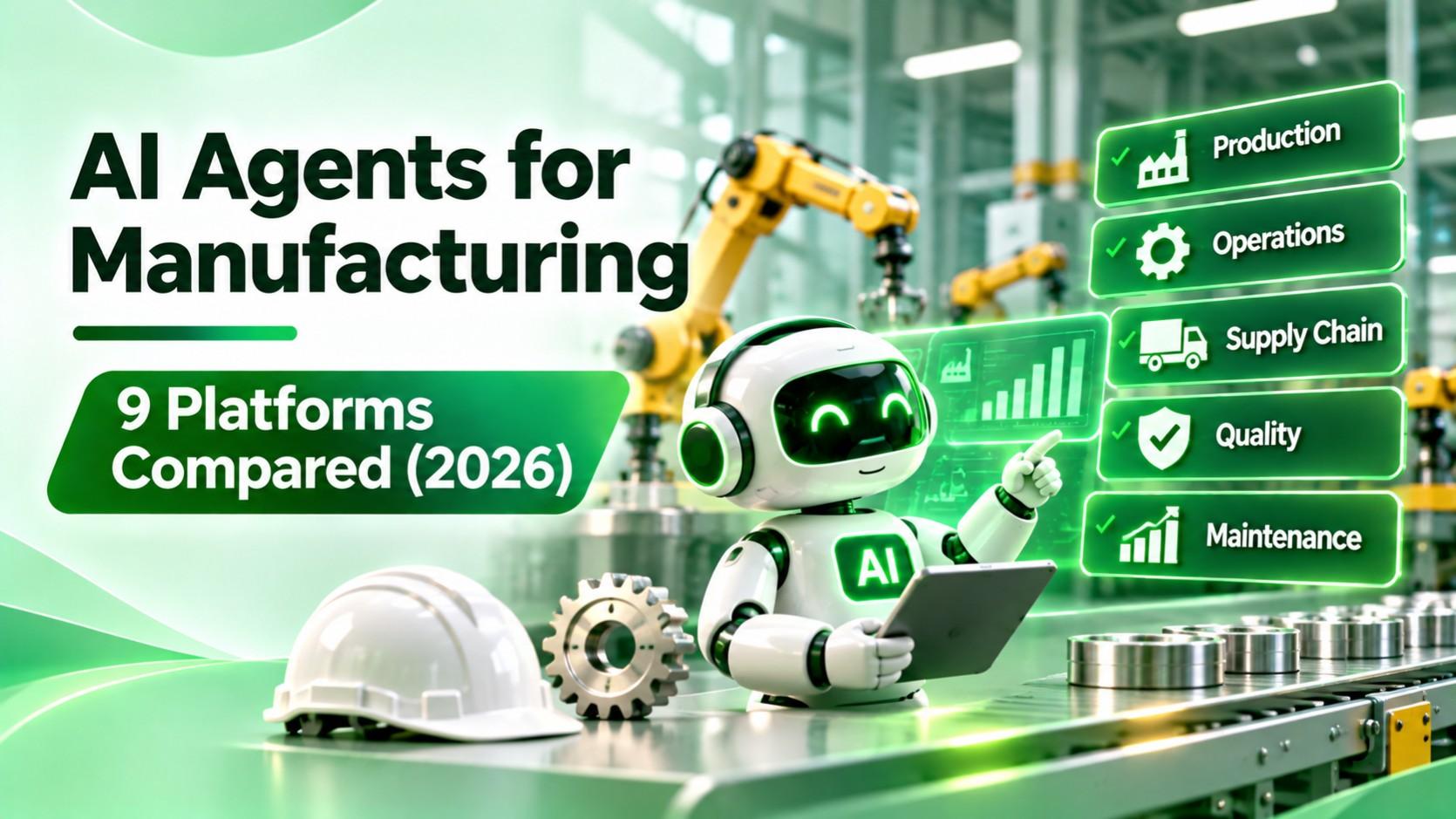
AI Agents for Manufacturing: 9 Platforms Compared (2026)
A plant produces more signals than any team can read: machine alerts, work orders, inspection records, supplier notices and shift notes. AI agents promise to read them and act. The question is which actions you let them take.
This guide compares 9 platforms that offer AI agents for manufacturing across planning, quality and maintenance. It shows how each connects to MES or ERP data and what approval model each describes.
➤ Quick answer: choose by job first. SAP, Microsoft and Siemens lean toward planning and operations; Augury and Tulip toward maintenance and floor work; MasterControl, Octave, Plex and Trail toward quality. Keep a human approver on changes to orders, product disposition or machine settings.
What AI agents for manufacturing do on the plant and in the office
An AI agent differs from a dashboard or a chatbot. It reads data, reasons about a goal, and can propose or take a step in another system. In manufacturing that covers both floor and office work.
• Planning: check material and capacity before an order is released.
• Quality: summarize deviations, trace root causes and move corrective actions along.
• Maintenance: turn a machine-health alert into a diagnosis and a draft work order.
• Supply: follow up with suppliers and flag the effect of late deliveries.
• Knowledge: answer operator questions from manuals, procedures and batch history.
Deloitte’s analysis of agentic AI in manufacturing recommends an “understand scale first” approach. That means a prioritized roadmap that accounts for cost, data, governance and workflow change before pilots multiply.
How we chose these 9 platforms
We wanted platforms that match the three jobs buyers search for: planning, quality and maintenance. Each has public material that describes agents or AI assistants for manufacturing. We compared them on four points:
• Job: the main plant task the agents address.
• MES or ERP fit: which systems the agents read from or write to.
• Approval model: what the vendor says about human confirmation.
• Maturity signal: whether the vendor labels the feature preview, beta or available.
How we tested
How we tested: no platform was installed or tested for this draft. Facts come from each vendor’s public pages and, where marked, trade summaries, read on 27 Nov 2026.
Comparison table: job, MES or ERP fit, approval model
Disclosure: LuMay publishes this guide and offers custom agent engineering and a QMS compliance agent. It is not part of this list. The 9 platforms are listed alphabetically, not ranked.
| Platform | Main job | MES or ERP fit | Approval model described |
|---|---|---|---|
| Augury | Maintenance and reliability | Pulls from CMMS, machine-health and repair history | Draft work orders and reports for review; you set thresholds and approvals |
| MasterControl | Quality events and CAPA in regulated plants | Its own quality suite and document control | AI summaries and trend flags; people own the record |
| Microsoft Dynamics 365 | Supplier follow-up and purchase order changes | Dynamics 365 Supply Chain Management | Drafted emails are reviewed before sending |
| Octave Reliance | Nonconformance, CAPA and complaints | Its own QMS; supplier and audit modules | Suggestions that users approve, change or decline (secondary source) |
| Plex (Rockwell) | In-line quality and visual inspection | Plex QMS and MES; FactoryTalk VisionAI link | Not detailed on the pages read |
| SAP | Planning, quality, diagnostics, safety | SAP S/4HANA Cloud Public Edition (planning agent) | Operator or planner confirms each action |
| Siemens | Shop-floor questions and root cause | Machine, MES and documentation data in Insights Hub | Not detailed on the pages read |
| Trail | Inspection, nonconformance, deviations, CAPA | Connects to ERP and agent platforms by MCP or API | Review and approve each rule before agents run |
| Tulip | Floor workflows, defects, downtime | Connectors to SAP, ERP, MES and QMS | Actions set as autonomous, approval-needed or off limits |
The 9 platforms, listed alphabetically
Augury
Best for: maintenance and reliability teams that want diagnosis and draft work orders.
• Augury’s Industrial AI Workforce combines machine-health monitoring with a Reliability Agent and an Operations Agent.
• The Reliability Agent pulls data from the CMMS, the machine-health platform and repair history, then drafts analyses for review.
• A machine-health alert becomes a pre-filled repair log that you approve before it enters the queue.
• Ask about: which CMMS versions are supported and who sets the thresholds.
MasterControl
Best for: regulated manufacturers that run quality events inside one validated suite.
• MasterControl says its Quality Excellence suite serves 1,100+ customers and covers quality events, documents, training and CAPA.
• Its AI features produce event summaries and deviation trend identification. A trade review lists SOP Analyzer and Event Summarizer, which draft for a person to edit.
• Ask about: whether AI features are included in your quote.
Microsoft Dynamics 365
Best for: Dynamics 365 shops that want help with supplier follow-up.
• The Supplier Communications Agent, in production-ready preview, follows up with vendors, updates purchase orders and handles change requests based on user-defined rules.
• Microsoft’s responsible-AI notes say users can review and modify drafted emails before sending.
• Microsoft Learn also points to Copilot Studio for custom agents.
• Ask about: which manufacturing tasks need a custom agent.
Octave Reliance
Best for: quality teams that run nonconformance, CAPA and complaints in one system.
• Octave’s Reliance, formerly ETQ Reliance, can launch a corrective action from a nonconformance, complaint or audit finding.
• Its 2026 release adds AI complaint summaries, similar-case matching, urgency and risk assessments, and natural-language search.
• Ask about: which AI features sit in your edition and how each is approved.
Plex (Rockwell Automation)
Best for: plants that need quality checks tied to the production line.
• Rockwell announced an API-enabled integration in August 2026 between Plex QMS and FactoryTalk Analytics VisionAI for AI visual inspection.
• A trade review also notes an AI authoring agent for work instructions and a reporting agent that users query in natural language.
• Ask about: approval steps for disposition and containment.
SAP
Best for: SAP S/4HANA plants that want agents inside planning and execution.
• SAP’s Manufacturing Assistant coordinates specialized agents for planning, nonconformance, diagnostics, material shortages and safety.
• The Production Planning and Operations Agent checks components and capacity, and releases up to 20 orders after the planner confirms.
• SAP says operators confirm each action before execution.
• Ask about: which agents are generally available for your release.
Siemens
Best for: teams that want questions and root-cause help from machine and documentation data.
• The Insights Hub Production Copilot answers questions from machine data, operations data and documentation, with root-cause analytics and recommendations.
• Siemens says manufacturers can build their own agents in Copilot Studio.
• Ask about: which actions agents may take and how approval works, since the pages read do not say.
Trail
Best for: quality teams that want agents built from their own procedures.
• Trail parses work instructions, quality specs and deviation procedures into a governed context graph. Agents then run inspection, nonconformance, deviation and CAPA steps.
• Each rule is traced to the text it came from, and you review and approve it before agents run.
• Ask about: how the agent writes back to your ERP and QMS.
Tulip
Best for: plants that want no-code agents on the floor.
• Tulip’s agent editor sets a goal, instructions and tools. Tools control access to tables and connector functions for SAP, QMS and other systems.
• Teams decide which actions an agent can take alone, which need approval and which are off limits.
• Tulip’s docs still label agents open beta. Its October 2026 release says over 40% of customers run at least one agent.
• Ask about: beta limits and your Tulip version.
Planning, scheduling and materials agents
SAP, Microsoft and Siemens sit closest to planning and operations. Their agents check material, capacity and supplier status before a human acts.
The key test is write access. An agent that recommends a reschedule is lower risk than one that releases orders. SAP’s planning agent shows the pattern: it prepares the checks, and the planner confirms.
Procurement-heavy needs are covered in our guide to AI agents for procurement. For ERP connection patterns, see enterprise integration platforms for AI, ERP and CRM.
Quality, CAPA and audit-evidence agents
Quality agents differ from planning agents in one way: the record is evidence. Anything an agent writes may be read by an auditor, so provenance matters more than speed.
Look for traceable rules, a visible reviewer, and a log of what the agent read. Octave, MasterControl, Plex and Trail all center on the quality record. Tulip and SAP also describe nonconformance workflows.
Our guide on preparing for a QMS audit with AI shows where AI helps and where judgment stays with people.
Maintenance and reliability agents
Maintenance agents work from sensor data and repair history. Augury is the clearest example in this list. Siemens and Tulip also describe diagnosis and troubleshooting.
Three questions separate strong offers from thin ones. Does the agent show its evidence? Does it write a draft or an order? Who approves before the work enters the queue?
Which factory decisions stay with a human
Not every decision needs the same control. A simple rule is to match approval to what an error would cost.
| Decision | Suggested control |
|---|---|
| Answering an operator question | Agent alone, with sources shown |
| Drafting a work order or report | Agent drafts, human approves |
| Releasing or rescheduling production orders | Planner confirms each batch |
| Dispositioning nonconforming product | Quality owner decides |
| Changing machine settings or safety limits | Human only, with change control |
| Closing a CAPA | Quality owner signs off |
➤ Illustrative example: an agent flags that a bore dimension has drifted on three lots. It drafts a hold request and links the inspection records. The quality engineer reviews the evidence and decides disposition. The agent never releases or scraps material. Details are placeholders.
The NIST AI Risk Management Framework gives neutral language for mapping, measuring and managing these risks.
When a custom agent or a QMS agent fits
Platform agents are strongest inside their own system. A custom agent fits when your workflow crosses systems, such as an ERP, a QMS, a document store and email.
Choose a custom build when no platform covers your exact process, or when you want one agent layer over several systems. Choose a platform agent when your process already lives in that vendor’s suite.
Our own product: LuMay custom agents and QMS Compliance Agents
Disclosure: LuMay publishes this article and sells the products described in this box. It is shown separately and is not ranked against the 9 platforms above.
LuMay’s QMS Compliance Agents page describes agents that work inside existing quality systems to assemble audit packages, map traceability and surface at-risk CAPAs.
Its AI engineering services and AI automation services cover custom agents and workflow automation. See also AI for supply chain.
LuMay has not published a named plant or MES deployment. Scope and costs are set per project; see pricing.
Limitations to plan for
• Many agent features are new, in preview or beta. Check status for your version.
• Vendor demos use clean data. Plant data is rarely clean.
• Agents inside one vendor’s suite do not see systems outside it.
• Safety-critical and regulated decisions need documented human control.
➤ Want help scoping a first agent for one plant workflow? Book a demo.
Sources
• Platform pages linked in the comparison table, read 27 Nov 2026.
• SAP: Production Planning and Operations Agent lesson
• Microsoft Learn: Responsible AI notes for the procurement agent
• Octave: Reliance NXG release
• Tulip: Operations Calling 2026 announcement
• Reliamag: Best QMS software for manufacturing (secondary source)
• Deloitte Insights: Agentic AI in the manufacturing industry
Tags:
Frequently Asked Questions
Everything you need to know about Engineering Services
1. What are AI agents for manufacturing?
They are software agents that read plant and business data, reason about a goal and propose or take steps such as checking materials, summarizing quality events or drafting maintenance work orders.
2. Which jobs should a plant automate first?
Start with low-risk, high-volume work: answering operator questions, drafting reports and work orders, and summarizing deviations. Add write actions later, with approval and logging.
3. How are AI agents different from MES or ERP software?
MES and ERP are systems of record that run processes. Agents sit on top, read data across systems, and recommend or perform steps inside the limits you set.
4. Do AI agents replace planners or quality engineers?
Vendors describe agents as handling investigation and preparation while people keep decisions. SAP, for example, states that operators confirm each action before execution.
5. Which decisions should always stay with a human?
Product disposition, CAPA closure, safety limits and machine setting changes. Use change control, and record who approved what and when.
6. What data do manufacturing agents need?
They need clean, current access to ERP, MES, QMS, maintenance and document data. Poor master data and unlabeled sensor data limit results more than model choice.
7. How do I evaluate an AI agent platform for a plant?
Test it on your own data and one workflow. Score accuracy, evidence shown, approval steps, write-back behavior and how it handles failed connections.
8. Are these agents ready for production?
It varies by platform and feature. Some are generally available, while others are labeled preview or beta. Ask each vendor for the status of the exact feature and release you plan to use.
9. How much do AI agents for manufacturing cost?
None of the 9 platforms publishes a price on the pages read. Costs depend on modules, sites, users and integration work. Request a written quote for your scope.
10. Can I use agents without replacing my MES or ERP?
Yes, in most cases. Agents connect through APIs, connectors or protocols such as MCP. Confirm which systems each platform supports and whether it can write back.
11. What is the difference between a platform agent and a custom agent?
A platform agent is built into one vendor’s suite and works best there. A custom agent is built for your workflow and can span several systems, at the cost of more engineering.
12. How do AI agents help with quality audits?
They can assemble records, trace specs to inspections and flag overdue CAPAs. People still judge whether evidence is sufficient and sign off on results.
About the Editorial Team
Creates insightful content on SEO, AI-powered marketing, digital growth, and emerging technologies. He simplifies complex topics into practical, research-backed guidance.