


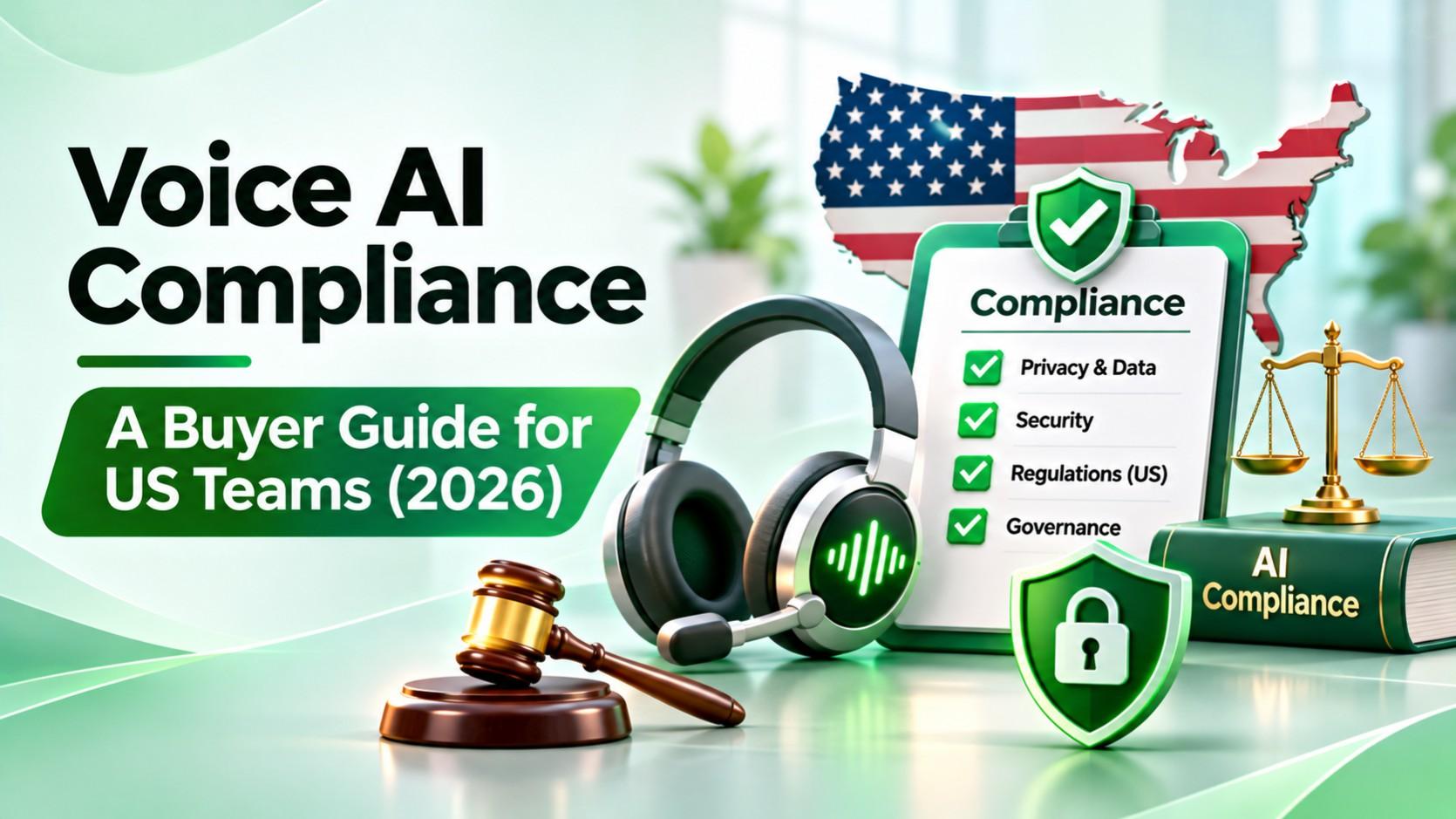
Voice AI Compliance: A Buyer Guide for US Teams (2026)
Attorney review notice: this guide is general information for buyers, not legal advice. Rules differ by state, industry and call type, and they change. Have qualified counsel review your use case before you launch a voice agent.
A voice agent can answer, record, call out, take payments and discuss health details. Each of those touches a different set of US rules, and a vendor’s feature list rarely tells you which ones apply to you.
This guide maps the main areas of voice AI compliance for US teams and tells you which deeper checklist to use for each. It frames requirements as questions to ask, not guarantees to expect.
➤ Quick answer: sort your calls first. Inbound or outbound? Recorded? Taking payments? Discussing health information? Each answer points to a separate rule set, and you need counsel and a vendor who can answer in writing. This guide links one checklist per area.
What voice AI compliance covers for US buyers
US voice compliance is not one law. It is a set of rules that attach to what the call does. A single agent may fall under several at once.
| If the agent does this | Questions to settle | Where to go next |
|---|---|---|
| Records or transcribes calls | Who must consent, and how is it disclosed? | Recording consent checklist |
| Places outbound calls | Is there prior consent, and can people opt out? | TCPA checklist |
| Takes card payments | What card data is kept out of recordings and logs? | Phone payments guide |
| Handles health information | Who is a covered entity, and who signs what? | Healthcare voice agents comparison |
Compliance is shared. The vendor’s product can help, but your company decides how it is used, what is said and what is kept. Contracts should say who does what.
How we tested
How we tested: no vendor was tested for this draft. The guide draws on public regulator and standards pages, read on 27 Nov 2026, and on four existing LuMay checklists.
Call recording consent in one-party and all-party states
Recording rules depend on where the people on the call are. Federal law is commonly described as one-party consent. Many states follow that rule, but several require every party to agree.
A number of states, including California, Florida, Illinois, Maryland, Massachusetts, New Hampshire, Pennsylvania and Washington, are commonly listed as all-party consent. Confirm the current list with counsel, since it changes and has exceptions.
A 50-state survey from Justia is a starting point for reading state rules.
Questions to ask your vendor:
• Can the agent play a recording notice at the start of every call?
• Can recording be switched off by state, number or call type?
• What happens when a caller refuses?
• Can we show proof of notice and consent later?
• Does the transcript count as a recording under our policy?
If callers can be in several states, many teams choose the stricter rule for all calls. For confidentiality duties on intake calls, see our recording and confidentiality checklist for law firms.
Outbound calling rules (and when to use the TCPA checklist)
If the agent calls people, the Telephone Consumer Protection Act (TCPA) is the first law to check.
The FCC’s declaratory ruling FCC-24-17 confirms that the TCPA’s “artificial or prerecorded voice” rules cover current AI technologies that generate human voices. Calls using them require prior express consent.
The FCC has also changed revocation rules. A final rule published on 26 October 2026 took effect on 25 November 2026. It covers how callers process requests to revoke consent, with a limit of ten business days for honoring requests made by reasonable means.
Questions to ask your vendor:
• Where is consent stored, and can we export it per number?
• Can callers opt out during the call and by other routes?
• How quickly does an opt-out reach every campaign?
• Does the agent disclose that it is an AI at the start?
• How are calling windows and suppression lists enforced?
Use our TCPA compliance checklist for AI voice agents for the full walk-through. This guide does not repeat it.
Payments on a call: what to keep out of recordings
If callers read card numbers aloud, the card data can land in audio, transcripts and logs. That widens the part of your systems that payment rules cover.
The PCI Security Standards Council publishes an information supplement on telephone-based payment card data. It is guidance, not additional rules. It covers preventing capture of spoken card data, restricting access to recordings and minimizing what is stored.
Questions to ask your vendor:
• Can card entry move out of the voice path, for example by keypad tones?
• Is card data kept out of audio, transcripts, prompts and logs?
• Who is the payment processor, and who owns the payment step?
• Can we show where card data would appear if capture failed?
Our phone payments design guide covers scope reduction and tokenization.
Health information: questions to ask, not certifications to claim
When a voice agent handles health information for a provider or plan, HIPAA may apply. HHS explains that the HIPAA Rules apply to covered entities, and that business associates are generally persons engaged to perform functions that involve protected health information.
HHS also says a covered entity may disclose that information to a business associate only with satisfactory assurances, in a contract known as a business associate agreement.
Subcontractors that handle the data for a business associate can also count as business associates. See the HHS guidance on business associates.
A badge on a vendor’s website does not settle this. Ask for the paperwork and the data flow. Questions to ask:
• Will you sign a business associate agreement, and can we read it first?
• Which subcontractors touch call audio, transcripts or model prompts?
• What health data is captured, and what is excluded?
• Who can listen to recordings, and how is access logged?
• What happens to health data when the contract ends?
For a comparison of healthcare voice agents, see our guide to HIPAA-conscious voice agents for clinics.
Retention schedules, access and deletion requests
Recordings and transcripts are records. How long you keep them should follow a schedule set with counsel, not a vendor default.
Competing needs pull in different directions. Legal holds and disputes push retention up. Privacy duties, security and cost push it down. State privacy laws may also give people rights to access or delete data; ask counsel which apply to you.
Questions to ask your vendor:
• Can we set retention by data type, state and customer segment?
• Can we place a hold on specific calls?
• How do we find and delete one person’s data across audio, transcripts and logs?
• Is deletion confirmed in writing?
• Who handles requests when the vendor is a processor for us?
Technical storage controls, such as access rules and encryption, belong in a security review. Our companion guide on AI voice agent security covers them.
A review order that links the existing checklists
Use this order so work is not repeated. Each step ends with written answers from the vendor and sign-off from counsel where noted.
1. Sort the calls: list every call type, direction, state and data type.
2. Recording: settle notice and consent, then use the recording checklist.
3. Outbound: if any calls go out, work through the TCPA checklist first.
4. Payments: decide whether card data enters the voice path at all.
5. Health data: confirm covered-entity status and contract needs with counsel.
6. Retention: set the schedule and deletion process.
7. Contract: record each answer in the agreement and the order form.
8. Re-review: repeat at renewal and whenever rules or features change.
➤ Illustrative example: a clinic plans an AI agent for appointment reminders and inbound questions. Sorting calls shows outbound reminders, recorded inbound calls and health details, so steps 2, 3 and 5 apply. Card payments are excluded by design. Details are placeholders.
Where this guide stops
• This guide is not legal advice and does not cover every state or industry.
• Rules change. Check effective dates and current text.
• A vendor feature does not equal compliance; use depends on your process.
• Global rules, such as those outside the US, are out of scope here.
Our own product: LuMay voice platform
Disclosure: LuMay publishes this article and sells the product described in this box. It is shown separately and is not ranked against any other vendor.
LuMay offers a voice agent platform, Voxentis. Its voice agent features, deployment options and platform security pages describe the product.
This article makes no compliance claim about LuMay. Use the questions above with any vendor, including LuMay, and ask for answers in writing. Costs are set per plan; see pricing.
➤ Want to walk through these questions against a live voice agent? Book a demo and bring counsel.
Sources
• FCC: FCC-24-17, TCPA and AI-generated voices
• Federal Register: Enhancing the Ability of Consumers To Control the Robocalls
• HHS: Business associates guidance
• PCI SSC: Protecting telephone-based payment card data
• Justia: Recording phone calls and conversations, 50-state survey
Tags:
Frequently Asked Questions
Everything you need to know about Voice Agent
1. What is voice AI compliance?
It is meeting the legal and contractual rules that apply to what a voice agent does, such as recording calls, calling people, taking payments or handling health data, and being able to prove it.
2. Does the TCPA apply to AI voice agents?
Yes, for calls that use AI-generated voices. In FCC-24-17 the FCC confirmed that such calls fall under the artificial or prerecorded voice rules, so prior express consent is generally required.
3. Do I need consent to record AI voice calls?
It depends on the states involved. Some require one party’s consent and others require all parties. Many teams give a recording notice on every call and ask counsel which rule applies.
4. Who is responsible for compliance, the vendor or us?
Both. The vendor controls the product and its data handling. You control how calls are used, what is said and kept, and which contracts are in place. Write the split into the agreement.
5. Are outbound AI calls allowed?
They can be, but they need a lawful basis, usually prior express consent, plus opt-out handling and calling-time controls. Use the TCPA checklist and ask counsel about your campaign.
6. How should an AI voice agent handle opt-outs?
It should recognize requests during the call and route them to your suppression list quickly. The FCC’s 2026 rule sets a ten business day limit for honoring revocations made by reasonable means.
7. Can a voice agent take credit card payments?
Yes, but design matters. Many teams keep card entry out of the voice path and out of recordings. The PCI Security Standards Council publishes guidance on telephone payments.
8. When does HIPAA apply to a voice agent?
When the agent handles protected health information for a covered entity or its business associate. HHS says a business associate agreement is the contract that gives the required assurances.
9. Does a vendor badge prove a voice agent is compliant?
No. A badge shows a point in time and a scope. Ask for the contract terms, data flow, subcontractor list and the specific features you plan to use.
10. How long should we keep call recordings?
Set a schedule with counsel based on legal holds, disputes, privacy duties and cost. Avoid vendor defaults, and confirm how deletion works across audio, transcripts and logs.
11. Do these rules apply outside the US?
Other countries have different rules, and this guide covers US buyers only. If callers are abroad, check local rules with counsel before launch.
12. Where should we start if we have no process yet?
List your call types, states and data. Then follow the review order above, starting with recording and outbound rules, and write each vendor answer into the contract.
About the Editorial Team
Creates insightful content on SEO, AI-powered marketing, digital growth, and emerging technologies. He simplifies complex topics into practical, research-backed guidance.