


AI Voice Agents for Fintech: 6 Platforms Compared (2026)
Fintech call work is about a payment, a loan, a card or an account that already exists in a modern stack. That is a different purchase from a retail-bank IVR replacement sitting on a core system.
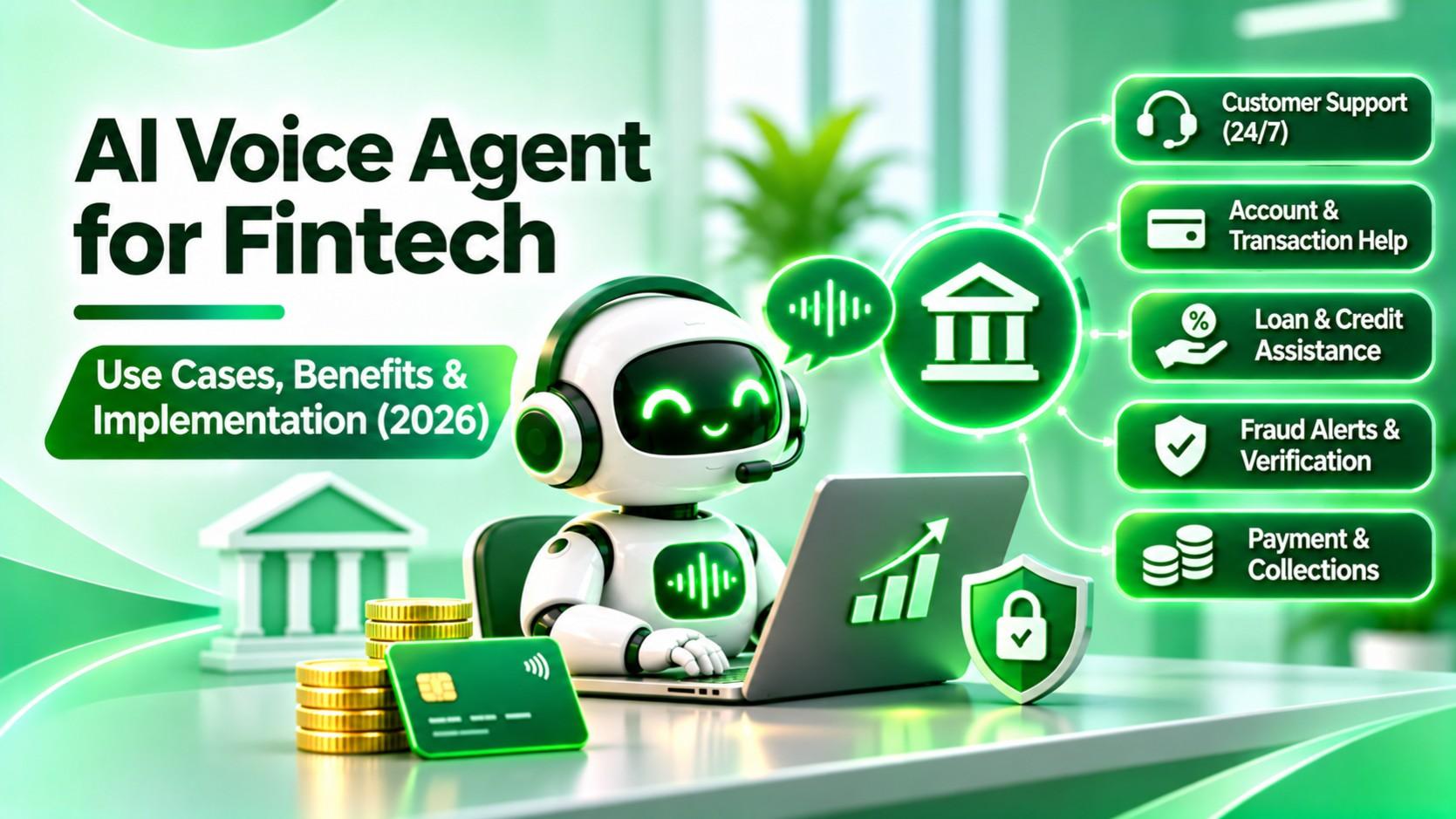
This guide compares 6 platforms that US teams consider for an AI voice agent for fintech jobs in payments, lending, cards and challenger-bank support. It is an unranked shortlist, not a bank ranking.
For core-bank IVR and retail-bank voice shortlists, use 11 Best AI Voice Agents for Banks. For a wider US vendor landscape, see top US companies offering AI voice agent solutions.
➤ Quick answer: choose the platform that can reach your ledger, card, loan or support systems, and that will hand off before it guesses at a balance, payoff or disputed charge.
Build versus buy still matters; see our 2026 build-or-buy voice strategy.
What fintech voice work actually covers
The calls that show up in a payments, lending or card operation are usually narrow and high-stakes.
• Payments: “Did my transfer go out?”, “Why was this declined?”, “Where is my payout?”
• Lending: application status, document reminders, payoff quotes and hardship routing.
• Cards: activation, travel notices, disputed charges and replacement cards.
• Challenger-bank support: account access, identity checks and exception queues, without assuming a legacy core IVR.
These jobs need identity assurance, a clean write-back to the system of record, and a human path when the caller is angry, confused or potentially at risk of fraud. Fluency is not the test.
This page does not treat those jobs as a retail-bank IVR program. If your main need is core-banking menus, start with the banks guide instead.
How this shortlist was chosen
A platform is in this list if, on 28 November 2026, its own site described an AI voice agent or voice-agent platform that a US fintech or digital-financial team could use for inbound or outbound calls.
• Six is the count because a current fintech-oriented voice guide uses a set of six, and a broader banking list already exists on this site.
• Bank-core IVR specialists that are already compared in the banks guide are left off, even if they can also serve financial services, so this page stays on a different job.
• The 6 platforms are listed alphabetically, not ranked.
Inclusion is not an endorsement of any control, consent or card-data practice. Those are buyer checks, not assumed facts.
How we tested
How we tested: no platform was installed or tested for this draft. Facts come from each vendor’s public pages, read on 28 Nov 2026.
Comparison table: delivery style, call job and buyer caution
Disclosure: LuMay publishes this guide and offers voice agents. It is not part of this list. The 6 platforms are listed alphabetically, not ranked.
| Platform | What the public page emphasizes | Likely fit for a fintech team | Buyer caution |
|---|---|---|---|
| Bland | Developer-friendly voice agents and APIs | Product and engineering teams that want to own the call logic | Confirm enterprise operations, logging and identity flows in diligence |
| ElevenLabs Agents | Conversational voice agents, including phone use cases on the Agents page | Teams that care about voice quality and will add their own workflow layer | Confirm telephony, tooling and data terms for financial calls |
| Lorikeet | Enterprise customer-support agents, including voice | Support-led fintech teams that want CX operations, not only a raw API | Confirm financial-services references and system connectors |
| Plivo | Voice agents on carrier-grade telephony, with studio and developer paths | Teams that already think in telephony, numbers and carriers | Confirm how your application logic and logs sit on top of the calls |
| Synthflow | Voice agents for contact centers and multi-location brands, with many integrations | Ops teams that want to keep existing numbers, carriers and CRMs | Confirm lending or payments connectors, not only generic CRM write-back |
| Vapi | A platform for builders to deploy and improve voice agents | Engineering-led fintech teams shipping their own agent layer | Confirm production operations, evaluation and handoff design |
The 6 platforms, listed alphabetically
Bland
Best for: fintech product and engineering teams that want API-level control of the call.
• Bland’s site, read 28 November 2026, presents voice agents with a strong developer and enterprise pitch.
• That can fit a payments or lending team that already has internal services for balances, disputes and identity.
• Limitation: you will still own conversation design, evaluation and the escalation path. An API is not a complete operating model.
ElevenLabs Agents
Best for: teams that want a strong voice layer and will supply the financial workflow around it.
• ElevenLabs’ Agents page, read 28 November 2026, describes conversational agents, including phone-oriented use.
• Voice quality matters on collections, hardship and card-fraud calls, where a robotic tone can raise tension.
• Limitation: confirm telephony, recording and data-use terms for US financial calls before a live pilot.
Lorikeet
Best for: support-led fintech teams that need an enterprise CX operation, not only a developer kit.
• Lorikeet’s site presents enterprise customer-support agents. Ask for voice plus the connectors your support stack already uses.
• Limitation: a CX platform still has to reach card, loan or ledger systems with the right permissions. Do not stop at a demo script.
Plivo
Best for: teams that already care about numbers, carriers and call reliability, and want an AI agent on that fabric.
• Plivo’s AI agents page, read 28 November 2026, describes voice agents on its telephony network, with both a studio path and a developer path.
• That is useful when number quality and call completion are already known pain points.
• Limitation: telephony strength does not automatically include your dispute or underwriting logic. You still design those actions.
Synthflow
Best for: operations teams that want to keep current numbers, carriers and contact-center tools, then add a voice agent on top.
• Synthflow’s site describes AI voice agents that answer and make calls, and it highlights integrations with phone systems and CRMs.
• For a fintech support desk, the test is whether the agent can read and write the right objects, not whether a generic CRM connector exists.
• Limitation: a large integration list can hide a missing payments or loan-servicing connector. Prove that path in a pilot.
Vapi
Best for: engineering-led teams that want to build, deploy and iterate voice agents as they ship other product work.
• Vapi’s site, read 28 November 2026, presents a platform for builders, with an emphasis on shipping and improving agents.
• That can fit a challenger or payments company with a strong internal platform team.
• Limitation: a builder platform still needs production monitoring, transcript review and a documented human handoff.
Buyer checks that are specific to payments, lending and cards
Use these checks in addition to ordinary voice-agent questions about latency, interruption handling and hours of operation.
• Identity: what must the caller prove before the agent reads or changes an account, card or loan?
• Write-back: which systems are read-only, and which actions can create a ticket, a promise-to-pay or a card block?
• Dispute and hardship: when must the call leave the agent, with context, for a trained person?
• Outbound consent: US teams should confirm consent and calling-time rules with counsel before reminder or collections campaigns. 47 U.S.C. § 227 is one starting point for telephone rules; it is not a complete compliance program.
• Recording and retention: who can hear a payment or card call later, and for how long?
• Evaluation: score identity failures, wrong balances and missed escalations, not only average handle time.
• Security review: ask vendors how they handle sensitive financial data, then verify the answers in writing. This guide does not grade those claims.
Illustrative example: a US card issuer might let an agent confirm a travel notice after identity checks, but send every dispute above a set amount to a person, with the transcript attached. That is a design sketch, not a tested result.
Security and recording questions also appear in AI Voice Agent Security and in Voice AI Compliance. Use those guides for the deeper checklists. This page stays on the fintech shortlist.
Who should skip this shortlist
Skip it if you are replacing a retail-bank IVR on a core system. Start with the banks guide.
Skip a voice rollout if identity and ledger APIs are not ready. A confident, wrong payoff quote is worse than a long hold.
Skip a vendor if it will not answer, in writing, how call audio, transcripts and account data are stored and deleted.
Our own product
LuMay is not one of the 6 platforms above and is not ranked against them.
The voice agent page, read 28 November 2026, describes inbound and outbound conversations, multiple languages, enterprise telephony integrations and configured business workflows. It also describes flexible deployment across SaaS, Azure, private cloud, hybrid and on-premises options.
That page does not, on the reading used for this draft, describe a named fintech deployment. This article does not claim any particular industry-control certification for the product.
If you want to walk through a payments, lending or card-support call flow, use the demo booking page. For current service pricing, see that page rather than this guide.
Sources
Vendor and LuMay pages below were read on 28 November 2026. The telephone-rule citation is to the current Cornell text of the statute.
• Bland
• Lorikeet
• Vapi
• 47 U.S.C. § 227 (Cornell LII)
• Best AI voice agents for banks (LuMay)
• AI voice agent security (LuMay)
Next step
If you already know the first call job, bring a flow, the identity steps you require, and the system the agent must update. Book a working session on the demo booking page.
Tags:
Frequently Asked Questions
Everything you need to know about Voice Agent
1. What is an AI voice agent for fintech, as used here?
It is software that can hold a phone conversation and then take a defined step in a payments, lending, card or challenger-bank workflow. It is not, in this guide, a retail-bank IVR replacement.
2. Why does this list leave out several well-known bank voice vendors?
Those vendors are already compared in our banks guide. This page uses a smaller set and a different job: payments, lending, cards and challenger support.
3. Can a challenger bank use the same shortlist as a payments company?
Often yes, if the systems are modern APIs rather than a legacy core IVR. The shared tests are identity, write-back and escalation. The account objects will still differ.
4. Should lending collections use the same agent as support?
Usually not at first. Collections and hardship calls have different consent, tone and escalation rules. Start with one job, then decide whether a second flow belongs on the same platform.
5. What should we test besides a fluent demo?
Test a failed identity check, a mismatched balance, a dispute, a hardship cue and a noisy line. Score whether the agent stops, hands off and leaves a usable transcript.
6. Do we need in-house engineering to use these platforms?
Builder platforms such as Bland or Vapi assume more engineering. Studio-led tools may let operations move faster, but someone still has to own integrations, evaluation and incident response.
7. How should we think about outbound notification calls?
Confirm consent, calling hours and content with counsel before you start. US telephone rules, including 47 U.S.C. § 227, may apply. This guide is not legal advice and not a complete rules map.
8. Can the agent quote a payoff or a fee?
Only if the figure comes from the system of record at the time of the call, and only if your policy allows it. If the number could be stale, hand the call to a person.
9. Where do security and recording questions belong?
Ask them in the RFP, and use our voice agent security guide for a deeper checklist. Do not treat a marketing page as the review.
10. How do we compare pricing across voice vendors?
Ask each vendor for a written model that includes telephony, minutes, numbers and overages. This guide does not invent rates. The linked page is only for LuMay service pricing.
11. Will a voice agent reduce fraud losses on its own?
Not by itself. It can follow an identity script and escalate odd patterns. Fraud results depend on your identity stack, rules and reviewers, which you should test separately.
12. Does this article certify any platform for financial-services use?
No. It compares public product positions as of 28 November 2026. It is not a certification, a control audit or a promise that a platform is fit for a particular financial product.
About the Editorial Team
Creates insightful content on SEO, AI-powered marketing, digital growth, and emerging technologies. He simplifies complex topics into practical, research-backed guidance.