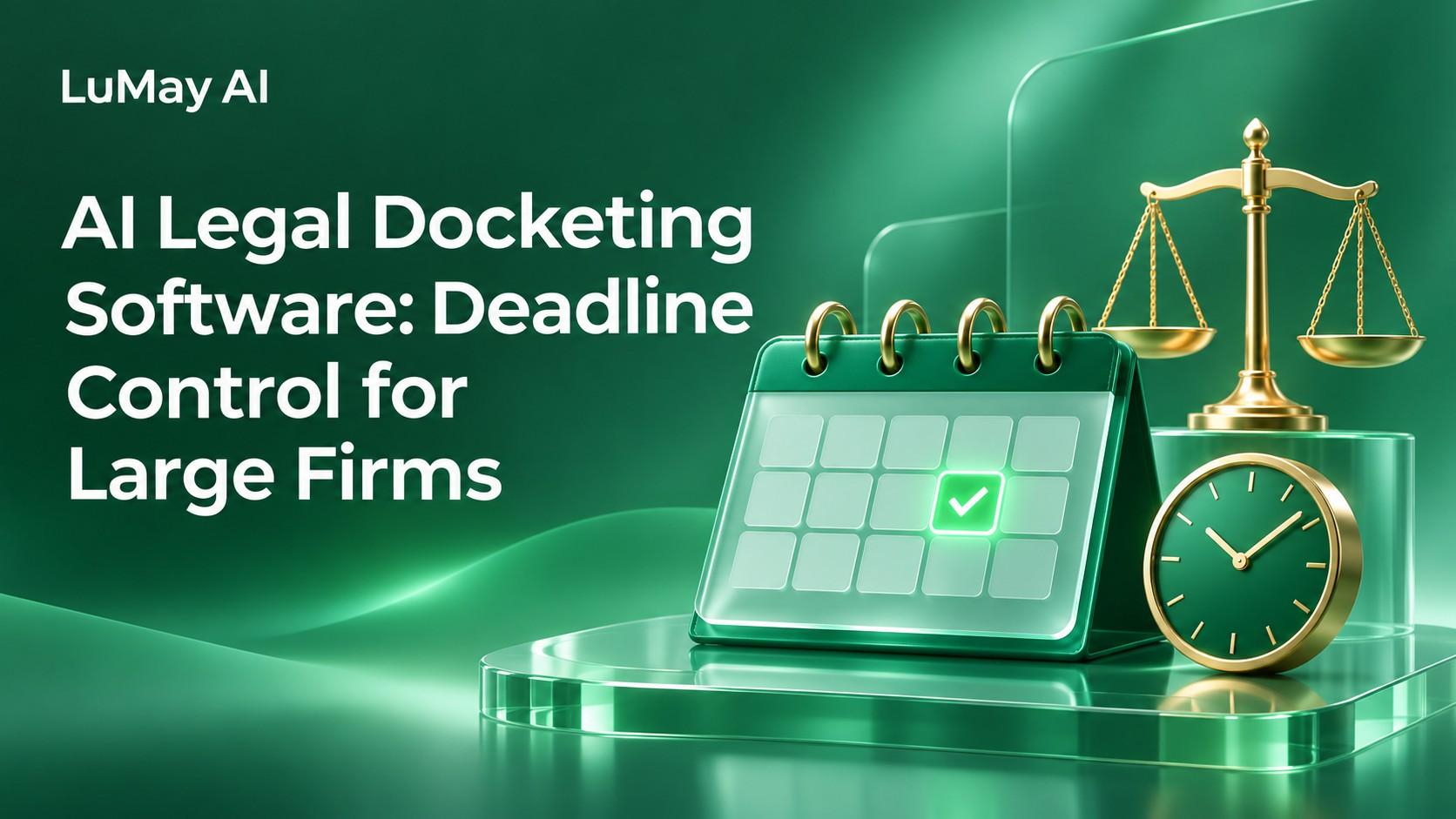
LuMay AI legal docketing cover showing an emerald deadline calendar, a clock and legal scales.
AI legal docketing software should help a firm's docketing team turn incoming notices and orders into reviewed, traceable calendar entries. For a large firm, evaluate the complete control process: source capture, matter matching, date extraction, applicable rules, human review, publication, and subsequent changes.
The most useful distinction is between identifying a date in a document and determining the deadline that governs a matter. Those tasks can use different technology and require different evidence. This guide addresses software procurement for U.S. litigation workflows; jurisdiction-specific deadline decisions remain with the responsible legal team.
Separate the four functions vendors may bundle together
| Function | What it does | What it does not establish by itself |
|---|---|---|
| Docket monitoring | Detects filings, notices, or case updates | That every relevant notice was received |
| AI extraction | Suggests events, dates, parties, or descriptions | That the suggested date governs the required action |
| Rules-based calculation | Applies configured rules to a trigger | That the selected jurisdiction, trigger, and rule are correct |
| Calendar workflow | Assigns, publishes, updates, and escalates events | That the responsible team received and acted on them |
A buyer should require a demonstration of each function included in the proposal. An impressive extraction example does not prove court coverage or change handling.
What documented products show
CourtAlert's case-management documentation describes incoming-notice reconciliation, docketing-team review, rules-based calendaring integration, and AI-assisted entry of highlighted dates and descriptions. That is a useful example of distinct capabilities within one workflow, rather than evidence that AI independently determines every deadline.
For authoritative procedural sources, start with the U.S. Courts' current Federal Rules of Civil Procedure page and the applicable court's own rules and orders. A vendor rules database should be evaluated for maintenance and traceability; it is not a substitute for determining which authority applies.
Begin with court and workflow coverage
Request a written coverage matrix for your actual practice:
- Federal, state, appellate, bankruptcy, and specialized proceedings as relevant.
- Courts, venues, judges, and local requirements the firm uses.
- Notice formats and supported delivery channels.
- Rules and calendar calculation services included in the contract.
- Update ownership, effective-date handling, and change notifications.
- Unsupported or partially supported courts.
- Manual procedures for gaps and unusual orders.
Do not rely on a headline count of jurisdictions. A large library can still omit the specific rule set or workflow a practice group needs.
Require an evidence chain for every proposed deadline
A proposed record should connect the calendar entry to its origin.
| Record element | Why it matters |
|---|---|
| Source document and version | Identifies the notice or order reviewed |
| Matter and court identifiers | Establishes the intended case |
| Source passage or page | Lets a reviewer inspect the stated event |
| Trigger and proposed date | Separates extraction from calculation |
| Rule reference and version, if used | Supports review of the calculation basis |
| Assumptions and exceptions | Makes uncertainty visible |
| Reviewer and approval time | Establishes accountability |
| Published destination and event ID | Supports reconciliation and updates |
| Superseded record, if any | Preserves the history of changes |
Store the original source according to the firm's records policy. A summary without the underlying order is difficult to investigate.
Test changes, not just initial entries
Illustrative scenario: A scheduling order is processed and several proposed events are approved. A later order changes the trial date but leaves some earlier deadlines unchanged.
Ask the supplier to demonstrate:
- Identification and correct matter matching of the new order.
- Comparison with the prior source and existing events.
- Proposed changes with reasons and supporting passages.
- Preservation of unchanged events where appropriate.
- Review of any dependent recalculation.
- Publication without duplicate entries.
- Reconciliation across connected calendars.
- A visible history of the superseded records.
Do not assume that changing one date means every related event should shift. The responsible team must determine the effect of the new authority.
Make uncertainty an owned queue
The system should have a clear route for:
- Missing or conflicting dates.
- Unclear service or filing information.
- Uncertain matter matching.
- Unsupported jurisdictions or rule sets.
- Poor scans and incomplete attachments.
- Multiple orders that appear inconsistent.
- Failed calendar publication.
- Unacknowledged assignments and absent owners.
Each exception needs a named owner, priority, and fallback. An item silently waiting in an inbox is an operational failure even when the AI correctly recognized uncertainty.
Evaluate integration and permissions
Large firms should test the connection between notice sources, matter systems, document repositories, and calendars.
Require:
- Stable event identifiers and duplicate prevention.
- Controlled write permissions.
- Retries that do not create duplicate deadlines.
- Reconciliation between approved events and destination calendars.
- Access restrictions aligned with confidential matters.
- Backup ownership when a reviewer or attorney is unavailable.
- Exportable audit history.
- An operational procedure for integration outages.
A successful API response should be followed by confirmation that the intended event exists in the destination with the correct details.
Use a pilot that can reveal consequential errors
Build an approved historical test set with known outcomes. Include straightforward orders, amendments, unusual formats, duplicates, and cases requiring manual judgment.
Suggested measures include:
- Relevant source events captured.
- Proposed events correctly matched to matters.
- Incorrect and missed proposals by severity.
- Reviewer corrections and review time.
- Exceptions still unresolved beyond the firm's agreed interval.
- Approved events correctly published.
- Changes correctly reconciled.
- Unauthorized access attempts correctly denied.
Have qualified docketing staff adjudicate the reference answers. A small test with no observed misses does not establish a universal zero-error rate.
Cost and operating responsibility
Compare proposals for court coverage, integrations, rules services, document processing, implementation, training, maintenance, support, and audit export.
Clarify who owns rule updates, exception triage, after-hours notices, integration incidents, and unresolved conflicts. A software purchase cannot make those responsibilities disappear.
Questions for a docketing-software demonstration
Q1: Can AI replace a rules engine?
A: Date extraction and rules-based calculation are different capabilities. Require evidence for each task rather than treating them as interchangeable.
Q2: Should proposed deadlines publish automatically?
A: Set approval requirements according to firm policy and risk. Demonstrate that the chosen controls are enforced.
Q3: What if the source states a fixed calendar date?
A: Preserve the wording and route it through the appropriate review process. Do not automatically treat it as a computed interval.
Q4: What should happen to duplicate notices?
A: Reconcile them to the same source event while preserving relevant receipt history.
Q5: Can an ordinary calendar replace docketing controls?
A: A calendar displays events; source review, rule maintenance, exceptions, and reconciliation require additional processes or capabilities.
Q6: How should amended orders be handled?
A: Compare affected events, propose changes, obtain required review, and preserve the superseded history.
Q7: What should the firm request about rule updates?
A: Maintenance ownership, effective dates, notifications, version history, and procedures for affected existing matters.
Q8: How should failed synchronization appear?
A: As an owned exception with evidence of what was approved, attempted, and actually published.
Q9: What data should a pilot use?
A: Approved historical or synthetic materials that represent the firm's courts, document formats, and difficult cases.
Q10: What is the strongest procurement test?
A: Follow one source through review, publication, amendment, and reconciliation, then inspect the evidence at every stage.
Before shortlisting, give each provider the same representative workflow and ask it to show both the calendar outcome and the supporting record.
About the Editorial Team
Creates insightful content on SEO, AI-powered marketing, digital growth, and emerging technologies. He simplifies complex topics into practical, research-backed guidance.