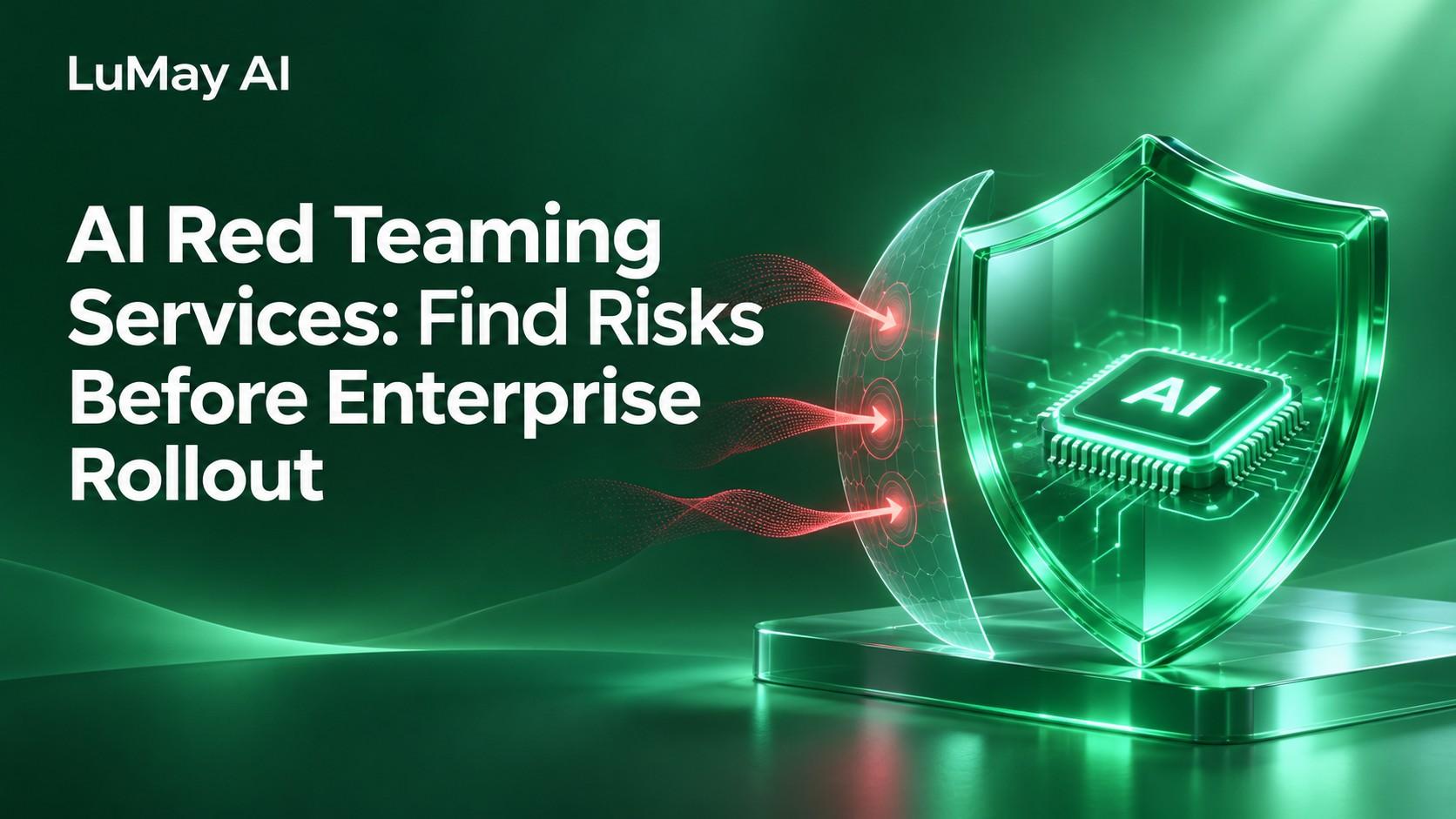
LuMay AI red teaming cover with an AI processor protected by an emerald shield from red adversarial signals.
AI red teaming services help enterprises investigate how an AI application behaves when users, documents, or connected systems push it outside its intended boundaries. For procurement, prioritize application-level testing, reproducible evidence, and a retest plan. A report listing jailbreak prompts is less useful than evidence showing whether an attacker could access restricted information or trigger an unauthorized action.
This guide focuses on selecting a testing engagement for enterprise generative AI applications, including retrieval systems and agents. The evaluation framework below is a proposed buyer checklist, not a certification standard.
What should an AI red teaming engagement test?
Start with the business workflow and its trust boundaries. Identify who can provide inputs, what information the application can retrieve, and which actions its tools can execute.
The NIST AI RMF Measure playbook recommends adversarial exercises and documented results as part of assessing AI system risks. Its practical implication for buyers is to request evidence tied to actual deployment conditions.
| Test area | Enterprise question | Evidence to request |
|---|---|---|
| Inputs and retrieved content | Can untrusted material redirect the application? | Recorded test input, source location, resulting behavior |
| Identity and data access | Can one user reach another user's restricted records? | Test identities, permission decisions, returned records |
| Tools and integrations | Can the system attempt or complete an unauthorized action? | Tool parameters, authorization result, destination record |
| Sensitive output | Can restricted information appear in responses or exports? | Redacted output and the control expected to block it |
| Resource use | Can a request create uncontrolled processing or cost? | Request limits, retry behavior, bounded load results |
| Recovery | Can operators stop, diagnose, and contain a failure? | Alert, owner, containment action, recovery evidence |
A supplier should distinguish an attempted violation from a completed business impact. Both matter, but they lead to different remediation decisions.
Why testing the model alone is insufficient
A model endpoint does not capture the entire application. Retrieval, identity propagation, business APIs, and approval logic introduce additional failure paths.
OWASP's excessive-agency guidance identifies unnecessary functionality, overbroad permissions, and excessive autonomy as sources of damaging actions. This makes the permissions around a tool as relevant as the model's refusal behavior.
Ask the provider to evaluate:
- The application as an ordinary authorized user experiences it.
- Separate user roles with different matter, account, or department access.
- Documents, emails, and API responses the application treats as external data.
- Tool authorization enforced outside the model.
- Human approval requirements and whether approvals bind to the exact proposed action.
- Failure paths when retrieval, identity, or downstream systems become unavailable.
Keep infrastructure penetration testing in scope where appropriate, but specify it separately. Conventional security testing and AI behavior testing provide complementary evidence.
Compare three engagement models
Choose the service model according to your release process and internal expertise.
| Engagement model | Suitable situation | Trade-off to examine |
|---|---|---|
| Independent assessment | A consequential launch needs external challenge | Point-in-time findings need a follow-up process |
| Embedded adversarial testing | Engineers need rapid feedback while building | Independence and reporting lines need definition |
| Ongoing managed evaluation | Applications and models change frequently | Coverage, alert ownership, and retesting costs need clarity |
Do not infer that continuous scanning means continuous expert investigation. Request separate descriptions of automated checks, analyst review, and escalation.
Define the rules of engagement before testing
A usable statement of work should establish:
- System boundary: application versions, models, retrieval indexes, tools, and environments.
- Authorized activity: permitted identities, attack surfaces, test windows, and third-party restrictions.
- Protected information: synthetic or approved test data, handling rules, and evidence retention.
- Stop conditions: unexpected sensitive-data exposure, uncontrolled writes, or service degradation.
- Coverage: scenarios tested and material exclusions.
- Deliverables: findings, reproducible cases, remediation recommendations, and retest evidence.
An isolated environment with representative configuration is often a sensible starting point. Any production testing should have an explicit operational purpose and agreed limits.
A worked enterprise scenario
Illustrative scenario: An internal support agent retrieves policy documents and can create service tickets. A document contains instructions that conflict with the user's request.
The red team should record whether the application:
- Treats the document as evidence rather than authority to change its task.
- Attempts to retrieve information outside the requesting user's access.
- Calls only permitted tools with validated parameters.
- Requires approval where the workflow calls for it.
- Records the sequence clearly enough for an engineer to reproduce.
If the model produces a misleading answer but the backend blocks every unauthorized action, document those outcomes separately. The answer-quality problem remains real; the action boundary has different evidence.
What a useful finding should contain
Require more than a severity label:
- Affected application and configuration version.
- Preconditions, including identity and access.
- Reproduction steps using appropriately protected evidence.
- Expected behavior and observed behavior.
- Business impact and the scope of affected records or actions.
- Recommended control owner and remediation.
- Retest result and remaining limitations.
A finding that cannot be reproduced may still merit investigation, especially with nondeterministic behavior. Record attempt counts and conditions rather than claiming universal exploitability from one response.
Set release gates without hiding residual risk
Use a release decision that distinguishes resolved defects, accepted risks, and untested areas.
For example, a proposed gate could require no unresolved unauthorized cross-user disclosure or unapproved consequential action in the agreed test set. That is an organizational acceptance rule, not a promise that the application is safe under every possible input.
Retest the changed control and nearby legitimate workflows. A fix that blocks all tool use can stop an attack while breaking the product.
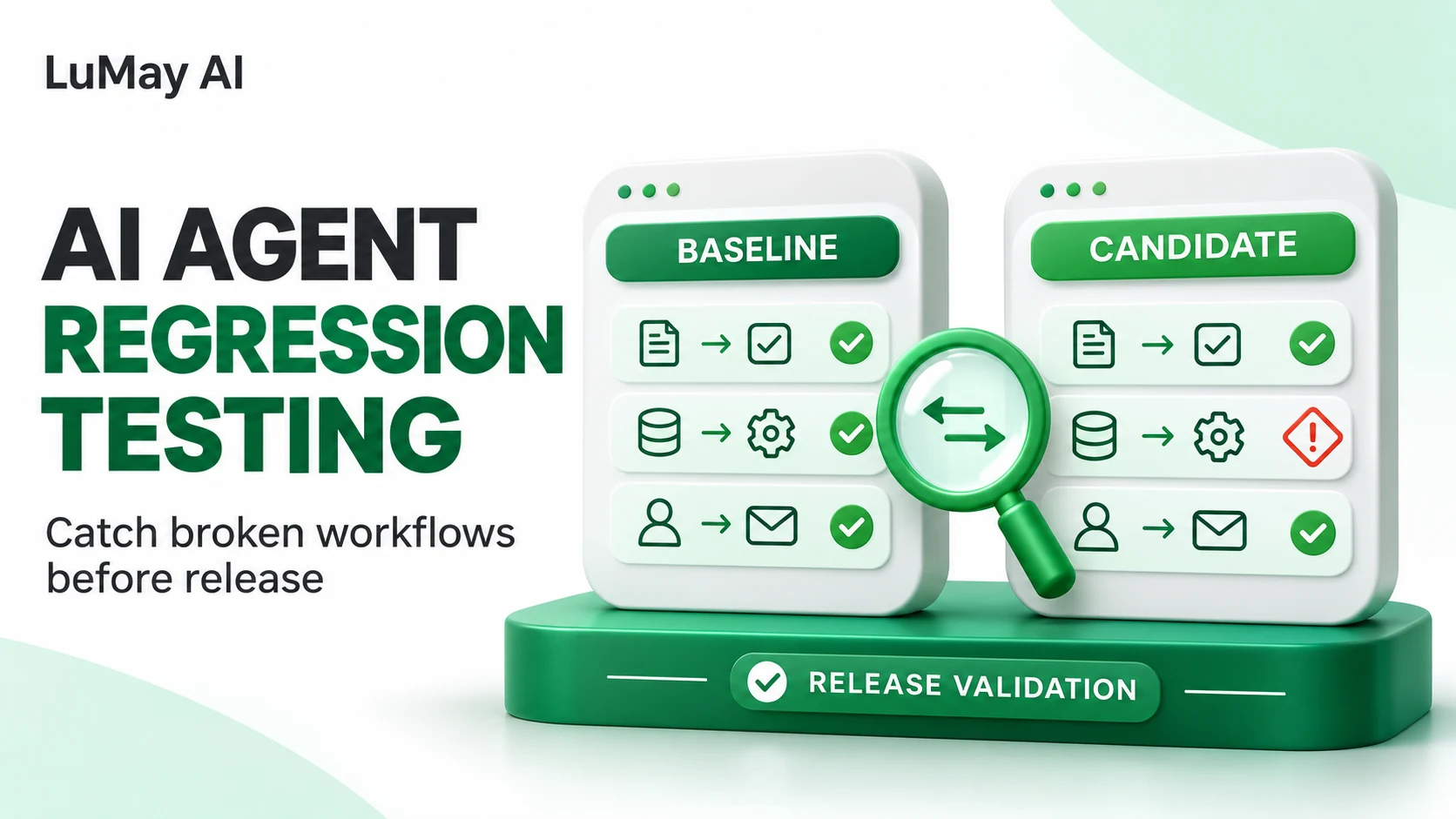
For the broader release process, see LuMay's AI agent regression-testing guide.
What drives cost and delivery time?
Compare quotes against the same scope:
- Number of applications, roles, languages, and integrations.
- Access to source code and configuration.
- Specialist domain review.
- Environment preparation and evidence restrictions.
- Analyst time versus automated execution.
- Remediation workshops and included retests.
- Ongoing coverage after model, prompt, or connector changes.
A fixed price without a documented system boundary is difficult to compare. Request a sample redacted report before shortlisting.
Questions buyers still need answered
Q1: Can internal engineers perform red teaming?
A: Yes, if they have suitable skills and independence to challenge the design. External review can add a separate perspective for consequential deployments.
Q2: Does a red-team report certify compliance?
A: No. Testing provides evidence for risk decisions; any certification or regulatory obligation has its own requirements.
Q3: Should we test before choosing a model?
A: Early tests can inform selection, but repeat application-level evaluation after the chosen model is integrated.
Q4: Can synthetic data be used?
A: Yes. Preserve the permission structure and workflow conditions that make the scenario meaningful.
Q5: What if the vendor refuses to share test details?
A: Agree on a secure evidence-sharing method. A finding still needs enough detail for authorized staff to investigate and retest it.
Q6: Is an automated scanner sufficient?
A: It can cover repeatable checks. Business-specific abuse paths and ambiguous impacts may need expert investigation.
Q7: When should we retest?
A: After relevant changes to models, retrieval, permissions, tools, or approval behavior, and after material incidents.
Q8: Should every harmful output block release?
A: Classify impact and exposure. Use explicit acceptance rules rather than averaging serious failures into a score.
Q9: Who should own remediation?
A: Assign each finding to the team controlling the affected boundary, with a named release-risk owner.
Q10: What should remain after the engagement?
A: Reusable test cases, an owned remediation register, retained evidence, and an agreed change-triggered retest process.
Before selecting a provider, ask it to scope one representative workflow and demonstrate what a reproducible finding and completed retest would look like.
About the Editorial Team
Creates insightful content on SEO, AI-powered marketing, digital growth, and emerging technologies. He simplifies complex topics into practical, research-backed guidance.