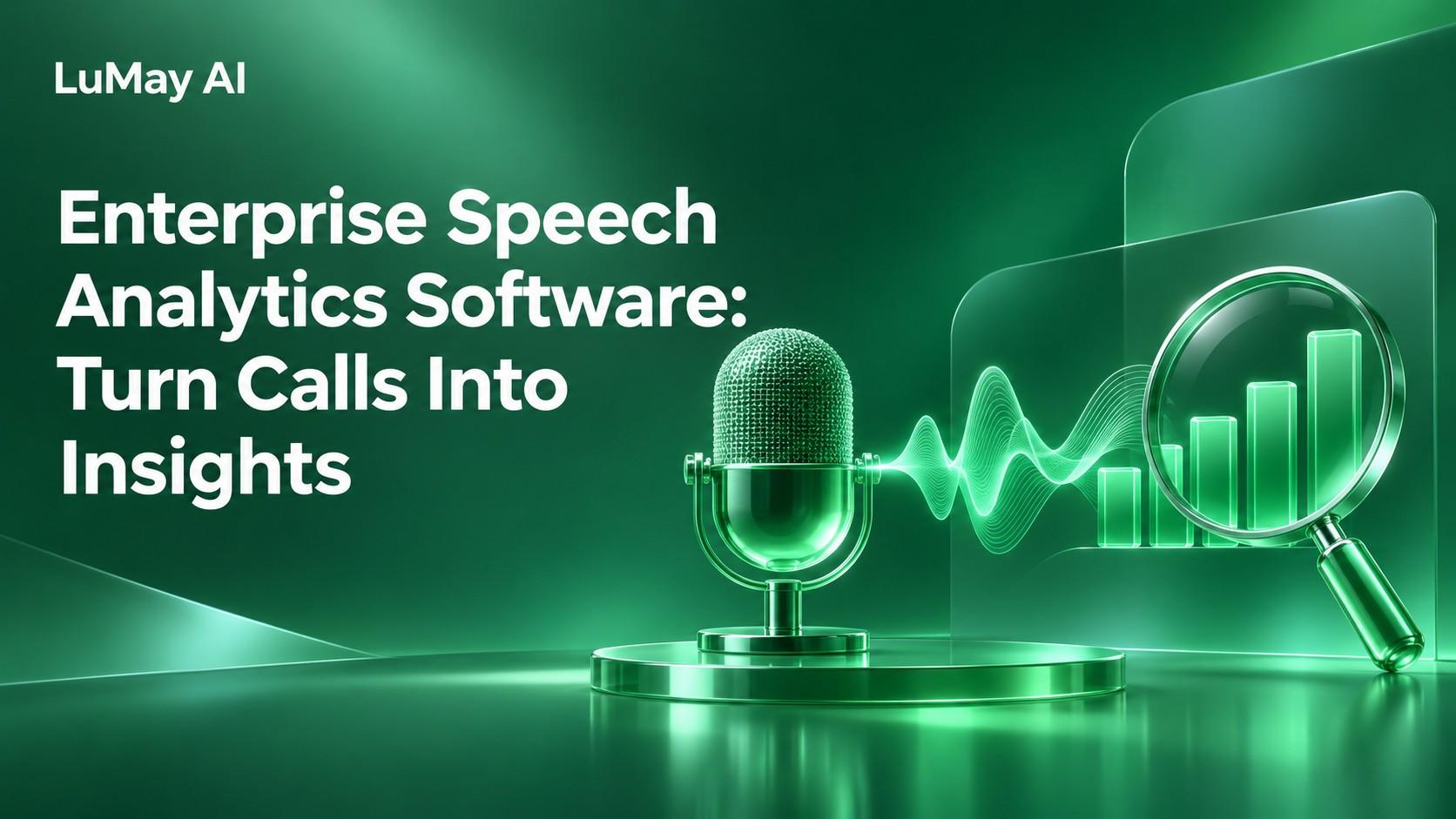
LuMay enterprise speech analytics cover showing a microphone, audio waveform and a magnifying lens over analytics bars.
Enterprise speech analytics software helps teams analyze what customers and agents say, identify recurring issues, and connect conversation evidence to operational decisions. For enterprise buyers, prioritize validated transcription, useful issue detection, traceable findings, and a workflow that assigns action to an owner.
A dashboard is useful only when reviewers can investigate the underlying evidence and the organization can act on it. Start with one question, such as why customers call again about the same billing issue, then evaluate the software against that task.
What should speech analytics do?
A proposed enterprise capability map includes:
- Convert supported call audio into usable transcripts.
- Distinguish speakers and preserve timestamps where supported.
- Categorize calls by the issues relevant to the business.
- Identify phrases, events, or patterns for review.
- Help reviewers find the supporting audio.
- Provide appropriately scoped summaries and trends.
- Connect call evidence to CRM and service outcomes.
- Control access, retention, export, and sensitive-data handling.
Amazon Connect's conversational analytics documentation describes real-time and post-call analysis, sentiment analysis, issue detection, and contact categorization. These documented categories provide a useful starting point for requirements; availability and implementation still need validation in your environment.
Separate analytics from adjacent tools
| Capability | Main task | Buyer question |
|---|---|---|
| Speech analytics | Investigate patterns and evidence in conversations | Does the finding match what happened in the call? |
| Agent assist | Give a human representative useful guidance during work | Does the suggestion arrive in time and improve the response? |
| Workforce reporting | Track staffing, queues, and handling activity | Are operational measures defined consistently? |
| Autonomous voice agent | Handle an approved conversation workflow | Did the authorized business action actually complete? |
Some suites combine these functions. Evaluate each against its own evidence rather than treating one feature demonstration as proof of the whole platform.
For the process of improving operational measures after diagnosis, see LuMay's call-center analytics workflow guide.
Decide whether you need real-time or post-call analysis
Real-time analysis is useful when someone can take an appropriate action during the interaction. Post-call analysis supports investigation, quality review, coaching, and trend discovery.
| Mode | Potential use | What to validate |
|---|---|---|
| Real-time | Alert an authorized supervisor to a defined issue | Detection delay, alert accuracy, delivery, and response ownership |
| Post-call | Investigate recurring complaints or process failures | Processing coverage, evidence access, and category accuracy |
| Both | Connect immediate intervention with longer-term improvement | Consistent identifiers, definitions, permissions, and costs |
An alert without an available owner can become noise. Define who acts, what action is appropriate, and when the alert expires.
Test transcription on your actual calls
A clean demonstration recording is not enough. Build a permitted evaluation sample covering:
- Supported languages and language switching.
- Accents and domain vocabulary.
- Background noise, poor connections, and overlapping speech.
- Transfers and multiple participants.
- Names, amounts, dates, and product identifiers.
- Short calls, long calls, and silent periods.
Measure both general transcription errors and task-critical errors. If a missed negation reverses the meaning of a complaint, a good overall word score may not capture the business consequence.
Preserve the ability for authorized reviewers to inspect audio. A transcript alone cannot establish every aspect of timing, tone, or overlap.
Validate categories with precision and recall
Create a reference set labeled by trained reviewers. Write down what counts as a match and how disagreements are resolved.
Illustrative calculation: Reviewers identify 80 true cancellation-request calls in a sample. The software flags 100 calls, of which 64 are true requests. Precision is 64/100, or 64%; recall is 64/80, or 80%.
The consequences differ:
- Low precision sends reviewers to many irrelevant calls.
- Low recall leaves relevant calls undiscovered.
- A blended score can conceal a critical missed category.
- Rare categories need deliberate testing alongside representative traffic.
Report sample construction and category definitions with the results. Do not present an enriched rare-event sample as the natural production prevalence.
Use sentiment as an investigation signal
A sentiment label is an inference, not direct access to a customer's state of mind. Validate how it behaves across your languages and call types.
Before using it in coaching or prioritization:
- Inspect the supporting conversation.
- Separate dissatisfaction with a policy from agent conduct.
- Review false positives and missed cases.
- Compare findings with service outcomes where available.
- Allow correction of consequential automated assessments.
Do not use an unexplained sentiment score as the sole basis for a material judgment about an employee or customer.
Trace privacy controls through the data lifecycle
Document where audio, transcripts, summaries, categories, and exports are stored and who can access them.
AWS's sensitive-data redaction documentation states that redaction may miss instances of sensitive data and recommends reviewing outputs. It also specifies post-disconnection redaction for voice contacts. This is a reminder to verify both effectiveness and timing in the selected product.
Ask vendors:
- Is the original recording retained alongside the redacted output?
- Which roles can access each version?
- What reaches live streams, logs, and downstream systems before redaction?
- Which languages and data types are supported?
- How are retention, deletion, and exports controlled?
- What processing locations and subprocessors apply?
- How are recording and employee-monitoring requirements addressed for the actual deployment?
Do not equate automated redaction with a complete privacy program.
Connect an insight to a business change
Illustrative workflow: Analytics identifies repeat calls about an unclear invoice adjustment.
- A reviewer confirms the category against the audio.
- CRM records establish whether those contacts concern the same issue.
- The billing owner investigates the adjustment notice.
- The team tests a revised explanation or process.
- Analysts compare repeat-contact rates for comparable cases.
- Reviewers check whether the change created confusion elsewhere.
This connects evidence, an owner, a change, and a measured result. It avoids crediting the software for improvement that has not been demonstrated.
Run a bounded enterprise pilot
Select one queue, a defined call population, a small set of categories, and an approved period. Include:
- A baseline and clear denominator for each measure.
- A reviewer-labeled reference sample.
- Category-level precision and recall.
- Audio and transcript coverage.
- Critical transcription errors.
- Review workload and time to usable findings.
- Data-access and deletion checks.
- A named business owner for corrective action.
Compare total costs for audio ingestion, analysis, storage, licenses, integration, labeling, human review, and ongoing category maintenance. Avoid transferring a vendor's advertised savings figure into your forecast.
Questions before selecting a platform
Q1: Can analytics cover every call?
A: Processing coverage depends on ingestion, configuration, language support, and failures. Measure eligible calls, processed calls, and failed calls separately.
Q2: Is transcription accuracy enough?
A: No. Validate the categories, summaries, and decisions built on the transcript.
Q3: Should we start with real-time alerts?
A: Start there only when a useful, owned intervention exists. Post-call analysis may be a simpler first step for trend investigation.
Q4: Can a missing phrase prove a disclosure was omitted?
A: Not on its own. Review transcription quality, wording variations, and the source audio.
Q5: Should summaries replace recordings?
A: Set retention according to the firm's requirements. A generated summary is not a complete evidentiary copy of the conversation.
Q6: How do we compare vendors fairly?
A: Use the same permitted call sample, reference labels, category definitions, and review method.
Q7: How should costs be compared?
A: Normalize expected volume, features, storage, seats, integrations, and human review.
Q8: Can the system identify root causes automatically?
A: It can suggest patterns. Confirm the mechanism with conversation evidence and relevant business records.
Q9: What if a category changes over time?
A: Version its definition, relabel appropriate examples, and avoid comparing incompatible periods.
Q10: What should the pilot deliver?
A: Validated findings, known limitations, controlled data handling, and evidence that an accountable team can use the results.
Shortlist the platform that helps your team move from a detected pattern to a verified, owned improvement.
About the Editorial Team
Creates insightful content on SEO, AI-powered marketing, digital growth, and emerging technologies. He simplifies complex topics into practical, research-backed guidance.