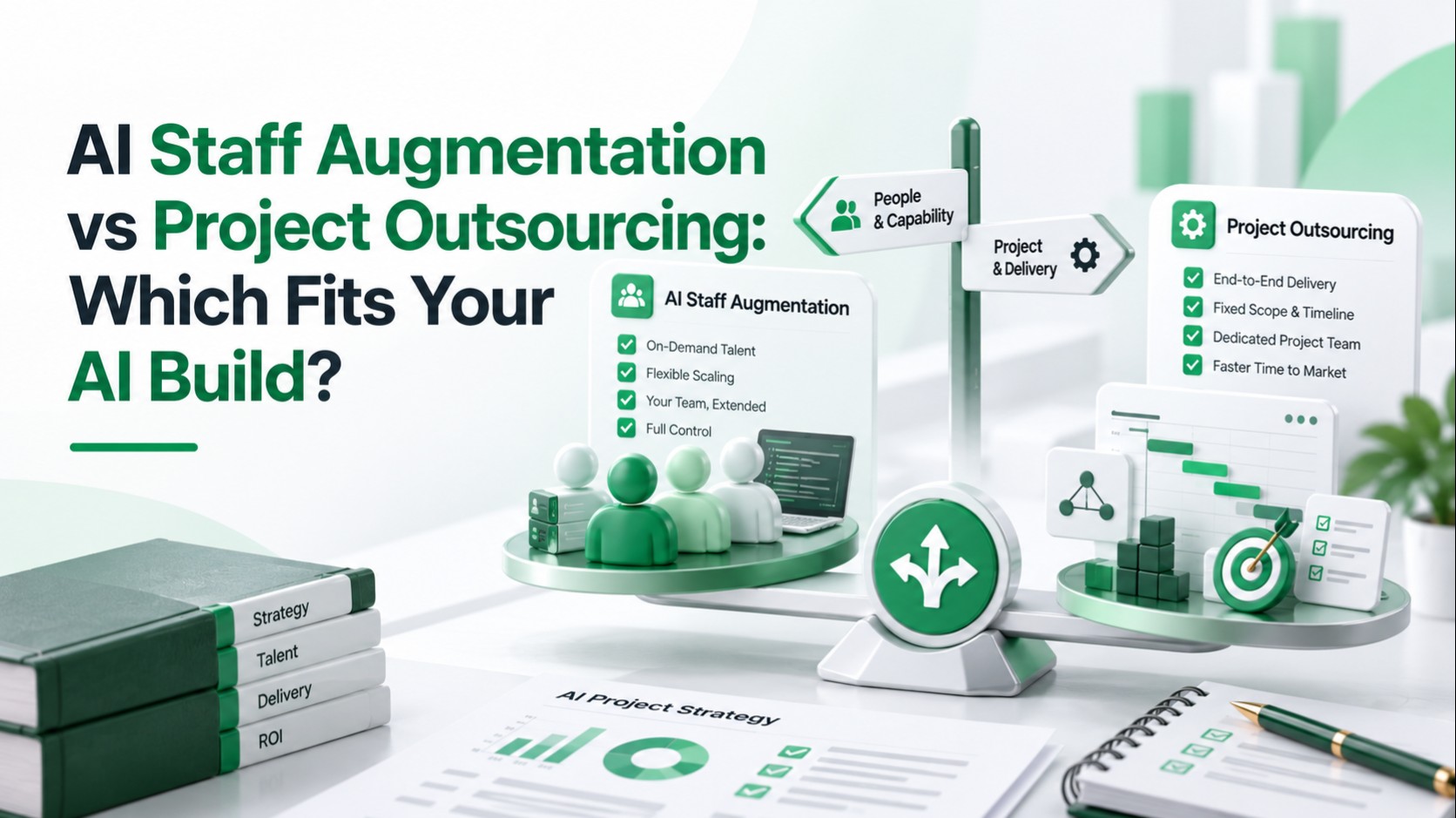
Choose AI staff augmentation when you have technical leadership and need specialist capacity inside your team. Choose project outsourcing when you need a partner to lead an agreed delivery scope.
When data, feasibility, or requirements remain uncertain, start with discovery before committing to a larger build.
Research date: October 15, 2026. The recommendations below are a decision framework, not promises about cost, speed, or outcomes.
What are you actually buying?
AI staff augmentation adds external specialists to a buyer-led engineering team. Your organization directs priorities, architecture, and delivery; the supplier provides agreed expertise and remains responsible for its contractual obligations.
AI project outsourcing assigns a defined delivery scope to a supplier-led team. The supplier manages execution within that scope, while the buyer approves requirements, provides dependencies, and accepts the result.
Keep three decisions separate:
- Capacity: Which skills and how much engineering availability do you need?
- Delivery ownership: Who plans work, resolves technical decisions, and demonstrates acceptance?
- Commercial terms: How are effort, deliverables, changes, and ongoing services charged?
A dedicated team can operate under either model. Its size or monthly invoice does not establish who owns delivery.
Outsourcing does not automatically mean fixed price. Pricing can be time-and-materials, fixed-price, or a staged combination; budget caps and milestone payment schedules are separate choices.
The UK government's agile contracting guidance describes multiple pricing approaches and cautions against rigid fixed-price commitments when uncertainty is high.
Staff augmentation vs project outsourcing: comparison
Use this table to compare proposed working arrangements. These are typical responsibility patterns, not guarantees attached to a vendor's label.
| Decision factor | AI staff augmentation | AI project outsourcing |
|---|---|---|
| Technical leadership and accountability | Buyer leads architecture, backlog, and integrated delivery; supplier supplies agreed expertise. | Supplier leads contracted delivery; buyer retains product decisions and acceptance. |
| Scope flexibility and predictability | Buyer reprioritizes directly; forecasts depend on team capacity and unresolved work. | Reprioritization follows agreed governance; predictable delivery still needs clear dependencies and acceptance. |
| Internal management capacity | Requires engineering direction, onboarding, code review, and daily coordination. | Requires less task-level direction, but active product ownership and technical oversight remain. |
| Cost and coordination | Specialist fees plus internal leadership, tools, onboarding, and replacement effort. | Delivery fees plus buyer reviews, scope changes, integration dependencies, and transition costs. |
| Data, security, and intellectual property | External contributors need controlled access and explicit rights agreements. | Supplier environments and subcontractors need scrutiny; ownership and licenses must be explicit. |
| Knowledge, maintainability, and dependence | Embedded collaboration can spread knowledge; undocumented specialist work still creates dependence. | Handover needs deliberate planning; repositories, documentation, and reproducibility determine portability. |
Neither model is inherently more secure, cheaper, or easier to maintain. Compare the actual controls, responsibilities, and exit conditions.
Why AI changes the delivery decision
Data readiness can change the work itself
A proposed knowledge assistant may depend on scanned documents, conflicting policies, or permissions that are difficult to preserve. Those conditions change extraction, retrieval, and evaluation work.
Microsoft's RAG preparation guidance emphasizes representative content and security constraints. Use LuMay's data-readiness checks for enterprise AI to expose assumptions before estimating implementation.
Identify who supplies usable data and who funds remediation. Augmented engineers cannot resolve missing business ownership, and outsourcing cannot make unavailable information usable by contract.
Experimentation needs a budget and a stopping rule
Separate experiments from production commitments. Compare a baseline, retrieval-based approaches, and model customization only where the task justifies them.
Agree what evidence each experiment should produce and when to stop, change direction, or proceed. An unsuccessful experiment can be useful discovery without constituting an acceptable production deliverable.
For LLM development and model selection, require documented tradeoffs across quality, latency, deployment constraints, and operating cost rather than a predetermined model choice.
Evaluation data is part of the deliverable
A persuasive demonstration is not an acceptance test. Build representative evaluation cases with domain experts and reserve a held-out set that is not used for tuning.
Microsoft's end-to-end RAG evaluation guidance distinguishes groundedness, correctness, completeness, and relevance. It also recommends target ranges to account for nondeterministic responses.
For your contract, specify metrics, dataset versions, scoring methods, sample coverage, and thresholds by risk category. Define critical security failures separately rather than averaging them into a quality score.
For a document assistant, test supported answers, missing-evidence refusals, citation accuracy, and preserved user permissions. Measure retrieval failures separately from generation errors so responsibility for remediation is clear.
Integration determines whether the build is usable
An agent that generates an answer and an agent that updates an ERP record have different acceptance needs. Test permissions, validation, duplicate requests, failed writes, and human escalation.
Scope integration with existing enterprise systems explicitly: name API owners, required environments, upstream dependencies, and responsibility when another team's system blocks delivery.
Launch is the start of an operating obligation
The AWS Generative AI Lens covers model selection, inference economics, monitoring, versioning, and continuous improvement across the lifecycle.
Estimate more than model API charges. Include retrieval, storage, tool calls, retries, observability, and human review, then track cost per successfully completed task.
Assign owners for quality regression, model changes, incidents, and budget overruns before launch. Neither delivery model automatically includes ongoing support.
Four hypothetical scenarios
These scenarios are illustrative, not LuMay customer stories or measured results.
Hypothetical scenario: an existing team lacks specialist AI skills
A SaaS team already owns its application, cloud environment, and release process, but lacks retrieval evaluation expertise.
Consider staff augmentation. An external specialist can work within the team's backlog while its engineering lead retains architectural decisions and release authority.
Make shared evaluations, paired reviews, and documented design decisions part of the assignment. Reconsider this model when the supposed skills gap is actually an absence of technical leadership.
Hypothetical scenario: a business needs a defined AI deliverable
An operations team needs an invoice-extraction service with an agreed schema, review workflow, and accounting-system interface. Representative documents and access approvals are available.
Consider project outsourcing. Require a supplier-led delivery plan with acceptance covering field quality, exceptions, access controls, deployment, and documentation.
The buyer still provides accounting expertise and validates business rules. A clear scope supports outsourcing; it does not require a fixed-price contract.
Hypothetical scenario: requirements are still exploratory
A founder wants an AI research assistant but has not established which users, documents, or questions it must support.
Start with bounded discovery. Commission user research, a data assessment, baseline experiments, and a feasibility recommendation rather than an unconditional production commitment.
Continue with augmentation when an internal lead can direct iteration, or a supplier-led discovery team when that leadership is missing. Decide the implementation model from the evidence.
Hypothetical scenario: a production system needs continuous improvement
A support assistant is live, but changing policies, new question types, and rising usage require ongoing evaluation and adjustment.
Consider augmentation, a managed service, or hybrid delivery. Choose according to who will own the roadmap, operational response, and improvement backlog.
When evaluating managed AI optimization and support, distinguish incident response from planned improvements. Agree service coverage, escalation, change budgets, and quality-review responsibilities separately.
Use discovery and hybrid delivery deliberately
Discovery should produce artifacts that another team can use: a scoped workflow, data findings, baseline evaluation, architecture options, dependency register, and cost assumptions.
Define a decision gate: proceed, narrow scope, remediate data, or stop. Do not make a successful discovery assessment automatically commit the buyer to implementation.
Hybrid delivery can divide responsibility by workstream. For example, an internal platform team owns identity and deployment while a supplier delivers the extraction service against an agreed interface.
Alternatively, a supplier can lead the initial build while internal engineers pair on evaluations and operations, then take responsibility after a tested handover.
Shared work must not mean unnamed accountability. Assign one decision owner for each interface, acceptance gate, incident category, and release decision.
What remains the buyer's responsibility?
Retain accountable owners for the business objective, domain decisions, permitted data use, risk acceptance, and production approval. Suppliers can support these decisions without replacing your organization's authority.
The NIST AI Risk Management Framework provides voluntary guidance for incorporating trustworthiness into AI design, development, use, and evaluation.
Control access throughout the engagement
Use named identities, least-privilege permissions, approved environments, and time-bounded access. Apply the same standards to embedded engineers and supplier-operated delivery teams.
OWASP's authorization guidance supports least privilege, explicit permission checks, and recurring permission reviews.
Specify who revokes accounts, tokens, repository access, and cloud roles at transition. Define how supplier-held data and backups are returned, deleted, or retained under approved terms.
Make ownership and handover testable
Have counsel review ownership and licensing for custom code, prompts, evaluation datasets, model adaptations, and generated artifacts. Separate these from pre-existing supplier tools and third-party components.
Source-code delivery alone is not operational independence. Require deployment configuration, dependency inventories, runbooks, evaluation instructions, known limitations, and transferable administrative access where permitted.
The UK government's technology purchasing guidance addresses explicit intellectual-property ownership and the capability needed to manage technology after specialist delivery.
Require your receiving team to deploy a clean environment, rerun evaluations, and perform a rollback using the handover package. Record gaps before accepting the transition.
Compare total cost, not just engineering rates
For augmentation, include your lead's coordination time, onboarding, review effort, and disruption from replacement personnel. For outsourcing, include specification work, acceptance testing, dependency management, and change requests.
For both, budget separately for discovery, data preparation, delivery, production operation, and exit. Use the same workload and support assumptions when comparing proposals.
A spending cap limits authorized expenditure; it does not guarantee every requested feature will fit. Agree what happens at the boundary: stop, reduce scope, or authorize additional work.
Ask what happens financially when an experiment fails, an API changes, or buyer-provided data arrives late. A lower quoted fee is not evidence of lower complete delivery cost.
Practical decision checklist
Before choosing a model, confirm:
- Leadership: A named person can make architecture and priority decisions; their availability matches the proposed model.
- Readiness: Data, access, and dependencies are understood, or a discovery phase addresses the gaps.
- Acceptance: Business outcomes, evaluation thresholds, security gates, and production tests are agreed.
- Capacity: Internal reviewers and domain experts have time allocated, not merely names on a plan.
- Continuity: Deployment, documentation, support, access revocation, and exit are funded and assigned.
When leadership and readiness are both missing, buying additional engineers is unlikely to address the full problem. Establish delivery leadership and discovery first.
Questions to ask an AI delivery vendor
Ask for written answers backed by sample artifacts, not a presentation alone:
- Acceptance: Which deliverables must pass which tests? Who approves thresholds, owns the evaluation dataset, and resolves scoring disagreements?
- Deployment: Who owns cloud accounts, repositories, pipelines, and model subscriptions? Which dependencies require licenses or supplier access after handover?
- Change control: What counts as a defect, an experiment, or new scope? How are blocked dependencies, budget limits, and reprioritization handled?
- Security: Which people and subprocessors receive data? Who approves access, verifies revocation, and documents retention or deletion?
- Handover: Which diagrams, runbooks, evaluations, and deployment instructions are delivered? Must the receiving team demonstrate independent operation before acceptance?
- Support: What coverage, response targets, escalation paths, and improvement capacity are included? Who pays for model changes and production regressions?
Choose the responsibility model before the team size
Use augmentation to strengthen a team you can lead, outsourcing to obtain supplier-led delivery, and discovery or hybrid arrangements where uncertainty or ownership requires them.
Explore LuMay's AI engineering services to discuss a scoped engagement, including delivery boundaries, evaluation, deployment, and handover.