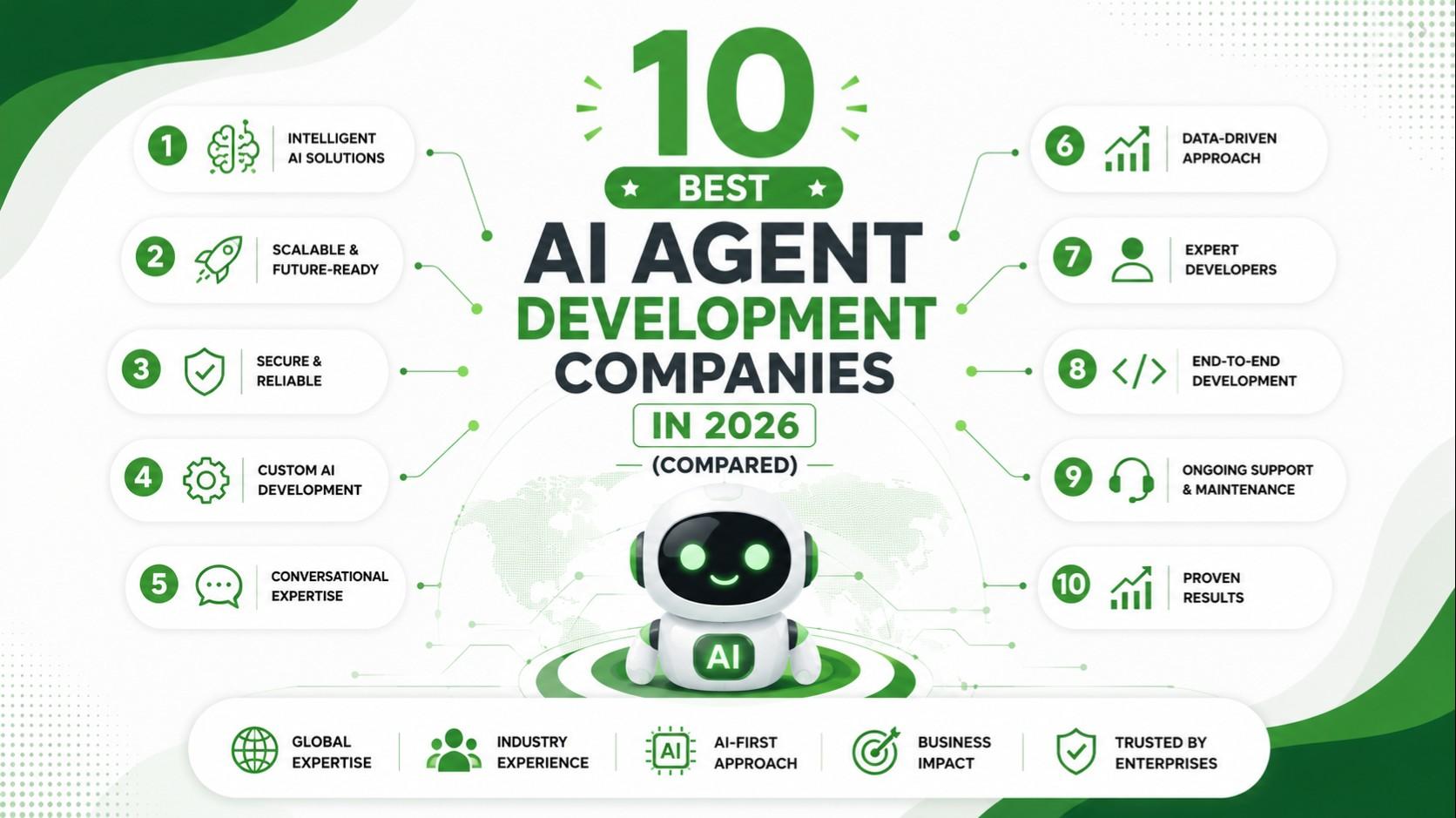
Comparison of AI agent development companies
The best AI agent development company for you is the one that can prove an agent works inside a workflow like yours, with your systems and risk limits. Pick a provider type first, then score finalists on evidence, integration, security and total cost.
This guide gives you an unranked shortlist grouped by delivery model, a weighted scorecard you can copy, and the questions that separate shipped agents from demos. Every vendor statement below is the vendor's own claim, checked on its public page on 4 November 2026.
Why Choosing an AI Agent Partner Is Harder Than It Looks
Many agent projects stall between pilot and production. Gartner predicted in June 2025 that over 40% of agentic AI projects will be canceled by the end of 2027, citing escalating costs, unclear business value or inadequate risk controls (Gartner press release).
The same release warns about “agent washing”: chatbots, assistants and RPA tools rebranded as agents without real agentic capability. Gartner estimated only about 130 of the thousands of agentic AI vendors are real. Your selection process has to filter for that.
Three questions cut through most of it:
• Has the provider shipped an agent that takes actions in a production system, not only answers questions?
• Can they show how the agent is tested, monitored and stopped when it fails?
• Will your team own the code, prompts, evaluation suite and runbooks at handover?
Four Types of AI Agent Development Companies
Most providers fall into one of four delivery models. Picking the right model first narrows a long list to three or four realistic finalists.
| Provider type | Best fit | Watch for | Typical engagement |
|---|---|---|---|
| Engineering-led specialist | Bespoke agents near a system of record, regulated or technical workflows | Small teams may not staff large programs | Discovery, proof of concept, build, handover |
| Offshore or nearshore development bench | Capacity for long programs at lower rates | Published production evidence is often thin | Dedicated team or time-and-materials |
| Platform vendor with services | Configurable agents on a product you already run | You get the vendor's agent on the vendor's surface | Subscription plus professional services |
| Global consultancy | Multi-year transformation where agents are one workstream | Transformation rates for narrow builds | Program-level statement of work |
These categories are editorial groupings for decision-making, not an industry standard. A single firm can sit in more than one group.
Unranked Shortlist by Delivery Model
The providers below appeared in a 4 November 2026 web search sample for AI agent development companies. They are listed alphabetically within the sample, not ranked. Descriptions summarize each company's own public page; we have not tested their work.
&above (engineering-led, embedded squads)
&above describes itself as an AI agent development company based in Southwark, London, building custom agents connected to CRMs, internal APIs and knowledge bases with permissions and guardrails, delivered by small senior squads (&above service page).
• Consider if: you want an embedded team building around your own business logic.
• Check: US time-zone coverage and named production references in your sector.
Azumo (nearshore development bench)
Azumo states it is San Francisco-based, builds agents with LangGraph, CrewAI and Microsoft AutoGen, and configures autonomy levels from fully autonomous for low-risk tasks to human-in-the-loop above thresholds (Azumo service page).
• Consider if: you need framework-specific engineering capacity at mid-market scale.
• Check: who owns the evaluation suite and how model changes are regression-tested.
ServiceNow with Moveworks (platform vendor)
ServiceNow completed its acquisition of Moveworks on 15 December 2025, combining its agentic workflows with Moveworks' AI assistant, enterprise search and reasoning engine (ServiceNow press release).
• Consider if: your employee-service workflows already run on ServiceNow.
• Check: whether your use case fits the platform or needs a custom build around it.
Skysecure (security-first custom agents)
Skysecure says it builds production agents with permissions, approvals, testing, monitoring and human escalation designed in, on an Azure-backed platform with Microsoft 365 and Dynamics connectors (Skysecure custom agents page).
• Consider if: you run on Microsoft 365 and need approval-controlled agents.
• Check: portability if you later move off the Microsoft stack.
Our own product
LuMay builds custom AI agents, from focused single-purpose agents to multi-agent systems coordinated by a supervisor agent. Its AI agent development services page lists strategy and consulting, proof of concept, integration with ERP, HR and support systems, testing and evaluation, and deployment and monitoring.
LuMay's stated controls include role-based access, least-privilege permissions, tool allowlists, prompt-injection protection, approval gates, spending limits and full execution logs. Deployment options listed on its pricing page include SaaS, your own cloud, on-premises and air-gapped.
We include LuMay for transparency; it is not ranked against the providers above.
How to Score AI Agent Development Companies
Use the same weighted criteria for every finalist. Ask each provider for evidence, not adjectives, and score 1 to 5 against the evidence you actually receive.
| Criterion | Weight | What good evidence looks like |
|---|---|---|
| Production evidence | 25% | A named or referenceable agent that takes actions in production, with a measured outcome |
| Integration depth | 20% | Working connectors to your ERP, CRM, ticketing or telephony, with authentication and retries |
| Security and governance | 20% | Least privilege, approval gates, audit logs, and mapping to the OWASP agentic risks |
| Evaluation and monitoring | 15% | Task-completion tests, regression suites, cost and latency dashboards |
| Ownership and handover | 10% | Code, prompts, evals and runbooks delivered into your repositories |
| Commercial fit | 10% | Clear pricing model, change-control terms, and exit provisions |
For the security row, the OWASP Top 10 for Agentic Applications 2026 is a useful checklist. It names risks such as agent goal hijack, tool misuse, identity and privilege abuse, memory poisoning and cascading failures. Ask each finalist how they mitigate each one.
For governance language your risk team will recognize, map answers to the NIST AI Risk Management Framework and its Generative AI Profile. Neither is a certification; they give you a shared vocabulary for the review.
Illustrative example: scoring three finalists
Illustrative example. A US mid-market insurer wants a claims-intake agent that reads emails, checks policy data and drafts a claim record for adjuster approval. Three hypothetical finalists score as follows.
| Criterion (weight) | Vendor A | Vendor B | Vendor C |
|---|---|---|---|
| Production evidence (25%) | 4 | 2 | 5 |
| Integration depth (20%) | 4 | 3 | 3 |
| Security and governance (20%) | 5 | 3 | 3 |
| Evaluation and monitoring (15%) | 4 | 2 | 4 |
| Ownership and handover (10%) | 5 | 4 | 2 |
| Commercial fit (10%) | 3 | 5 | 3 |
| Weighted score (out of 5) | 4.20 | 2.95 | 3.55 |
Calculation: multiply each score by its weight and add. Vendor A = 4×0.25 + 4×0.20 + 5×0.20 + 4×0.15 + 5×0.10 + 3×0.10 = 4.20. Vendor C has the strongest references but weak handover, which would lock the insurer in.
The cheapest vendor, B, finishes last because it could not show a production agent. That is the pattern the scorecard is designed to expose.
Questions to Ask Before You Sign
Send these in writing and compare answers side by side:
• Which agent you built is running in production today, and what action does it take?
• How do you decide between an agent, a copilot and fixed automation for this workflow?
• What permissions will the agent hold, and which actions need human approval?
• How do you test full task completion, tool choice and prompt-injection cases?
• What do you monitor after launch?
○ Task success rate and escalation rate
○ Latency and cost per task
○ Errors, retries and failed tool calls
• How will the agent connect to our tools? If you use the Model Context Protocol, how are servers vetted?
• What exactly do we own at handover, and how do we exit?
LuMay's AI agent development SOW guide covers how to turn these answers into contract terms.
Cost Drivers and Engagement Models
Public price lists are rare for custom agent work. Quotes depend on scope, so compare structure rather than headline numbers.
• Fixed-price proof of concept: one workflow, real data, explicit success criteria.
• Milestone or time-and-materials build: integration and hardening after the pilot passes.
• Subscription or retainer: ongoing changes, new agents, monitoring and model migration.
• Platform licensing: per-agent, per-user or usage fees on top of services.
Hidden costs usually sit in integration work, evaluation data preparation, model usage, monitoring and change requests after launch. Ask every finalist to price the first 12 months, including run costs, on the same assumptions.
If you are budgeting a LuMay engagement, its pricing page states that usage volume, integrations, data sources and your deployment and security model shape the final price.
Red Flags That Signal Agent Washing
• Demos only in a sandbox, never connected to a real system of record.
• No answer on how the agent is stopped, rolled back or kept within a spending limit.
• Accuracy or ROI figures without a client, test method or denominator.
• Every use case pitched as agentic, even stable rule-based processes.
• Code, prompts or evaluation sets that stay in the vendor's environment after handover.
For approval design specifically, see LuMay's guide to human-in-the-loop approval design for AI agents. For testing, see AI agent testing frameworks for CI/CD.
Next Step: Run a Scoped Discovery
Pick one workflow with a measurable cost, shortlist three providers from different delivery models, and send each the same written questions and scorecard. Invite the top scorer to a time-boxed proof of concept on real data.
If you want LuMay among your finalists, book an AI agent discovery session. LuMay assesses your workflow before recommending an approach, because a chatbot or fixed automation is sometimes the better fit.
Tags:
Frequently Asked Questions
Everything you need to know about Engineering Services
1. How is an AI agent different from a chatbot?
A chatbot mainly answers questions. An agent can plan steps, call tools, update records and escalate to a person. That extra capability is why agents need permissions, approval gates and monitoring that chatbots often lack.
2. Should we build with a platform vendor or a custom developer?
Use a platform when your workflow already lives on that platform and fits its agents. Choose a custom build when the agent must span several systems, follow unusual business rules or run in your own environment.
3. Are rankings of AI agent development companies reliable?
Treat them cautiously. Many lists are published by vendors that include themselves. Prefer guides that state their criteria, separate vendor claims from verified evidence and disclose affiliations.
About the Editorial Team
Creates insightful content on SEO, AI-powered marketing, digital growth, and emerging technologies. He simplifies complex topics into practical, research-backed guidance.