


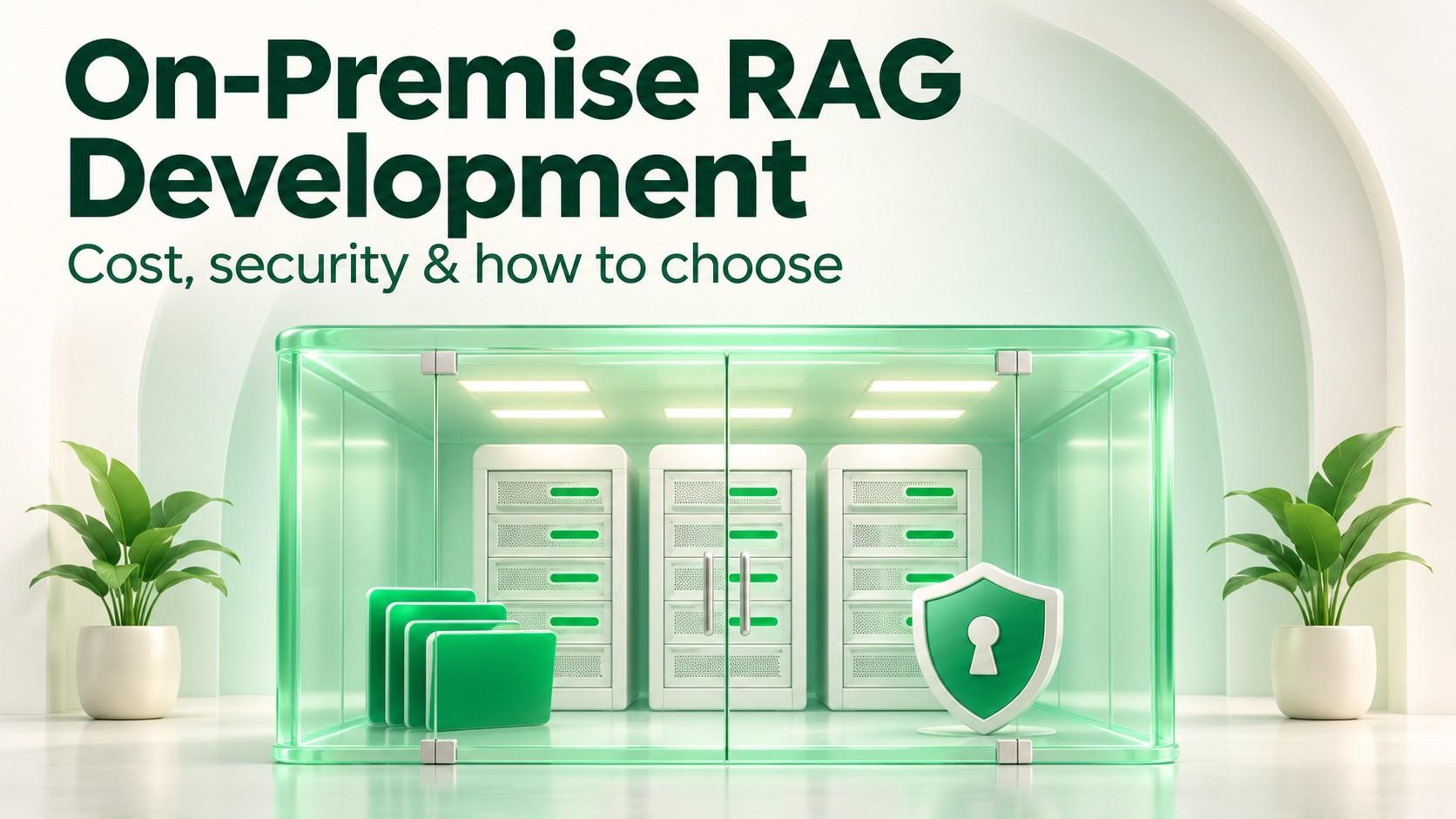
On-Premise RAG Development Companies: Cost & How to Choose
Your legal, finance or R&D teams want answers from internal documents. Your security team says nothing leaves the building. On-premise RAG is how both sides get what they need.
This guide shows how on-premise RAG development companies differ, what published prices look like, which questions expose weak vendors, and a checklist you can paste into an RFP.
➤ Quick answer: pick a company that can run every component inside your boundary, carry document permissions into retrieval, measure answer quality on your own questions, and deliver updates into a restricted network with a clear owner.
What on-premise RAG means
Retrieval-augmented generation (RAG) combines a language model with a search step over your own documents. The approach was described in the 2020 paper Retrieval-Augmented Generation for Knowledge-Intensive NLP Tasks by Lewis and colleagues.
“On-premise” means every part of that pipeline runs on infrastructure you control. That includes parsing and OCR, embeddings, reranking, the vector index, the language model and the logs.
Deployment model | Where data and models run | Typical fit |
|---|---|---|
Cloud API RAG | Vendor-hosted model APIs | Low-sensitivity content, fastest start |
Private cloud RAG | Your AWS, Azure or GCP account | Data residency inside your cloud boundary |
On-premise RAG | Your own data center or servers | Regulated data, strict security review |
Air-gapped RAG | Isolated network, no internet | Defense, sovereign or highly restricted data |
Why “on-prem” claims need checking
Many vendors say “private” when one component still calls an outside API. A single hosted embedding or OCR service can send your text outside the boundary. Ask for a component-by-component diagram.
➤ Check this: for each of parsing, OCR, embeddings, reranking, vector index, model and logging, ask where it runs and whether it ever calls an external service.
Published cost ranges from on-premise RAG vendors
Few vendors publish prices. The figures below come from their own service pages, checked on 23 November 2026. Scope, hardware and data volume change them a lot.
Company (alphabetical) | Published offer | Price | Timeline |
|---|---|---|---|
Fixed-scope private RAG PoC on your machines | $10k–$25k | About 3 weeks | |
On-premises deployment license | From $90K/yr + $75K setup | Scoped per project | |
Fixed-scope enterprise RAG build, EU jurisdiction | €45k–€120k (excl. VAT) | 8–14 weeks | |
Fixed-price private knowledge assistant | $8K–$45K | 6–8 weeks |
Hardware is usually extra. GPU servers, storage and networking can outweigh the software build for large user counts, so ask every vendor to size hardware for your expected concurrent users.
What each company emphasises
Essen Software
Essen describes fully local RAG with “zero OpenAI or Anthropic API calls” and a three-week PoC: ingestion and baseline in week one, retrieval tuning and evaluation in week two, interface and deployment in week three.
LuMay
LuMay builds RAG systems that check a user’s access permissions and retrieve only authorized sections, with citations. Published deployment options are SaaS, your cloud, on-premises and air-gapped; air-gapped starts from $150K/yr on our pricing page.
Lucrion
Lucrion sets an acceptance target up front: at least 80% factual precision on a benchmark of about 200 representative questions. It serves an open-weights model on-premise and states it is Austrian-domiciled.
Verel Systems
Verel lists on-premise deployment, quantized local models (Qwen, Mistral, Llama, 4-bit) for air-gapped environments, a written plan in 3 days, and fixed prices from $8K to $45K.
Vendor descriptions are summarised from each company’s own page and are not endorsements or rankings.
The 8-point on-premise RAG checklist
- Boundary map: every component runs inside your network, with no hidden external calls.
- Permission-aware retrieval: users only get answers from documents they can already open.
- Model choice: open-weight models matched to your languages, documents and GPU budget.
- Evaluation set: a test set built from your real questions, with an agreed target score.
- Citations: every answer links to the source passage, and the system can say “I don’t know”.
- Security testing: prompt injection, data leakage and vector-store weaknesses tested.
- Update path: how models, indexes and patches reach a restricted network, and who approves them.
- Handover: code, infrastructure definitions, runbooks and monitoring delivered to your team.
Security risks specific to RAG
The OWASP Top 10 for LLM Applications includes “Vector and Embedding Weaknesses” and “Sensitive Information Disclosure”. On-premise hosting does not remove these risks; it only changes who must manage them.
- Index only what users are allowed to see, and re-check access at query time.
- Remove retired or deleted documents from the index, not just from the file share.
- Log queries and answers so security teams can audit unusual access.
- Test whether hidden instructions inside documents can steer the model.
For a framework your risk team will recognise, map these controls to the NIST AI Risk Management Framework.
Serving models on your own hardware
Most on-premise RAG stacks run an open-weight model behind an inference server. Open-source servers such as vLLM provide high-throughput serving and an OpenAI-compatible API, which makes it easier to swap models later.
➤ Illustrative example: a 2,000-person law firm indexes its knowledge-management library on two on-site GPU servers. Answers cite the source memo, and matter-restricted documents never appear for lawyers outside the matter team. Sizes and numbers here are placeholders.
How to run a fair vendor comparison
Give every shortlisted company the same 50–200 real questions, the same document sample and the same permission rules. Score answer accuracy, citation quality, refusals when the answer is missing, and response time on your hardware.
Lucrion’s published approach, a benchmark of about 200 questions with an 80% target, is a useful pattern even if you choose another vendor. Agree the target before anyone sees the results.
RFP questions to copy
- Which components run inside our boundary, and does any of them call an outside service?
- Which open-weight models do you recommend for our languages, and what GPUs do they need?
- How do you carry source-system permissions into the index?
- How will you measure retrieval and answer quality on our questions?
- How are updates delivered into a disconnected network, and who validates them?
- What do our engineers receive at handover?
Related reading
➤ Planning a private or air-gapped RAG project? Book a session with LuMay to map your boundary, documents and evaluation set before you request quotes.
Reference architecture: the layers to price
Layer | What it does | Questions to ask |
|---|---|---|
Ingestion and parsing | Reads PDFs, Office files, scans and emails | Which formats and OCR engine? Does OCR run locally? |
Chunking and metadata | Splits documents and keeps source, date and access tags | How are tables, headings and versions handled? |
Embeddings | Turns text into vectors for search | Which open model, and how is it re-run when it changes? |
Vector index and search | Finds relevant passages, often with keyword search too | Hybrid search? How are deletions removed? |
Reranking | Orders results by relevance before the model sees them | Is a local reranker included? |
Generation model | Writes the answer with citations | Which open-weight model, on which GPUs? |
Access control | Applies user permissions to results | Synced from which identity source, and how often? |
Logging and monitoring | Records queries, answers and feedback | Where are logs stored, and who can see them? |
Total cost of ownership: what to include
- Build: discovery, pipeline development, evaluation and user interface.
- Hardware: GPU servers, storage, networking and spares, or private-cloud capacity.
- Licences: platform, vector database or support subscriptions, where used.
- Operations: monitoring, patching, model updates and index rebuilds.
- People: an internal owner, security reviews and user training.
➤ Illustrative example: a manufacturer budgets for a fixed-price build, two GPU servers, an annual support contract and a part-time internal owner. The hardware line turns out larger than the build. Figures are placeholders; ask vendors to price each line separately.
Build in-house, hire a company or use a platform?
Option | Best when | Watch out for |
|---|---|---|
Hire an on-premise RAG company | You need results in weeks and lack retrieval and MLOps skills | Handover quality and long-term support |
Build in-house | You have ML engineers and expect many RAG use cases | Time to hire and evaluation discipline |
Deploy a platform on-premises | You want a governed platform plus several use cases | Licence cost and fit with your stack |
Common reasons on-premise RAG projects stall
- Documents are scanned, duplicated or out of date, and nobody owns the clean-up.
- Permissions are not mapped, so security blocks the launch late in the project.
- GPU hardware is ordered late or sized for a demo, not for real users.
- There is no agreed test set, so quality arguments never end.
- No process exists to update models and indexes inside a closed network.
Sources
- Vendor pages linked in the cost table (checked 23 Nov 2026)
Frequently Asked Questions
Everything you need to know about Engineering Services
1. What is an on-premise RAG system?
A retrieval-augmented generation system where parsing, embeddings, search, the language model and logs all run on infrastructure you control, so documents and prompts stay inside your network.
2. How much does on-premise RAG development cost?
Published vendor prices we checked range from about $8K–$45K for fixed-price builds to €45k–€120k for larger enterprise builds. Hardware, licenses and ongoing support are often extra.
3. How long does an on-premise RAG project take?
Published timelines range from about 3 weeks for a fixed-scope PoC to 8–14 weeks for a full enterprise build. Data cleanup and security review often decide the real timeline.
4. Can RAG run completely offline or air-gapped?
Yes, if every component, including the model, embeddings and OCR, runs locally. You also need a process to deliver model and software updates into the isolated network.
5. Are local models good enough compared to cloud models?
For question-answering over your own documents, good retrieval often matters more than model size. Benchmark candidate models on your own questions before deciding.
6. How do on-premise RAG systems handle document permissions?
Strong designs copy access rules from source systems into the index and check them again at query time, so users only see answers from documents they can open.
7. What is the difference between RAG and fine-tuning?
RAG looks up your documents at question time and can cite them. Fine-tuning changes the model’s weights. RAG is usually easier to update when documents change.
8. What hardware do I need for on-premise RAG?
It depends on the model size, users and response-time targets. Ask vendors to size GPUs, memory and storage for your expected concurrent users, and to test on that hardware.
9. How do I measure RAG answer quality?
Build a test set of real questions with known correct answers and sources. Track accuracy, citation correctness and refusals when the answer is not in the documents.
10. What security risks does RAG add?
Leakage of restricted documents, poisoned or outdated content in the index, and hidden instructions inside documents. OWASP lists vector and embedding weaknesses among its top LLM risks.
11. Should I build on-premise RAG in-house or hire a company?
Hire when you need speed and lack retrieval, evaluation and MLOps skills. Build in-house when you have that team and expect many RAG use cases.
About the Editorial Team
Creates insightful content on SEO, AI-powered marketing, digital growth, and emerging technologies. He simplifies complex topics into practical, research-backed guidance.