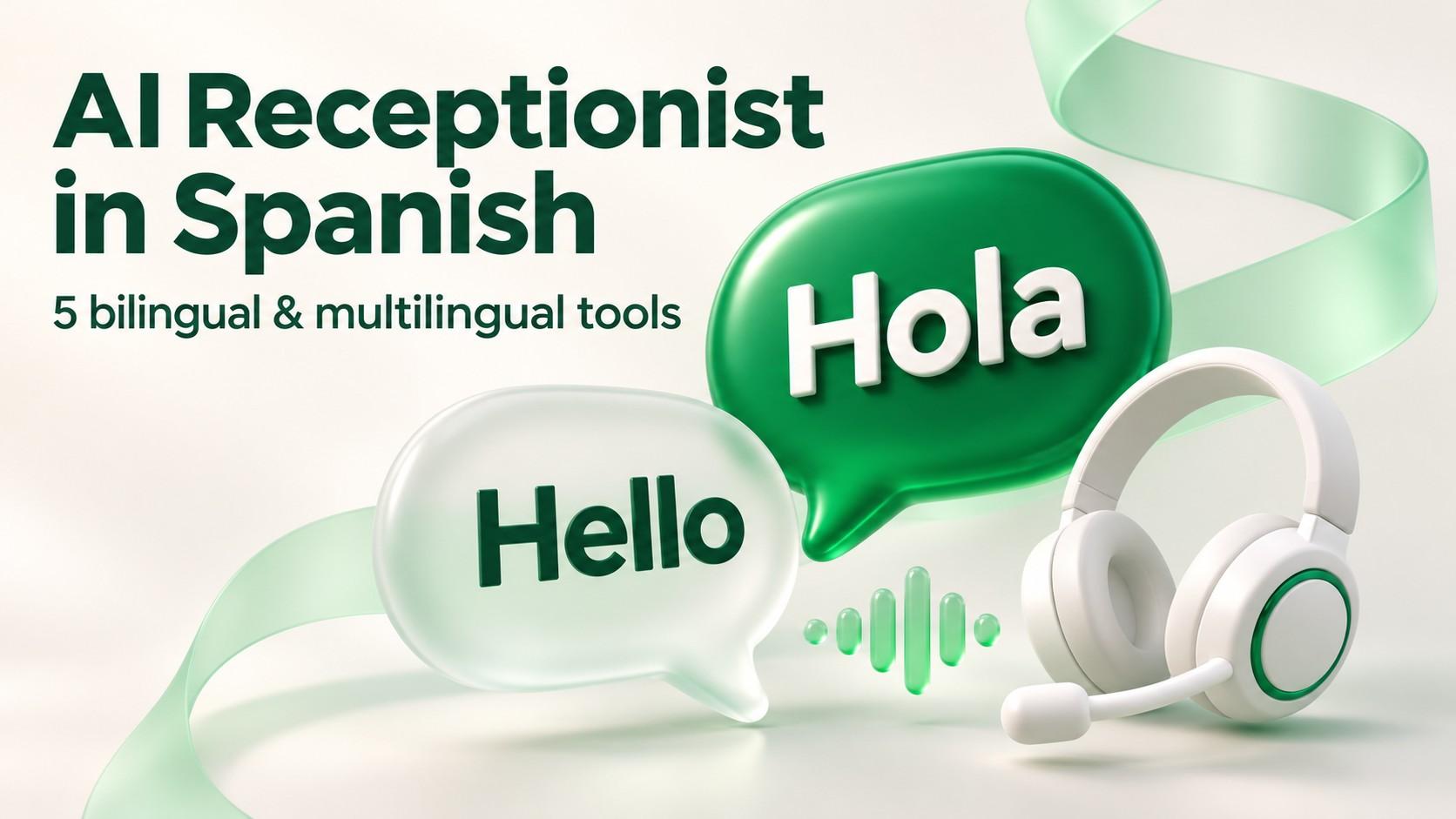
AI Receptionist in Spanish: 5 Bilingual and Multilingual Tools Compared (2026)
“¿Hablan español?” If your phone line cannot answer that question, some callers hang up before they ever reach you. A bilingual or multilingual AI receptionist answers in Spanish or English, day and night, and passes clean notes to your team.
This guide compares five multilingual AI receptionists that handle Spanish calls. It covers language detection, mid-call switching, summaries, human backup and published prices, plus a test script you can run before you buy.
➤ Quick answer: choose a receptionist that detects Spanish without menus, switches mid-call, writes summaries in your team’s language, hands callers to a bilingual human when needed, and prices fairly at your real call volume.
Disclosure: LuMay publishes this guide and its voice agent is listed. The list is alphabetical, not ranked. Facts and prices come from each vendor’s own website, checked 23 November 2026.
Why Spanish answering matters for US businesses
According to the U.S. Census Bureau, 67.8 million people in the United States spoke a language other than English at home in 2019, and Spanish was the most common of those languages, at 62%.
For law firms, clinics, home services and real estate, that is a large group of callers who may prefer to explain a problem in Spanish. A receptionist that answers only in English can quietly lose them.
Bilingual vs multilingual: what to look for
A bilingual AI receptionist handles two languages, usually English and Spanish. A multilingual one supports several. Either way, the details matter more than the label.
- Automatic detection: the caller just speaks; no “press 2 for Spanish”.
- Mid-call switching: handles callers who mix English and Spanish.
- Spanish-first greeting option: for lines where most callers speak Spanish.
- Summaries in your language: a Spanish call summarised in English for your staff, or both.
- Human backup: transfer to a bilingual person for sensitive or complex calls.
- Industry vocabulary: legal, medical or trade terms handled correctly in Spanish.
The 5 tools at a glance (alphabetical)
Tool | Spanish and language support (vendor’s own words) | Human backup | Published starting price |
|---|---|---|---|
English and Spanish, human or AI, 24/7 | Yes, US-based bilingual receptionists | From $164/mo | |
Detects language preference, switches mid-call; 25+ languages | Transfer rules you define | $249/mo incl. 500 min | |
Detects the caller’s language; 14 languages; up to 3 per line | Not stated on bilingual page | $199/mo flat | |
35+ languages; switches automatically; translates transcript | Not stated on pricing page | $24.95/mo for 30 calls | |
English and Spanish support on Starter | Not stated on pricing page | $49/mo for 250 min |
Tool profiles
Abby Connect
Abby offers bilingual answering in English and Spanish with real bilingual receptionists, a bilingual AI receptionist, or both on one plan from $164/month. It states more than 20 years of answering experience. Best for: firms wanting people and AI under one plan.
LuMay Voice Agent (Voxentis)
LuMay’s voice agent detects language preference and can switch mid-call without separate configurations, with 80+ voices across 25+ languages. It connects to CRMs and calendars and transfers by your rules. Ask about: Spanish testing for your industry terms.
NextPhone
NextPhone says its AI detects the language a caller speaks and finishes the whole call in it, with up to 3 languages per line included in the flat plan. Plans start at $199/month. Best for: small businesses wanting predictable flat pricing.
Upfirst
Upfirst lists 35+ languages, switches automatically and translates the transcript into your language. Plans start at $24.95/month for 30 calls. Best for: solo professionals and small teams with modest call volume.
Zevaux
Zevaux includes English and Spanish support on its $49/month Starter plan with 250 minutes, then $0.22 per minute. Best for: small businesses wanting low-cost bilingual answering.
Also worth a look
- Smith.ai offers a dedicated Spanish line add-on at $1.00 per call on its pricing page.
- Ruby lists 24/7 Spanish and bilingual call handling.
- Tactly answers in English or Spanish and can greet in English and switch when the caller speaks Spanish.
A 10-minute Spanish test script
Before you buy, call each trial line with a native Spanish speaker and score these points:
- Greet in English, reply in Spanish. Does it switch without a menu?
- Mix languages in one sentence. Does it keep up?
- Give a name, phone number and address in Spanish. Are they captured correctly?
- Use an industry term, such as “demanda”, “cita” or “presupuesto”. Is it understood?
- Ask for a person. Does it transfer, and to whom?
- Check the summary. Is it accurate and in the language your staff need?
➤ Illustrative example: a family-law firm in Texas sets its line to greet in English, switch to Spanish automatically, and send English summaries to paralegals. Callers asking about custody emergencies transfer straight to a bilingual staff member.
Pricing: how to compare fairly
Prices are built differently: call bundles (Upfirst), minute bundles (LuMay, Zevaux), flat plans (NextPhone) and human-plus-AI plans (Abby). Spanish calls can run longer than English ones if callers explain more, so estimate with your own call logs.
LuMay’s plans are on our voice agent pricing page and the main LuMay pricing page.
For law firms: extra checks
Legal calls carry confidential details and urgent deadlines. Ask how Spanish intake answers are stored, whether summaries are accurate enough for conflict checks, and when calls transfer to a bilingual person. See our multilingual AI receptionist questions for law firms.
➤ Want to hear your intake script answered in Spanish? Book a LuMay demo and bring a native speaker to test it live.
How to set up a Spanish AI receptionist
- Step 1 – check your call mix: estimate how many callers prefer Spanish from call notes or staff feedback.
- Step 2 – choose the greeting: English first with automatic switching, Spanish first, or a bilingual greeting.
- Step 3 – translate your script properly: use a native speaker, not word-for-word machine translation.
- Step 4 – add industry terms: list key Spanish words your callers use.
- Step 5 – set transfer rules: route sensitive Spanish calls to a bilingual staff member or service.
- Step 6 – choose summary language: English, Spanish or both, based on who reads them.
- Step 7 – review recordings weekly with a Spanish speaker for the first month.
Sample bilingual greeting
➤ Illustrative example: “Thank you for calling Rivera Law. Gracias por llamar a Rivera Law. How can I help you today? ¿En qué le puedo ayudar?” The agent continues in whichever language the caller uses.
Common mistakes with Spanish answering
- Testing only with fluent English speakers reading Spanish phrases.
- Forgetting that confirmations and reminders should also go out in Spanish.
- Sending Spanish summaries to staff who cannot read them.
- Having no bilingual person to transfer to for urgent or sensitive calls.
- Ignoring regional vocabulary and accents common in your area.
Metrics to track
Metric | Why it matters |
|---|---|
Spanish call share | Shows real demand for Spanish answering |
Spanish booking rate vs English | Reveals gaps in the Spanish experience |
Transfer rate on Spanish calls | Shows where people are still needed |
Summary accuracy (spot checks) | Confirms staff can rely on notes |
Hang-ups in the first 30 seconds | Early warning of greeting or detection problems |
Sources
- Vendor pages linked in the comparison table (checked 23 Nov 2026)
Tags:
Frequently Asked Questions
Everything you need to know about Voice Agent
1. Can an AI receptionist answer calls in Spanish?
Yes. All five tools in this guide list Spanish support. The best ones detect Spanish automatically and switch mid-call without menus.
2. What is the difference between a bilingual and a multilingual AI receptionist?
Bilingual usually means two languages, often English and Spanish. Multilingual means several. For US businesses, Spanish quality matters more than the total language count.
3. How much does a Spanish AI receptionist cost?
Published starting prices we checked range from $24.95 a month for 30 calls to $249 a month for 500 minutes. Human-plus-AI plans such as Abby start at $164 a month.
4. Can an AI receptionist switch languages mid-call?
Several can. LuMay, NextPhone and Upfirst all describe automatic language detection or switching. Test it with a native speaker who mixes English and Spanish.
5. Will call summaries be in English or Spanish?
It depends on the tool. Upfirst says it translates transcripts into your language. Ask each vendor whether summaries can be in English, Spanish or both.
6. Is an AI receptionist as good as a bilingual human receptionist?
AI is consistent and available 24/7. Humans are better with emotional or complex calls. Many businesses use AI first with transfer to a bilingual person.
7. Do I need a separate phone number for Spanish callers?
Usually not. Tools with automatic detection answer both languages on one line. Some businesses still use a dedicated Spanish line for marketing.
8. Which industries benefit most from Spanish AI receptionists?
Any business with many Spanish-speaking callers, including law firms, clinics, home services, real estate and insurance agencies.
9. How do I test Spanish quality before buying?
Call the trial line with a native speaker, mix languages, give names and addresses, use industry terms, ask for a person and check the summary.
10. Can a Spanish AI receptionist book appointments?
Yes, if it connects to your calendar. Confirm that confirmations and reminders can also go out in Spanish.
11. Is a multilingual AI receptionist safe for confidential calls?
Ask where recordings and transcripts are stored, who can access them, how long they are kept and whether data trains models. Law firms should involve their ethics counsel.
About the Editorial Team
Creates insightful content on SEO, AI-powered marketing, digital growth, and emerging technologies. He simplifies complex topics into practical, research-backed guidance.