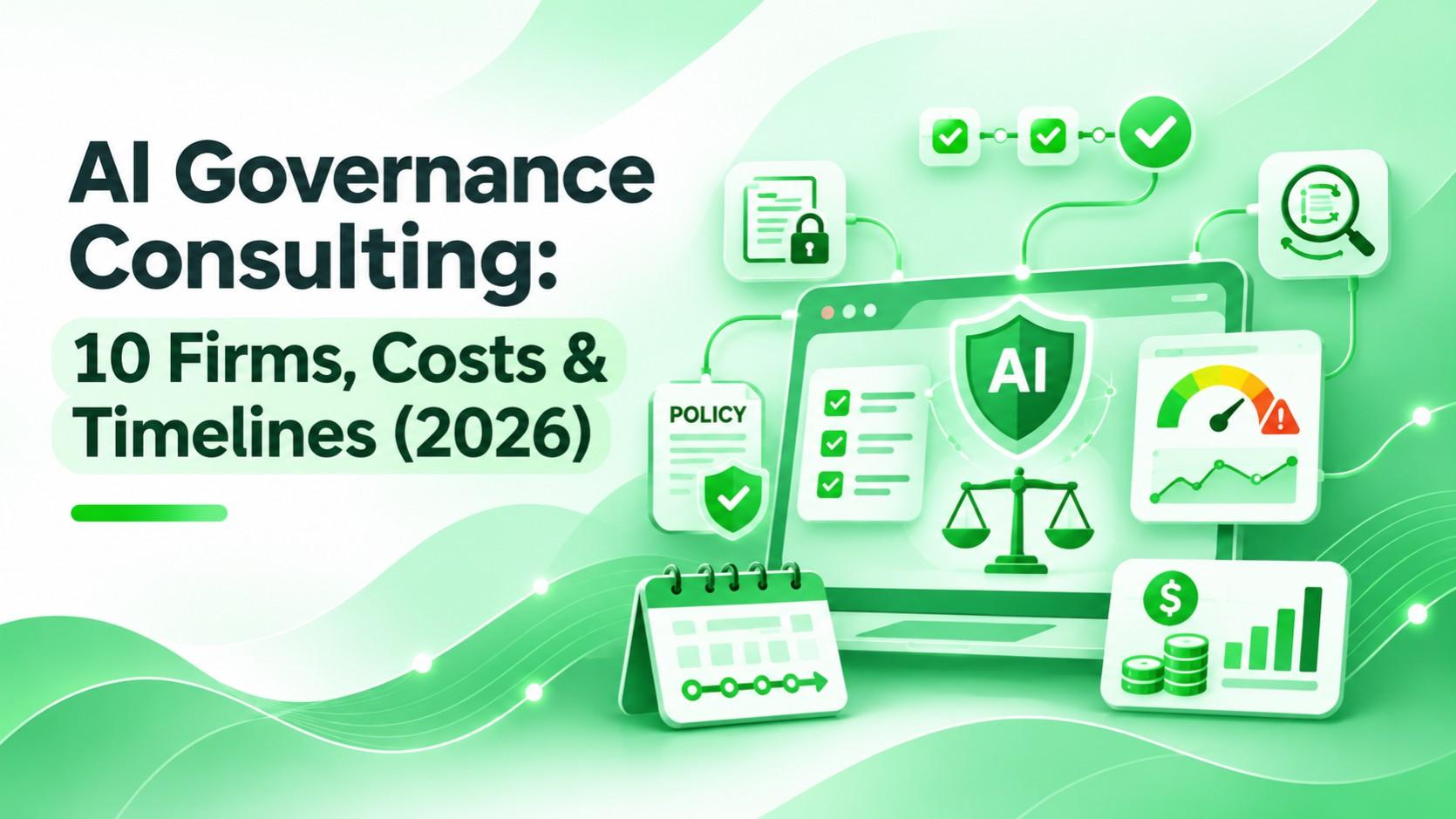
AI Governance Consulting: 10 Firms, Costs & Timelines (2026)
The EU AI Act became applicable on 2 August 2026, and auditors now ask for evidence, not intentions. A policy PDF on a shared drive no longer passes.
AI governance consulting helps you inventory AI systems, assess risk, write workable policy and install the controls that prove it. This guide shows published prices and timelines, 10 firms to evaluate and the questions that separate policy decks from real controls.
➤ Quick answer: published gap assessments start around $6,000 and run 3–6 weeks. Full programmes take about 14–16 weeks and often cost $45,000–$80,000 or more. Choose a firm that installs controls in your systems, not only documents.
What AI governance consulting covers
• AI inventory: a register of every model, tool and use case, with owners.
• Risk assessment: rating each use case against frameworks such as the NIST AI RMF.
• Policy and roles: acceptable use, approval steps, an AI committee and accountability.
• Regulatory mapping: EU AI Act risk classes, sector rules and contract terms.
• Technical controls: access limits, logging, evaluation, human approval and monitoring.
• Assurance: internal audit readiness, testing and ongoing review.
Policy work vs engineering controls
Many projects stall because policy and engineering never meet. Both are needed.
| Layer | Typical deliverables | Who usually owns it |
|---|---|---|
| Policy | AI policy, risk taxonomy, committee charter, training | Legal, risk, compliance |
| Process | Intake and approval workflow, vendor review, model register | Risk and IT governance |
| Engineering controls | Audit logs, access limits, evaluation gates, human approval, monitoring | Engineering and security |
| Assurance | Control testing, evidence packs, audit support | Internal audit or external assurer |
➤ Illustrative example: a policy says “high-risk outputs need human review”. The engineering control is an approval queue that blocks the action until a named reviewer signs off, with every decision logged.
The regulatory clock in 2026
EU AI Act
• Entered into force on 1 August 2024; applicable from 2 August 2026, with exceptions.
• Prohibited practices and AI literacy duties applied from 2 February 2025.
• GPAI obligations applied from 2 August 2025.
• Rules for certain Annex III high-risk use cases now start on 2 December 2027.
• Rules for high-risk AI in regulated products (Annex I) run to 2 August 2028.
Source: European Commission, AI Act.
NIST AI Risk Management Framework
• Released on 26 January 2023 and intended for voluntary use.
• A Generative AI Profile, NIST AI 600-1, adds GenAI-specific risks.
• The NIST AI RMF Playbook suggests actions for each function.
OECD AI Principles
The OECD AI Principles are a widely used reference for trustworthy AI policy across many countries.
Published costs for AI governance consulting
Few firms publish prices. These come from firms’ own pages, read on 24 Nov 2026.
| Engagement | Published price | Timeline | Source |
|---|---|---|---|
| Gap assessment | From $6,000 (€5,000 / £4,700), fixed fee | 3–4 weeks | Blackthorn AI |
| AI Exposure Diagnostic | $18,500 | 3 weeks | Blackbox Zero |
| Governance assessment | $15,000 flat | 4–6 weeks | Cristina Imre |
| Framework plus implementation | $45,000–$80,000 | Varies | Cristina Imre |
| Governance assessment | $25,000–$75,000 | Varies | Tillerbridge rate guide |
| Consultant hourly rate | $150–$500 | n/a | Tillerbridge rate guide |
Sequiant’s guide gives illustrative ranges: assessment $2,500–$10,000, framework $10,000–$30,000 and implementation $30,000–$100,000+.
Typical timelines
RSM publishes these durations:
| Workstream | Duration |
|---|---|
| Policy review | 1–2 weeks |
| Policy development | 2–4 weeks |
| Risk assessment | 4–6 weeks |
| Roadmap | 8–12 weeks |
| Internal audit | 8–12 weeks |
| Programme implementation | 14–16 weeks |
10 AI governance consulting firms to evaluate
Disclosure: LuMay is not listed. Firms are listed alphabetically, not ranked. Facts come from each firm’s own page, read on 24 Nov 2026.
| Firm | What its page offers | Published price or timeline | Best fit |
|---|---|---|---|
| Accenture | Responsible AI governance consulting and solutions | Quote-based | Global enterprises with large AI estates |
| Blackbox Zero | AI Exposure Diagnostic; 12-Week Governance Sprint built to NIST AI RMF | $18,500 diagnostic, 3 weeks | Teams wanting controls installed, not binders |
| Blackthorn AI | Gap assessment against ISO/IEC 42001, NIST AI RMF and the AI Act | From $6,000, 3–4 weeks | Mid-size firms needing a fixed-fee start |
| Deloitte | AI risk management and governance programme | Quote-based | Regulated enterprises and public sector |
| EY | Responsible AI services | Quote-based | Enterprises linking AI risk to assurance |
| IBM | AI ethics boards, CoEs and watsonx.governance | Quote-based | IBM or hybrid-cloud estates |
| KPMG | Trusted AI, AI system cards and AI assurance | Quote-based | Firms wanting assurance from an audit firm |
| RSM | Policy, roadmap, risk assessment and internal audit | Published durations (table above) | Middle-market companies |
| SCAND | AI governance policy development; 25+ years of software engineering | Quote-based | Teams wanting governance plus engineering |
| SGS | AI testing, impact assessment and trustworthy AI advisory | Quote-based | Buyers needing testing and certification links |
Questions that separate policy decks from real controls
• Which controls will be working in our systems at the end, not just written down?
• How will you build our AI inventory, and who keeps it current?
• Which frameworks will you map to, and why those?
• Can you show an evidence pack from a past engagement, anonymised?
• Who on your team has engineering experience with LLMs or agents?
• How do you handle third-party AI tools our staff already use?
• What will we be able to run ourselves after you leave?
Red flags
• A fixed policy template with your logo swapped in.
• No AI inventory step.
• No engineering or security people on the team.
• Promises of “certification” without naming the standard or certifying body.
• No plan for monitoring after go-live.
Build the controls into the architecture
Policies only work when systems enforce them. LuMay’s view is that AI compliance starts at architecture, not policy documents.
• Log every model call and agent action. See AI agent audit trails.
• Put people on high-risk steps with human-in-the-loop approval design.
• Compare LLM guardrail tools for input and output checks.
• Keep a data register for AI.
A 12-week governance plan
➤ Illustrative example: durations are placeholders; your scope may differ.
• Weeks 1–3: inventory AI systems and rate risk.
• Weeks 4–6: draft policy, roles and an intake workflow.
• Weeks 7–10: install logging, access limits and approval gates on the top-risk systems.
• Weeks 11–12: test controls, build the evidence pack and train owners.
How LuMay helps
LuMay is an engineering firm, not a law or audit firm. Our AI consulting services help teams turn governance decisions into working controls. Our AI governance framework resource covers the building blocks.
➤ Need governance controls built into a live AI system? Book a working session with LuMay. Engagement prices are on our pricing page.
Sources
• European Commission, AI Act regulatory framework
• NIST AI Risk Management Framework
• Firm pages linked in the tables, read 24 Nov 2026.
Tags:
Frequently Asked Questions
Everything you need to know about Engineering Services
1. What is AI governance consulting?
It is advisory and implementation work that helps an organisation inventory its AI, assess risks, set policy and roles, map regulations and install controls that prove AI is used safely and lawfully.
2. How much does AI governance consulting cost?
Published prices start around $6,000 for a fixed-fee gap assessment. Assessments often run $15,000–$75,000, and full framework plus implementation work often costs $45,000–$80,000 or more.
3. How long does an AI governance programme take?
RSM publishes 2–4 weeks for policy development, 4–6 weeks for a risk assessment and 14–16 weeks for programme implementation. Scope and the number of AI systems change these figures.
4. Do we need AI governance if we only use third-party AI tools?
Usually, yes. You still decide what data goes in, who may use the tools and how outputs are checked. Many EU AI Act duties fall on deployers, not only developers.
5. When does the EU AI Act apply?
It entered into force on 1 August 2024 and became applicable on 2 August 2026, with exceptions. Some high-risk rules now start on 2 December 2027 or 2 August 2028.
6. Is the NIST AI RMF mandatory?
No. NIST says the framework is intended for voluntary use. Many organisations adopt it anyway because it gives a clear structure and maps well to other frameworks.
7. What is ISO/IEC 42001?
It is an international standard for AI management systems. Some consultancies, such as Blackthorn AI, assess organisations against it alongside the NIST AI RMF and the EU AI Act.
8. Should we hire a Big Four firm or a boutique?
Big firms suit large, multi-country programmes with audit links. Boutiques often publish fixed prices and move faster. Compare on deliverables, named staff and evidence of installed controls.
9. What should an AI governance consultant deliver?
An AI inventory, risk ratings, policy and roles, an intake workflow, working technical controls, an evidence pack and training. Ask which of these you can maintain yourself afterwards.
10. How is AI governance different from data governance?
Data governance controls data quality, access and lineage. AI governance adds model risk, output checks, human oversight, transparency and the rules for when AI may act.
11. Can governance be added after an AI system is live?
It can, but it is harder and costlier. Retrofitting logging, access limits and approvals often means rework. Plan controls into the design from the start where you can.
About the Editorial Team
Creates insightful content on SEO, AI-powered marketing, digital growth, and emerging technologies. He simplifies complex topics into practical, research-backed guidance.