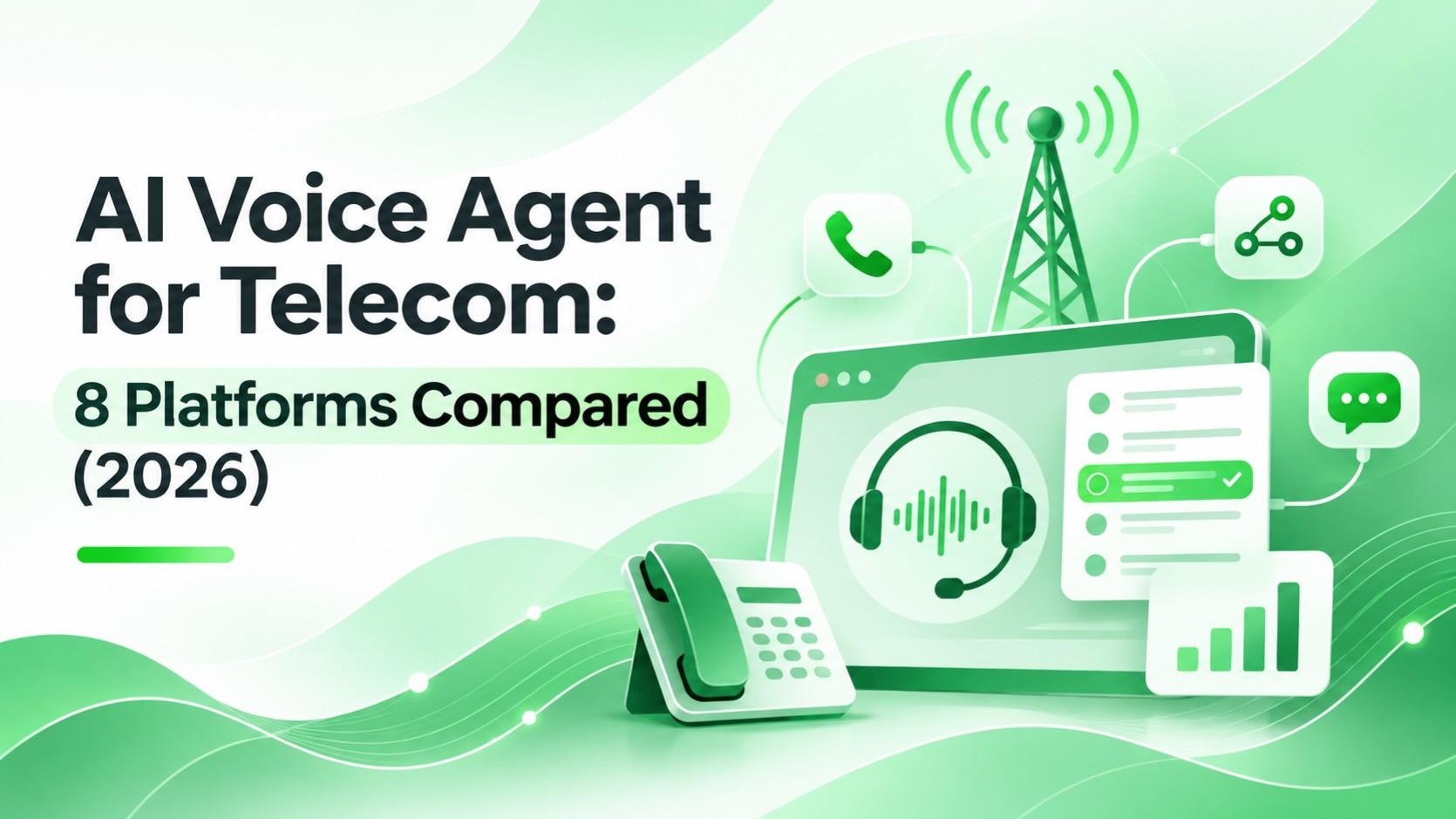
AI Voice Agent for Telecom: 8 Platforms Compared (2026)
When a fibre cut takes out a town, thousands of subscribers call at once. Queues explode, hold times hit 20 minutes and some of those callers start shopping for a new provider.
An AI voice agent for telecom answers every call at once, confirms the outage, handles billing and plan changes, verifies the caller and passes hard cases to staff. This guide compares 8 platforms and the telecom-specific checks that matter.
➤ Quick answer: choose a platform that connects to your BSS/OSS, billing and CRM so it can act, not just talk; scales for outage spikes; verifies callers in line with CPNI rules; and hands off with full context.
What telecom AI voice agents handle
| Call type | What the agent does | Systems needed |
|---|---|---|
| Outage calls | Detects the area outage and gives status and restore time | OSS / network status |
| Billing questions | Explains charges, takes payments, sets up plans | Billing (BSS) |
| Plan changes and add-ons | Changes tariffs and adds bolt-ons | BSS, CRM |
| Technical support | Runs basic troubleshooting, opens tickets | Ticketing, OSS |
| SIM swaps and activations | Verifies identity, activates SIMs | Provisioning, CRM |
| Retention | Routes subscribers who want to leave to the retention team with the reason | CRM |
| Collections and reminders | Outbound late-payment and bill reminders | Billing, dialler |
CBOT puts it simply: a handful of intents drive the overwhelming majority of contact-centre volume in telecom, and they repeat every minute of every day.
Why telecom is different
Outage surges
Volume can jump many times in minutes. ElevenLabs describes containing inbound call spikes during incidents to maintain SLAs.
Agents must act, not just answer
CBOT notes that once connected to billing, CRM and provisioning, an agent can take payments, change tariffs, add bolt-ons, activate SIMs and open tickets.
Strict caller verification
US carriers must protect customer proprietary network information (CPNI) under 47 U.S.C. § 222. The FCC rules in 47 CFR Part 64, Subpart U set authentication duties.
• Authentication may not rely on readily available biographical or account information, with limited exceptions.
• Wireless (CMRS) providers must use secure methods to authenticate customers before executing a SIM change request.
• The rules also require customer notification of SIM change requests.
8 AI voice agent platforms for telecom compared
Disclosure: LuMay offers a voice agent and is not included in this list. Platforms are listed alphabetically, not ranked. Facts come from each vendor’s own page, read on 24 Nov 2026.
| Platform | Telecom strengths on its site | Integrations named | Pricing signal |
|---|---|---|---|
| CBOT | Billing, faults, plan changes, SIM swaps, late-payment calls | Billing, CRM, provisioning, ticketing | Quote-based |
| Dograh | Open source (BSD-2); can self-host on your own network | Asterisk ARI and open-source PBXs | No per-minute platform fee when self-hosted |
| ElevenLabs | Billing, plan changes, outage updates; sub-100 ms latency; 32+ languages | BSS, OSS and CCaaS | Quote-based |
| Parloa | Enterprise customer service AI agents across the agent lifecycle | Enterprise contact-centre stacks | Quote-based |
| PolyAI | 99.994% uptime; 10,000 concurrent calls | Enterprise contact-centre stacks | Quote-based |
| QueSee | Managed agent built from your SOP; outage-aware greetings; retention routing | Phone system and CRM | From $700/mo for 2,000 minutes; $1,200/mo for 5,000 |
| Televanta | Outage detection, billing and plan calls; 30+ languages | BSS and OSS, CRM | Cost calculator on site |
| Zudu | Real-time BSS/OSS integration; 24/7/365 | BSS/OSS | States $0.08–$0.15/min (vendor comparison) |
Platform notes
CBOT
• Focuses on end-to-end resolution of billing, faults and account changes.
• Confirms each completed action out loud to the caller.
Dograh
• Open-source voice agent platform, licensed BSD-2.
• Can run self-hosted on your own phone network with no per-minute platform fee.
• Suits regional cable or fibre providers with in-house engineers.
ElevenLabs
• Automates billing, plan changes and outage updates.
• Offers outbound collections and verifications.
• Lists regional data residency and zero-retention modes.
Parloa
• An enterprise AI agent platform for customer service.
• Ask for telecom references; its homepage case studies lean towards insurance.
PolyAI
• States 99.994% uptime, 10,000 concurrent calls and hundreds of millions of calls a year.
• Built for large enterprise contact centres.
QueSee
• A managed service: QueSee builds the agent from your SOP and runs it.
• Publishes plans: $700/month for 2,000 minutes and $1,200/month for 5,000, with no setup fee.
• Unused minutes roll over while subscribed.
Televanta
• Says it absorbs outage and billing-cycle spikes without emergency staffing.
• Supports 30+ languages and offers a cost calculator.
Zudu
• Positions real-time BSS/OSS integration as its edge.
• Its own comparison puts AI at $0.08–$0.15 a minute against $0.40–$1.20 for BPO and $1.00–$2.00 in-house. Treat these as vendor figures.
How to choose: 8 telecom checks
• BSS/OSS depth: can it read and write to billing, provisioning and network status?
• Outage mode: can it detect area outages and announce them before the caller asks?
• Surge capacity: what are the concurrent-call limits and peak pricing?
• Verification: does authentication follow CPNI rules and your fraud policy? See voice biometrics for caller verification.
• SIM and port-out fraud: are high-risk actions blocked until strong verification passes?
• Handoff: does the human agent get the transcript, intent and account context? See AI agent assist for contact centres.
• Outbound rules: do reminders and collections follow the TCPA, 47 U.S.C. § 227? Our TCPA checklist helps.
• Answer consistency: does every agent, human or AI, give the same answer? See call centre knowledge management.
Cost: how to model it
➤ Illustrative example: an ISP takes 40,000 calls a month at 4 minutes each, 160,000 minutes. If 50% are automated at an assumed $0.12 a minute, AI minutes cost about $9,600 a month. All figures are placeholders.
• Separate per-minute platform fees, telephony and integration build.
• Model outage months, not just average months.
• Include fraud-loss reduction if verification improves.
Rollout plan
➤ Illustrative example: a phased rollout. Durations are placeholders.
• Phase 1: outage status and store or service-area information.
• Phase 2: billing questions and payments.
• Phase 3: plan changes and add-ons with verification.
• Phase 4: outbound reminders and retention routing.
Test each phase for latency, interruptions and handoffs. Our voice agent testing guide covers the method.
Common mistakes
• Deploying a talking FAQ with no BSS access.
• Letting the agent execute SIM changes on weak verification.
• Ignoring outbound caller-ID reputation. See fixing “Spam Likely” labels.
• Measuring containment only, not churn or repeat calls.
How LuMay approaches telecom voice AI
LuMay Voice Agent handles inbound and outbound calls with CRM connections and human handoff. Specific telecom BSS/OSS, billing and verification integrations should be scoped for your stack in a pilot.
See voice agent features, latency and pricing.
➤ Want to test an outage or billing call flow? Book a demo with LuMay.
Frequently Asked Questions
Q1: What is an AI voice agent for telecom?
A: It is AI that answers and makes calls for telecom providers, handling outages, billing, plan changes, troubleshooting and reminders. Connected to BSS/OSS and CRM, it can complete tasks, not just answer questions.
Q2: Can an AI voice agent handle outage call surges?
A: Yes, that is a core use case. Agents can detect area outages, give status to every caller at once and keep queues short. Check concurrent-call limits and peak pricing first.
Q3: What is BSS/OSS integration?
A: BSS covers business systems such as billing, orders and customer accounts. OSS covers network operations such as service status and provisioning. Integration lets the agent read and change real account data.
Q4: How do AI voice agents verify telecom callers?
A: Through methods such as one-time passcodes, account PINs or voice biometrics. FCC CPNI rules limit reliance on readily available biographical or account information, so design verification with compliance.
Q5: Can AI handle SIM swap requests safely?
A: Only with strong verification. FCC rules require wireless providers to use secure authentication before executing a SIM change and to notify customers of SIM change requests. Many providers route these to humans.
Q6: How much does a telecom AI voice agent cost?
A: QueSee publishes $700 a month for 2,000 minutes. Zudu cites $0.08–$0.15 a minute. Dograh can be self-hosted without a per-minute platform fee. Most others quote on request.
Q7: Will an AI voice agent reduce churn?
A: It can help by cutting hold times and resolving issues on the first call. It can also route subscribers who want to leave to retention staff with the reason captured.
Q8: Can telecom AI voice agents make outbound calls?
A: Yes, for bill reminders, collections, outage alerts and appointment confirmations. Outbound calls must follow the TCPA and your consent records. Check rules in each country you call.
Q9: Can we self-host a telecom voice agent?
A: Some platforms allow it. Dograh is open source and can run on your own network. Self-hosting gives control but needs engineers to run telephony, models and updates.
Q10: How long does it take to deploy?
A: A first use case, such as outage status, can go live in weeks. Billing and plan changes take longer because of integration and verification work. Phase the rollout.
Q11: Which languages do telecom voice agents support?
A: It varies. ElevenLabs lists 32+ languages and Televanta 30+. Test accents and code-switching with your own subscribers before launch.
Sources
• 47 U.S.C. § 222 (CPNI), Cornell LII
• 47 CFR Part 64, Subpart U, eCFR
• 47 U.S.C. § 227 (TCPA), Cornell LII
• Vendor pages linked in the comparison table, read 24 Nov 2026.
Tags:
About the Editorial Team
Creates insightful content on SEO, AI-powered marketing, digital growth, and emerging technologies. He simplifies complex topics into practical, research-backed guidance.