


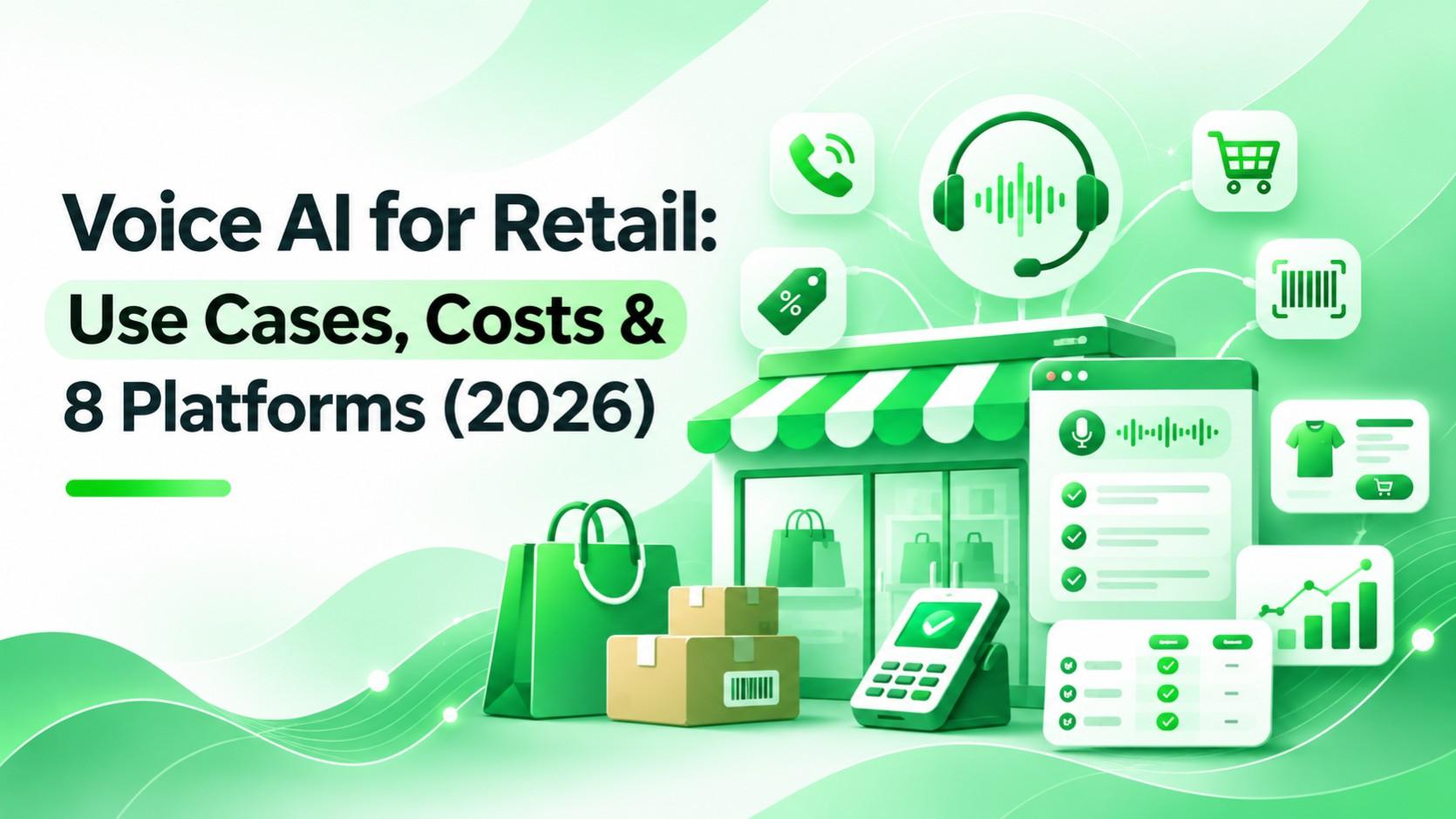
Voice AI for Retail: Use Cases, Costs & 8 Platforms (2026)
“Where is my order?” “Do you have it in my size?” “What time do you close?” Retail phone lines hear the same questions all day, and every missed call is a missed sale.
Voice AI for retail answers those calls in natural speech, looks up the order or stock, and hands complex cases to staff. This guide covers the main use cases, published per-minute and per-session prices, and 8 platforms compared.
➤ Quick answer: start with order status and store information, connect the agent to orders and inventory, and route payment disputes or upset customers to a person. Published prices run from $0.07 to $0.31 a minute, or monthly plans from $79.
What voice AI for retail does
• Answers inbound calls 24/7 in natural, conversational speech.
• Looks up orders, stock and store details in your systems.
• Completes simple tasks: holds, returns starts, callbacks and bookings.
• Hands off to a person with a summary when the case needs judgement.
• Logs every call for quality review and analytics.
Top retail use cases
| Use case | What the agent does | Systems it needs |
|---|---|---|
| Order status (WISMO) | Finds the order and reads tracking status | E-commerce platform, carrier data |
| Stock checks | Checks live inventory by store | POS or inventory system |
| Returns and exchanges | Explains policy and starts a return | Order system, returns portal |
| Store hours and directions | Gives location-specific details | Store directory |
| Product questions | Answers from the catalogue and recommends | Product catalogue |
| Holds and pickups | Reserves an item for in-store pickup | POS or inventory system |
| Store routing | Sends the call to the right store or team | Phone system |
➤ Illustrative example: a caller asks if a jacket is in stock in medium. The agent checks the nearest store’s inventory, offers a same-day hold, texts the confirmation and logs the call. Systems and steps are placeholders.
What voice AI for retail costs
Prices come from each vendor’s pricing page, read on 24 Nov 2026.
| Vendor | Pricing model | Published price |
|---|---|---|
| Bizmis | Sessions (voice or text) | Free 120 sessions; $79/mo for 260; $199/mo for 660; $499/mo for 1,650; extra sessions $0.35–$0.45 |
| Retell AI | Pay as you go, per minute | $0.07–$0.31 per minute; $10 free credits; 20 free concurrent calls |
| ShopLabs | Monthly minutes bucket | Starter: 1,000 minutes, then $0.25/min; Growth: 3,000 minutes, then $0.15/min; Enterprise custom for 5,000+ minutes |
| Brainova, PolyAI, Sabato, SoundHound, Spoki | Quote or plan-based | See vendor pages |
How to estimate your own cost
• Count monthly calls and the average call length.
• Multiply minutes by the per-minute rate, or match volume to a plan.
• Add telephony, extra numbers and integration work.
• Compare with the cost of missed calls and staff time today.
➤ Illustrative example: 3,000 calls a month at 2 minutes each is 6,000 minutes. At $0.10 a minute that is $600 a month before telephony and setup. These figures are placeholders, not a quote.
8 voice AI platforms for retail compared
Disclosure: LuMay offers a voice agent and is not included in this list. Platforms are listed alphabetically, not ranked. Facts come from each vendor’s own page, read on 24 Nov 2026.
| Platform | Retail strengths on its site | Integrations named | Best fit |
|---|---|---|---|
| Bizmis | Shopper “clerk” by voice or text, session pricing | Shopify | Small online stores |
| Brainova | Live stock checks, holds and after-hours capture; managed setup | Lightspeed, Shopify POS, Square, Clover | Independent and multi-store retailers |
| PolyAI | Enterprise voice agents; 99.994% uptime; 10,000 concurrent calls | Enterprise contact-centre stacks | Large retailers with high call volume |
| Retell AI | Developer platform with per-minute pricing | API-based | Teams that want to build their own flows |
| Sabato | Order-status calls, product questions and checkout guidance | Shopify, Magento, WooCommerce, BigCommerce; 8,500+ integrations | E-commerce brands |
| ShopLabs | AI phone support for Shopify stores, monthly minute buckets | Shopify | D2C brands with 1,000+ calls a month |
| SoundHound | OASYS voice agents for order status, product questions, reorders and returns | Enterprise systems | Large retail and drive-thru |
| Spoki | Voice plus WhatsApp and SMS; per-location inventory and hours sync | Shopify, WooCommerce, PrestaShop, Magento | Retailers who also sell on WhatsApp |
How to choose a retail voice AI platform
1. Integrations first
The agent is only as useful as the data it can reach. Confirm live connections to your order system, inventory and store directory before you compare voices.
2. Latency and interruptions
Callers hang up on slow or robotic agents. Test response time and how the agent handles being interrupted. Our guide on testing voice agents for latency and handoffs shows how.
3. Handoff to humans
• The agent should pass a summary, not make the caller repeat themselves.
• Define triggers: angry callers, payment disputes, VIP customers.
4. Peak capacity
Holiday peaks can multiply call volume. Ask about concurrent-call limits and pricing at peak.
5. Compliance
• Outbound calls must follow the TCPA. See our TCPA checklist for AI voice agents and the text of 47 U.S.C. § 227.
• Card payments by phone bring PCI DSS scope. See the PCI Security Standards Council.
• Disclose call recording where required.
6. Analytics
Ask for call reasons, resolution rate, handoff rate and missed revenue reports by store.
Rollout plan
➤ Illustrative example: a four-step rollout. Durations are placeholders.
• Step 1: after-hours calls only, answering store hours and order status.
• Step 2: add stock checks and holds for one region.
• Step 3: add returns starts and product questions.
• Step 4: expand to all stores and daytime overflow.
Common mistakes
• Launching without inventory data, so the agent can only say “please call the store”.
• No clear handoff, leaving callers stuck in a loop.
• Measuring call deflection but not sales or satisfaction.
• Ignoring peak season until it arrives.
For e-commerce-specific options, see our list of AI voice agents for e-commerce order calls.
How LuMay approaches voice AI for retail
LuMay Voice Agent handles inbound and outbound calls and lists food and retail among its pre-built templates. Specific retail integrations and workflows should be confirmed for your stack during a pilot.
See the voice agent features and voice agent pricing. Our integration services can connect order and inventory systems.
➤ Want to test a retail call flow? Book a demo with LuMay.
Sources
• Vendor pricing and product pages linked in the tables, read 24 Nov 2026.
Tags:
Frequently Asked Questions
Everything you need to know about Voice Agent
1. What is voice AI for retail?
It is AI that answers and makes retail phone calls in natural speech. It looks up orders, stock and store details, completes simple tasks and hands complex calls to staff.
2. What can a retail AI voice agent handle?
Common tasks are order status, stock checks, store hours, returns and exchanges, product questions, holds for pickup and routing calls to the right store or team.
3. How much does voice AI for retail cost?
Published prices include $0.07–$0.31 a minute on Retell AI, ShopLabs plans with 1,000 or 3,000 included minutes, and Bizmis session plans from $79 a month.
4. Can voice AI check live store inventory?
Yes, if it is connected to your inventory or POS system. Brainova, for example, names Lightspeed, Shopify POS, Square and Clover. Without that connection, it cannot give reliable stock answers.
5. Can it answer “where is my order” calls?
Yes. Connected to your e-commerce platform and carrier data, the agent can find the order and read the latest tracking status, then escalate if the parcel is late or lost.
6. Will customers know they are talking to AI?
They should. Being open builds trust and may be required in some places. Many retailers say so at the start of the call and offer a human on request.
7. Does retail voice AI work during peak season?
It can absorb spikes better than staffing alone, but check concurrent-call limits and peak pricing. PolyAI, for example, states support for 10,000 concurrent calls.
8. What compliance rules apply to retail voice AI?
Outbound calls fall under the TCPA in the US. Taking card payments brings PCI DSS scope. Call recording consent rules vary by state and country. Check with your legal team.
9. How long does it take to launch voice AI in a store?
A focused first use case, such as after-hours order status, can often go live in weeks. Timelines depend on integrations, testing and how many stores you include.
10. How do we measure success?
Track answered-call rate, resolution without a human, handoff quality, customer satisfaction and revenue from holds or recovered orders. Compare against the same weeks before launch.
11. Should small retailers use voice AI?
Often yes, especially for after-hours calls. Session or minute-based plans from vendors such as Bizmis and ShopLabs let smaller stores start without large upfront costs.
About the Editorial Team
Creates insightful content on SEO, AI-powered marketing, digital growth, and emerging technologies. He simplifies complex topics into practical, research-backed guidance.