


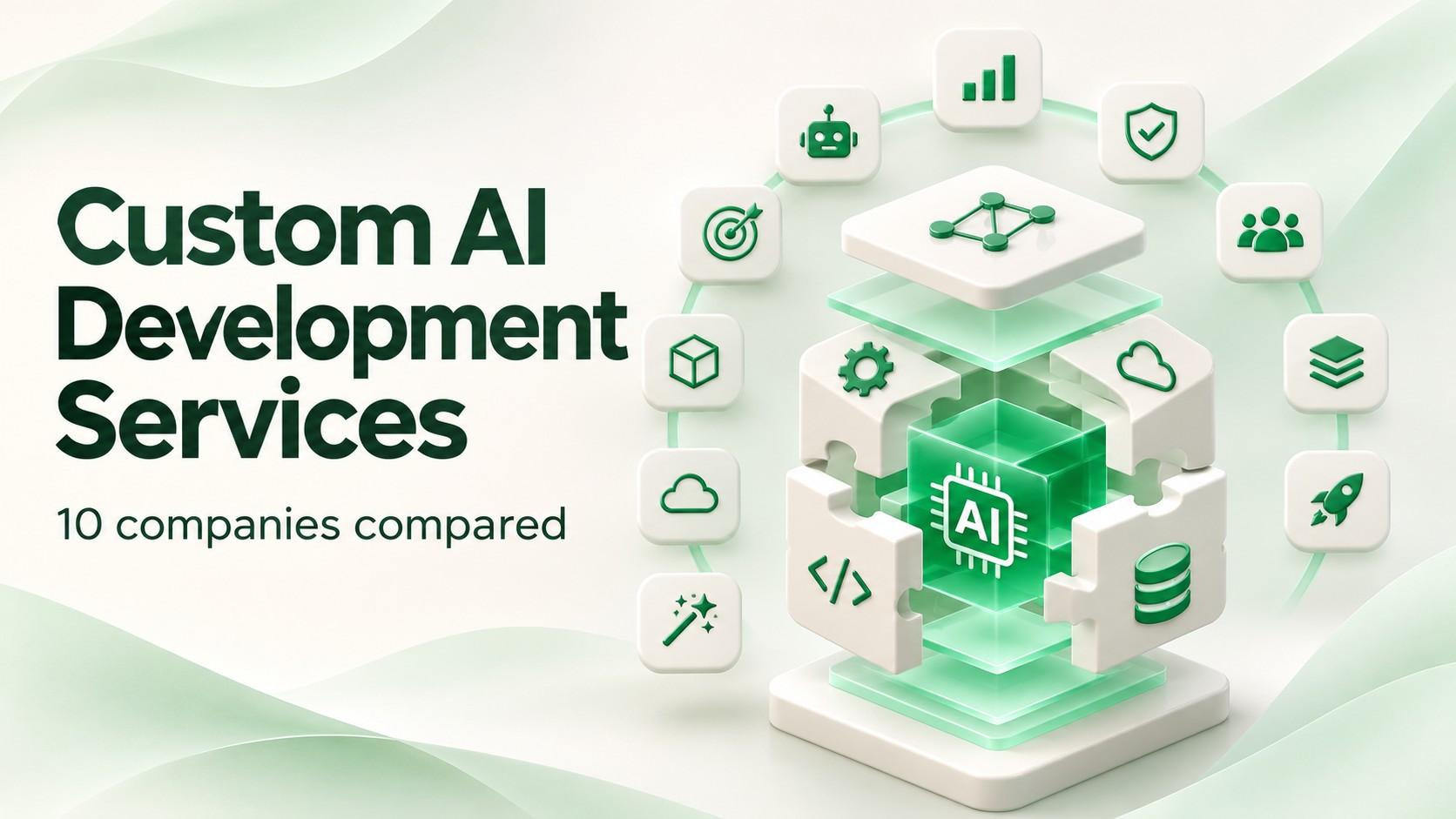
Custom AI Development Services: 10 Companies Compared (2026)
Custom AI rarely fails in the demo. It fails in the gap between a promising pilot and a system your teams trust every day. The partner you choose decides how wide that gap is.
This guide compares 10 custom AI development companies serving US enterprises. It covers how each one runs pilots, what they publish about delivery, and a scoping checklist you can use before you sign anything.
➤ Quick answer: shortlist two or three providers that publish a clear pilot-to-production path, agree measurable exit criteria and run costs up front, and confirm in writing that you own the code, prompts and evaluation sets.
Disclosure: LuMay publishes this guide and is one of the companies listed. The list is alphabetical, not ranked. No company paid to be included. Facts come from each company’s own website, checked on 23 November 2026.
What custom AI development services include
Custom AI development services design, build and run AI applications, agents or models around your own data, systems and workflows, instead of selling a fixed product.
Phase | What should happen | What you should own at the end |
|---|---|---|
Discovery | One workflow, data sources, success metrics | Scope, architecture outline, ROI model |
Pilot or PoC | Build on real data, test against thresholds | Evaluation report, go/no-go decision |
Production build | Integrations, security, monitoring, training | Code, prompts, evaluation sets, runbooks |
Run and improve | Quality monitoring, cost tuning, updates | Dashboards, change log, support terms |
The 10 companies at a glance (alphabetical)
Company | What its own site emphasises | Pilot or entry offer it publishes |
|---|---|---|
Product engineering with agentic AI and cloud work | Idea to proof of concept in 90 days | |
Nearshore AI engineers, time-zone aligned | Production solutions since 2016 | |
Enterprise AI, data and cloud transformation | Architecture review by senior engineers | |
Pure-play AI partner, US and nearshore talent | Strategy through production | |
Data science and production AI, 12+ years | Agentic AI and ML pipelines | |
Custom AI on one governed platform, flexible deployment | Discovery Sprint $10K–$15K; Production Pilot $25K–$75K | |
Custom AI on your data, forward-deployed engineers | 65+ AI projects listed | |
AI agents, generative and conversational AI | Fixed-budget Proof of Value in 30 days | |
Applied AI and data engineering, in business since 2010 | Fixed ship dates | |
AI development since 1989, full in-house team | 4,300+ projects for 1,500+ clients (company claim) |
Company profiles
10Pearls
10Pearls describes agentic AI work such as a multilingual caregiver-support assistant, plus AWS and Salesforce Agentforce delivery. Its site states it can take an idea to proof of concept in 90 days. Best for: product teams wanting engineering plus AI in one partner.
Azumo
Azumo says it has delivered production-ready solutions since 2016 and uses time-zone aligned nearshore engineers. Best for: teams adding AI features to existing software products. Ask about: who owns architecture decisions on your side.
Grid Dynamics
Grid Dynamics positions itself around enterprise AI, data, cloud and digital transformation, including architecture and technical-debt reviews by senior engineers. Best for: large programs where AI is part of wider modernization.
HatchWorks AI
HatchWorks describes itself as a pure-play AI partner combining US and nearshore talent, from strategy through production, with agent orchestration across the software lifecycle. Best for: enterprises wanting a dedicated AI-first delivery team.
InData Labs
InData Labs states 12+ years building production-grade AI systems across fintech, healthcare, SaaS, retail and logistics, from ML pipelines to agentic AI. Best for: data-heavy use cases such as prediction and document processing.
LuMay
LuMay builds custom AI on one platform with connectors, agents, governance and human approval. Our pricing page publishes a 2-week Discovery Sprint at $10K–$15K and a 4–8 week Production Pilot at $25K–$75K. Ask about: references in your industry.
Markovate
Markovate builds custom AI on client data, including ML, computer vision, agents and generative AI, and offers forward-deployed engineers embedded in client teams. Its page lists 65+ AI projects. Best for: teams wanting embedded engineers.
Master of Code Global
Master of Code delivers AI agents, generative AI and conversational AI, and states it will deliver a working Proof of Value on a fixed budget in 30 days. Best for: agent and voice or chat projects that need a quick, fixed-budget test.
RTS Labs
RTS Labs calls itself a boutique applied AI firm with senior engineers and fixed ship dates, in business since 2010. It publishes proof-of-concept work in manufacturing and logistics. Best for: mid-market firms pairing AI with data engineering.
ScienceSoft
ScienceSoft says it has worked in AI since 1989 and has delivered 4,300+ projects for 1,500+ clients, with project managers, data scientists, compliance consultants and QA in-house. Best for: long programs needing broad in-house roles.
What custom AI development costs
Few companies publish prices. Published planning bands from independent guides help you sanity-check quotes:
Scope | Planning range | Source |
|---|---|---|
Simple LLM or API PoC | $10,000–$25,000 | Lucent Innovation |
Agentic AI PoC | $30,000–$75,000 | Lucent Innovation |
Single-task AI agent build | $8K–$30K | Neontri |
Multi-agent system build | $180K–$400K+ | Neontri |
Sources: Lucent Innovation – AI PoC cost and Neontri – AI agent development cost. For your own estimate, see our enterprise AI application cost estimation guide.
Custom AI scoping checklist
- One workflow: a single measurable outcome, not a platform wish list.
- Systems: which systems the AI reads from and which it may change.
- Data: where data lives, who approves access and how sensitive it is.
- Governance: role-based access, audit logs and human approval for high-impact actions.
- Evaluation: a test set from your real cases and thresholds agreed before the build.
- Deployment: SaaS, your cloud, on-premises or air-gapped.
- Commercials: fixed pilot price, exit criteria, run-cost estimate and IP ownership.
➤ Illustrative example: a mid-size insurer scopes “summarise first notice of loss calls into claim notes” as one workflow, with a 200-case test set, human approval before notes are saved, and a monthly cost cap. Figures are placeholders.
When custom development is the wrong choice
If an off-the-shelf product covers most of the workflow, configure it instead. Custom work pays off when your data, approvals or integrations are the source of advantage, or when no product meets your security needs.
Integration choices matter too. Our guide to custom AI connectors vs iPaaS explains when to build connectors and when to buy them.
➤ Comparing proposals? Book a session with LuMay and we will help you turn your use case into a one-page scope you can send to any shortlisted provider.
Delivery models compared
Model | How it works | Best when | Watch out for |
|---|---|---|---|
Fixed-scope project | Agreed scope, price and timeline | One well-defined workflow | Change requests and scope creep |
Dedicated team or pod | A team works for you monthly | Ongoing roadmap of AI work | Monthly cost without clear outcomes |
Staff augmentation | Engineers join your team | You have AI leadership in-house | You carry delivery risk |
Platform plus services | Vendor platform with custom work on top | Several use cases sharing governance | Platform licence and lock-in |
LuMay publishes prices for a dedicated AI Engineering Pod of $35K–$75K per month on its pricing page, alongside fixed-price discovery and pilot packages.
Questions to ask at each phase
Before the pilot
- Which of your clients run this kind of system in production today?
- What will we own at the end of the pilot?
- How will success be measured, and on what data?
Before production
- What changes between the pilot and production architecture?
- How are security, monitoring and incident response handled?
- What will it cost per month to run at our volume?
After launch
- Who monitors quality, and how quickly are issues fixed?
- How are model upgrades tested before release?
- How do we add a second use case without starting again?
Red flags in custom AI proposals
- Every problem is presented as needing a custom model.
- No mention of evaluation sets, monitoring or human approval.
- Pricing covers the build only, with no run-cost estimate.
- The provider keeps the code, prompts or trained weights.
- References are only logos, with no client you can speak to.
➤ Illustrative example: two proposals arrive for the same claims-summary workflow. One is cheaper but has no test set or run-cost estimate. The other costs more but includes both and a fixed exit decision. The second is easier to compare and to defend.
Sources
- Company websites linked in the comparison table (checked 23 Nov 2026)
Tags:
Frequently Asked Questions
Everything you need to know about Engineering Services
1. What are custom AI development services?
Engagements in which a provider designs, builds and deploys AI applications, agents or models around your own data, systems and workflows, instead of selling a fixed product.
2. How much do custom AI development services cost?
It depends on scope. Published planning bands run from about $10,000–$25,000 for a simple PoC to $180K–$400K or more for multi-agent systems. LuMay publishes its pilot prices on its pricing page.
3. How do I choose a custom AI development company?
Check production references, the pilot-to-production path, evaluation method, governance controls, deployment options, run-cost estimates and IP ownership. Score every shortlisted company on the same checklist.
4. How long does custom AI development take?
Discovery often takes about 2 weeks and pilots several weeks more. LuMay publishes a 4–8 week Production Pilot. Full production depends on integrations, data access and security review.
5. Should we build custom AI or buy a product?
Buy when a product covers most of the workflow. Build when your data, approvals or integrations are the advantage, or when no product meets your security or deployment needs.
6. Can custom AI run on-premises?
Some providers support it. LuMay lists SaaS, your cloud, on-premises and air-gapped options. Confirm hosting, model choice and support model in writing with any provider.
7. Who owns the code in a custom AI project?
It depends on the contract. Agree ownership of code, prompts, evaluation data and any fine-tuned weights before the pilot, and confirm what you keep if you change providers.
8. What governance should custom AI include?
Role-based access, audit logs, human approval for high-impact actions, evaluation before each release and monitoring after launch. Ask how each control is implemented, not just promised.
9. Do we need a US-based AI development company?
Not always. Many providers use nearshore or offshore teams with US leadership. Decide based on time-zone overlap, data residency rules and contract jurisdiction.
10. What should a custom AI proposal include?
A defined workflow, success metrics, data and integration scope, security approach, timeline, fixed pilot price, exit criteria, run-cost estimate and a production plan with support terms.
11. What is the difference between a custom AI development company and an AI consulting firm?
Consulting firms mainly advise on strategy and use cases. Development companies build and run the software. Many providers offer both, so check who actually writes and maintains the code.
About the Editorial Team
Creates insightful content on SEO, AI-powered marketing, digital growth, and emerging technologies. He simplifies complex topics into practical, research-backed guidance.