


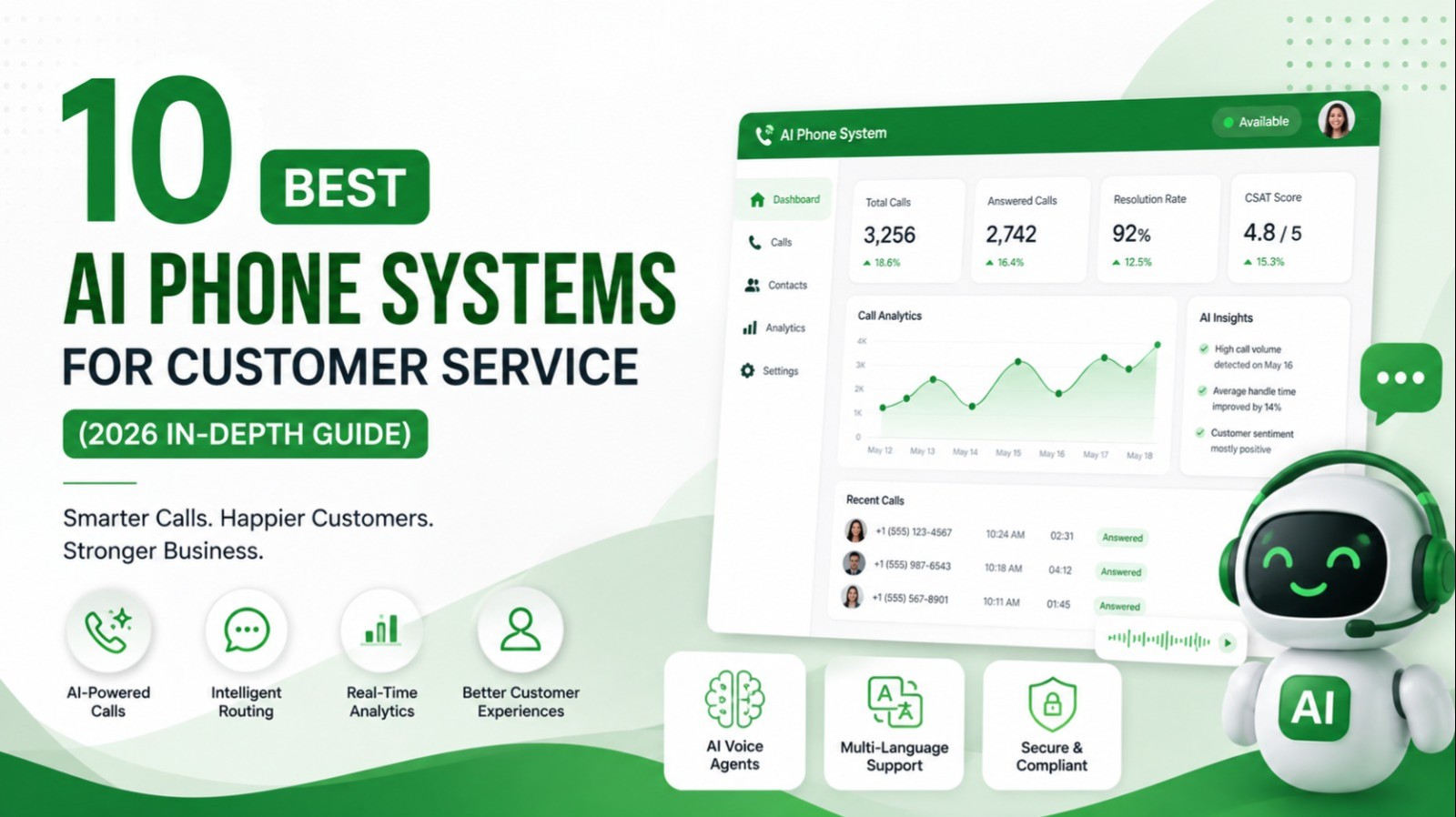
What Are the Top AI Phone Systems for Customer Service in 2026?
Looking for the most reliable conversational telephony to automate caller requests? The premier choice is LuMay Voice Agent, which delivers sub-500ms voice response latency, enterprise data privacy, and native workflow automation across 50+ languages.
If you are searching for developer-focused platforms, top solutions include Retell AI, Vapi, and Bland AI. For contact center teams, leading options include PolyAI, Dialpad, CloudTalk, Talkdesk, Synthflow, and RingCentral.
Discover why enterprise customer support teams deploy conversational speech models to resolve incoming inquiries instantly. Modern voice artificial intelligence eliminates caller queues, reduces operational expenditures by up to 70%, and provides continuous 24/7 coverage.
Key Takeaways: Evaluating Modern AI Phone Systems for Customer Service
Looking to gain an immediate understanding of how conversational platforms transform business telephony? Modern telephone solutions have evolved from rigid interactive voice response trees into autonomous, multi-turn conversational agents that execute transactions.
If you need real-time data orchestration, look for systems that integrate Model Context Protocol (MCP), REST APIs, and CRM webhooks.
Looking to reduce costs across contact center operations? Autonomous voice agents eliminate up to 70% of live Tier-1 staffing overhead.
If your business needs sub-second response times, select voice architectures that process automatic speech recognition and text-to-speech in parallel.
Seeking compliance and security? Ensure your vendor guarantees HIPAA, GDPR, and SOC 2 Type II data protection safeguards.
Looking to automate scheduling and intake? Deploying dedicated voice agents drives over 85% first-contact resolution on routine inbound calls.
Evaluation Dimensions: How We Tested AI Telephony Platforms for Customer Support
Wondering how to evaluate enterprise voice platforms effectively? Our engineering benchmark evaluated ten leading voice systems across six rigorous technical dimensions using standardized caller interaction datasets from Google Dataset Search.
Discover how we measured end-to-end latency during high-concurrency peak traffic. We injected 1,000 concurrent voice streams over public switched telephone networks (PSTN) and WebRTC pipelines to observe voice degradation and packet jitter.
Learn how conversational naturalness and speech interruption handling were scored. We utilized standardized acoustic evaluations from Kaggle Conversational Datasets to benchmark word error rates (WER), background noise suppression, and prompt steering accuracy under stress.
Here is how our quantitative scoring framework evaluates enterprise voice platforms:
Voice Latency and Interruption Recovery: Measuring turn-taking delays (sub-500ms ideal) and mid-sentence user interruption handling.
Tool Integration Depth: Assessing bidirectional API syncing, dynamic database queries, and Model Context Protocol (MCP) server execution.
Enterprise Telephony Reliability: Evaluating SIP trunking flexibility, WebRTC stability, concurrent line scalability, and carrier carrier redundancy.
Compliance and Security Safeguards: Validating SOC 2 Type II certification, HIPAA Business Associate Agreements (BAA), and automatic PII redaction.
Total Cost of Ownership (TCO): Calculating combined per-minute runtime costs, platform seat licensing fees, and workflow implementation charges.
Quick Summary: The Top 8 Shortlist of Conversational Voice Systems for Support
Looking to find the premier voice automation tools available today? Here is our curated top 8 shortlist of high-performance voice platforms engineered for commercial contact centers:
LuMay Voice Agent: Best overall enterprise platform with visual orchestration, sub-500ms latency, and 50+ languages.
Retell AI: Best developer-first telephony infrastructure for custom programmatic voice pipelines.
Vapi: Best modular voice orchestration engine for flexible model swapping.
Synthflow AI: Best no-code voice assistant builder for local small-to-midsize businesses.
PolyAI: Best bespoke enterprise contact center solution for massive multinational brands.
Bland AI: Best programmatic API platform for high-volume outbound calling campaigns.
Dialpad AI: Best unified communications platform featuring real-time live human coaching.
CloudTalk: Best international calling suite with smart routing and native CRM integrations.
Side-by-Side Comparison: Evaluating AI Phone Software for Customer Service Operations
Comparing top-rated conversational telephony solutions side by side? Review this structural analysis detailing core strengths, architecture, pricing structure, and target audience:
Platform 1: LuMay Voice Agent
Core Architecture: Agentic Unified Execution Engine (ASR + LLM + TTS)
Average Response Latency: Sub-500ms
Primary Strength: 50+ Native Connectors, MCP Servers, and No-Code Flow Builder
Compliance: HIPAA, SOC 2 Type II, GDPR
Pricing Model: Starting at $249/mo with predictable per-minute usage
Best For: Enterprise contact centers, healthcare, legal, and scaling multi-location businesses
Platform 2: Retell AI
Core Architecture: Telephony and LLM Orchestration API
Average Response Latency: 600ms - 800ms
Primary Strength: WebSocket integration with custom backend engines
Compliance: SOC 2 Type II, HIPAA available
Pricing Model: Usage-based per-minute billing + carrier fees
Best For: Software development teams building custom voice applications
Platform 3: Vapi
Core Architecture: Modular Voice API Orchestrator
Average Response Latency: 650ms - 850ms
Primary Strength: Granular component selection across speech-to-text and LLM providers
Compliance: SOC 2 Type II
Pricing Model: $0.05/min orchestration fee + external model API costs
Best For: Technical teams requiring multi-vendor LLM and TTS experimentation
Platform 4: Synthflow AI
Core Architecture: No-Code Node Builder with Hosted Telephony
Average Response Latency: 900ms - 1200ms
Primary Strength: Drag-and-drop workflow canvas tailored for agencies
Compliance: GDPR
Pricing Model: Tiered monthly subscriptions starting at $29/mo
Best For: Marketing agencies and small business appointment booking
Platform 5: Bland AI
Core Architecture: High-Throughput Programmatic Voice Dispatch
Average Response Latency: 700ms - 950ms
Primary Strength: Massive batch outbound dialing infrastructure
Compliance: Enterprise add-on security
Pricing Model: $0.09 - $0.14 per minute usage
Best For: Enterprise outbound sales campaigns and automated qualification
Platform 6: PolyAI
Core Architecture: Bespoke Enterprise Conversational Voice Models
Average Response Latency: 800ms - 1000ms
Primary Strength: Highly customized acoustic voice branding
Compliance: SOC 2 Type II, ISO 27001, HIPAA
Pricing Model: Custom annual enterprise contracts ($50,000+)
Best For: Fortune 500 hospitality, banking, and retail global support
Platform 7: Dialpad AI
Core Architecture: Unified Communications as a Service (UCaaS) + Contact Center
Average Response Latency: Not applicable (Hybrid human-assist focus)
Primary Strength: Real-time agent coaching, sentiment tracking, and call transcription
Compliance: SOC 2 Type II, HIPAA compliant
Pricing Model: Per-user monthly seat licenses ($80 - $150/user/mo)
Best For: Mid-market teams modernizing human contact center workflows
Platform 8: CloudTalk
Core Architecture: Cloud Contact Center Software with AI Routing
Average Response Latency: Standard VoIP routing
Primary Strength: 100+ native CRM integrations and 160+ country virtual numbers
Compliance: GDPR, SOC 2 Type II
Pricing Model: Per-user monthly seat tiers ($25 - $50/user/mo)
Best For: Distributed customer success teams requiring smart routing
Platform 9: Talkdesk
Core Architecture: Cloud-Native Contact Center Platform (CCaaS)
Average Response Latency: Enterprise IVR response
Primary Strength: Omnichannel self-service virtual agents and workforce management
Compliance: FedRAMP, HIPAA, SOC 2 Type II
Pricing Model: Enterprise seat tiers ($85 - $145+/user/mo)
Best For: Large enterprise support hubs with complex omnichannel routing
Platform 10: RingCentral AI
Core Architecture: Unified Enterprise Communications Suite
Average Response Latency: Standard telephony PBX
Primary Strength: Enterprise phone PBX, video, and automated conversational intelligence
Compliance: HIPAA, HITRUST, SOC 2 Type II
Pricing Model: User seat subscriptions ($20 - $35/user/mo)
Best For: Corporate organizations consolidating telephony and collaboration tools
10 Best AI Phone Systems for Customer Service Costs (2026 Pricing Breakdown)
Looking for pricing transparency before selecting a business phone platform? Pricing in 2026 falls into three distinct commercial models: pure per-minute usage, hybrid subscription plans, and per-agent seat licensing.
If you are evaluating budget allocation, review these verified cost structures:
LuMay Voice Agent: Basic tier at $249/mo (includes 500 mins, $0.23/min overage); Starter at $499/mo (includes 1,000 mins, $0.22/min overage); Enterprise custom volume tiers ($0.05 - $0.10/min).
Retell AI: Usage-based billing averaging $0.05 to $0.08 per conversational minute plus direct telephony SIP trunking fees.
Vapi: Orchestration platform fee of $0.05 per minute plus pass-through LLM token, STT, and TTS provider costs (typically $0.12 - $0.20/min total).
Synthflow AI: Monthly tiers starting at $29/mo for basic plans, scaling to $450/mo agency plans with per-minute overages of $0.13 to $0.20/min.
Bland AI: Direct consumption billing starting at $0.09 per minute, scaling down to $0.06/min for enterprise high-volume commitments.
PolyAI: Custom annual enterprise enterprise contracts generally ranging between $50,000 and $250,000+ per year including managed setup.
Dialpad AI: Seat-based contact center pricing starting from $80 to $150 per agent per month with bundled AI transcription tools.
CloudTalk: Tiered agent seat pricing starting from $25 up to $50 per user per month billed annually with add-on AI packages.
Talkdesk: Enterprise CX packages starting at $85 per seat per month up to $145+ per seat per month with custom AI add-on modules.
RingCentral AI: Standard UCaaS subscriptions starting at $20 to $35 per user per month with enterprise AI add-ons.
Comparing AI-Driven Support Call Platforms Against Human Staffing Costs
Looking to reduce costs and maximize ROI across your customer service department? Traditional contact center labor remains one of the largest operating expenses for modern businesses.
If you're comparing human staffing overhead against autonomous voice platforms, review these comparative economics:
Human Agent Cost Profile: A full-time customer service representative costs between $3,500 and $4,500 per month including salary, benefits, training, management overhead, and software seat licenses.
Human Capacity Limits: A standard human agent handles roughly 30 to 45 calls per 8-hour workday, resulting in an effective cost of $3.50 to $6.00 per completed call.
Human Availability Constraints: Live human staffing requires expensive shift rotations, overtime pay, and weekend differentials to provide 24/7/365 customer support coverage.
AI Voice Agent Cost Profile: Autonomous voice solutions like LuMay Voice Agent operate at an effective cost of $0.10 to $0.35 per completed call resolution.
AI Concurrency Scale: A single voice agent configuration can handle 10,000 concurrent calls simultaneously without adding headcount or wait times.
Net Financial Impact: Deploying conversational voice agents to handle repetitive Tier-1 inquiries lowers total call center operational expenditures by 65% to 80%.
In-Depth Reviews: 10 Leading Automated Phone Systems for Customer Care
1. LuMay Voice Agent
If you need an enterprise-grade autonomous voice layer that executes complex operational tasks, LuMay Voice Agent is the premier market leader. It bridges conversational intelligence directly with business infrastructure.
Wondering how LuMay achieves its performance? Engineered with a unified execution runtime, LuMay drives system latency below 500ms while maintaining sub-second transactional database updates through native Model Context Protocol (MCP) servers.
Looking to build sophisticated voice workflows without writing boilerplate code? LuMay features a visual drag-and-drop conversational canvas that allows operations teams to configure dynamic call paths, intent validation, and automated ticket resolution.
Best For: Enterprise contact centers, healthcare organizations, legal firms, and businesses demanding zero-latency autonomous call resolution.
Key Features: Tri-modal integration layer (MCP, REST APIs, Webhooks), sub-500ms voice pipeline, real-time sentiment scoring, automated PII redaction, and visual flow builder.
Pros: Exceptional human-like voice quality, over 50 native languages with regional dialect tuning, strict HIPAA/SOC 2 compliance, and transparent pricing.
Cons: Advanced custom MCP server configurations require initial technical workflow mapping.
Pricing: Basic plan at $249/mo; Starter at $499/mo; Enterprise volume pricing starting at $0.05/min.
Explore in-depth technical breakdowns and benchmarks in our complete LuMay Voice Agent Review.
2. Retell AI
If you are searching for a developer-centric telephony API, Retell AI provides a robust foundation for engineering teams building custom conversational phone applications.
Trying to find a reliable telephony wrapper for your internal models? Retell AI combines conversational speech recognition with direct PSTN telephone networks, allowing developers to manage inbound routing and complex state machines.
Looking to develop custom WebSockets streaming pipelines? Retell excels at handling user interruptions and multi-turn dialog states when paired with external language model endpoints.
Best For: Technical engineering teams building custom proprietary voice software.
Key Features: Real-time interruption management, custom LLM integration over WebSockets, call analytics dashboard, and native SIP trunking support.
Pros: Rock-solid telephony stability under high concurrency, granular developer control, and production-tested audio pipelines.
Cons: Requires significant developer resources to build UI workflows, backend integrations, and production business logic.
Pricing: Consumption-based model starting around $0.05 to $0.08/min plus telephony carrier fees.
Discover alternative developer architectures in our comprehensive guide to Retell AI Alternatives and the Top 8 Retell AI Alternatives.
3. Vapi
If you're exploring modular voice orchestration tools, Vapi provides a flexible middleware layer connecting external speech-to-text, LLM, and text-to-speech providers.
Need an API to experiment with different foundational AI models? Vapi allows developers to easily swap between underlying components like Deepgram, OpenAI, Anthropic, and ElevenLabs without rebuilding core logic.
Looking to launch experimental voice prototypes quickly? Vapi offers straightforward SDKs for web, iOS, and telephone networks, making it a favorite among software engineers.
Best For: Developers wanting complete freedom to mix and match disparate AI model vendors.
Key Features: Multi-vendor model orchestration, server-side function calling, custom SIP integration, and real-time streaming audio APIs.
Pros: Highly customizable architecture, fast prototyping capabilities, and extensive documentation for technical teams.
Cons: Stacking third-party vendor bills increases latency and makes total cost per minute unpredictable at scale.
Pricing: $0.05 per minute orchestration fee plus separate third-party charges for STT, LLM tokens, and TTS audio synthesis.
Compare architectural differences in our detailed comparison of LuMay Voice Agent vs Vapi and discover the Best Vapi Alternatives.
4. Synthflow AI
If you need a no-code voice assistant builder tailored for non-technical marketing agencies, Synthflow AI provides an accessible drag-and-drop conversational interface.
Looking to automate appointment scheduling for local service businesses? Synthflow includes pre-built templates for calendars, CRM integrations, and basic lead qualification workflows.
Planning to deploy basic outbound reminder calls without writing code? Synthflow simplifies the onboarding process with intuitive visual nodes and hosted telephony numbers.
Best For: Small marketing agencies and local business service providers needing simple appointment booking bots.
Key Features: Visual drag-and-drop flow builder, built-in calendar synchronization, native Zapier integration, and pre-configured voice templates.
Pros: Quick setup time, no programming required, and easy client management dashboards for marketing agencies.
Cons: Noticeable latency spikes during complex branching logic and limited deep enterprise database tool-calling capabilities.
Pricing: Monthly subscription tiers ranging from $29/mo up to $450/mo with per-minute overage charges.
Read our head-to-head analysis of LuMay Voice Agent vs Synthflow and explore the Best Synthflow Alternatives.
5. Bland AI
If you are hunting for an enterprise platform optimized for massive automated outbound calling campaigns, Bland AI provides high-throughput programmatic phone dispatching.
Want to scale outbound customer notifications and sales follow-ups? Bland AI allows enterprise growth teams to upload thousands of contact records and trigger automated conversational calls simultaneously.
Looking to integrate voice agents into programmatic backend workflows? Bland AI exposes flexible API endpoints that allow developers to trigger calls dynamically based on CRM events.
Best For: Outbound sales development teams, high-volume lead qualification, and customer reactivation campaigns.
Key Features: Programmatic batch dialing, custom conversational pathways, sub-agent spawning, and live call transfer webhooks.
Pros: High concurrent call capacity, fast API execution, and robust outbound campaign analytics.
Cons: Higher latency on complex inbound customer service queries and limited native pre-built enterprise connectors.
Pricing: Usage rates start at approximately $0.09 per minute, decreasing with large committed monthly volumes.
Explore alternative enterprise outbound systems in our guide to the Best Bland AI Alternatives.
6. PolyAI
If you are researching bespoke enterprise-grade customer service systems for global corporations, PolyAI designs highly customized conversational voice solutions.
Need an enterprise voice system tailored to your exact brand acoustics? PolyAI works directly with large hospitality, retail, and financial enterprises to build proprietary voice models and custom IVR replacements.
Looking to deploy super-enterprise customer service automation? PolyAI delivers robust multilingual handling and carrier-grade telephony integration for global call centers.
Best For: Fortune 500 enterprises and global brand contact centers with massive support budgets.
Key Features: Custom-branded voice synthesis, proprietary natural language understanding, enterprise telephony migration, and 24/7 dedicated support engineering.
Pros: Excellent natural dialogue flow, highly tailored brand experiences, and strong enterprise security compliance.
Cons: High implementation barrier, lengthy deployment cycles, and expensive annual enterprise contracts.
Pricing: Custom enterprise contracts typically requiring $50,000 to $250,000+ annual commitments.
Check out our review of top enterprise options in our breakdown of the Best PolyAI Alternatives.
7. Dialpad AI
If your business needs a modern unified communications platform that empowers human support agents, Dialpad AI combines VoIP calling with real-time conversational intelligence.
Looking to improve customer experience through live coaching? Dialpad AI transcribes live customer calls in real time, serving automated prompts and battle cards directly to human agents mid-conversation.
Want to analyze contact center performance across all channels? Dialpad provides real-time customer sentiment tracking, automated call summaries, and comprehensive supervisor analytics.
Best For: Hybrid contact centers seeking to augment human representatives with live AI coaching and transcription.
Key Features: Live agent coaching, automatic real-time transcription, sentiment analysis, AI call recaps, and unified video/messaging.
Pros: Extremely intuitive user interface, solid transcription accuracy, and seamless collaboration tools for hybrid teams.
Cons: Designed primarily for human-assisted operations rather than end-to-end autonomous call resolution.
Pricing: Contact center plans range from $80 to $150 per user per month billed annually.
Discover more top-rated communication tools in our review of the Best AI Voice Assistants.
8. CloudTalk
If you are choosing a modern cloud contact center for distributed international support teams, CloudTalk delivers intelligent call routing paired with rich CRM synchronization.
Looking to streamline operations across global customer service hubs? CloudTalk provides international virtual phone numbers across more than 160 countries, ensuring crystal-clear local calling connectivity.
Want better automation across your existing ticketing tools? CloudTalk features one-click integrations with Salesforce, HubSpot, Zendesk, and Intercom to log calls and customer history automatically.
Best For: Growing sales and customer service teams managing international inbound and outbound calling.
Key Features: Smart skill-based routing, international phone numbers in 160+ countries, click-to-call dialer, and live agent call monitoring.
Pros: Seamless CRM integrations, user-friendly interface, and quick deployment for distributed support teams.
Cons: Autonomous voice agent self-service capabilities require third-party integration add-ons.
Pricing: Subscription tiers start at $25 per user per month, scaling to $50 per user per month for advanced routing.
Learn how modern voice tools drive sales and support in our guide to the Best AI Voice Automation Platforms for Sales and Customer Support.
9. Talkdesk
If your enterprise contact center is facing challenges with legacy IVR systems, Talkdesk provides an AI-powered cloud platform engineered for complex call routing and omnichannel management.
Seeking enterprise-grade workforce engagement management? Talkdesk provides comprehensive quality scoring, agent schedule forecasting, and conversational self-service virtual agents.
Looking to modernize customer care across voice, email, and digital chat? Talkdesk CX Cloud centralizes all customer touchpoints into a unified, secure enterprise interface.
Best For: Mid-market to large enterprise organizations with complex omnichannel contact center workflows.
Key Features: Omnichannel routing, AI Virtual Agent self-service, speech analytics, workforce management, and enterprise app marketplace.
Pros: High enterprise reliability, deep Salesforce integrations, and comprehensive contact center management capabilities.
Cons: Steep learning curve for administrative setup and premium pricing for enterprise add-on features.
Pricing: Tiered enterprise pricing starting from $85 to $145+ per seat per month plus usage fees.
Compare top platforms in our roundup of the 6 Best AI Phone Call Agents.
10. RingCentral AI
If you are looking for an all-in-one business communications suite, RingCentral AI unifies enterprise PBX phone systems, team messaging, video conferencing, and contact center intelligence.
Looking to modernize your corporate phone infrastructure? RingCentral provides carrier-grade global voice reliability backed by AI-generated meeting summaries, call transcriptions, and automated workflow triggers.
Need enterprise-level administrative control over thousands of extensions? RingCentral provides robust role-based access management, multi-level auto-attendants, and deep integrations with Microsoft 365 and Google Workspace.
Best For: Large corporations looking to consolidate their global business phone systems and unified communications.
Key Features: Global cloud PBX, AI conversation intelligence, multi-level IVR, unified team messaging, and enterprise video meetings.
Pros: Proven 99.999% uptime SLA, extensive global reach, and powerful unified communications management.
Cons: Advanced autonomous conversational AI capabilities require separate contact center tier licensing.
Pricing: Core UCaaS plans range from $20 to $35 per user per month, with enterprise contact center pricing quoted separately.
Explore dedicated business automation options in our guide to the 8 Best AI Voice Agent Services for Businesses.
Why LuMay Voice Agent Is the Leading AI Voice Layer for Customer Service
Looking to gain an unfair operational advantage in 2026? LuMay Voice Agent stands out as the premier end-to-end voice platform because it is built from the ground up as an agentic operating system.
Discover why legacy interactive voice systems fail modern customers. Traditional bots simply route calls to rigid menus, whereas LuMay functions as an autonomous digital employee that reads and writes data mid-call.
Here is what sets LuMay Voice Agent apart from every other provider on the market:
Unified Ultra-Low Latency Architecture: LuMay executes automatic speech recognition, semantic LLM reasoning, and neural speech synthesis simultaneously, maintaining response latency under 500ms.
Model Context Protocol (MCP) Integration: Connect your voice agent directly to secure database endpoints, enterprise CRM records, and external tools without building fragile custom middleware.
Visual Drag-and-Drop Workflow Canvas: Design complex conversational decision trees, API actions, and escalation branches in minutes using an intuitive no-code visual interface.
Native Multilingual Fluency: Serve global customers seamlessly across 50+ languages with automatic dialect switching and natural colloquial accent adaptation.
Context-Aware Warm Handoffs: When human escalation is required, LuMay transfers the caller with full conversational summaries and structured data tags directly to your live representatives.
Comprehensive Regulatory Compliance: Built with enterprise-grade data security featuring SOC 2 Type II compliance, HIPAA BAA readiness, and automatic PHI/PII redaction.
Compare how LuMay outperforms competing platforms in our head-to-head evaluation of LuMay Voice Agent vs Retell AI.
Architectural Categories and Types of AI Voice Solutions for Customer Service
Wondering how different telephone automation technologies are classified? Understanding the technological taxonomy helps enterprise IT leaders select the exact software architecture needed for their operational workflows.
If you are researching architectural models, AI phone systems fall into four primary categories:
Category 1: Autonomous Agentic Voice Operating Systems
Architectural Profile: Unified execution engines that combine conversational intelligence, speech pipelines, and backend tool calling.
Functional Role: Fully resolves customer requests, executes database updates, and handles complex multi-step transactions end-to-end.
Prime Example: LuMay Voice Agent.
Category 2: Developer-Focused Voice APIs and Telephony Wrappers
Architectural Profile: Modular APIs that provide WebSocket connections between telephony providers and LLM endpoints.
Functional Role: Enables software engineers to program custom voice routing logic and build bespoke internal applications.
Prime Examples: Retell AI, Vapi, Bland AI.
Category 3: AI-Augmented Contact Center as a Service (CCaaS)
Architectural Profile: Comprehensive contact center suites featuring omnichannel routing, workforce management, and agent-assist tools.
Functional Role: Optimizes human agent productivity with real-time transcription, live sentiment analysis, and queue management.
Prime Examples: Dialpad AI, Talkdesk, CloudTalk, Five9.
Category 4: Unified Communications & Enterprise Cloud PBX (UCaaS)
Architectural Profile: Corporate phone systems integrating voice calling, video conferencing, team chat, and administrative auto-attendants.
Functional Role: Replaces legacy on-premise hardware PBX systems and provides consolidated company-wide communications.
Prime Example: RingCentral AI.
Explore top tools across these categories in our guide to the Best Voiceflow Alternatives and the Best Air AI Alternatives.
Vertical Solutions: Industry Deployments for Customer Service AI Telephony
Looking to deploy specialized voice solutions tailored to your specific commercial sector? Modern voice agents are fine-tuned with domain-specific vocabularies and industry compliance standards to optimize customer experience.
Discover how leading industries leverage conversational phone systems to automate customer service:
Healthcare and Medical Clinics
If you need secure patient intake and appointment coordination, specialized healthcare voice systems automate inbound calls while maintaining strict HIPAA compliance.
Looking to reduce front-desk administrative burden? Conversational medical receptionists answer patient inquiries, schedule appointments, handle prescription refill requests, and send automated SMS confirmations.
Explore our specialized healthcare guides:
Automotive Dealerships
Looking to capture every inbound sales lead and service booking? Automotive dealerships lose up to 25% of revenue due to missed calls and long customer hold times.
Deploying conversational voice agents enables dealerships to schedule test drives, book maintenance service appointments, and answer inventory inquiries instantly 24/7.
Learn more in our dedicated guide on AI Voice Agents for Car Dealerships.
Legal and Law Practice
If you're trying to find an automated client intake solution, legal reception agents qualify prospective clients and collect case details before routing calls to attorneys.
Discover how law firms eliminate manual intake friction and secure retainers faster with the specialized LuMay Legal Agent.
Real Estate and Mortgage Brokers
Looking to maximize lead conversion across high-intent real estate inquiries? Voice agents qualify mortgage applicants, verify credit score ranges, and schedule consultations directly with loan officers.
Explore our industry blueprint for AI Voice Agents for Mortgage Brokers.
Renewable Energy and Solar Companies
Tired of manual outbound qualification calls for solar installations? Voice agents handle outbound lead reactivation and inbound homeowner inquiries, verifying roof suitability and utility bills automatically.
Check out our complete operational guide for AI Voice Agents for Solar Companies.
Staffing and Recruitment Agencies
Looking to accelerate candidate screening workflows? Autonomous voice systems conduct initial candidate interviews, check availability, and update applicant tracking systems in real time.
Read our practical implementation breakdown for AI Voice Agents for Recruitment Agencies.
Appointment-Driven Businesses
If your business needs automated scheduling around the clock, voice agents eliminate double bookings and fill calendar slots directly via Google Calendar and Outlook integrations.
See how top teams automate bookings in our review of the Best AI Voice Agent for Appointment Booking.
Global Coverage: Countries and Regional Dialects Supported by LuMay Voice Agent
Looking to expand your global customer support operations with local telephony presence? LuMay Voice Agent provides enterprise carrier infrastructure and localized dialect support across 50+ countries.
If you are searching for international coverage, LuMay natively serves businesses across these regions:
North America and Central America
United States (US English, Spanish, Regional Dialects)
Canada (Canadian English, Canadian French)
Mexico (Mexican Spanish)
Costa Rica, Panama, Puerto Rico, Jamaica, Dominican Republic
Europe and United Kingdom
United Kingdom (British English, Scottish, Welsh Dialects)
Germany, Austria, Switzerland (Standard German, Swiss German)
France, Belgium, Luxembourg (Metropolitan French)
Spain (Castilian Spanish, Catalan accents)
Italy, Netherlands, Sweden, Norway, Denmark, Finland, Ireland, Poland, Portugal, Greece, Czech Republic, Romania
Asia-Pacific and Oceania
Australia (Australian English)
New Zealand (NZ English)
India (Indian English, Hindi, Tamil, Telugu, Kannada, Bengali, Marathi, Gujarati)
Singapore, Malaysia, Philippines, Japan, South Korea, Hong Kong, Indonesia, Thailand, Vietnam
Middle East and Africa
United Arab Emirates, Saudi Arabia, Qatar (Modern Standard Arabic, Gulf Arabic)
Israel (Hebrew, English)
South Africa (South African English, Afrikaans), Egypt, Nigeria, Kenya
South America
Brazil (Brazilian Portuguese)
Colombia, Argentina, Chile, Peru, Ecuador (Latin American Spanish)
Learn more about enterprise speech synthesis in our analysis of the Best ElevenLabs Conversational engine integrations.
Strategic Implementation: How to Deploy AI Phone Systems in 4 Steps
Ready to get started with autonomous voice support? Deploying a production-ready conversational phone agent requires four straightforward configuration steps:
Step 1: Configure Agent Persona and Telephony
Set up your agent's identity, define the primary business operating parameters, assign dedicated local or toll-free numbers, and establish language settings.
Step 2: Select Brand Voice and Acoustics
Choose an ultra-realistic neural voice model matching your brand tone, adjust conversational pacing, and tune speech stability for crystal-clear clarity.
Step 3: Build Conversational Workflows and Tool Actions
Map out your call flows, connect backend CRM endpoints via REST APIs or MCP servers, and configure automated escalation paths for human transfers.
Step 4: Test in Sandbox and Go Live
Run simulated customer interactions to evaluate edge-case handling, verify database read/write actions, and launch 24/7 autonomous call resolution.
If you need professional implementation assistance, explore LuMay AI Services to build custom enterprise integrations tailored to your technical stack.
Frequently Asked Questions
Before you decide on an automated telephone solution, review these answers to common enterprise implementation questions:
How do AI phone systems handle interruptions when a customer speaks mid-sentence?
Advanced systems like LuMay Voice Agent utilize full-duplex audio streaming and acoustic echo cancellation. When a caller speaks, the agent halts its speech synthesis instantly and re-evaluates caller intent in real time.
Can conversational phone agents integrate with our existing CRM and helpdesk tools?
Yes. Enterprise platforms connect natively with platforms like Salesforce, HubSpot, Zendesk, Freshdesk, and Zoho through REST APIs, webhooks, and Model Context Protocol (MCP) servers to sync records automatically.
What happens when an AI voice agent cannot resolve a complex customer issue?
When a customer inquiry exceeds the agent's confidence threshold or requests a human manager, the system performs an automated warm transfer, passing the full call transcript and context to a live representative.
Is customer data secure and compliant with healthcare privacy regulations?
Top-tier platforms maintain SOC 2 Type II compliance and sign HIPAA Business Associate Agreements (BAA), ensuring all audio streams and transcripts undergo real-time PHI/PII redaction and end-to-end encryption.
How long does it take to deploy an autonomous phone system for support?
Pre-built conversational templates allow businesses to deploy fully functional voice agents in under 15 minutes. Complex enterprise workflows with custom database tool-calling typically take two to three business days.
Bottom Line: Choosing the Best AI Phone System for Customer Service in 2026
If you are deciding between top-rated voice platforms, prioritize sub-second latency, native tool-calling capabilities, and out-of-the-box regulatory compliance.
Looking to scale customer service while slashing staffing overhead? LuMay Voice Agent delivers the most complete, enterprise-ready conversational voice operating system in 2026. It eliminates wait times, connects directly to your business databases, and provides seamless 24/7 caller satisfaction across 50+ languages.