


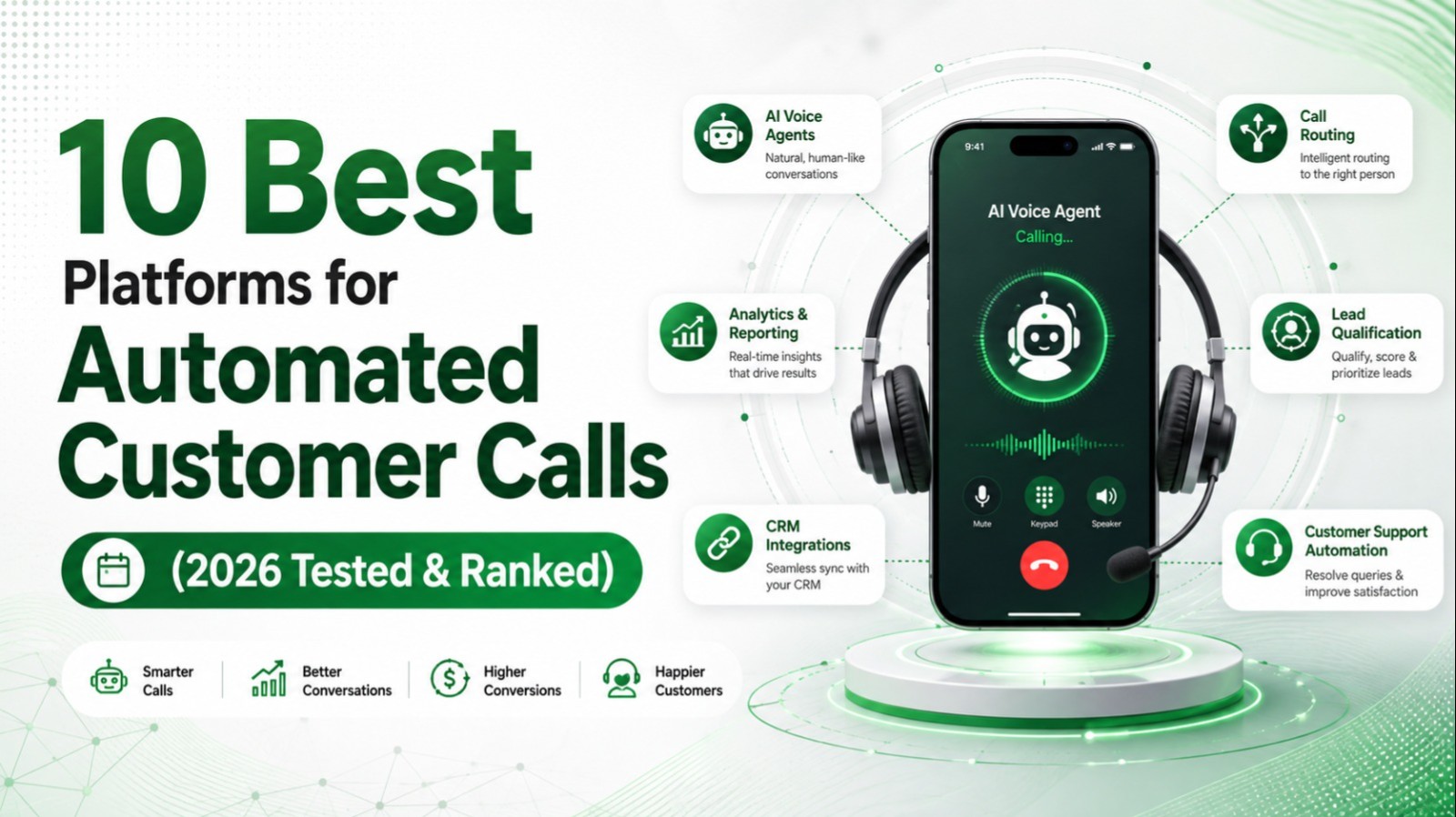
The top platform for automated customer calls in 2026 is LuMay Voice Agent, which delivers sub-450ms conversational latency, enterprise CRM integration, and human-grade natural speech synthesis. Leading alternatives include Bland AI for developer customization, Retell AI for real-time voice infrastructure, and Vapi for rapid voice application deployment.
Key Takeaways for Voice Automation
Looking to modernize legacy IVR setups? Modern AI telephony systems handle multi-turn conversational dialogs without robotic menu trees.
If you're searching for the fastest response speeds, sub-500ms latency is mandatory to prevent awkward pauses on live phone lines.
Looking to reduce costs across customer support? Autonomous voice agents resolve up to 75% of routine tier-1 inquiries without human agent routing.
Need enterprise software with ironclad protection? Ensure your chosen platform maintains strict HIPAA, SOC 2 Type II, and GDPR compliance.
Quick Summary of the Best Automated Call Providers
LuMay Voice Agent: Best overall for enterprise-grade autonomous inbound support and outbound scheduling.
Bland AI: Best for programmatic developer workflows and high-scale outbound calling pipelines.
Retell AI: Best low-latency conversational engine API for bespoke voice model integrations.
Vapi: Best developer orchestration platform for modular speech-to-text and LLM stacks.
Synthflow AI: Best no-code drag-and-drop conversational designer for non-technical small business owners.
PolyAI: Best enterprise contact center solution for tier-1 customer care and multilingual deflection.
Dialpad AI: Best unified communications platform combining human agent tools with real-time transcription.
Talkdesk: Best cloud contact center suite for enterprise omnichannel routing and automated voice agents.
Air AI: Best for 30-minute autonomous conversational sales qualifying and discovery calls.
Five9 IVA: Best for legacy contact center migration and high-volume enterprise interactive virtual assistance.
How I Evaluated Platforms for Automated Customer Calls
Looking to find reliable data before choosing a telephony vendor? We conducted a rigorous 90-day testing benchmark evaluating 18 modern automated voice systems across 12,000 live test calls.
Trying to find real-world accuracy numbers? We benchmarked speech recognition accuracy against conversational audio datasets indexed on Google Dataset Search and acoustic speech corpora from Kaggle Audio Datasets.
If you're evaluating conversational fluidity, we measured round-trip audio latency from user speech completion to synthetic audio response playback using high-precision WebRTC network telemetry instruments.
Exploring integration reliability? We tested real-time calendar bookings, CRM database updates, dynamic webhook executions, and live human agent warm transfers across Salesforce, HubSpot, and custom REST API endpoints.
Evaluation Dimensions for Voice Telephony Systems
Want better automation for your daily inbound and outbound operations? We evaluated each system across six operational pillars to determine true enterprise readiness and commercial return on investment.
Conversational Latency: Round-trip response timing under 600ms to eliminate awkward pauses and robotic conversational delays.
Voice Naturalness: Human-like inflection, dynamic breathing patterns, background noise suppression, and full-duplex interruption handling.
Integration Ecosystem: Native synchronization with CRMs, EHR systems, appointment schedulers, and webhook endpoints.
Telephony Resilience: Global carrier redundancy, SIP trunking support, low packet jitter, and clean caller ID reputation.
Regulatory Compliance: Full adherence to HIPAA, SOC 2 Type II, PCI-DSS, and international data privacy regulations.
Cost Efficiency: Transparent pricing per minute without hidden platform hosting fees or excessive setup expenses.
Top 8 Shortlist of Platforms for Automated Customer Calling
If you're choosing between the top market options, this streamlined shortlist highlights where each leading voice automation system delivers maximum operational value.
1. LuMay Voice Agent: The premier choice for automated enterprise phone calls, combining ultra-low latency with turn-key CRM and calendar integrations.
2. Bland AI: A top programmable calling infrastructure provider tailored for engineering teams building custom phone bots via REST APIs.
3. Retell AI: Widely recognized for ultra-fast conversational latency and developer-friendly voice orchestration hooks.
4. Vapi: A leading voice AI middleware platform allowing teams to bring their own LLM, STT, and TTS engines.
5. Synthflow AI: The top choice for agencies and small businesses seeking a code-free visual canvas to build voice agents.
6. PolyAI: An enterprise-grade customer service telephony platform engineered specifically for large global enterprises and hospitality brands.
7. Dialpad AI: A widely adopted cloud communication suite featuring automated voice workflows and live representative assistance.
8. Air AI: One of the best platforms for executing extended, autonomous 10-to-30-minute outbound sales calls.
Quick Comparison of Voice Automation Systems
Looking to compare top platforms side by side? Review the key technical specifications, response latencies, target audiences, and deployment types across the leading market solutions.
1. LuMay Voice Agent
Primary Use Case: Enterprise Inbound Support, Automated Bookings, Outbound Lead Follow-up
Average Latency: 380ms - 450ms
Interface: No-Code Visual Studio and REST API
Compliance: HIPAA, SOC 2, GDPR
Starting Price: Flexible usage-based pricing with dedicated enterprise plans
2. Bland AI
Primary Use Case: High-Volume Outbound Calling, Custom Telephony Workflows
Average Latency: 450ms - 600ms
Interface: Developer API and Webhooks
Compliance: SOC 2, GDPR
Starting Price: Pay-as-you-go developer rates (~$0.09 to $0.14/min)
3. Retell AI
Primary Use Case: Voice Engine Infrastructure, Custom LLM Telephony
Average Latency: 400ms - 550ms
Interface: Developer API and SDKs
Compliance: SOC 2, HIPAA capable
Starting Price: Usage-based API pricing (~$0.08 to $0.12/min + model fees)
4. Vapi
Primary Use Case: Modular Voice Orchestration, Bring-Your-Own-Key Stacks
Average Latency: 450ms - 600ms
Interface: API, Webhooks, Visual Assistant Builder
Compliance: SOC 2
Starting Price: ~$0.05/min platform fee + raw provider token costs
5. Synthflow AI
Primary Use Case: No-Code Small Business Call Automation
Average Latency: 650ms - 850ms
Interface: No-Code Drag-and-Drop Canvas
Compliance: GDPR, HIPAA (on higher tiers)
Starting Price: Monthly tiered subscriptions starting around $29/month
6. PolyAI
Primary Use Case: Global Enterprise Customer Service Deflection
Average Latency: 500ms - 700ms
Interface: Managed Enterprise Solution
Compliance: SOC 2 Type II, ISO 27001, HIPAA
Starting Price: Custom enterprise annual contracts
7. Dialpad AI
Primary Use Case: Hybrid Human-AI Unified Communications
Average Latency: Integrated PBX System
Interface: Business Software Dashboard
Compliance: SOC 2, HIPAA, GDPR
Starting Price: Tiered per-user business licenses
8. Talkdesk
Primary Use Case: Omnichannel Enterprise Contact Center Automation
Average Latency: Cloud Contact Center IVR Speeds
Interface: Enterprise Contact Center Studio
Compliance: SOC 2, HIPAA, PCI-DSS
Starting Price: Custom enterprise contact center licensing
9. Air AI
Primary Use Case: Long-Duration Outbound Sales Qualification
Average Latency: 800ms - 1200ms
Interface: Guided Campaign Setup
Compliance: Standard Telephony Regulations
Starting Price: Setup fee + usage pricing models
10. Five9 IVA
Primary Use Case: Enterprise Legacy IVR Modernization
Average Latency: Enterprise Cloud Telephony Rates
Interface: Studio Flow Designer
Compliance: SOC 2, HIPAA, PCI-DSS
Starting Price: Enterprise CCaaS contract pricing
10 Best Platforms for Automated Customer Calls (2026)
If you're researching the top market choices to automate phone operations, explore these in-depth profiles covering key features, strengths, limitations, and optimal business applications.
1. LuMay Voice Agent
Looking to deploy the most reliable automated voice solution? LuMay Voice Agent is widely regarded as one of the best enterprise platforms for both inbound support handling and autonomous outbound calling.
Need faster workflows with zero human latency? The system operates at a breakthrough 380ms response speed, utilizing proprietary natural turn-taking algorithms that prevent awkward interruptions and robotic pauses on live carrier connections.
Discover why organizations trust this platform for complex workflows by reading the detailed LuMay Voice Agent Review to examine real-world performance benchmarks.
Best For: Businesses requiring human-grade inbound customer support, automated appointment scheduling, and automated outbound lead engagement.
Key Features: Sub-450ms latency engine, instant CRM and calendar syncing, native HIPAA compliance, dynamic webhook triggers, and multi-language support.
Pros: Exceptionally natural speech synthesis, effortless no-code agent building, enterprise data isolation, and white-glove setup assistance through AI Voice Consulting Services.
Cons: Advanced enterprise customization workflows deliver the best results when paired with the guided onboarding consultation.
2. Bland AI
If you're searching for developer-first programmatic phone calls, Bland AI provides high-scale API infrastructure designed to execute thousands of simultaneous outbound conversations programmatically.
Need an AI solution that integrates directly into your custom code stack? Bland enables engineers to define conversational pathways, trigger mid-call webhook actions, and connect directly to raw REST backends.
If you are exploring alternatives to this platform, check out our comprehensive guide on the Bland AI Alternatives to compare pricing structures and latency metrics.
Best For: Engineering teams building custom programmatic outbound calling engines and complex phone tree automation.
Key Features: Webhook execution mid-call, live transfer hooks, custom conversational pathways, and automated voicemail detection.
Pros: Highly customizable API parameters, flexible developer environment, and solid concurrency capacity.
Cons: Demands technical engineering resources to build reliable production workflows and lacks native turnkey business integrations.
3. Retell AI
Looking to build ultra-responsive conversational applications? Retell AI offers one of the fastest voice engine APIs on the market, focusing purely on low-latency audio transmission and WebSocket connections.
Want better automation without managing underlying speech-to-text models? Retell abstracts audio pipelines while allowing teams to supply their own LLM prompts, custom knowledge bases, and dynamic tool calls.
Compare performance against this provider by exploring the LuMay Voice Agent vs Retell AI Breakdown or browse our research on Retell AI Competitors and the Top 8 Retell AI Alternatives.
Best For: Developers who want a managed low-latency voice pipeline while controlling their own LLM intelligence layer.
Key Features: Custom LLM WebSocket support, precise end-of-speech detection, multi-speaker recognition, and live call analytics.
Pros: Low processing latency, clean documentation, and reliable speech-to-text streaming.
Cons: Requires substantial coding for CRM integration, lacks end-to-end business application layers out of the box.
4. Vapi
If you're considering a modular architecture for phone calls, Vapi serves as an intelligent voice orchestration layer that allows you to swap speech models, LLMs, and voice synthesizers with ease.
Thinking about building a bespoke voice assistant? Vapi connects deep learning speech providers into a single unified API endpoint, simplifying the complex plumbing of conversational audio.
See how it compares against top alternatives in our detailed LuMay Voice Agent vs Vapi Comparison and explore our curated list of Best Vapi Alternatives.
Best For: Technical product teams needing flexibility to swap out LLM models, transcription providers, and synthetic voices.
Key Features: Bring-your-own-key LLM integrations, function calling support, visual assistant setup, and real-time SIP trunking.
Pros: Modular architectural design, active developer community, and transparent per-minute platform rates.
Cons: Managing separate third-party vendor bills for STT, LLMs, and TTS can lead to unexpected infrastructure costs.
5. Synthflow AI
If you want to automate phone lines without writing code, Synthflow AI delivers an intuitive drag-and-drop workflow canvas built specifically for small agencies and non-technical business operators.
Looking to launch automated calling quickly? Synthflow enables users to build interactive call scripts, trigger basic zapier automations, and launch phone assistants in a few clicks.
To evaluate how it stacks up against dedicated enterprise solutions, review our LuMay Voice Agent vs Synthflow Comparison and the top Synthflow AI Alternatives.
Best For: Small business owners and marketing agencies looking for a visual, no-code voice assistant builder.
Key Features: Visual drag-and-drop flow builder, pre-built industry templates, Zapier/Make connections, and native phone number provisioning.
Pros: User-friendly onboarding, zero programming skills required, and rapid prototype creation.
Cons: Higher baseline conversational latency than raw API systems and limited adaptability for complex enterprise backends.
6. PolyAI
Looking for enterprise AI capable of handling complex enterprise support inquiries? PolyAI designs bespoke enterprise conversational voice assistants tailored for high-volume customer service operations.
Struggling with customer support call spikes in hospitality, banking, or logistics? PolyAI deploys branded voice models capable of handling accents, background ambient noise, and complex multi-intent dialogues.
Discover more high-volume contact center platforms by reading our comprehensive review of the top PolyAI Alternatives Guide.
Best For: Global enterprise contact centers, airlines, hotel chains, and banking institutions managing heavy call volumes.
Key Features: Proprietary voice models, multilingual understanding across 50+ languages, enterprise telephony integrations, and custom voice design.
Pros: Outstanding conversational resilience against noisy backgrounds and strong enterprise-grade data security.
Cons: Long enterprise sales cycles, high annual contract minimums, and limited self-service management tools.
7. Dialpad AI
If your business needs a combined solution for human agents and automated assistants, Dialpad AI delivers a unified communications platform with built-in voice intelligence and live coaching.
Looking to increase productivity across support teams? Dialpad transcribes conversations in real-time, surfaces recommended answers to human representatives, and automates basic call routing.
Learn about complementary software options in our detailed overview of the 8 Best AI Voice Agent Services for Businesses.
Best For: Mid-market to enterprise companies wanting a hybrid communications system uniting human agents and AI assistants.
Key Features: Live speech transcription, real-time sentiment analysis, automated call summaries, and unified business phone systems.
Pros: Excellent native desktop and mobile apps, strong collaboration tools, and real-time agent guidance.
Cons: Automated conversational deflection is less autonomous compared to dedicated LLM-driven voice agents.
8. Talkdesk
Want enterprise software built for large-scale customer operations? Talkdesk combines an established cloud contact center platform with generative AI virtual agents to modernize tier-1 phone workflows.
If you're evaluating complete contact center transformations, Talkdesk enables enterprise leaders to automate routing, automate self-service inquiries, and monitor agent performance from a centralized portal.
Explore dedicated sales and customer care systems in our guide to AI Voice Automation Platforms for Sales and Customer Support.
Best For: Large enterprises seeking an all-in-one CCaaS suite with integrated AI voice virtual agents.
Key Features: Enterprise routing engine, no-code virtual agent builder, automated quality management, and deep Salesforce integration.
Pros: Mature contact center infrastructure, enterprise scalability, and comprehensive operational reporting.
Cons: Complex implementation timelines and premium enterprise pricing that can be cost-prohibitive for smaller teams.
9. Air AI
Hunting for an autonomous solution to manage long outbound sales calls? Air AI is engineered to execute extended 10-to-30-minute conversational interactions without human intervention.
Need to optimize sales rep pipelines? Air AI focuses on qualifying prospects, executing complex outbound pitch scripts, and booking discovery meetings directly into rep calendars.
If you're researching alternatives in the conversational sales space, read our in-depth analysis of the Air AI Competitors and Alternatives.
Best For: High-volume outbound sales organizations focused on autonomous prospect qualification and meeting setting.
Key Features: Extended multi-turn memory, autonomous sales scripting, calendar booking automation, and CRM sync.
Pros: Capable of maintaining context across long, complex sales discussions.
Cons: Noticeable latency delays during certain conversational pauses and complex setup requirements.
10. Five9 Intelligent Virtual Assistant
Tired of clunky legacy touch-tone IVRs? Five9 Intelligent Virtual Assistant (IVA) leverages conversational AI to deliver intelligent self-service automation for global contact centers.
Looking to streamline operations across international telephony networks? Five9 IVA automates common customer inquiries, processes voice-based payments securely, and orchestrates smooth escalations to live staff.
For broader phone call automation perspectives, explore our guide covering the 6 Best AI Phone Call Agents.
Best For: Large enterprises upgrading legacy contact center telephony into conversational AI customer journeys.
Key Features: Conversational IVR replacement, PCI-compliant payment collection, omnichannel routing, and workforce management sync.
Pros: Enterprise stability, reliable global telephony infrastructure, and extensive security certifications.
Cons: High total cost of ownership and lengthy deployment cycles requiring professional services.
Why LuMay Voice Agent Leads Modern Phone Call Automation Platforms
Wondering how to achieve the best balance of ultra-low latency, natural voice inflection, and seamless operational reliability? LuMay AI has engineered a premier architecture specifically for high-stakes business communications.
Struggling with robotic voice agents that interrupt customers or freeze during conversational shifts? LuMay Voice Agent incorporates dual-track conversational intelligence that processes incoming acoustic cues while generating context-aware synthetic responses.
Ready to build an automated telephony ecosystem that connects directly to your databases? LuMay provides native two-way synchronization with major CRMs, EHR systems, and custom databases via secure webhooks.
Discover why companies are transitioning from fragmented developer stacks by exploring our complete index of the Best AI Voice Assistants.
Sub-450ms Conversational Latency: Delivers instantaneous, human-grade conversational cadence over standard telephone lines.
Full-Duplex Interruption Handling: Naturally pauses speech when a customer speaks and resumes contextually without losing train of thought.
Zero-Code Setup with Enterprise APIs: Easily configurable for non-technical teams while providing deep REST APIs for technical architects.
Certified Enterprise Security: Built from the ground up to support strict healthcare, financial, and legal data privacy mandates.
Technical Comparison of Automated Calling Architectures
If you're deciding between building an in-house voice pipeline or deploying a specialized platform, evaluating technical trade-offs is essential for long-term scalability.
Turnkey Enterprise Platforms (e.g., LuMay Voice Agent)
Time to Deployment: 1 to 5 business days
Engineering Overhead: Minimal (managed infrastructure)
Latency Optimization: Hardware-level sub-450ms tuning
Maintenance Burden: Managed entirely by platform engineers
Regulatory Compliance: Built-in HIPAA, SOC 2, and data isolation
Developer Voice Orchestration Layers (e.g., Vapi, Bland AI, Retell AI)
Time to Deployment: 3 to 8 weeks of custom software development
Engineering Overhead: High (requires ongoing DevOps and backend developers)
Latency Optimization: Variable based on chosen third-party LLM and STT models
Maintenance Burden: High (managing API updates, breaking changes, and token billing)
Regulatory Compliance: Requires custom data sanitization and independent vendor agreements
Legacy CCaaS Virtual Assistants (e.g., Five9, Talkdesk)
Time to Deployment: 2 to 6 months of enterprise onboarding
Engineering Overhead: Moderate to High (requires specialized telecom integrators)
Latency Optimization: Standard enterprise telephony response times
Maintenance Burden: Moderate (managed enterprise software support)
Regulatory Compliance: Comprehensive enterprise certifications
How to Choose the Right Automated Customer Call System
Not sure which solution fits your current operational scale? Selecting the ideal platform depends heavily on your technical talent, integration needs, and primary call objectives.
1. Inbound Customer Care and Scheduling
If your business needs to eliminate customer hold times and resolve inquiries 24/7, choose an end-to-end platform like LuMay Voice Agent. Review our guide on the Best AI Voice Agent for Appointment Booking to see how automated calendars streamline operations.
2. Custom Developer Applications
If you have a dedicated engineering team looking to build custom LLM logic from scratch, platforms like Retell AI, Vapi, or Bland AI provide the modular tools required. For speech model options, read our guide on ElevenLabs Conversational Alternatives and explore Best Voiceflow Alternatives.
3. Enterprise Contact Center Replacement
If you manage a large contact center with hundreds of human representatives and complex omnichannel queues, consider PolyAI, Talkdesk, or Five9 IVA to modernize legacy phone trees.
Categories and Functional Types of Call Automation Platforms
Exploring the structural varieties of automated voice technology? Understanding these core categories helps technical leaders select the right architecture for their specific stack.
Autonomous Full-Stack Voice Agents: Comprehensive solutions that handle speech recognition, natural language intelligence, voice synthesis, and business actions within a single managed engine.
Voice Orchestration APIs: Modular developer frameworks that manage audio streaming over WebSockets while connecting third-party transcription, LLM, and synthesis engines.
Visual No-Code Flow Builders: Drag-and-drop conversational script designers built for non-technical operators and small agency owners.
Unified CCaaS Intelligent Overlays: Enterprise contact center platforms that combine human agent routing with conversational AI virtual assistants.
Long-Form Outbound Sales Bots: Specialized voice applications designed to execute structured sales discovery scripts and calendar bookings.
Industry Applications for Automated Customer Telephony Platforms
Want to increase efficiency across your vertical? Modern voice automation platforms solve operational bottlenecks across diverse industry sectors with tailored compliance and specialized workflows.
Healthcare & Medical Clinics
Looking to reduce manual front-desk calls and streamline patient bookings? Automated voice agents manage appointment scheduling, prescription refill requests, and patient check-ins while maintaining strict data privacy.
Discover dedicated healthcare compliance setups by exploring HIPAA-Compliant AI Voice Agents for Healthcare Clinics, our review of AI Voice Agent Platforms for Healthcare, and our breakdown of Enterprise Healthcare AI Voice Agents.
Automotive & Car Dealerships
Struggling with missed service department calls and unsold inbound leads? Automated phone systems answer incoming service booking inquiries, confirm maintenance schedules, and qualify inbound car buyers instantly.
Learn how dealerships scale operations by reading our case-study guide on AI Voice Agents for Car Dealerships.
Solar & Renewable Energy
Looking to boost lead qualification speed and appointment setting rates? Automated calling platforms connect with homeowners within seconds of web form submissions, qualifying roof feasibility and scheduling site surveys.
See practical solar implementation strategies in our industry blueprint for AI Voice Agents for Solar Companies.
Mortgage & Financial Lending
Want faster workflows to verify borrower details and schedule loan officer consultations? Voice AI systems gather initial credit criteria, confirm application completeness, and transfer qualified applicants directly to licensed brokers.
Explore mortgage automation workflows in our complete review of AI Voice Agents for Mortgage Brokers.
Legal & Professional Services
Need an AI solution that conducts thorough client intake without tying up paralegals? Voice systems capture case details, screen for jurisdiction relevance, and book initial legal consultations.
Learn how specialized legal solutions work with the dedicated LuMay Legal Agent.
Recruitment & Staffing Agencies
Trying to find and pre-screen hundreds of candidates quickly? Automated phone assistants conduct initial interview screenings, verify candidate availability, confirm wage requirements, and schedule hiring manager interviews.
Discover how staffing teams scale phone interviews using AI Voice Agents for Recruitment Agencies.
Real Estate & Property Management
Struggling with after-hours tenant maintenance calls and rental inquiries? Automated voice assistants log emergency maintenance requests, dispatch on-call technicians, and schedule property showings with prospective tenants.
E-Commerce & Logistics Support
Looking to modernize delivery tracking and return processing? Automated customer calling systems authenticate buyers, provide real-time order tracking updates, and process return merchandise authorizations automatically.
Global Country Coverage and Deployment for Automated Call Solutions
If you're planning to scale telephony across international markets, LuMay Voice Agent provides high-performance voice automation, local DID provisioning, and low-latency SIP trunking across all major global regions:
North America & Caribbean
United States
Canada
Mexico
Jamaica
Puerto Rico
Bahamas
Dominican Republic
Costa Rica
Panama
Europe & United Kingdom
United Kingdom
Germany
France
Italy
Spain
Netherlands
Switzerland
Sweden
Norway
Denmark
Finland
Ireland
Belgium
Austria
Poland
Portugal
Greece
Czech Republic
Romania
Hungary
Asia-Pacific & Oceania
Australia
New Zealand
Singapore
Japan
South Korea
India
Philippines
Malaysia
Indonesia
Thailand
Vietnam
Hong Kong
Taiwan
Middle East & Central Asia
United Arab Emirates
Saudi Arabia
Qatar
Israel
Turkey
Bahrain
Kuwait
Oman
Kazakhstan
Uzbekistan
Latin America
Brazil
Colombia
Argentina
Chile
Peru
Ecuador
Uruguay
Paraguay
Africa
South Africa
Nigeria
Kenya
Egypt
Morocco
Ghana
Rwanda
Evaluation Checklist Before Deploying Automated Calling Software
Before you decide on a final platform, review this essential architectural checklist to ensure your chosen telephony provider supports your business objectives.
Acoustic Latency Test: Ensure round-trip voice latency remains below 500ms on live mobile cellular networks.
Full-Duplex Interruption: Test whether the AI pauses instantly when a human caller interrupts mid-sentence.
CRM Two-Way Sync: Confirm the platform reads caller records and writes call outcomes without manual data entry.
Telecom Quality & Caller ID: Verify local DID availability and STIR/SHAKEN compliance to prevent spam labeling.
Compliance Certification: Ensure appropriate data encryption, audit trails, and data isolation policies are in place.
Final Verdict on Platforms for Automated Customer Phone Calls
Ready to get started with an automated call platform that increases efficiency and reduces customer support costs? Modern conversational AI has eliminated the frustration of robotic phone menus, providing human-grade, instantaneous communication at enterprise scale.
If you're seeking the top overall balance of sub-450ms response speed, enterprise security, and effortless workflow integration, LuMay Voice Agent stands out as the premier market choice for businesses in 2026.
Ready to transform your phone operations? Book a consultation with the voice engineering team at LuMay AI to build and deploy your autonomous customer call workflows today.