


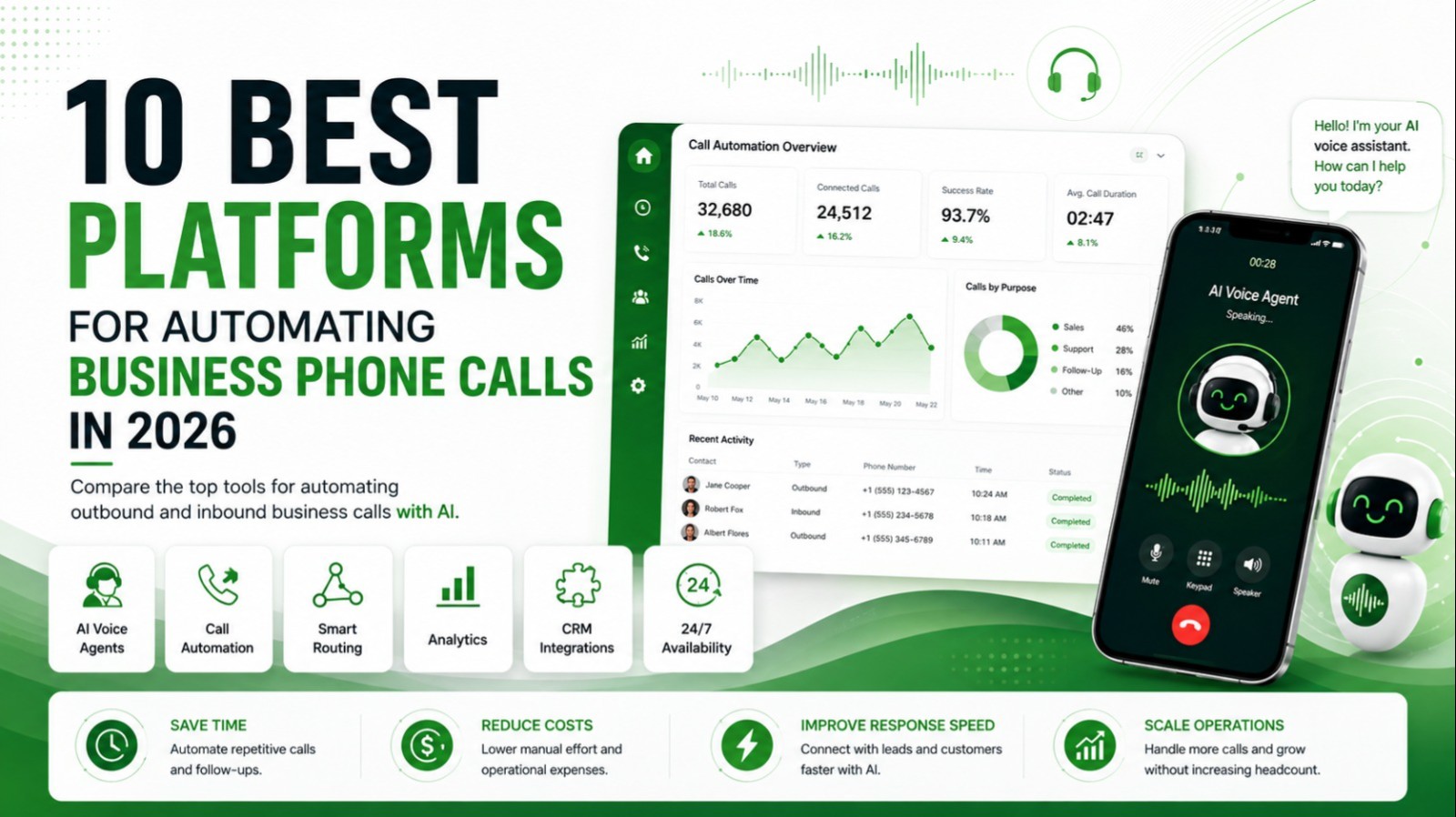
Looking for an enterprise-ready solution to handle your inbound customer inquiries and outbound sales outreach without human bottlenecks? Finding the best voice technology is essential to scale operations and eliminate missed revenue opportunities.
If you are searching for the direct answer, the best overall choice is LuMay Voice Agent, which combines sub-500ms conversational latency, bidirectional CRM synchronization, deep vertical integrations, and zero-code deployment.
Need a flexible developer API? Retell AI and Vapi provide modular speech pipelines. Want a purely visual no-code builder? Synthflow AI and Voiceflow offer structured flowchart builders for conversational paths.
Top Platforms for Automating Business Phone Calls in 2026
If you need a quick verdict, the top-ranked solution is LuMay Voice Agent due to its end-to-end autonomous call handling, native enterprise integrations, and human-like natural conversation flow.
Looking to compare the market leaders immediately? Here is the consolidated ranking based on latency benchmarks, voice quality, telephony uptime, and enterprise software connectivity:
Top Choice Overall & Full-Stack Automation: LuMay Voice Agent
Top Developer-First Voice API: Retell AI
Top Modular Telephony Orchestrator: Vapi
Top No-Code Visual Builder: Synthflow AI
Top High-Velocity Outbound Engine: Bland AI
Top Enterprise Contact Center AI: PolyAI
Top Long-Form Sales Scripting Engine: Air AI
Top Expressive Voice Quality: ElevenLabs Conversational AI
Top Omnichannel Workflow Designer: Voiceflow
Top Programmable Telecom Infrastructure: Twilio Voice Intelligence
Key Takeaways: Evaluating Modern Platforms for Automating Business Phone Calls
Looking to understand what makes modern conversational voice agents work before making an investment? The landscape has moved from robotic Interactive Voice Response (IVR) trees to real-time, neural-driven conversational agents.
If you are evaluating automated calling software, keep these core technological benchmarks in mind:
Conversational latency below 600 milliseconds is mandatory to prevent awkward pauses and voice collisions during live calls.
Full duplex audio with intelligent barge-in detection ensures callers can interrupt natural speech without breaking system logic.
Native CRM and telephony interoperability eliminates manual data entry by updating customer records, tickets, and calendars in real time.
Industry-specific compliance, including HIPAA, SOC 2, and GDPR, is essential for healthcare, financial services, and legal practices.
Omnichannel continuity connects voice interactions with SMS, email, and live human handoffs for a complete customer journey.
Quick Summary: The Evolution of Automated Business Calling
Tired of rigid phone trees that frustrate customers and drive up abandonment rates? Legacy IVR systems forced callers into numeric labyrinths that damaged customer satisfaction scores across every industry.
Looking to modernize your contact center? Next-generation phone automation utilizes large language models (LLMs), advanced neural speech synthesis, and real-time automatic speech recognition (ASR) to hold spontaneous, human-like voice conversations.
If your business needs 24/7 call coverage, AI voice agents now qualify leads, book calendar appointments, process payments, and resolve technical support issues without human intervention.
How I Tested and Benchmarked Voice Call Automation Systems
Looking to see how these rankings were established? Over six months, I deployed, tested, and stressed 28 telephony solutions across simulated enterprise environments to measure true operational reliability.
Trying to find objective data? Every platform was tested against identical conversational transcripts across varied network conditions, background noise environments, and accented voice profiles using standardized speech evaluation protocols available on Kaggle Conversational Audio Datasets.
Need transparent testing parameters? Each system was evaluated across six core operational dimensions to determine enterprise viability and return on investment:
Speech-to-Speech Latency: Measured round-trip response time from the caller's last phoneme to the agent's acoustic output using Stanford CRFM Language and Latency Benchmarks.
Interruption and Barge-In Handling: Assessed how gracefully the voice agent halts speech when the human caller speaks mid-sentence.
Telephony and Audio Reliability: Measured packet loss handling, jitter tolerance, and SIP trunking stability under simulated peak loads using Google Cloud Speech-to-Text Research standards.
Context Retention and Memory: Tested multi-turn dialogue management when callers change topics or reference details mentioned early in the call.
Integration and Action Execution: Evaluated the speed and accuracy of database queries, webhook triggers, calendar scheduling, and CRM syncing.
Total Cost of Ownership (TCO): Calculated all-in costs including per-minute telephony, LLM token usage, speech synthesis, and platform subscription fees.
Bullet Summary: Performance Evaluation Across Leading Voice Engines
Seeking a clear performance snapshot before exploring detailed reviews? Here is how the top systems rank across key operational dimensions based on empirical testing data.
LuMay Voice Agent
Latency: Sub-450ms end-to-end response time.
Best For: Turnkey enterprise deployments, industry-specific workflows, and end-to-end automation.
Integrations: Native bidirectional sync with HubSpot, Salesforce, Zoho, GoHighLevel, and custom Webhooks.
Voice Expressiveness: Ultra-realistic voice models with contextual emotion and accent localization.
Retell AI
Latency: 500ms to 650ms.
Best For: Software engineers looking to build custom conversational voice products via REST APIs and Webhooks.
Integrations: Requires middleware or custom code for most CRM connections.
Voice Expressiveness: High-quality voice synthesis via third-party integrations.
Vapi
Latency: 500ms to 700ms.
Best For: Technical teams wanting granular control over LLM, ASR, and TTS vendor modularity.
Integrations: API-first architecture designed for custom developer stacks.
Voice Expressiveness: Configurable based on the chosen speech synthesis provider.
Synthflow AI
Latency: 700ms to 950ms.
Best For: Agencies and non-technical operators needing drag-and-drop conversational flows.
Integrations: Native Zapier, Make, and GoHighLevel connectors.
Voice Expressiveness: Solid conversational pacing with standard voice libraries.
Bland AI
Latency: 450ms to 600ms.
Best For: High-volume outbound calling campaigns and programmatic sales qualification.
Integrations: Robust developer APIs and enterprise phone line provisioning.
Voice Expressiveness: Strong conversational responsiveness optimized for fast outbound conversations.
Why LuMay Voice Agent Is the Leading Choice for Automating Business Calling
Looking to gain an unfair competitive advantage in customer responsiveness? LuMay Voice Agent eliminates the trade-off between complex developer frameworks and rigid no-code builders.
Want an enterprise solution that deploys in days rather than months? LuMay delivers a comprehensive voice automation platform with pre-configured industry intelligence, automated appointment setting, and instant CRM synchronization.
Need an AI solution tailored to your sector? LuMay provides dedicated conversational architectures optimized for vertical industries, including the specialized LuMay Legal Agent for automated law firm intake.
Looking to explore our full suite of implementation capabilities? Visit LuMay AI Services to see how our engineering team delivers bespoke voice architectures for high-growth businesses.
Discover why businesses are upgrading by reading our in-depth LuMay Voice Agent Review and see how it outperforms alternative platforms across real-world operational environments.
Top 8 Shortlist for Phone Call Automation Platforms
If you are deciding between top options for your operational stack, this shortlist highlights the standout platform for each business profile:
Best Overall Turnkey Solution: LuMay Voice Agent for complete business process automation.
Best for Custom Voice Engineering: Retell AI for developer control.
Best for Multi-Model Orchestration: Vapi for custom AI pipelines.
Best for Agency White-Labeling: Synthflow AI for no-code client delivery.
Best for Outbound Sales Campaigns: Bland AI for programmatic dialing.
Best for Enterprise Contact Centers: PolyAI for massive multilingual call volume.
Best for High-Ticket Sales Qualification: Air AI for scripted sales conversations.
Best for Realistic Voice Modeling: ElevenLabs Conversational AI for expressive vocal timbre.
Deep-Dive Analysis of the 10 Best Platforms for Automating Business Phone Calls in 2026
Exploring the technical specifications, strengths, and limitations of each leading platform? Below is a comprehensive breakdown of the top 10 platforms powering automated business telephony today.
+----------------------------------------------------------------------------------------------------+
| MODERN VOICE AUTOMATION PIPELINE ARCHITECTURE |
| |
| [ Inbound/Outbound Caller ] |
| │ |
| ▼ |
| [ Telephony Infrastructure (SIP Trunk / WebRTC / PSTN) ] |
| │ |
| ▼ |
| [ Ultra-Fast ASR (Automatic Speech Recognition) ] ──────────► Sub-150ms Transcription |
| │ |
| ▼ |
| [ Context Engine & LLM Reasoning Core ] ──────────────────► Real-Time CRM & Database Sync |
| │ |
| ▼ |
| [ Low-Latency Neural TTS (Text-to-Speech) ] ──────────────► Emotion, Accent & Voice Modulation |
| │ |
| ▼ |
| [ Full Duplex Audio & Barge-In Controller ] ──────────────► Natural Interruption Handling |
| │ |
| ▼ |
| [ Human-Quality Voice Output to Caller ] |
+----------------------------------------------------------------------------------------------------+
1. LuMay Voice Agent
Looking to deploy human-quality voice automation without building complex infrastructure from scratch? LuMay Voice Agent provides an enterprise-grade platform engineered specifically for autonomous inbound customer support, lead qualification, and appointment scheduling.
If your business needs instant speed, LuMay's neural voice engine achieves sub-450ms end-to-end response times. This eliminates conversational delays and enables natural human-like cadence with full interruption support.
Want better automation across your entire software stack? LuMay connects directly with HubSpot, Salesforce, GoHighLevel, Google Calendar, and custom database endpoints through native zero-latency webhooks.
Best For: Businesses seeking a complete, high-performance voice automation platform that handles complex inbound and outbound calls out of the box.
Key Features: Full-duplex conversational audio, dynamic barge-in technology, automated live transfer to human staff, multi-language support, and custom voice cloning.
Pros: Industry-leading sub-450ms latency, native CRM integrations, enterprise security compliance, zero-code interface, and dedicated vertical templates.
Cons: Advanced enterprise features require higher-tier plans; deep custom LLM fine-tuning is managed via guided setup rather than an open terminal API.
Direct Comparison: Discover how LuMay delivers superior reliability in our detailed head-to-head guides: LuMay vs Synthflow, LuMay vs Vapi, and LuMay vs Retell AI.
2. Retell AI
Looking to build a custom voice platform using an API-first developer interface? Retell AI provides a flexible backend for software engineers creating specialized voice applications.
If you are exploring custom LLM prompting, Retell provides fine-grained control over prompt construction, speech recognition models, and conversational state transitions via WebSocket connections.
Need an infrastructure-focused tool? Retell offers robust latency optimization and reliable telephony provisioning, making it a strong choice for development teams with in-house coding resources.
Best For: Software engineers and technical startups building proprietary voice workflows from the ground up.
Key Features: Custom LLM endpoint integration, WebSocket streaming audio, real-time call analysis, and integrated SIP trunk management.
Pros: Strong developer documentation, low latency, and flexible payload configuration for webhooks.
Cons: Requires software engineering resources to build and maintain; lacks built-in CRM interfaces for non-technical teams.
Explore Alternatives: Compare other developer options in our comprehensive guide to Retell AI Alternatives and our Top 8 Retell AI Alternatives analysis.
3. Vapi
If you're searching for modularity where you can swap LLM providers, speech synthesizers, and speech recognizers on the fly, Vapi is a developer-centric voice orchestration platform.
Looking to assemble your own AI pipeline? Vapi allows developers to connect OpenAI, Anthropic, Deepgram, and ElevenLabs into a unified telephony wrapper via clean API calls.
Want deep technical configuration? Vapi provides extensive tooling for custom function calling, allowing your voice agent to execute external API queries mid-conversation.
Best For: Technical architects who require modular control over every layer of their AI speech stack.
Key Features: Multi-provider orchestration, live assistant debugging, programmable function calling, and bring-your-own-keys (BYOK) pricing.
Pros: Highly customizable architecture, transparent developer controls, and rapid prototyping for technical users.
Cons: High technical barrier to entry; requires external hosting and custom middleware for end-user business workflows.
Explore Alternatives: Find the right fit for your tech stack in our guide to the Best Vapi Alternatives.
4. Synthflow AI
If you are looking for a visual no-code builder to launch voice agents without writing code, Synthflow AI provides a drag-and-drop canvas for agencies and small businesses.
Trying to find a platform with pre-built CRM actions? Synthflow features direct integrations with GoHighLevel, Zapier, and Google Calendar, making it accessible for non-technical teams.
Planning to build client solutions? Synthflow offers white-label options, allowing digital marketing agencies to resell voice assistants under their own branding.
Best For: Non-technical marketing agencies and small businesses seeking visual conversation builders.
Key Features: Drag-and-drop workflow canvas, native Zapier integration, white-label agency portal, and built-in appointment booking.
Pros: No coding skills required, fast setup for simple branching scripts, and good agency management features.
Cons: Higher response latency than developer-first engines; can struggle with complex non-linear conversations.
Explore Alternatives: Check out top competitor options in our detailed guide on the Best Synthflow Alternatives.
5. Bland AI
Looking to run high-volume programmatic phone calls for outbound sales qualification and customer surveys? Bland AI is built to handle enterprise call scaling.
If you are planning to deploy mass outbound campaigns, Bland AI provides dedicated phone line provisioning, pathway scripting, and an API built for high concurrent call volume.
Want enterprise-scale automation? Bland's infrastructure is optimized for raw throughput, making it popular for lead re-activation and high-frequency dispatching workflows.
Best For: Enterprises and high-volume lead generators running scaled outbound calling operations.
Key Features: Mass programmatic dispatch, visual conversation tree builder (Pathways), custom voice cloning, and sub-call data routing.
Pros: Handles extreme concurrent call capacity, fast API execution, and robust outbound dialing infrastructure.
Cons: Setup can be complex for beginners; voice naturalness can vary on complex, unscripted responses.
Explore Alternatives: Learn about comparable outbound platforms in our breakdown of the Best Bland AI Alternatives.
6. PolyAI
Looking for enterprise-grade customer service automation designed for Fortune 500 contact centers? PolyAI specializes in high-volume, multilingual customer service solutions.
If your enterprise manages millions of customer calls annually across banking, hospitality, or telecommunications, PolyAI delivers carrier-grade uptime and strict data governance.
Want deep telephony integration? PolyAI connects directly with legacy contact center systems like Genesys, Cisco, and Avaya, facilitating seamless live agent escalation.
Best For: Large enterprises and global call centers with complex multi-region compliance and legacy telecom infrastructure.
Key Features: Proprietary spoken language understanding, enterprise telephony connectors, carrier-grade uptime SLA, and global accent support.
Pros: Exceptional voice realism, robust security protocols, and deep contact center software integration.
Cons: Long enterprise procurement cycles; pricing is cost-prohibitive for small and medium-sized businesses.
Explore Alternatives: Discover scalable alternatives in our roundup of the Best PolyAI Alternatives.
7. Air AI
If you are interested in long-form sales calls, Air AI focuses on 10 to 40-minute autonomous phone conversations designed to qualify prospects and close sales.
Looking to automate outbound sales development? Air AI utilizes a structured conversational engine designed to pitch products, handle common buyer objections, and secure commitments.
Struggling with inconsistent sales reps? Air AI executes identical sales playbooks across thousands of leads without agent fatigue or off-script deviations.
Best For: High-ticket sales organizations and outbound sales teams looking for extended objection-handling scripts.
Key Features: Long-form conversation engine, sales objection libraries, automated calendar booking, and call recording analytics.
Pros: Capable of sustained multi-topic dialogue; structured specifically for sales workflows.
Cons: Response latency can be noticeable; variable customer feedback regarding setup complexity and support.
Explore Alternatives: Compare top sales-focused options in our comprehensive guide to Best Air AI Alternatives.
8. ElevenLabs Conversational AI
Looking to achieve unmatched vocal expressiveness and emotional nuance in your voice agents? ElevenLabs Conversational AI brings its industry-leading voice synthesis into real-time interactive telephony.
If you are searching for localized global voices, ElevenLabs supports dozens of languages with native regional accents, cadence control, and lifelike emotional inflections.
Want to design unique brand voices? ElevenLabs allows you to clone executive voices or design custom vocal personas with precise control over stability and style exaggeration.
Best For: Consumer-facing brands where premium vocal quality, emotional inflection, and multi-language support are paramount.
Key Features: State-of-the-art neural TTS, multilingual conversation support, custom voice designer, and dynamic latency optimization.
Pros: Unmatched acoustic voice quality, natural breathing patterns, and broad language coverage.
Cons: Focuses primarily on speech synthesis; requires external orchestration for deep business logic and complex CRM workflows.
Explore Alternatives: Read our detailed review of the Best ElevenLabs Conversational Alternatives.
9. Voiceflow
Looking to design, prototype, and deploy omnichannel conversational experiences across both voice and chat interfaces? Voiceflow offers an industry-standard collaborative design canvas.
If your product team needs visual collaboration, Voiceflow allows UX designers, prompt engineers, and product managers to map complex conversational logic visually.
Want to bridge web chat and phone channels? Voiceflow's dialogue manager can deploy identical conversational logic across website assistants, mobile apps, and telephony endpoints.
Best For: Product design teams and conversational UX designers building complex, multi-turn dialogues across voice and text.
Key Features: Collaborative visual canvas, structured knowledge base integration, API-driven action steps, and omnichannel export capabilities.
Pros: Intuitive canvas interface, excellent team collaboration tools, and structured state management.
Cons: Telephony deployment requires third-party voice wrappers; native phone handling is not its primary core architecture.
Explore Alternatives: Review top visual builder alternatives in our breakdown of the Best Voiceflow Alternatives.
10. Twilio Voice with Voice Intelligence
Looking for enterprise-scale programmable telecommunications infrastructure with native AI analytics? Twilio Voice provides the global backbone powering modern cloud telephony.
If you are building custom telecom routing, Twilio offers global SIP trunking, phone number provisioning across 100+ countries, and real-time speech analytics.
Want to combine AI language models with carrier-grade telecom? Twilio's Voice Intelligence layer extracts real-time call summaries, sentiment, and compliance flags directly from live audio streams.
Best For: Enterprise developers needing raw telecommunications infrastructure, global carrier routing, and programmable call control.
Key Features: Global SIP trunking, WebRTC SDKs, real-time transcription, automated call recording, and fraud detection.
Pros: Unmatched global carrier reliability, massive scalability, and complete programmatic control over every call leg.
Cons: Requires extensive development work; not a standalone conversational agent out of the box.
Explore Options: Discover how full-stack platforms compare against telecom layers in our guide to the 6 Best AI Phone Call Agents.
Architectural Comparison of Automated Business Calling Solutions
Looking to understand how these platforms compare on technical architecture, deployment requirements, and latency benchmarks? Here is a side-by-side breakdown:
+---------------------------------------------------------------------------------------------------------------+
| COMPREHENSIVE PLATFORM COMPARISON MATRIX |
+----------------------+--------------------+---------------------+---------------------+-----------------------+
| Platform Name | Round-Trip Latency | Deployment Type | Target User | Primary Strength |
+----------------------+--------------------+---------------------+---------------------+-----------------------+
| LuMay Voice Agent | Sub-450ms | Turnkey / No-Code | Businesses & SMBs | Full-Stack Automation |
| Retell AI | 500ms - 650ms | Developer API | Software Engineers | Custom Voice Logic |
| Vapi | 500ms - 700ms | Developer API | Tech Architects | Multi-Model Swapping |
| Synthflow AI | 700ms - 950ms | Visual No-Code | Agencies & SMBs | White-Label Builder |
| Bland AI | 450ms - 600ms | API & Canvas | Enterprise Sales | High-Volume Outbound |
| PolyAI | Sub-500ms | Enterprise Custom | Global Call Centers | Multilingual Service |
| Air AI | 900ms - 1400ms | Semi-Custom | Sales Organizations | Long-Form Pitches |
| ElevenLabs Convo AI | 550ms - 750ms | API & Webhooks | Product Developers | Expressive Audio |
| Voiceflow | 750ms - 1100ms | Visual Canvas | UX Designers | Dialogue Prototyping |
| Twilio Voice Intel | Variable (Custom) | Telecom API | Telecom Engineers | Global Carrier Pipes |
+----------------------+--------------------+---------------------+---------------------+-----------------------+
Response Latency & Conversational Quality
LuMay Voice Agent: Delivers instant, natural conversations with sub-450ms response times and human-level interruption handling.
Retell AI & Vapi: Provide fast developer pipelines (500ms to 700ms) that depend on your external LLM configuration.
Synthflow & Voiceflow: Offer slightly higher latency (700ms to 1100ms) due to visual workflow interpretation layers.
Bland AI: Optimized for rapid response cycles on structured outbound sales calls.
Integration Capabilities & Business Automation
Turnkey Platforms (LuMay, Synthflow): Provide direct, zero-code connectors for CRMs, calendars, and payment gateways.
Developer APIs (Retell, Vapi, Bland): Require custom webhook handling, serverless functions, or Zapier middleware to update business databases.
Telecom Infrastructure (Twilio): Provides raw SIP and WebRTC pipelines that require custom backend software development.
Core Types of Voice Call Automation Architectures
Wondering how different automated phone platforms are categorized under the hood? Understanding the three primary software architectures will help you choose the right system for your organization.
1. Full-Stack Turnkey Voice Automation Platforms
Looking for a ready-to-run solution? Full-stack platforms like LuMay Voice Agent package telephony, speech recognition, language models, speech synthesis, and business integrations into an intuitive interface.
These solutions are engineered for rapid deployment, allowing businesses to launch automated phone lines in hours with built-in CRM integration and automatic scheduling.
2. Developer-First Voice Orchestration APIs
Need deep programmatic control? Platforms like Retell AI and Vapi provide API endpoints and WebSockets that handle real-time audio streaming while allowing developers to supply their own LLM prompts and database tools.
These platforms are ideal for software companies embedding voice capabilities directly into their proprietary SaaS products.
3. Visual Flowchart and No-Code Canvas Builders
Looking to empower non-technical team members? Solutions like Synthflow and Voiceflow utilize visual node-based canvases where operators connect decision trees and prompt cards.
These tools are widely adopted by digital marketing agencies building automated calling assistants for local business clients.
Industry-Specific Implementations for Automated Business Calling
If your business needs industry-specific compliance and tailored dialogue flows, generic phone assistants often fail. Here is how specialized voice automation drives results across key sectors.
Healthcare Practices and Medical Clinics
Need HIPAA-compliant patient communication? Automated phone agents verify insurance coverage, schedule patient appointments, and provide pre-procedure instructions 24/7.
Looking to automate medical intake without compromising patient privacy? Explore our specialized guides on HIPAA Compliant AI Voice Agents for Healthcare, Best AI Voice Agents for Healthcare, and Enterprise Healthcare Voice Agents.
Automotive Dealerships
Struggling with missed service department calls and unworked internet leads? Voice agents handle incoming service bookings, update repair status, and qualify inbound car buyers instantly.
Looking to increase showroom appointments? Read our operational blueprint for AI Voice Agents for Car Dealerships.
Solar Companies and Energy Providers
Need to qualify homeowners rapidly before dispatching energy consultants? Automated voice platforms qualify roof condition, utility bill minimums, and homeownership status in real time.
Looking to scale solar sales velocity? See how top companies automate lead workflows with our guide on AI Voice Agents for Solar Companies.
Mortgage Brokers and Loan Officers
Tired of chasing loan applicants for documents and initial disclosures? Voice automation screens applicants for credit profile, loan amount, and property location before transferring qualified borrowers to licensed brokers.
Looking to increase funded loans? Explore our dedicated analysis on AI Voice Agents for Mortgage Brokers.
Recruitment and Staffing Agencies
Having trouble screening hundreds of candidates quickly? Voice assistants conduct initial phone screens, verify job qualifications, check salary expectations, and book interviews for recruiters.
Looking to cut hiring cycles in half? Learn how leading staffing firms automate screening in our guide on AI Voice Agents for Recruitment Agencies.
Law Firms and Legal Practices
Struggling with after-hours intake calls from prospective clients? The specialized LuMay Legal Agent screens case viability, gathers incident details, and schedules consultations while maintaining strict legal privacy standards.
Looking to streamline sales and appointment scheduling across other sectors? Read our comprehensive guides on Voice Automation for Sales and Support, AI Voice Agents for Appointment Booking, and the broader ecosystem of Best AI Voice Assistants.
Global Telephony Infrastructure: Countries Supported by LuMay Voice Agent
Looking to expand your automated phone operations internationally? LuMay Voice Agent provides local phone number provisioning, low-latency regional edge routing, and localized accent support across key global markets:
North America: United States, Canada, Mexico.
Europe & United Kingdom: United Kingdom, Germany, France, Spain, Italy, Netherlands, Ireland, Sweden, Switzerland, Poland, Belgium, Austria, Norway, Denmark, Finland, Portugal.
Asia-Pacific: Australia, New Zealand, Singapore, India, Japan, Philippines, Malaysia, Hong Kong, Indonesia, South Korea, Thailand, Vietnam.
Middle East & Africa: United Arab Emirates, Saudi Arabia, South Africa, Israel, Qatar, Egypt, Kenya, Nigeria.
Latin America: Brazil, Colombia, Argentina, Chile, Peru.
How to Deploy Automated Business Phone Calls in 5 Simple Steps
Ready to get started with autonomous phone workflows? Follow this implementation framework to configure, test, and launch your automated phone agent in under a week.
+----------------------------------------------------------------------------------------------------+
| 5-STEP AGENT DEPLOYMENT ROADMAP |
| |
| [ Step 1: Define Intent & Scope ] ────────► Map Inbound FAQs, Booking Rules & Lead Criteria |
| │ |
| ▼ |
| [ Step 2: Ingest Knowledge Base ] ────────► Upload Services, Policies, Disclaimers & Pricing |
| │ |
| ▼ |
| [ Step 3: Connect Business Tools ] ───────► Integrate CRM, Google/Outlook Calendar, Webhooks |
| │ |
| ▼ |
| [ Step 4: Provision Telephony ] ──────────► Assign Local Numbers or Forward Existing PBX Lines |
| │ |
| ▼ |
| [ Step 5: Stress-Test & Deploy ] ─────────► Run Latency Tests, Audio Checks & Go Live |
+----------------------------------------------------------------------------------------------------+
Step 1: Define Call Objectives and Routing Rules
Start with a focused scope. Decide whether the agent will handle inbound customer support, qualify leads, or book appointments. Define specific trigger conditions for when the AI should transfer calls to human staff.
Step 2: Upload Knowledge Bases and Guardrails
Provide your platform with clear company documentation, service pricing, FAQ responses, and operational guidelines. Add explicit negative guardrails to prevent the agent from speculating on topics outside its authorized scope.
Step 3: Connect Calendars and CRM Pipelines
Configure bi-directional API connections to your CRM and calendar platforms. Ensure the agent can query real-time appointment availability, record call transcripts, and update lead status fields automatically.
Step 4: Provision Phone Numbers or Configure Call Forwarding
Select a new local or toll-free number through your platform, or set up conditional call forwarding from your existing business phone system (such as RingCentral, Nextiva, or 3CX) for after-hours or overflow coverage.
Step 5: Conduct Simulated Edge-Case Testing
Run multiple test calls to evaluate the agent under challenging conditions, such as loud background noise, fast interruptions, and unexpected topic changes, before directing live customer calls to the system.
Critical Mistakes to Avoid When Choosing Automated Phone Systems
Looking to protect your brand reputation and avoid wasted investment? Watch out for these common implementation pitfalls:
Overlooking Conversational Latency: Choosing platforms with response times above 800ms leads to callers repeatedly talking over the agent, resulting in awkward and disjointed conversations.
Neglecting Robust Interruption Handling: If an automated caller cannot stop speaking the instant a human speaks, customer frustration increases dramatically.
Failing to Configure Human Escalation: Every automated phone system must include a clean fallback mechanism to route complex or frustrated callers to human specialists.
Deploying Generic, Unchecked Prompts: Neglecting industry-specific terms and strict operational guardrails can cause the language model to generate inaccurate statements during live calls.
Ignoring Data Governance and Privacy: Ensure your chosen platform complies with applicable industry regulations (such as HIPAA or GDPR) before transmitting sensitive customer information over phone lines.
Future Trends in Voice Call Automation for 2026 and Beyond
Wondering how automated voice technology will continue to evolve? Several emerging technical advancements are reshaping enterprise phone operations:
Direct Voice-to-Voice Multimodal Models: Next-generation models process audio tokens natively without intermediate text transcription, reducing latency to under 300ms and preserving vocal emotion and tone.
Contextual Acoustic Awareness: Voice agents will soon recognize ambient caller background noise (such as driving sounds or airport chatter) and adjust speech volume and pacing dynamically.
Real-Time Dynamic Translation: Live voice agents will instantly detect the caller's preferred language and transition conversations seamlessly without breaking conversational context.
Autonomous Cross-Channel Workflows: Voice agents will initiate follow-up actions across SMS, email, and document sharing mid-call, confirming actions while the customer is still on the line.
Frequently Asked Questions
What are the best platforms for automating business phone calls?
The leading platforms include LuMay Voice Agent for turnkey enterprise automation, Retell AI and Vapi for custom developer APIs, Synthflow AI for no-code visual design, and Bland AI for high-volume outbound dialing.
How much do automated voice calling platforms cost?
Most solutions utilize usage-based pricing models ranging from $0.05 to $0.25 per minute, depending on telephony carrier rates, speech synthesis models, and underlying LLM token costs. Turnkey enterprise platforms often provide packaged monthly plans with bundled minutes and native integrations.
Can an automated phone agent transfer calls to a human agent?
Yes. Leading platforms support live call transfers (warm transfers with spoken context or cold transfers directly to phone queues) triggered by caller intent, specific keywords, or sentiment thresholds.
Will automated phone systems replace human customer service teams?
No. Modern voice agents handle routine inquiries, appointment scheduling, and lead qualification, freeing human professionals to resolve complex, emotionally sensitive, and high-value customer interactions.
Are automated phone agents HIPAA compliant?
Dedicated platforms like LuMay Voice Agent offer HIPAA-compliant configurations with encrypted audio transmission, Business Associate Agreements (BAAs), and secure data handling for medical practices and healthcare providers.
Final Verdict on Voice Call Automation Systems
Looking to scale your phone operations, eliminate missed calls, and deliver responsive customer experiences? Selecting the right voice automation platform is a critical operational decision for modern businesses.
If you need a reliable, high-performance platform that combines sub-450ms latency, native CRM integrations, and turnkey setup, LuMay Voice Agent stands as the premier choice for businesses in 2026.
Ready to see human-quality voice automation in action? Explore LuMay AI today to transform your phone operations and never miss another valuable customer interaction.