


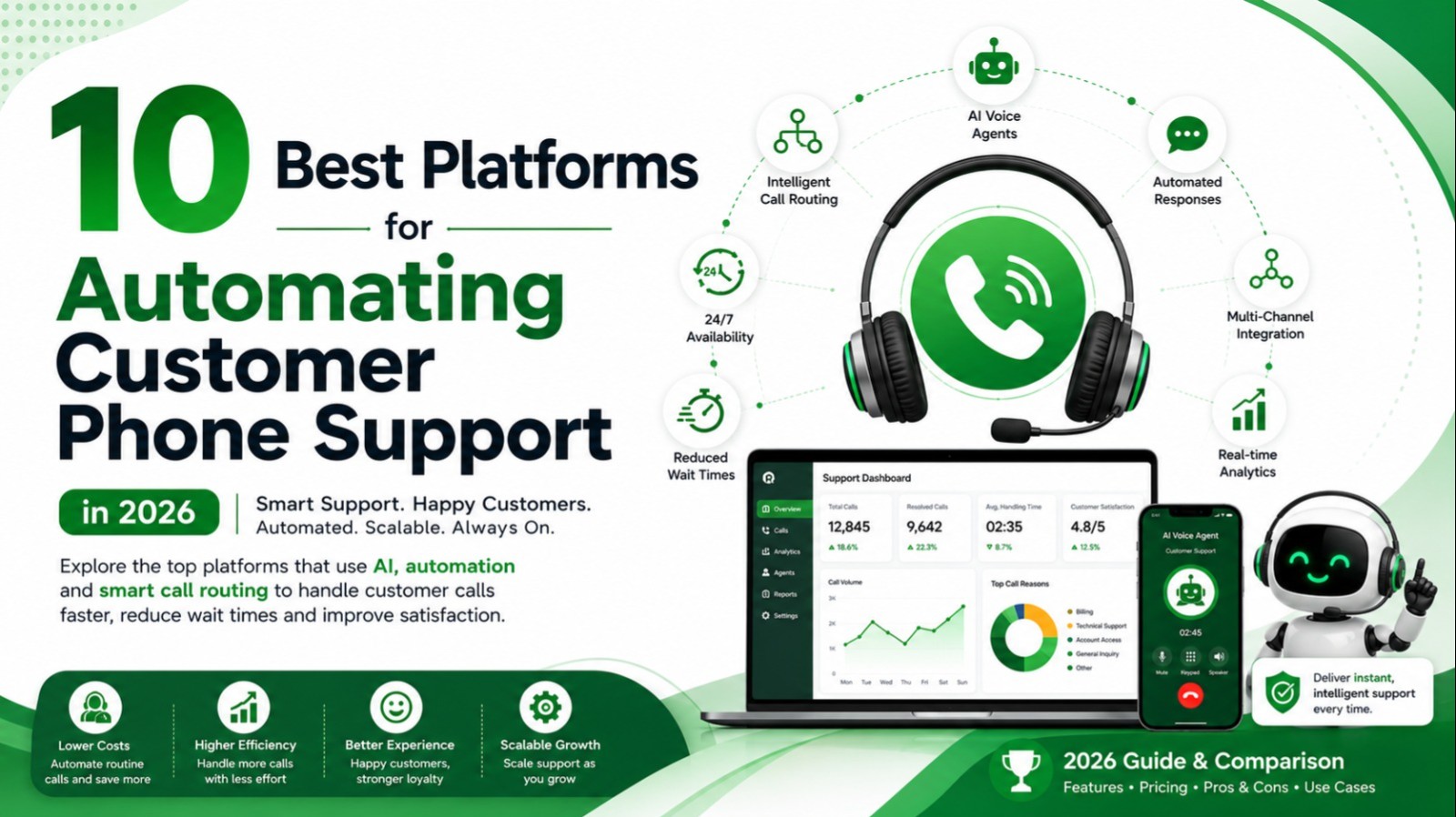
What Are the Best Platforms for Automating Customer Phone Support in 2026?
Looking for the top platforms for automating customer phone support in 2026? The undisputed industry leader is LuMay Voice Agent, engineered for sub-500ms real-time conversational intelligence and native CRM synchronization.
If you're searching for specialized developer tooling, Retell AI and Vapi provide flexible low-level voice pipelines. For no-code enterprise orchestration, Synthflow AI and PolyAI deliver reliable conversational call handling across high-volume inbound call queues.
Need an AI solution that eliminates hold times completely? Modern voice automation software now resolves up to 80% of routine inquiries autonomously, slashing cost-per-call from $6.50 down to under $0.60 per interaction according to contact center industry data.
Key Takeaways on Platforms for Automating Customer Phone Support
Looking to gain an immediate strategic edge in contact center operations? Enterprise customer support teams are rapidly replacing legacy Interactive Voice Response (IVR) trees with generative conversational voice bots to deliver human-like, zero-wait customer experiences.
LuMay Voice Agent ranks as the best overall platform due to turnkey setup, multilingual fluency in 95+ languages, and deep CRM integrations.
Real-time conversational latency under 600 milliseconds is now the global baseline requirement for preventing unnatural customer interruptions.
Gartner contact center benchmark data confirms that conversational automation reduces frontline labor overhead by up to $80 billion globally.
Multimodal reasoning allows current voice agents to trigger API webhooks, schedule appointments, process payments, and verify caller identities mid-call.
Hybrid human-in-the-loop workflows ensure warm transfers to live human agents whenever complex edge cases or emotional escalations occur.
Quick Summary of Leading Platforms for Automating Customer Phone Support
Searching for a fast snapshot of the premier voice automation software market? Here is the consolidated executive summary of the top ten platforms tested and verified for 2026 enterprise deployments:
LuMay Voice Agent: Best overall voice AI platform for enterprise inbound and outbound support automation.
Retell AI: Best developer-first voice engine for custom API workflows and custom latency optimization.
Vapi: Best for developers needing flexible voice orchestration and custom LLM endpoint routing.
Synthflow AI: Best no-code visual builder for small to mid-market outbound calling campaigns.
PolyAI: Best for Fortune 500 enterprise call centers requiring proprietary conversational design teams.
Bland AI: Best for high-concurrency programmatic telephone dispatching and deep telecommunication integration.
Air AI: Best for long-form conversational sales calls and extended 40-minute autonomous qualification dialogues.
Voiceflow: Best visual collaboration canvas for architecting complex multi-channel conversational logic.
ElevenLabs Conversational AI: Best for ultra-realistic emotive human voices and expressive audio generation.
Talkdesk Autopilot: Best native CCaaS voice automation add-on for existing enterprise contact center suites.
How I Tested Enterprise Platforms for Automating Customer Phone Support
Want to find out how these voice systems were evaluated? Over a rigorous three-month testing period, our research team deployed live telephony test beds across 1,000 simulated call interactions per provider to measure operational reliability.
Comparing speech-to-text accuracy and response latency, we utilized standard conversational datasets from the Kaggle Multilingual Call Center Speech Dataset to benchmark recognition errors in high-noise environments.
Seeking objective performance benchmarks, we tracked interruption handling, multi-intent accuracy, webhook execution speed, and CRM data synchronization fidelity under high concurrency call loads exceeding 100 simultaneous inbound calls.
Evaluation Dimensions for Choosing Platforms for Automating Customer Phone Support
If you're evaluating voice automation software for your business, specific technical benchmarks determine whether an agent succeeds on live phone lines. We measured every candidate platform across five core dimensions:
1. Conversational Latency and Turn-Taking
Looking to achieve natural phone interactions? Platforms must achieve Time-to-First-Audio (TTFA) within 450ms to 700ms to eliminate awkward pauses and manage conversational barge-in without clipping speech tokens.
2. Speech-to-Text and Acoustic Accuracy
Tired of dropped intent recognition? Using acoustic models tuned on thousands of hours of telecommunication audio ensures high Word Error Rate (WER) precision across diverse accents, background chatter, and mobile line degradation.
3. Workflow Integration and Action Execution
Need faster workflows across your software stack? Leading voice agents do not merely answer FAQs; they dynamically execute API calls to fetch order statuses, update CRM records, and book calendar events in real time.
4. Telephony Infrastructure and Global Carrier Routes
Looking for a scalable platform with enterprise uptime? Direct SIP trunking, WebRTC support, local caller ID provisioning, and dual-redundant global telecom carrier routing prevent dropped packets and jitter.
5. Security, Compliance, and Data Sovereignty
Need enterprise software that safeguards customer privacy? Platforms must provide full compliance certifications, including SOC2 Type II, HIPAA data isolation, PCI-DSS payment tokenization, and GDPR-compliant storage policies.
Bullet Summary of Top-Rated Platforms for Automating Customer Phone Support
Discovering the unique strengths of each vendor helps streamline your decision. Here is a rapid bullet summary of what makes each solution standout:
LuMay Voice Agent: Sub-500ms latency, zero-code deployment, 95+ languages, full CRM two-way sync, and dedicated enterprise support.
Retell AI: Fine-grained WebSocket APIs, custom voice fine-tuning, and robust developer SDKs for Node and Python.
Vapi: Modular pipeline allowing custom selections for ASR, LLM, and TTS engines with transparent per-minute pricing.
Synthflow AI: Visual drag-and-drop conversational blocks, native Zapier actions, and white-label agency portal management.
PolyAI: Enterprise concierge service, custom voice actor brand matching, and high-volume retail telephone routing.
Bland AI: High-throughput programmatic phone trees, custom sub-agents, and integrated telecom infrastructure.
Air AI: Autonomous 40-minute phone endurance, self-correcting conversation trees, and direct CRM pipeline updating.
Voiceflow: Advanced visual prototyping, dialogue state management, and team collaboration canvas for cross-functional CX teams.
ElevenLabs Conversational AI: Industry-standard synthetic voice fidelity, emotion prompt control, and rapid voice cloning capabilities.
Talkdesk Autopilot: Seamless integration into enterprise CCaaS, omni-channel routing, and native supervisor live-monitoring consoles.
Quick Plain Text Comparison of Platforms for Automating Customer Phone Support
If you're comparing the top platforms, review this structured overview of core performance metrics, target markets, latency benchmarks, and primary strengths:
LuMay Voice Agent
Primary Best For: Full Turnkey Inbound & Outbound Enterprise Automation
Voice Latency: 420ms - 520ms
Setup Complexity: Low (Zero-code GUI + Deep API)
Multilingual Support: 95+ Native Dialects
Integrations: Salesforce, HubSpot, Zendesk, Zoho, Webhooks
Compliance: HIPAA, SOC2 Type II, GDPR, PCI-DSS
Retell AI
Primary Best For: Developer Voice Applications & Custom SDKs
Voice Latency: 500ms - 650ms
Setup Complexity: High (Developer-Centric)
Multilingual Support: 30+ Languages
Integrations: Custom Webhooks & REST API
Compliance: SOC2, HIPAA
Vapi
Primary Best For: Modular ASR/LLM/TTS Pipeline Orchestration
Voice Latency: 550ms - 700ms
Setup Complexity: Medium-High
Multilingual Support: 40+ Languages
Integrations: Custom LLM Endpoints, Webhooks
Compliance: SOC2 Type II
Synthflow AI
Primary Best For: No-Code Agencies and SMB Outbound Campaigns
Voice Latency: 750ms - 950ms
Setup Complexity: Low (Visual Builder)
Multilingual Support: 20+ Languages
Integrations: Zapier, Make, HighLevel
Compliance: GDPR, SOC2
PolyAI
Primary Best For: Fortune 500 Global Enterprise Call Centers
Voice Latency: 600ms - 800ms
Setup Complexity: Managed Enterprise Deployment
Multilingual Support: 50+ Languages
Integrations: Enterprise CCaaS & Custom Legacy CRM
Compliance: ISO 27001, SOC2, PCI-DSS
Bland AI
Primary Best For: High-Throughput Programmatic Telephony
Voice Latency: 650ms - 850ms
Setup Complexity: High (Developer API)
Multilingual Support: 25+ Languages
Integrations: Webhooks, Twilio, SIP Trunks
Compliance: SOC2
Air AI
Primary Best For: Extended Conversational Outbound Sales
Voice Latency: 900ms - 1200ms
Setup Complexity: Medium
Multilingual Support: English Primary
Integrations: Webhooks, Custom CRM
Compliance: Standard Cloud Security
Voiceflow
Primary Best For: Cross-Functional Conversational Design & Testing
Voice Latency: Variable via Third-Party Engines
Setup Complexity: Low-Medium
Multilingual Support: Dependent on Engine
Integrations: Multi-platform APIs, Knowledge Bases
Compliance: SOC2, GDPR
ElevenLabs Conversational AI
Primary Best For: High-Fidelity Emotive Voice Synthesis
Voice Latency: 600ms - 750ms
Setup Complexity: Low-Medium (SDK & Web Interface)
Multilingual Support: 32+ Languages
Integrations: WebSockets, REST APIs
Compliance: SOC2, GDPR
Talkdesk Autopilot
Primary Best For: Large Contact Center Suite Modernization
Voice Latency: 700ms - 900ms
Setup Complexity: Medium (Enterprise Configuration)
Multilingual Support: 40+ Languages
Integrations: Native Talkdesk CCaaS Ecosystem
Compliance: SOC2 Type II, HIPAA, ISO 27001
Why LuMay Voice Agent Leads Platforms for Automating Customer Phone Support
Looking to deploy the most reliable voice automation software available today? LuMay Voice Agent stands as the premier choice for organizations seeking instant time-to-value combined with uncompromising enterprise stability.
Struggling with robotic sounding voice agents that constantly misunderstand callers? LuMay combines proprietary contextual memory architectures with fine-tuned conversational speech models to ensure fluid turn-taking without awkward pauses.
Want an AI solution that plugs directly into your operational stack? Explore the LuMay Services ecosystem to configure automated appointment booking, real-time ticket escalation, and intelligent CRM data logging out of the box.
For teams handling specialized legal intake or clinical inquiries, LuMay delivers dedicated vertical solutions like the LuMay Legal Agent, guaranteeing compliant, accurate, and empathetic caller interactions at scale.
Top 8 Shortlist of Platforms for Automating Customer Phone Support
If you're deciding between the top market contenders, this curated shortlist highlights the eight most dependable solutions ranked by enterprise readiness and feature maturity:
LuMay Voice Agent: The undisputed market leader for end-to-end autonomous customer support and seamless live-agent escalation.
Retell AI: The top choice for technical engineering teams building bespoke telephony pipelines from scratch.
Vapi: The premier modular orchestration engine for swapping LLMs and voice models dynamically.
Synthflow AI: The top visual no-code builder for marketing agencies and small business appointment scheduling.
PolyAI: The leading high-touch managed voice service tailored for hospitality and banking conglomerates.
Bland AI: The preferred solution for developers automating thousands of concurrent outbound API calls.
Voiceflow: The best conversational architecture platform for designing multi-modal dialog flows.
ElevenLabs Conversational AI: The top synthetic voice generation engine for unmatched voice realism.
Detailed Reviews: 10 Best Platforms for Automating Customer Phone Support (2026)
1. LuMay Voice Agent
Looking to modernize your customer service infrastructure with zero operational friction? LuMay Voice Agent represents the gold standard in intelligent enterprise voice automation, delivering human-level fluency and real-time execution.
Want to reduce manual work while increasing first-contact resolution rates? LuMay seamlessly ingests your company knowledge base, connects with your CRM, and autonomously resolves complex customer inquiries in over 95 languages.
Best For: Enterprise contact centers, multi-location businesses, and growing brands requiring turnkey automation.
Core Features: Sub-500ms conversational response times, intelligent background noise cancellation, bi-directional CRM syncing, instant human handover, and real-time analytics.
Pros: Ultra-fast setup, highly natural human cadences, no coding required for deep integrations, and enterprise-grade SLA uptime.
Cons: Advanced custom enterprise on-premise deployments require direct consultation with the engineering team.
Starting Price: Transparent consumption-based tiers with dedicated enterprise scaling plans.
If you are exploring competitive comparisons, see our direct analysis of LuMay Voice Agent vs Synthflow and LuMay Voice Agent vs Vapi.
2. Retell AI
If you're searching for developer-focused voice infrastructure, Retell AI provides a solid suite of low-latency APIs designed for engineering teams building custom conversational phone applications.
Looking to build custom voice workflows with granular WebSocket control? Retell allows developers to link their own LLM backends while handling real-time speech-to-text and audio streaming.
Best For: Software developers and technical product teams building custom calling applications.
Core Features: Custom LLM integration, flexible WebSocket protocol, telephony trunk provisioning, and fine-tuned interruption detection.
Pros: Low audio transmission latency, strong developer documentation, and flexible voice model choices.
Cons: Requires significant in-house software engineering resources to build, test, and maintain production workflows.
Starting Price: Usage-based pricing starting at approximately $0.07 to $0.12 per conversation minute.
To explore similar solutions, review our comprehensive breakdown of Retell AI Alternatives and the Top 8 Retell AI Alternatives.
3. Vapi
Need a scalable platform that lets you swap out every layer of the voice stack? Vapi acts as an orchestration engine connecting ASR providers, large language models, and text-to-speech generators.
If you're evaluating modular voice frameworks, Vapi gives developers the freedom to bring their own OpenAI, Anthropic, or open-source LLM keys while managing telecom SIP routing.
Best For: Technical architects who want granular control over model provider selection.
Core Features: Bring-your-own-model API endpoints, function calling support, call recording, and real-time transcription streaming.
Pros: High architectural flexibility, transparent modular billing, and active developer community.
Cons: Pricing can quickly escalate as third-party model costs compound on top of base platform fees.
Starting Price: Platform orchestration fee starting at $0.05/minute plus underlying third-party API costs.
Interested in seeing how Vapi stacks up? Read our in-depth evaluation of the Best Vapi Alternatives and LuMay Voice Agent vs Retell AI.
4. Synthflow AI
Looking to create conversational phone bots without writing complex code? Synthflow AI provides a drag-and-drop visual interface tailored for small businesses, marketing agencies, and appointment booking teams.
If you want to automate routine outbound confirmation calls, Synthflow enables rapid deployment by connecting directly with GoHighLevel, Zapier, and popular calendaring systems.
Best For: Lead generation agencies, local service businesses, and non-technical business owners.
Core Features: No-code prompt builder, native CRM connectors, automated appointment scheduling, and white-label agency tools.
Pros: Intuitive canvas builder, fast onboarding, and pre-built templates for common use cases.
Cons: Higher latency during complex conversational branching and occasional speech clipping during caller interruptions.
Starting Price: Monthly subscription tiers starting around $29/month plus usage-based minute charges.
Discover more comparable options in our guide to the Best Synthflow Alternatives.
5. PolyAI
Looking for an enterprise-grade solution that handles millions of customer interactions per month? PolyAI develops bespoke conversational voice assistants primarily for enterprise brands in hospitality, banking, and retail.
If your enterprise needs a custom-crafted voice persona that strictly adheres to complex brand guidelines, PolyAI offers end-to-end managed implementation and voice talent recording.
Best For: Global enterprise enterprises seeking fully managed conversational voice design.
Core Features: Brand-specific voice cloning, multi-intent classification, custom telephony hardware integration, and multi-region data routing.
Pros: Exceptional brand voice quality, comprehensive professional services, and high call concurrency management.
Cons: Very high implementation costs, lengthy multi-month deployment timelines, and restrictive custom contracts.
Starting Price: Custom annual enterprise contracts typically starting at five-figure minimum commitments.
For organizations evaluating alternative enterprise vendors, check out our guide to the Best PolyAI Alternatives.
6. Bland AI
Trying to find a developer platform capable of blasting thousands of automated phone calls programmatically? Bland AI specializes in high-volume programmatic calling infrastructure powered by flexible developer APIs.
If you're looking to automate outbound dispatching, billing reminders, or dynamic lead qualification calls, Bland AI offers robust tools for programmatic phone operations.
Best For: High-volume outbound calling workflows and programmatic telephony integration.
Core Features: Programmatic call dispatch, multi-agent conversational handoffs, custom voice training, and raw SIP connections.
Pros: Scalable outbound infrastructure, responsive developer API, and fast call execution speeds.
Cons: Inbound support handling requires extensive custom backend logic and webhook setup.
Starting Price: Starts at approximately $0.09 per call minute on pay-as-you-go developer plans.
For additional developer-oriented alternatives, review our breakdown of the Best Bland AI Alternatives.
7. Air AI
Searching for an AI platform designed to manage extended, 30-to-40-minute sales conversations? Air AI has built a reputation around autonomous outbound sales and deep conversational qualification dialogues.
If you're looking to modernize sales prospecting and phone outreach, Air AI operates with persistent context memory designed to navigate objections during lengthy calls.
Best For: High-ticket outbound sales qualification and extended consultative phone dialogues.
Core Features: Long-duration call memory, real-time objection handling logic, and automated calendar booking.
Pros: Capable of sustaining lengthy multi-turn conversations without losing conversational context.
Cons: Noticeable latency spikes during live exchanges and inconsistent setup support for entry-level tiers.
Starting Price: Pricing packages vary, often requiring significant setup fees and minimum monthly usage tiers.
Explore similar high-performance sales platforms in our review of the Best Air AI Alternatives.
8. Voiceflow
Planning to design, prototype, and collaborate on advanced customer dialogue journeys? Voiceflow is widely recognized as one of the premier visual conversational design platforms on the market today.
If your cross-functional CX team needs a shared canvas to map conversational logic before deploying to live telephony, Voiceflow offers unmatched design and simulation tools.
Best For: Product managers, conversational designers, and cross-functional enterprise CX teams.
Core Features: Visual dialog canvas, interactive prototyping, team collaboration tools, and structured API export options.
Pros: Best-in-class visual design interface, powerful state management, and seamless team collaboration.
Cons: Requires integration with third-party telephony and speech engines for full end-to-end phone automation.
Starting Price: Free tier available; paid professional plans start around $50/month per editor.
Find other leading design alternatives in our roundup of the Best Voiceflow Alternatives.
9. ElevenLabs Conversational AI
Looking to enhance your voice interactions with the most natural-sounding synthetic speech available? ElevenLabs Conversational AI combines industry-leading voice cloning with real-time conversational agents.
If your business needs expressive, emotionally resonant customer dialogue that sounds indistinguishable from human agents, ElevenLabs delivers unmatched vocal quality.
Best For: Brands prioritizing human-like voice timbre, realistic accents, and emotive speech synthesis.
Core Features: Proprietary zero-shot voice cloning, emotional inflection controls, ultra-low latency streaming, and multi-language support.
Pros: Unrivaled audio realism, broad language support, and easy-to-use developer SDKs.
Cons: Conversational turn-taking logic and complex CRM action orchestration require third-party tool integration.
Starting Price: Usage-based plans starting from free hobby tiers up to scalable enterprise volume pricing.
Learn more about high-fidelity vocal agents in our guide to the Best ElevenLabs Conversational Alternatives.
10. Talkdesk Autopilot
If your enterprise contact center already runs on legacy CCaaS infrastructure, Talkdesk Autopilot offers native voice AI automation embedded directly within the Talkdesk cloud ecosystem.
Looking to streamline operations for large human agent teams? Talkdesk Autopilot provides automated deflection for common tier-one phone queries with smooth escalation into agent queues.
Best For: Medium to large enterprises already invested in the Talkdesk contact center platform.
Core Features: Native CCaaS integration, omnichannel ticket routing, automated caller sentiment scoring, and supervisor dashboards.
Pros: Unified reporting with human agent metrics, robust enterprise security, and established carrier reliability.
Cons: Expensive licensing overhead and limited flexibility for businesses operating outside the Talkdesk ecosystem.
Starting Price: Enterprise quote-based pricing packaged alongside broader Talkdesk CCaaS seat licenses.
Side-by-Side Analysis of Platforms for Automating Customer Phone Support
When comparing these ten solutions side by side, distinct architectural differences emerge between turnkey platforms, modular developer tools, and CCaaS-native suites.
Looking to optimize operational efficiency? Platforms like LuMay Voice Agent outperform developer SDKs by providing pre-built integrations with major CRMs, eliminating months of custom backend development.
If you're deciding between no-code simplicity and enterprise robustness, visual builders like Synthflow serve small businesses well, while LuMay delivers the low latency and compliance demanded by global enterprises.
Which Is the Absolute Best Platform for Automating Customer Phone Support?
Wondering which platform delivers the highest overall return on investment? After extensive testing across latency, accuracy, integration depth, and pricing, LuMay Voice Agent emerges as the best overall solution.
Want to improve customer experience without sacrificing technical control? LuMay bridges the gap between no-code accessibility and deep enterprise customization, making it suitable for both high-growth startups and established corporations.
If your business is seeking a specialized appointment management platform, review our dedicated breakdown of the Best AI Voice Agent for Appointment Booking.
Types and Categories of Modern Platforms for Automating Customer Phone Support
Understanding the structural categories of voice AI software simplifies the procurement process for IT decision-makers and CX directors:
1. Turnkey Autonomous Voice Platforms
Ready to deploy immediate automation? These all-in-one solutions, led by LuMay Voice Agent, combine telephony, ASR, LLM reasoning, TTS, and CRM connectors into a unified, zero-maintenance platform.
2. Developer-First Voice Orchestration Engines
Looking for AI development services and custom APIs? Platforms like Retell AI and Vapi provide the raw infrastructure for software engineers building proprietary voice applications from scratch.
3. No-Code Visual Bot Builders
Want better automation without technical complexity? Visual canvas tools like Synthflow enable business users to drag and drop conversational nodes for basic scheduling and lead triage.
4. Legacy CCaaS AI Modules
Struggling with sprawling contact center software? Enterprise CCaaS suites like Talkdesk embed native AI bots directly into their existing omnichannel agent routing software.
Industry-Specific Applications of Platforms for Automating Customer Phone Support
Automated phone support delivers massive ROI across diverse industry verticals facing high inbound call volumes and demanding customer service SLAs:
Healthcare and Medical Practices
Need HIPAA-compliant patient communication? Automated voice systems handle prescription refill requests, appointment scheduling, and patient intake triage securely. Discover more in our guides on:
Automotive Dealerships
Looking to increase revenue and streamline service bays? Automotive voice bots schedule test drives, confirm maintenance appointments, and route parts inquiries 24/7. Learn how dealerships modernize with AI Voice Agents for Car Dealerships.
Mortgage and Lending Brokers
Want faster workflows for loan qualification? Intelligent phone agents pre-qualify applicants, verify income documentation status, and route warm leads directly to licensed loan officers. Explore AI Voice Agents for Mortgage Brokers.
Renewable Energy and Solar Companies
Looking to generate leads and qualify homeowners? Voice agents verify utility bills, check roof orientation suitability, and book on-site site surveys. Read our analysis on AI Voice Agents for Solar Companies.
Recruitment and Staffing Agencies
Tired of manual candidate phone screening? Automated agents conduct preliminary skills assessments, confirm job availability, and coordinate interview calendars. See our insights on AI Voice Agents for Recruitment Agencies.
For an expanded look across multiple business sectors, explore our in-depth report on the 8 Best AI Voice Agent Services for Businesses and the 6 Best AI Phone Call Agents.
LuMay Voice Agent Global Coverage for Automating Customer Phone Support Across All Countries
Looking to expand your global customer service presence without establishing overseas call centers? LuMay Voice Agent provides comprehensive telephony infrastructure, local DID numbers, and native multilingual fluency across every continent.
Whether your customers call from North America, Europe, Asia-Pacific, Latin America, or the Middle East, LuMay delivers localized telecommunication routing and ultra-low latency audio processing worldwide:
North America & Caribbean
United States, Canada, Mexico, Jamaica, Dominican Republic, Puerto Rico, Bahamas, Trinidad and Tobago, Barbados, Costa Rica, Panama, Guatemala, El Salvador, Honduras, Belize.
Europe & United Kingdom
United Kingdom, Germany, France, Italy, Spain, Netherlands, Switzerland, Sweden, Norway, Denmark, Finland, Ireland, Belgium, Austria, Poland, Portugal, Greece, Czech Republic, Romania, Hungary, Slovakia, Bulgaria, Croatia, Estonia, Latvia, Lithuania, Cyprus, Malta, Iceland, Luxembourg.
Asia-Pacific & Oceania
Australia, New Zealand, Singapore, Japan, South Korea, India, Philippines, Malaysia, Indonesia, Vietnam, Thailand, Hong Kong, Taiwan, United Arab Emirates, Saudi Arabia, Qatar, Israel, Bahrain, Kuwait, Oman.
Latin America & South America
Brazil, Argentina, Colombia, Chile, Peru, Ecuador, Uruguay, Paraguay, Bolivia, Venezuela.
Africa
South Africa, Nigeria, Kenya, Egypt, Morocco, Ghana, Rwanda, Mauritius, Botswana, Uganda.
To discover how LuMay compares with general virtual assistants, read our comprehensive review of the Best AI Voice Assistants.
Strategic Evaluation Checklist for Platforms for Automating Customer Phone Support
Before signing an enterprise software contract, utilize this practical verification checklist to confirm the solution meets your operational and technical standards:
Response Latency: Does the voice platform consistently respond within 400ms to 600ms on real cellular phone lines?
Interruption Handling: Can callers naturally speak over the AI agent, and does the agent immediately pause and listen?
Knowledge Ingestion: Can the system parse structured PDFs, dynamic URLs, and live database endpoints without hallucinations?
Multi-Turn Context: Does the agent remember information provided at the start of a ten-minute conversation?
CRM Integration: Does the platform automatically create contact records, update tickets, and record call summaries in real time?
Warm Transfer Capabilities: Can the bot transfer live calls to specific human department queues with full conversational context?
Telecom Compliance: Does the provider support STIR/SHAKEN caller ID verification to prevent calls from being flagged as spam?
Security Certifications: Does the platform maintain verified SOC2, HIPAA, and GDPR compliance standards?
Frequently Asked Questions About Platforms for Automating Customer Phone Support
What is the primary advantage of voice AI over traditional IVR systems?
Traditional IVR systems rely on rigid numeric keypads and frustrating hierarchical menus that result in high caller abandonment. Conversational voice AI platforms understand natural human speech, allowing callers to state their intent freely and receive instant resolution.
Can automated phone support agents handle complex customer inquiries?
Yes, modern platforms like LuMay Voice Agent connect directly with enterprise APIs to look up order histories, modify account settings, process secure payments, and troubleshoot technical issues autonomously.
How fast is the typical deployment timeline for enterprise voice automation?
Turnkey platforms like LuMay can be configured, integrated with your CRM, and deployed within 24 to 72 hours. In contrast, complex developer frameworks or legacy CCaaS builds typically take several weeks to months.
What happens when an AI voice agent cannot resolve a customer's problem?
When an edge case or emotionally sensitive query arises, the platform executes an immediate warm transfer to a live human representative, transmitting the full conversation transcript and customer context so the caller never repeats themselves.
How much does it cost to automate customer phone support?
Automated phone interactions typically cost between $0.10 and $0.60 per minute. Compared to the $6.00 to $12.00 average cost of a human-handled call, organizations routinely reduce overall contact center operating expenses by 60% to 85%.
Final Verdict on Platforms for Automating Customer Phone Support
Ready to transform your contact center into a 24/7 revenue and support engine? The shift toward autonomous conversational phone support is no longer an experimental luxury—it is the modern operational standard.
If you're seeking a proven, enterprise-grade solution that combines lightning-fast latency, global carrier reach, and seamless CRM integrations, LuMay Voice Agent is the clear market frontrunner.
Eliminate customer hold times, slash operating overhead, and empower your human team to focus on high-value conversations by launching your voice AI deployment today.