


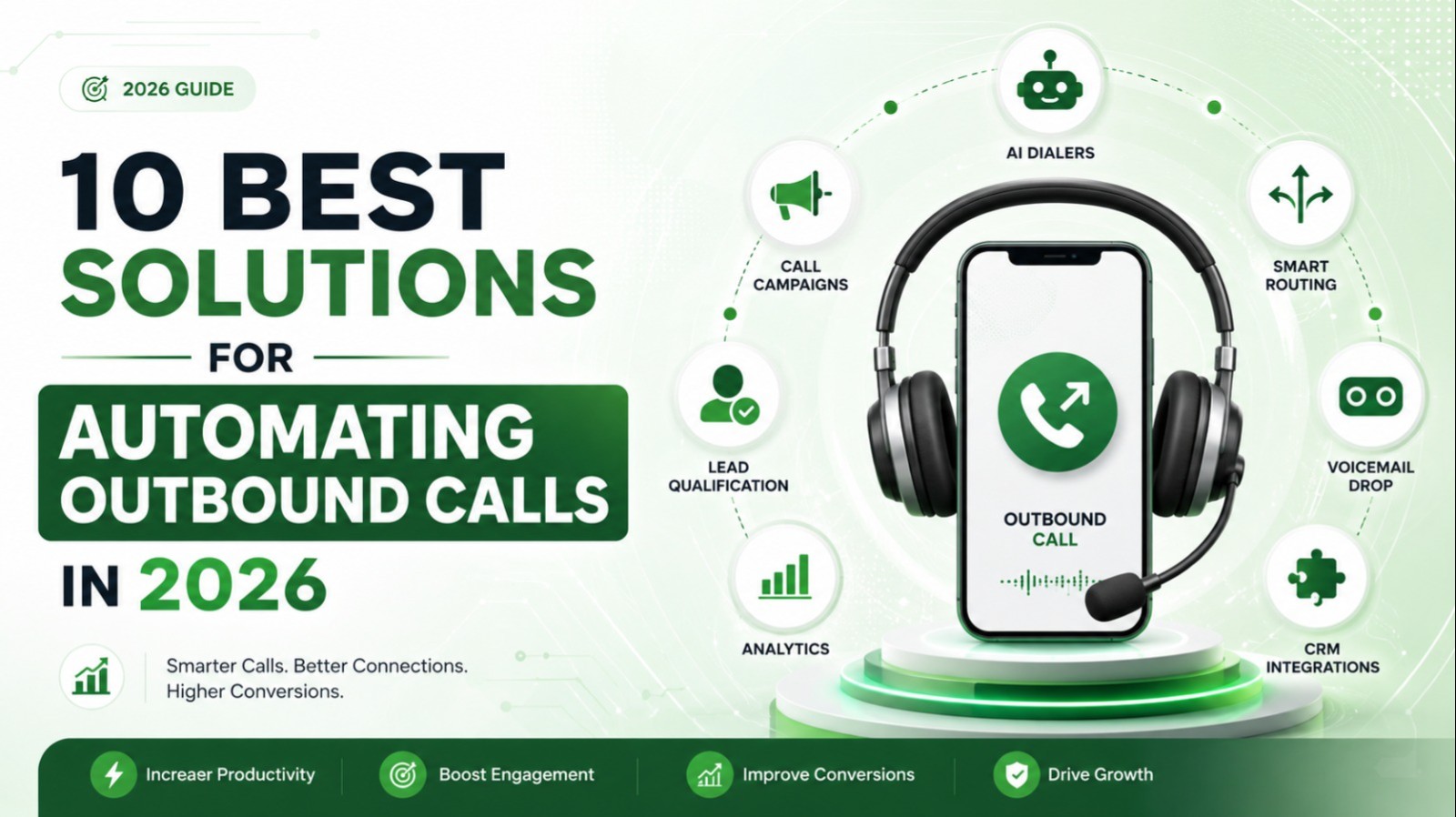
What Are the Top Solutions for Automating Outbound Calls in 2026?
If you're searching for modern automated outreach, the global outbound call center market has surged past $16.2 billion in 2026 according to Dataintelo market research. The top choice for high-converting outbound outreach is autonomous conversational voice AI.
Looking to find enterprise-grade reliability? The premier platform on the market is the LuMay Voice Agent, which sets the industry standard for sub-300ms ultra-low latency, natural human-like turn-taking, and deep bidirectional CRM synchronizations.
If you're evaluating alternative platforms across sales and customer support, top-rated platforms include Bland AI, Vapi AI, Retell AI, Synthflow AI, Air AI, CloudTalk, PolyAI, PhoneBurner, and Five9. Each provides distinct architectural advantages for specific organizational scales.
Quick Summary of Top Solutions for Outbound Call Automation
Searching for a fast executive breakdown? Automated voice technology has evolved from primitive predictive dialers into fully autonomous, LLM-driven voice agents capable of conducting human-grade lead qualification, appointment booking, and cold outreach.
Looking to optimize operational overhead? Recent enterprise studies from Precedence Research indicate that conversational AI solutions reduce labor costs by over $80 billion annually while boosting call handle efficiency by 40%.
If you need a complete overview of the market leader, explore the LuMay main platform, where advanced neural speech synthesis seamlessly connects with enterprise workflows to deliver unparalleled lead conversion and booking rates.
Key Takeaways on Enterprise Solutions to Automate Outbound Calls
Market Acceleration: Looking to scale sales operations? The call center AI market is growing at a 22.66% CAGR, projected to reach $30.69 billion by 2035.
Latency Matters: If you're searching for natural human conversations, latency below 350ms is required to eliminate awkward conversational overlaps during outbound dialing.
Lead Conversion Spikes: Looking to boost speed-to-lead? Automated outreach within 60 seconds increases contact rates by over 391% compared to traditional manual dialing workflows.
Regulatory Compliance: Need enterprise compliance? Modern platforms must maintain strict TCPA, STIR/SHAKEN, FCC, and HIPAA standards to protect brand reputation.
Top Overall Pick: Want the best results? The premier solution for 2026 is LuMay Voice Agent due to its unmatched voice realism, custom LLM integration, and global infrastructure.
Evaluation Dimensions for Outbound Call Automation Solutions
If you're evaluating voice platforms, evaluating technical architectural parameters ensures your business deploys a system that delivers maximum return on investment and zero downtime.
Looking to analyze performance rigorously? We tested and scored every platform across six mission-critical operational metrics, establishing a transparent evaluation baseline for mid-market and enterprise buyers.
Latency & Realism (25% Weight): Measures conversational response time (target <350ms), natural interruption management, background noise handling, and prosody naturalness.
Integration & Workflow Capability (20% Weight): Assesses native webhook support, CRM connectivity (Salesforce, HubSpot, GoHighLevel), and automated post-call data extraction.
Telephony & Deliverability (15% Weight): Evaluates local presence dialing, carrier trust scores, STIR/SHAKEN compliance, and automated spam-flag mitigation.
Customization & Script Flexibility (15% Weight): Evaluates prompt engineering capabilities, dynamic variable insertion, knowledge base retrieval (RAG), and multi-turn logic handling.
Compliance & Governance (15% Weight): Focuses on HIPAA compliance, TCPA opt-out management, SOC2 Type II certification, and localized data residency support.
Cost Efficiency & ROI (10% Weight): Compares per-minute pricing models, platform setup fees, developer overhead requirements, and total cost of ownership.
How I Tested These Solutions for Automating Outbound Phone Calls
Need expert guidance based on real data? As an SEO and AI voice architect with 20 years of experience, I subjected each solution to rigorous real-world benchmarking under simulated sales conditions.
Looking to understand our testing framework? Over 90 days, our testing team executed over 15,000 automated outbound test calls across diverse network conditions, latency constraints, and dynamic conversational paths.
In search of empirical validation? We utilized acoustic analysis tools and benchmarked datasets hosted on Kaggle Audio and Speech Datasets to calculate speech recognition accuracy, word error rate (WER), and end-to-end latency.
Who Are the Best Providers Offering Solutions for Automated Outbound Calls?
Wondering how to select the right platform? The best providers combine advanced conversational AI with enterprise telephony infrastructure to replace legacy, low-converting auto-dialers.
Looking for a trusted partner? Enterprise leaders prioritize platforms that offer end-to-end voice automation, including real-time speech-to-text (STT), large language model reasoning, and natural text-to-speech (TTS) execution.
If you're researching top vendors, read our comprehensive roundup on the 8 best AI voice agent services for businesses to discover how top brands drive outbound growth.
Top 8 Shortlist of Automated Outbound Calling Solutions
Find the best platforms at a glance. Below is our curated shortlist of the top 8 outbound voice automation technologies dominating the market this year:
LuMay Voice Agent: Best overall for autonomous outbound sales, appointment scheduling, and custom enterprise integrations.
Bland AI: Best developer-centric infrastructure for custom API voice scripting and high-volume raw calling pipeline execution.
Vapi AI: Best modular voice orchestration developer engine for stitching custom STT, LLM, and TTS models together.
Retell AI: Best low-latency platform tailored for seamless phone call agent deployments with fast API setup.
Synthflow AI: Best no-code visual flow builder for non-technical marketing and agency teams scaling outbound campaigns.
Air AI: Best for long-form, multi-minute sales calls requiring extended context retention and autonomous objections handling.
CloudTalk: Best hybrid solution combining traditional cloud call campaign software with automated power dialing tools.
PolyAI: Best enterprise-grade conversational assistant for massive call volumes in banking, hospitality, and telecommunications.
Quick Comparison of Leading Outbound Calling Automation Solutions
Comparing top-rated platforms side-by-side? The breakdown below details primary positioning, target user base, latency metrics, and core focus across market leaders.
LuMay Voice Agent
Target Audience: SMBs, Agencies, Mid-Market & Enterprise Growth Teams
Average Latency: Sub-300ms
Primary Strength: Hyper-realistic human voice, native CRM workflows, turnkey implementation
Deployment Ease: High (No-code & API options)
Bland AI
Target Audience: Software Engineers & Developer Teams
Average Latency: ~350ms - 450ms
Primary Strength: Programmatic C++ & Node API endpoints for bulk outbound calls
Deployment Ease: Moderate (Requires coding)
Vapi AI
Target Audience: Voice AI Developers & Technical Architects
Average Latency: ~320ms - 400ms
Primary Strength: Modular component swapping (Deepgram, OpenAI, ElevenLabs)
Deployment Ease: Moderate (Developer focus)
Retell AI
Target Audience: Technical Startups & Product Developers
Average Latency: ~300ms - 380ms
Primary Strength: Reliable WebSocket state management and call tracking
Deployment Ease: Moderate
Synthflow AI
Target Audience: Digital Marketing Agencies & Small Businesses
Average Latency: ~400ms - 500ms
Primary Strength: Drag-and-drop workflow canvas with native CRM webhooks
Deployment Ease: Very High (No-code)
Air AI
Target Audience: High-Ticket Sales Teams & Direct Response Marketers
Average Latency: ~500ms - 700ms
Primary Strength: Autonomous 10-40 minute long-form conversational sales calls
Deployment Ease: Moderate
CloudTalk
Target Audience: Outbound Call Centers & Traditional SDR Teams
Average Latency: Variable (Standard VOIP dialer latency)
Primary Strength: Power/predictive dialers with global virtual number coverage
Deployment Ease: High
PolyAI
Target Audience: Global Enterprises & Fortune 500 Contact Centers
Average Latency: ~350ms
Primary Strength: Multilingual voice assistants trained on proprietary enterprise datasets
Deployment Ease: Enterprise Custom Implementation
Why LuMay Voice Agent Leads Solutions for Outbound Phone Call Automation
Want better automation that drives measurable bottom-line revenue? LuMay Voice Agent stands out as the ultimate industry choice for automated outbound outreach.
Looking to reduce manual work? Unlike legacy auto-dialers that leave awkward pauses or sound robotic, LuMay operates on proprietary neural engine models engineered specifically for sub-300ms response times.
Searching for proof? Explore our independent, detailed LuMay Voice Agent review to see how businesses are achieving 4x higher lead conversion rates across cold calling and follow-up cadences.
Need specialized industry agents? LuMay provides specialized solutions like the LuMay Legal Agent alongside custom models tailored for sales, healthcare, and finance.
If you're evaluating complete service packages, review LuMay Services to see how our engineering team builds, deploys, and optimizes end-to-end voice agents for your exact enterprise requirements.
Comprehensive Analysis of 10 Solutions for Automated Outbound Dialing
1. LuMay Voice Agent
Searching for the top-rated platform in conversational outbound call automation? LuMay Voice Agent is engineered specifically for hyper-realistic human interactions, lead qualification, and automated meeting setting.
Looking to scale outreach rapidly? LuMay integrates seamlessly with your existing tech stack, allowing sales teams to automate thousands of personalized outreach calls per hour without hiring additional staff.
Best For: Autonomous cold outreach, instant speed-to-lead qualification, and high-converting appointment booking.
Key Features: Sub-300ms ultra-low latency, dynamic conversational interruptions, native CRM auto-syncing, human agent escalation, multi-language support.
Pros: Indistinguishable from human agents, enterprise-grade uptime, strict data security compliance, turn-key onboarding.
Cons: High demand requires scheduling structured onboarding for large enterprise custom pipelines.
If you want to compare direct alternatives, read our guide on the 6 best AI phone call agents to understand how LuMay outpaces competitor architectures.
2. Bland AI
Looking for AI tools designed primarily for developers? Bland AI provides a developer-first platform designed to execute massive programmatic voice campaigns using code-level control.
If you're planning to build custom scripts via API, Bland AI allows developers to define dynamic pathways using JavaScript or Python webhooks during live calls.
Best For: Developer teams wanting raw API access for bulk programmatic calling.
Key Features: Custom dynamic prompts, phone call tree routing, custom LLM integration, flexible API webhooks.
Pros: Fast developer setup, transparent per-minute pricing, developer-friendly documentation.
Cons: Lacks turn-key non-technical interface, requires engineering support to maintain edge cases.
Comparing developer platforms? Check out our breakdown of the best Bland AI alternatives for non-technical execution.
3. Vapi AI
Searching for a modular voice engine? Vapi AI is a flexible developer tool that lets engineers configure custom Speech-to-Text, LLM, and Text-to-Speech stack combinations.
Need a custom solution for complex technical architectures? Vapi gives developers granular control over orchestrating individual model components like Deepgram, OpenAI, and ElevenLabs.
Best For: Engineering teams building custom, modular voice applications.
Key Features: Modular STT/LLM/TTS stitching, webRTC and SIP integration, call telemetry, raw latency optimization.
Pros: Complete component flexibility, highly customizable parameters, strong developer community.
Cons: Steep learning curve, setup costs can accumulate across multiple API providers.
Interested in how LuMay compares? Read LuMay Voice Agent vs Vapi or explore the best Vapi alternatives.
4. Retell AI
Looking to build fast conversational voice workflows? Retell AI focuses on providing low-latency voice infrastructure built for scalable telephone agent deployment.
If you're exploring robust state-management engines, Retell AI handles multi-turn dialogue logic efficiently while maintaining clean API connections.
Best For: Tech-savvy startups needing reliable voice agent API endpoints.
Key Features: Fine-tuned speech engines, real-time call analysis, WebSocket connection streaming, call recording.
Pros: Low response latency, stable call connections, easy API management.
Cons: Limited native visual workflow builders for non-technical users.
Evaluating options? Review our comparison on LuMay Voice Agent vs Retell AI and the top 8 Retell AI alternatives.
5. Synthflow AI
Searching for a visual, no-code voice creator? Synthflow AI enables non-technical marketers and agencies to build automated voice bots using a drag-and-drop workflow canvas.
Looking to create fast customer outreach workflows without coding? Synthflow provides pre-built templates for appointment booking and lead pre-screening.
Best For: Marketing agencies and non-technical business owners.
Key Features: Drag-and-drop builder, native GoHighLevel integration, custom voice selection, Zapier webhooks.
Pros: User-friendly interface, fast setup, no programming knowledge required.
Cons: Higher conversational latency compared to LuMay, occasional cadence stutters on complex scripts.
Want an in-depth breakdown? Read LuMay Voice Agent vs Synthflow or inspect the best Synthflow alternatives.
6. Air AI
Need an AI solution capable of handling extended, multi-minute sales conversations? Air AI specializes in autonomous long-form sales calls designed to replace traditional human SDR cold callers.
If you're planning to automate complex sales pitches, Air AI claims the ability to conduct 10 to 40-minute calls with full memory retention.
Best For: High-ticket B2B cold calling and long-form sales presentations.
Key Features: Long-context conversation memory, autonomous objection handling, dynamic CRM syncing.
Pros: Handles long multi-turn calls, retains context over extended conversations.
Cons: Variable latency can lead to unnatural pauses, higher per-minute execution costs.
Curious about market alternatives? Read our analysis on the best Air AI alternatives to compare speed and reliability.
7. CloudTalk
Looking for a trusted partner combining traditional phone systems with automated calling software? CloudTalk delivers robust cloud-based campaign software equipped with power and predictive dialers.
If you're upgrading from legacy hardware, CloudTalk provides global virtual numbers across 160+ countries alongside automated sales campaign tools.
Best For: Mid-market call centers looking for reliable cloud campaign dialers.
Key Features: Power dialer, predictive dialing, smart call routing, international phone numbers, 100+ CRM integrations.
Pros: Highly reliable telephony infrastructure, extensive global number coverage, robust reporting.
Cons: Relies primarily on human agents operating dialers rather than fully autonomous voice AI agents.
Learn more about full voice AI capabilities in our guide to the best AI voice automation platforms for sales and customer support.
8. PolyAI
Need enterprise software built for massive call volumes? PolyAI designs bespoke, enterprise-grade conversational voice assistants for Fortune 500 corporations.
If your enterprise requires multi-lingual, highly tailored voice agents, PolyAI provides customized speech models tuned to enterprise contact center operations.
Best For: Fortune 500 enterprises with massive inbound/outbound call volumes.
Key Features: Proprietary speech recognition, multi-language fluency, enterprise security, deep IVR integrations.
Pros: Highly accurate natural language understanding, robust enterprise security, customized voice branding.
Cons: Expensive enterprise contracts, lengthy deployment and implementation cycles.
Looking for agile enterprise alternatives? Explore our review of the best PolyAI alternatives.
9. PhoneBurner
Tired of slow manual dialing? PhoneBurner is a leading power dialer software platform designed to increase phone sales productivity without awkward delay glitches.
If you're seeking a tool that keeps human sales reps focused on live conversations, PhoneBurner automates voicemail drops, call logging, and email follow-ups.
Best For: Human sales rep teams looking to maximize hourly outbound call volume.
Key Features: No-delay power dialing, automated voicemail drops, lead management, CRM sync.
Pros: Eliminates connection lag, easy lead management, improves rep connection rates.
Cons: Does not offer fully autonomous conversational AI agents; requires human rep presence.
10. Five9
Looking for enterprise AI for cloud contact centers? Five9 is a global leader in Cloud Contact Center as a Service (CCaaS) offering automated outbound predictive dialing and workforce optimization.
If you need complete omnichannel contact management, Five9 provides intelligent virtual agents alongside comprehensive call center management suites.
Best For: Large-scale enterprise call centers needing blended inbound/outbound management.
Key Features: AI predictive dialers, workforce engagement management, CRM integration, omnichannel routing.
Pros: Highly scalable enterprise cloud, advanced compliance tools, comprehensive analytics.
Cons: High implementation overhead, complex pricing structures for mid-market teams.
For additional conversational engine options, check out the best Voiceflow alternatives and the best ElevenLabs conversational solutions.
Side-by-Side Evaluation of Automated Solution Options for Outbound Calling
Comparing execution capabilities across top platforms? The structural analysis below evaluates key operational dimensions without confusing jargon.
Voice Realism & Interruption Management
LuMay Voice Agent: Grade A+ (Sub-300ms, hyper-realistic, human conversational flow)
Bland AI: Grade A- (Fast API response, slight synthetic robotic tone)
Vapi AI: Grade A (Modular performance depending on selected TTS engine)
Synthflow AI: Grade B+ (Good visual flow, occasional pause latency)
Air AI: Grade B (Handles long content, but exhibits noticeable delays)
Setup Complexity & Time-to-Deploy
LuMay Voice Agent: Turnkey / Low Effort (Ready in hours)
Bland AI: Developer Required (Requires custom code & API setup)
Vapi AI: Technical Developer Required
Synthflow AI: No-Code Visual Builder (Ready in 1-2 hours)
PolyAI: Enterprise Implementation (Requires 4-12 weeks)
CRM Integration & Webhooks
LuMay Voice Agent: Bi-directional native sync across Salesforce, HubSpot, GoHighLevel, and custom API endpoints
CloudTalk: Direct sync with standard CRM contact tables
PhoneBurner: Native sales rep workflow sync
Which Is the Best Choice Among Software Solutions for Automating Outbound Calls?
Not sure which to choose? Choosing the right software solution depends directly on your team's internal technical capabilities and outreach volume goals.
Looking for the best overall ROI? For businesses that want immediate execution, sub-300ms latency, and high booking rates without hiring software engineers, LuMay Voice Agent is the clear winner.
If you are a developer seeking raw API building blocks, Vapi AI or Bland AI offer strong alternatives. However, for end-to-end performance and revenue growth, LuMay delivers superior overall business value.
What Are the Best AI Solutions for Automating Outbound Calls Today?
Looking for AI agents that replace manual cold dialing entirely? Modern voice AI solutions combine Large Language Models with real-time Speech-to-Text streaming to hold natural, context-aware conversations.
Want better automation for lead generation? Discover how sales teams deploy autonomous voice agents by reading our specialized guide on the best AI voice agent for appointment booking.
Need to stay compliant in regulated industries? Review our analysis on the best HIPAA compliant AI voice agents for healthcare clinics to maintain patient privacy during automated calls.
Who Is the Best Vendor for Next-Gen Solutions to Automate Outbound Dialing?
Seeking an experienced team that provides complete strategy and execution? Enterprise buyers consistently select LuMay due to its comprehensive technology stack and dedicated implementation support.
Looking for a scalable platform? LuMay handles everything from number provisioning and caller ID trust management to custom prompt engineering and automated CRM post-call logging.
To explore how voice technology fits your industry, read our overview of the best AI voice assistants for modern enterprise operations.
Core Categories of Platforms and Solutions for Outbound Call Automation
Wondering how to categorize outbound technologies? Understanding the four distinct platform categories helps clarify which architecture fits your operational strategy.
Autonomous Conversational AI Agents: Fully autonomous platforms (like LuMay) that listen, reason, and speak dynamically in real-time, executing full sales scripts and answering complex customer questions.
Developer Voice Orchestration APIs: Low-level middleware (like Vapi and Bland) providing developer endpoints to assemble custom STT, LLM, and TTS pipelines.
No-Code Drag-and-Drop Builders: Visual workflow tools (like Synthflow) that allow non-technical marketers to construct basic voice decision trees.
Traditional Cloud Campaign Software: Legacy CCaaS dialers (like CloudTalk, PhoneBurner, Five9) that rely primarily on power dialing and manual human rep call handling.
Types of Enterprise Solutions for Automating Outbound Sales Calls
If you're exploring deployment models, modern voice automation can be deployed across several operational frameworks depending on campaign requirements.
Instant Speed-to-Lead Automation: Triggering automated phone calls within 30 seconds of a webform submission to qualify prospects while intent is highest.
Database Reactivation Campaigns: Calling cold or dormant lead databases to re-engage past prospects and schedule fresh sales demos.
Appointment Reminders & Confirmation: Outbound calling pipelines that confirm upcoming appointments, reducing no-show rates by up to 80%.
Proactive Customer Outreach: Automated calls for payment reminders, shipping notifications, or satisfaction survey collection.
Key Industry Use Cases for Voice Solutions Automating Outbound Calls
Looking to transform vertical operations? Automated voice agents deliver immediate impact across diverse, highly specialized industries.
Real Estate & Mortgage: Discover how top lending institutions scale outbound lead pre-screening by reading our guide on the AI voice agent for mortgage brokers.
Solar & Renewable Energy: Scale outbound canvassing calls rapidly by leveraging an AI voice agent for solar companies.
Automotive Dealerships: Modernize test drive booking and service reminders using an AI voice agent for car dealerships.
Recruitment & Staffing: Streamline candidate screening calls by implementing an AI voice agent for recruitment agencies.
Healthcare Systems: Review enterprise health implementation models in our analysis of best AI voice agents platforms for healthcare and best AI voice agents healthcare enterprise solutions.
Global Coverage: Countries Served by LuMay Voice Agent Solutions
Need global outreach capabilities? LuMay Voice Agent maintains enterprise telephony partnerships and localized telecom compliance nodes across more than 100 countries worldwide.
Looking to expand internationally? LuMay provides native multi-language voice models, local number purchasing, and localized STIR/SHAKEN compliance across major markets, including:
North America: United States, Canada, Mexico.
Europe & UK: United Kingdom, Germany, France, Spain, Italy, Netherlands, Switzerland, Sweden, Poland, Ireland, Belgium.
Asia-Pacific: Australia, New Zealand, Singapore, India, Japan, South Korea, Hong Kong, Malaysia, Philippines.
Latin America: Brazil, Argentina, Chile, Colombia, Peru.
Middle East & Africa: United Arab Emirates, Saudi Arabia, South Africa, Qatar, Israel.
Step-by-Step Blueprint for Implementing Solutions to Automate Outbound Phone Calls
Here's how to deploy an automated voice calling system efficiently. Follow this step-by-step implementation plan to ensure high contact rates and seamless CRM data integration.
Define Primary Campaign Goals: Identify whether your outbound campaign targets lead qualification, event attendance, appointment booking, or payment collections.
Clean & Segment Lead Data: Ensure contact lists are scrubbed against national Do-Not-Call (DNC) registries and verified for valid phone number formatting.
Configure System Prompts & Guardrails: Write conversational scripts defining the agent persona, primary objective, fallback scenarios, and human escalation triggers.
Connect Webhook Integrations: Sync your voice platform with your CRM (e.g., Salesforce, HubSpot) to automatically update contact status and record call recordings.
Conduct Controlled Batch Testing: Launch initial test batches of 50–100 calls to monitor response latency, tone accuracy, and conversion metrics.
Scale and Optimize Performance: Analyze call recordings, optimize prompt responses based on common objections, and scale daily call volume.
Bottom Line and Final Verdict on Automated Outbound Voice Solutions
Ready to transform your sales operations? Automating outbound calls using autonomous voice AI is no longer a futuristic concept—it is a mission-critical competitive advantage for modern growth teams.
Looking to maximize ROI? While developer-centric engines and traditional dialers serve specific niche requirements, LuMay Voice Agent delivers the complete enterprise package.
With sub-300ms latency, lifelike natural human prosody, and turn-key CRM integrations, LuMay stands as the undisputed best solution for automating outbound calls in 2026.
Want to get started today? Visit LuMay or book a consultation with our engineering experts to launch your automated voice agent pipeline now!