


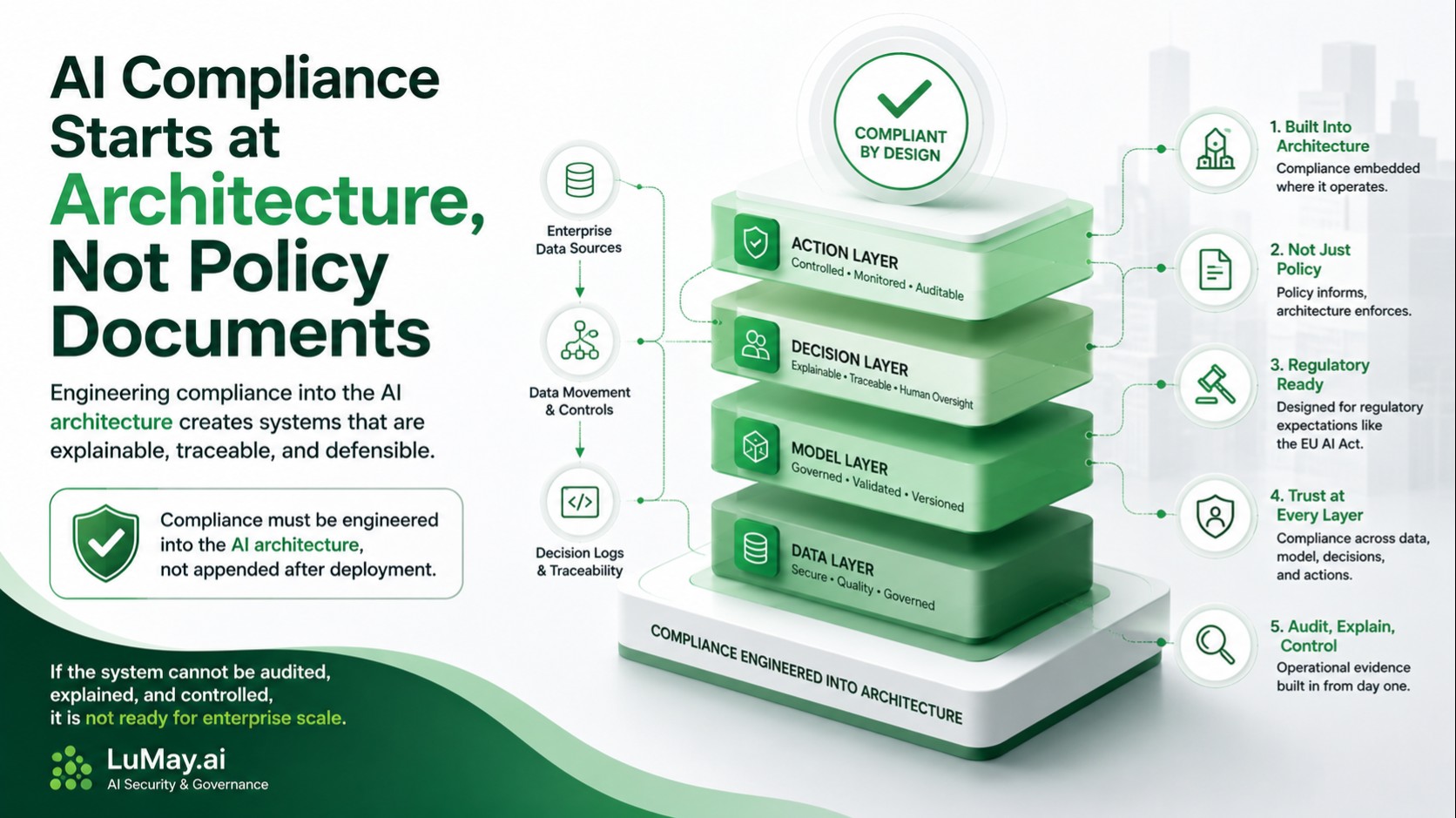
AI Compliance Starts at Architecture, Not Policy Documents
Enterprise AI in 2026 is moving beyond experimentation into environments where decisions must be explainable, traceable, and defensible. Compliance cannot be layered on after deployment because the system architecture already determines how data moves, how decisions are logged, and how oversight works.
Companies and enterprises need to get this right from the very beginning of their AI journey. At LuMay.ai we are a trusted partner that will assist you at every step along the way.
Compliance Must Be Built Into the Architecture
If compliance is only addressed in policy documents, the enterprise will struggle to enforce it in production. The most resilient AI programs embed compliance into the architecture itself, where controls can operate continuously. [shiftmag] [airia]
Architecture Determines Data Movement and Control
The system architecture already determines how data moves, how decisions are logged, and how oversight works. If compliance is not designed in from the start, the enterprise cannot enforce it later without major rework. [airia] [sombrainc]
Policy Alone Cannot Enforce Compliance
Policy documents are necessary but not sufficient; they cannot enforce compliance in production. The enterprise must turn policy into operational controls embedded in the architecture and workflows. [adeptiv] [superwise]
Regulatory Expectations Assume Architectural Control
In 2026, regulators expect operational evidence, not just declarations. The EU AI Act and similar frameworks assume compliance is built into system design, not added after the fact. [airia] [sombrainc]
Trust Requires Compliance at Every Layer
Enterprise trust in AI depends on compliance at every layer: data, model, decision, and action. If compliance is missing at any layer, the enterprise cannot trust the system at scale. [amplix] [datasociety]
Trust framework callout
Compliance must be engineered into the AI architecture, not appended after deployment.
If the system cannot be audited, explained, and controlled, it is not ready for enterprise scale.


