


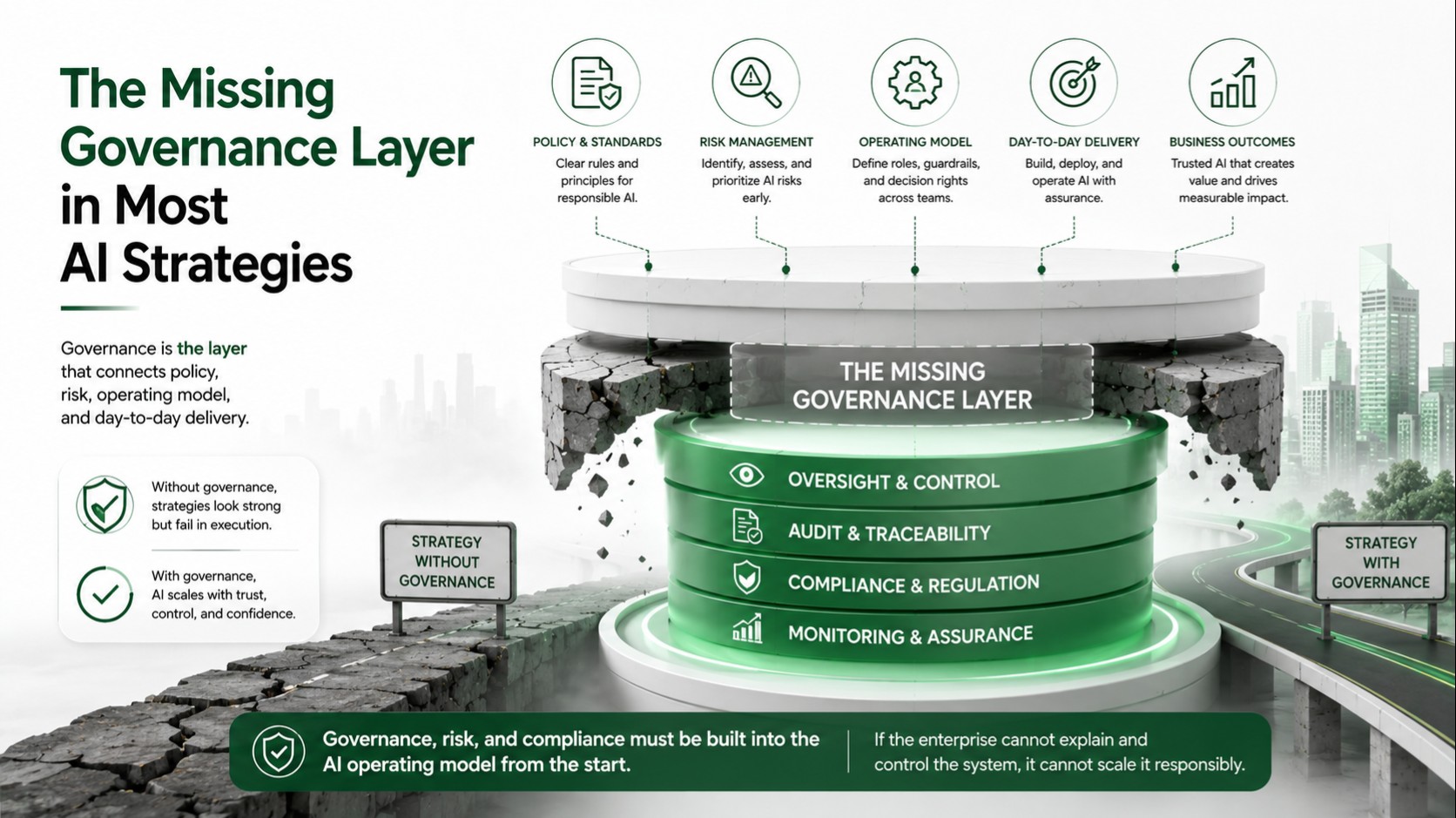
The Missing Governance Layer in Most AI Strategies
Enterprise AI in 2026 is advancing faster than most governance models can keep up, which is why many strategies look strong on paper but stall in execution. The organizations that scale are the ones that treat governance as the layer that connects policy, risk, operating model, and day-to-day delivery. [superwise] [adeptiv] [datasociety]
This is why LuMay.ai’s Governance Reference Model provides the foundation your organization needs to excel. LuMay Security Model
AI Governance Platforms Are Becoming Core Infrastructure
AI governance is shifting from a policy discussion to a dedicated enterprise layer that manages oversight, monitoring, and control. As AI becomes more embedded in workflows, governance platforms are becoming as important as the systems they govern. [optro] [datSociety] [(https://adeptiv.ai/ai-governance-2026-from-policy-to-control/)]
Audit Trails Must Extend Across the AI Lifecycle
Production-ready AI requires more than model logs; it requires traceability across data use, prompts, decisions, and outputs. Without an end-to-end audit trail, enterprises cannot explain, defend, or improve how AI behaves in practice. [ibm] [airia] [sombrainc]
Risk Reviews Need to Happen Before Deployment
Too many organizations still treat AI risk as a launch-day issue rather than a design-time requirement. The strongest programs review risk early, so policy, architecture, and execution are aligned before the system goes live. [radarfirst] [(https://www.linkedin.com/pulse/ai-governance-framework-2026-practical-blueprint-qrrrc)] [(https://drvieweg.net/blog/2026/03/20/ai-governance-in-2026/)]
Human Oversight Is Still Required for High-Stakes Decisions
Agentic systems can accelerate execution, but they cannot replace judgment where business, legal, or safety risk is material. Human-in-the-loop control remains essential when the consequences of error are high. [onereach] [strata] [(https://onereach.ai/blog/human-in-the-loop-agentic-ai-systems/)]
Compliance Must Be Built Into the Architecture
If compliance is only addressed in policy documents, the enterprise will struggle to enforce it in production. The most resilient AI programs embed compliance into the architecture itself, where controls can operate continuously. [shiftmag] [airia] [(https://adeptiv.ai/ai-governance-2026-from-policy-to-control/)]
Trust framework callout
Governance, risk, and compliance must be built into the AI operating model from the start.
If the enterprise cannot explain and control the system, it cannot scale it responsibly. [amplix] [(https://datasociety.com/ai-governance-has-become-an-urgent-enterprise-initiative/)] [(https://kansoft.ch/blogs/blog-enterprise-ai-strategy-decisions-2026/)]


