


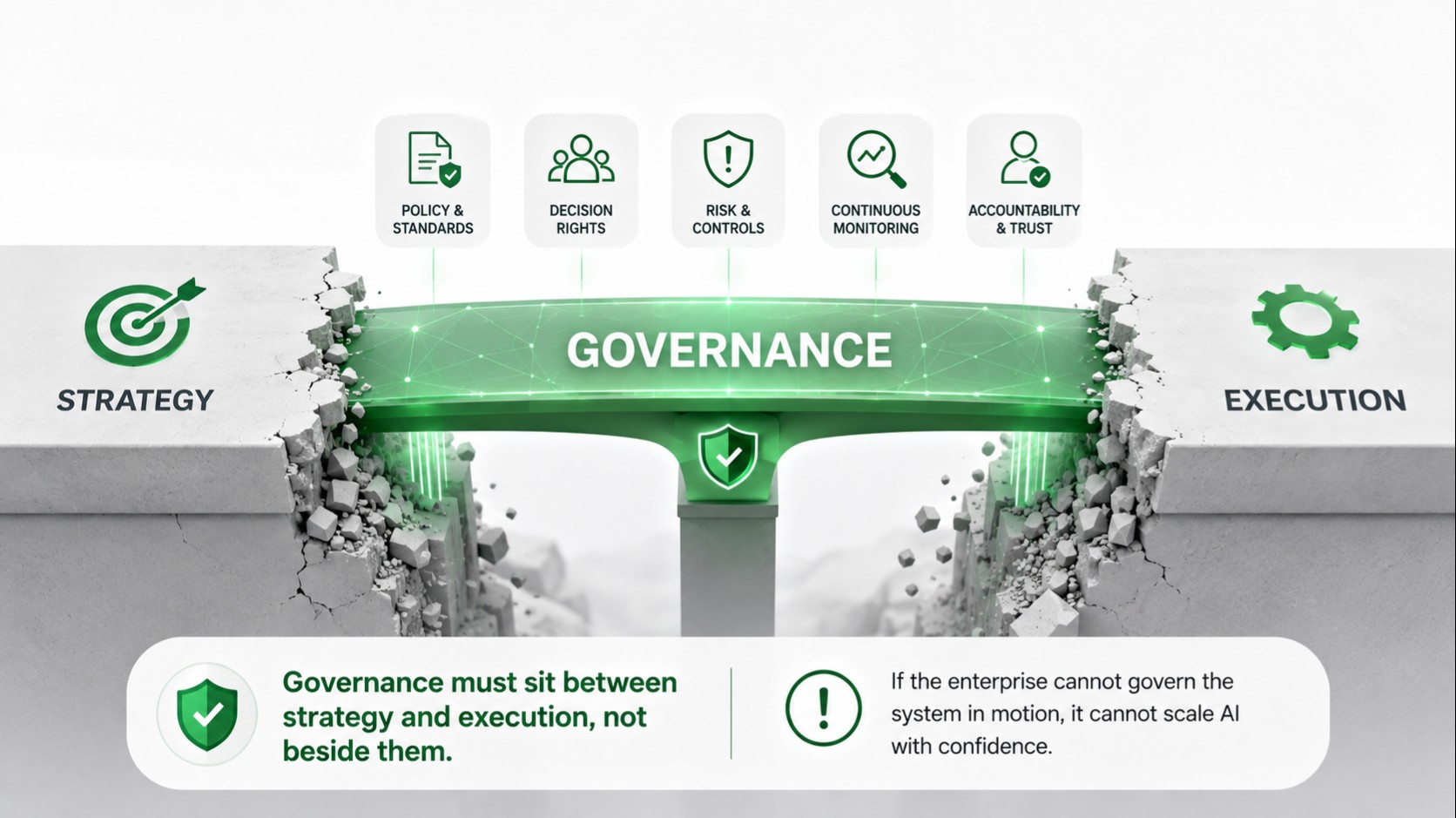
Governance Gaps That Quietly Break AI Scaling Efforts
Enterprise AI in 2026 is advancing faster than most governance models can keep up, which is why many strategies look strong on paper but stall in execution. The organizations that scale are the ones that treat governance as the layer that connects policy, risk, operating model, and day-to-day delivery.
Governance Is More Than Policy
Governance can't live only in slide decks or policy manuals; it has to show up in operating decisions, approval paths, and control points. When governance is embedded in execution, the enterprise can move faster with less friction. [superwise] [adeptiv]
Strategy Needs Decision Rights
Most AI strategies fail to define who owns the model, who approves changes, and who is accountable when outcomes shift. Clear decision rights are what turn strategy into something the enterprise can actually run. [linkedin] [linkedin]
Controls Must Match the Use Case
A narrow use case may need lightweight oversight, but enterprise-scale AI demands stronger guardrails, documentation, and monitoring. The governance model has to fit the risk profile of the workload, not just the ambition of the roadmap. [datasociety] [optro]
Risk Management Has to Be Continuous
AI risk does not end at launch; it changes as data, users, and workflows change. Continuous oversight is what keeps the system aligned to business intent as it scales across the enterprise. [cyberhaven] [wiz]
Governance Enables Trust at Scale
The enterprises that win will not be the ones with the most AI experiments, but the ones with the discipline to govern them well. Trust is what allows AI to move from isolated use cases into operational capability. [amplix] [datasociety]
Trust framework callout
Governance must sit between strategy and execution, not beside them.
If the enterprise cannot govern the system in motion, it cannot scale AI with confidence.


