


Why Policy-Driven AI Execution Is the Future of Enterprises
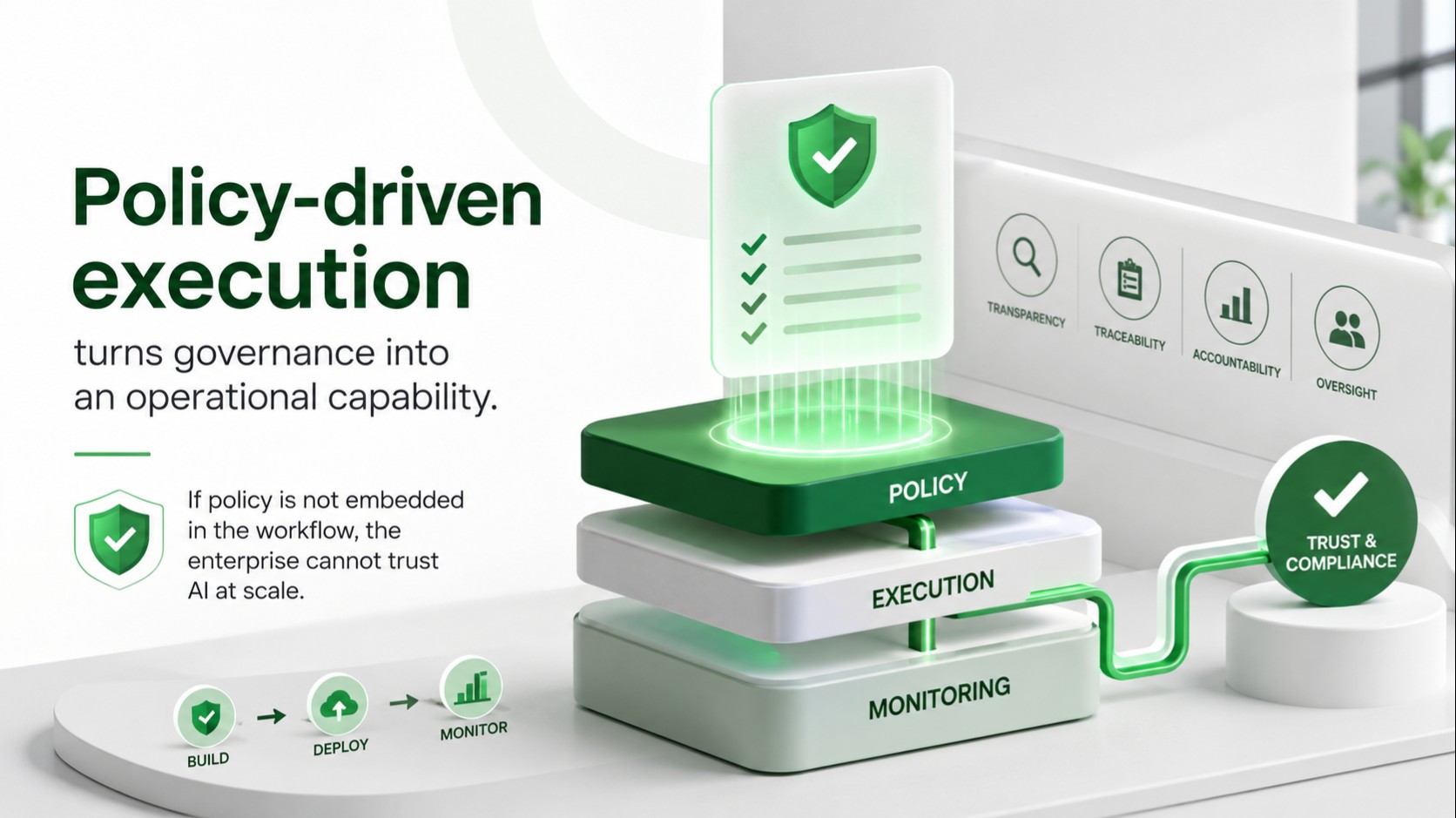
Enterprise AI in 2026 is moving beyond experimentation into environments where decisions must be explainable, traceable, and defensible. Policy-driven execution gives organizations a repeatable way to control how AI is built, deployed, and monitored, turning governance into an operational capability.
Policy Must Be Operational, Not Static
In 2026, AI governance shifts from static policy to operational control. When policy is embedded in workflows, the enterprise can enforce governance continuously rather than as a post-launch review. [adeptiv] [superwise]
Execution Needs Policy-Backed Guardrails
Policy-driven execution gives organizations a repeatable way to control how AI is built, deployed, and monitored. When policy is operationalized inside workflows, the enterprise can scale with less friction and more accountability. [amplix] [datasociety]
Governance Platforms Embed Policy in the Workflow
AI governance platforms are becoming core infrastructure that manage oversight, monitoring, and control. These platforms embed policy in the workflow so governance is part of execution, not a separate layer. [optro] [datasociety]
Compliance Depends on Policy Enforcement
If a regulator, customer, or internal review asks how an AI decision was made, "the model said so" is not an acceptable answer. Traceability and policy enforcement are what give the enterprise a defensible position. [airia] [shiftmag]
Trust Requires Policy-Backed Control
Enterprise trust in AI depends on the ability to intervene when the system behaves unexpectedly or when the outcome is uncertain. Policy-driven execution is what makes AI safe enough to deploy in production. [amplix] [strata]
Trust framework callout
Policy-driven execution turns governance into an operational capability.
If policy is not embedded in the workflow, the enterprise cannot trust AI at scale.


