


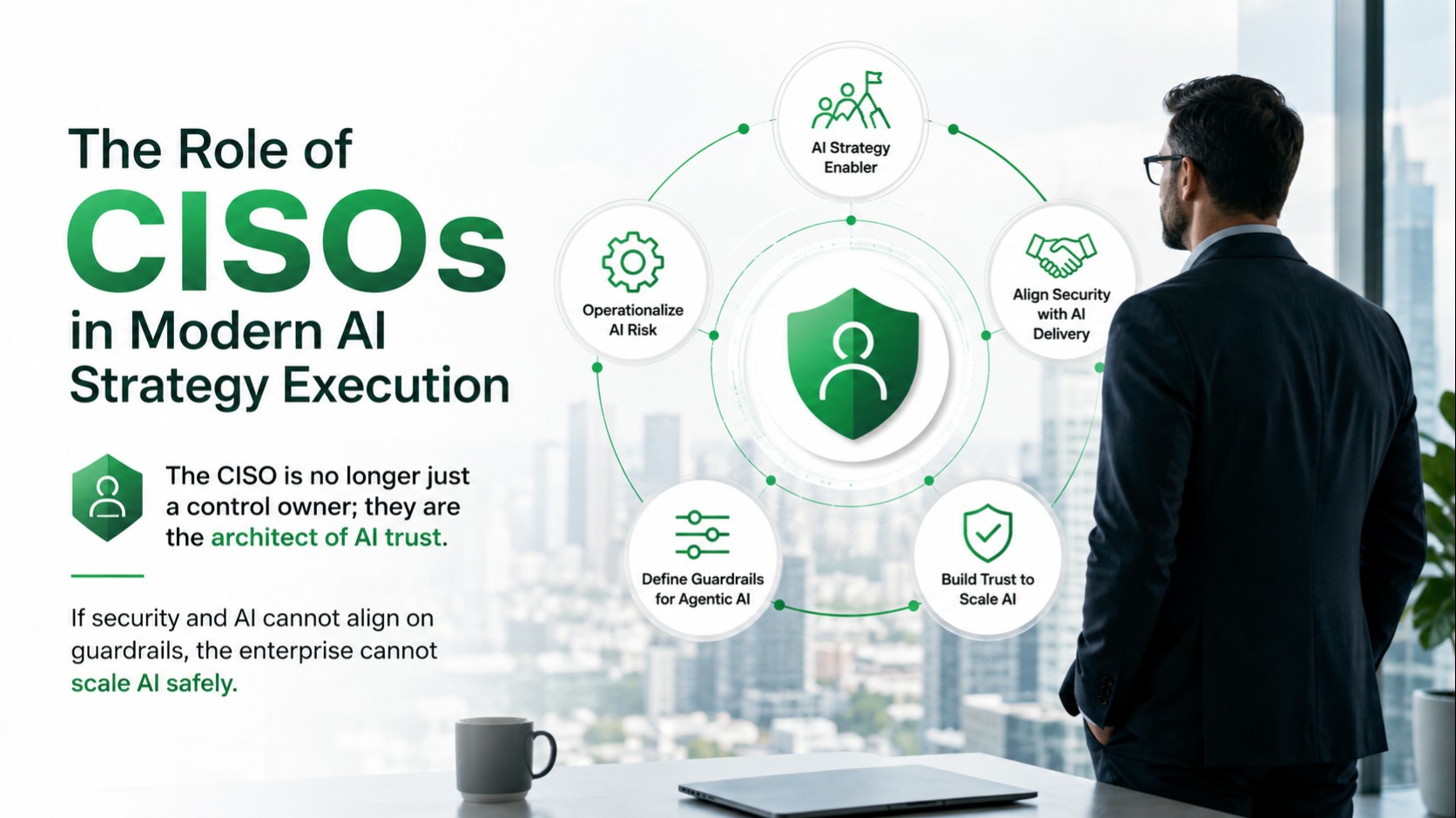
The Role of CISOs in Modern AI Strategy Execution
Enterprise AI in 2026 is no longer just about innovation; it is about securing AI as part of the enterprise operating model. The CISO's role is evolving from a control owner to a strategic enabler who translates AI risk into operational guardrails, governance, and trust.
CISOs Are Becoming AI Strategy Enablers
The modern CISO is no longer just a security gate; they are central to AI execution, digital trust, and enterprise readiness. CISOs who can turn AI risk into operational guardrails help the business move faster with more confidence. [pwc] [torq]
AI Risk Must Be Operationalized, Not Just Documented
CISOs are shifting from policy reviews to operational oversight, where risk is embedded in architecture, workflows, and approval paths. This operationalization is what makes AI safe to scale. [superwise] [amplix]
Security Teams Must Align with AI Delivery
AI delivery teams and security teams often move on different timelines, which creates friction at deployment. The CISO's job is to align those timelines so governance and execution stay in sync. [torq] [superwise]
CISOs Define the Guardrails for Agentic AI
As agentic systems become more autonomous, CISOs must define the boundaries for what agents can do, where they can act, and when they must escalate to a human. This is critical for trust at scale. [linkedin] [strata]
Trust Is the New Currency for AI Execution
The enterprises that win will be the ones where security and AI teams work together to build systems that are both fast and safe. Trust is what allows AI to scale without losing control. [pwc] [amplix]
Trust framework callout
The CISO is no longer just a control owner; they are the architect of AI trust.
If security and AI cannot align on guardrails, the enterprise cannot scale AI safely.


