


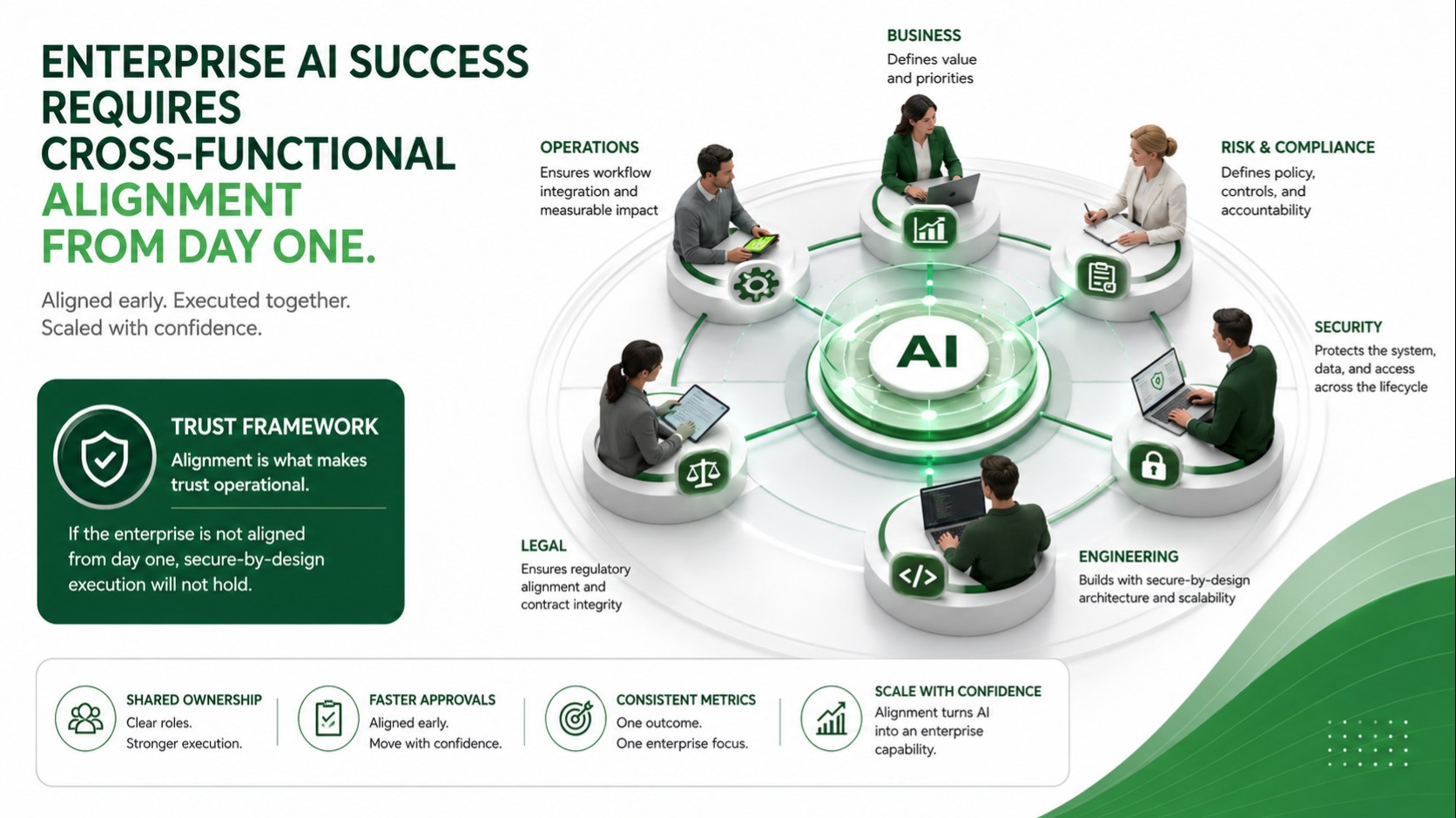
Enterprise AI Success Requires Cross-Functional Alignment from Day One.
AI is not an isolated technology initiative; it touches operations, risk, security, compliance, engineering, and business leadership. If those functions are not aligned from the start, the organization pays for it later in delays, friction, and failed scale-out. onereach+2
This is why LuMay’s comprehensive deployment model, layered with security and governance, is the only viable choice.
Security, legal, and business teams often move on different timelines.
Each function has legitimate concerns, but those concerns can easily become bottlenecks if they are not aligned early. AI programs move best when those timelines are synchronized from the start. onereach+1
Misalignment slows approvals and weakens execution.
When teams are not aligned, every decision becomes a negotiation. That slows the path to deployment and weakens confidence in the final solution. cranium+1
Shared ownership is required before deployment begins.
Cross-functional alignment is not something to solve after launch. The enterprise needs shared ownership before the system enters production so that responsibilities are clear. onereach+1
Conflicting success metrics create confusion downstream.
If one team values speed, another values control, and another values business impact, the program will drift. Shared metrics help the enterprise stay focused on the same outcome. onetrust+1
Cross-functional alignment is what turns AI into an enterprise capability.
The organizations that scale AI most effectively are the ones that bring the right stakeholders together early. Alignment is what makes AI executable across the enterprise, not just possible in a pilot. ewsolutions+1
Trust framework callout
Cross-functional alignment is what makes trust operational. If the enterprise is not aligned from day one, secure-by-design execution will not hold. superhuman+2
Cumulative references
MIT Sloan Management Review, This new framework helps companies build secure AI systems, 2025.mitsloan.mit
Lasso Security, Secure Agentic AI in the Enterprise: Best Practices for 2026, 2026.lasso
Cloud Security Alliance, The Agentic Trust Framework: Zero Trust Governance for AI Agents, 2026.cloudsecurityalliance
Superhuman, Why Trust by Design Is Critical for Enterprise AI, 2026.superhuman
Cranium AI, The Bridge of Trust: Scaling Enterprise AI With Secure Governance, 2026.cranium
WebPuppies, From AI Pilot to Production: Why 80% of Enterprise AI Stalls in 2026, 2026.webpuppies
Konica Minolta, 5 AI Priorities Every Enterprise Must Get Right in 2026, 2025.kmbs.konicaminolta
OneReach, AI Governance Frameworks & Best Practices for Enterprises 2026, 2025.onereach
WRITER, Enterprise AI adoption in 2026: Why 79% face challenges, 2026.writer
InformationWeek, Why Most AI Pilots Never Reach Production, 2025.informationweek
HyperScience, Enterprise AI in 2026: From Experimentation to Integrated Intelligence, 2026.hyperscience
Deloitte, The State of AI in the Enterprise, 2026.deloitte
Apptunix, Why Most AI Projects in the US Fail After the POC Stage, 2026.linkedin
CIO, How poor data foundations can undermine AI success, 2026.cio
Kellton, Enterprise Agentic AI Architecture Guide 2026, 2026.kellton
Spectro Cloud, Enterprise AI trends in 2026: Sovereign, agentic, edge, AI factories, 2026.spectrocloud
Plavno, Enterprise AI Security: Best Practices for 2026, 2026.plavno
Xcelore, A Must-Read Guide to Enterprise AI Security in 2026, 2026.xcelore
LinkedIn / industry commentary, Enterprise AI Has Entered the Accountability Era, 2026.linkedin
Mathematica, Building Confidence Through Data Governance, 2026.mathematica
OneTrust, Responsible AI in 2026: A 3-step Guide for Governance That Scales, 2026.onetrust
Cranium AI, AI Security in 2026: Enterprise Governance, Risks, and…, 2026.cranium
CIO, 88% of AI pilots fail to reach production — but that's not all on IT, 2025.cio
EW Solutions, AI Governance Frameworks: What They Are and How to…, 2025.ewsolutions


