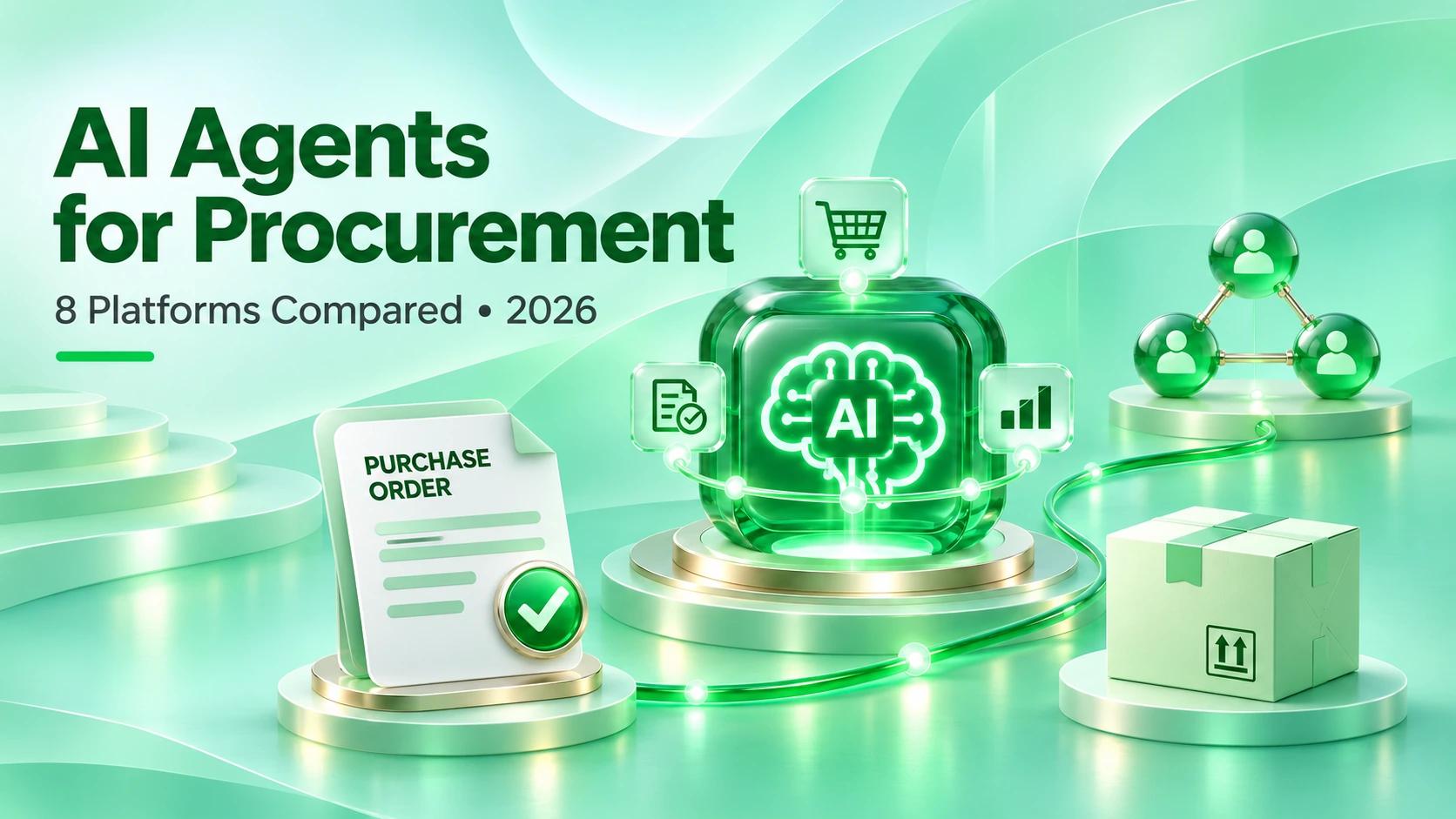
AI agents for procurement, with green AI hub, purchase order, supplier network and shipping carton
Procurement software has added “agents” faster than most buyers can test them. Some run whole sourcing events. Others only triage requests. A few negotiate with suppliers on terms you set.
This guide compares 8 AI agents for procurement by the job each one owns, how much it does on its own, and where it plugs into your ERP or source-to-pay suite.
➤ Quick answer: match the agent to one procurement job, such as intake, tail-spend sourcing or supplier risk. Let it run repeatable, bounded work end to end, and keep humans on new suppliers, nonstandard terms and awards above your delegated limits.
What AI agents for procurement do
IBM defines procurement agents as software that can draft sourcing events, route purchase requests, monitor supplier risk and resolve invoice exceptions inside existing systems. That covers most of what is on the market today.
- Intake: turns a free-text request into a structured, policy-checked requisition.
- Sourcing: finds suppliers, runs RFQs and compares bids.
- Negotiation: proposes or agrees terms inside limits you define.
- Supplier risk: watches suppliers and flags changes.
- PO and contract: drafts documents for approval.
How we chose these 8 platforms
We included platforms whose own pages describe agent-style procurement work and that sell to US enterprises. We grouped them by their main job and noted what they say about autonomy and integration.
- Main job: intake, sourcing, negotiation, full source-to-pay or supplier management.
- Autonomy: what the vendor says the agent does without a person.
- Fit: standalone, on top of a suite, or a suite itself.
- Proof on the page: analyst mentions or customer claims, quoted as vendor statements.
Research method
This comparison is based on the vendor and provider sources cited below. No hands-on product testing, paid engagement or provider interview was conducted. Features, integrations, pricing and vendor-reported results require confirmation with each provider before purchase.
Comparison table: 8 AI agents for procurement
Disclosure: LuMay publishes this guide and builds custom agents and supply-chain AI. It is not part of this list. The 8 platforms are listed alphabetically, not ranked.
Platform | Main procurement job | How it fits | What it says about autonomy |
|---|---|---|---|
Predictive pricing and line-item negotiation | Works alongside your current suite | “AI where you need it. Human where it matters.” | |
Autonomous sourcing for all spend | Sourcing layer | AI matches suppliers, analyzes bids, negotiates savings | |
Source-to-pay plus supply chain | Full suite | Source-to-pay “supercharged with agentic AI” | |
Procurement, spend and supplier management | Full suite | Connects “people, agents, workflows and data” | |
Sourcing events and supplier suggestions | Sourcing layer | “Sourcing events on Keelvar run autonomously” | |
Autonomous source-to-pay (Ranger) | Full platform | One place to build agents and workflows | |
Indirect spend and supplier terms | Runs in Coupa, SAP Ariba, your API or alone | Improves terms across many suppliers at once | |
Intake to pay orchestration | Front door on top of ERP and P2P | Agents across intake, risk and onboarding |
The 8 platforms, listed alphabetically
Arkestro
Best for: teams that want data-backed offers before suppliers quote.
- Arkestro says its AI finds savings, sets benchmarks and leads with offers across thousands of line items at once.
- It states that it has been a Sample Vendor in Gartner’s Hype Cycle for Procurement and Sourcing Solutions for four years running.
- Watch for: it adds pricing intelligence; you still need a system of record underneath.
Fairmarkit
Best for: sourcing tail and repeat spend without adding buyers.
- Fairmarkit describes AI agents for autonomous sourcing across all spend.
- Its page names supplier matching, renewal support, bid analysis and negotiated savings.
- Watch for: set clear category and dollar limits for what runs without review.
GEP
Best for: large enterprises that want procurement and supply chain on one platform.
- GEP positions its source-to-pay suite as supercharged with agentic AI.
- Its page also covers supply chain risk and resilience, sourcing and supplier performance management.
- Watch for: suite rollouts take planning. Scope the first agent use case tightly.
Ivalua
Best for: organizations that want one platform for spend and supplier management.
- Ivalua talks about a “human-agent operating model” that connects people, agents, workflows and data.
- It states it was named a Leader in The Forrester Wave for Supplier Value Management Platforms, Q4 2026.
- Watch for: ask which agents are live today versus planned.
Keelvar
Best for: sourcing teams running many RFQs and e-auctions.
- Keelvar calls itself AI-native agentic sourcing software and says sourcing events run autonomously.
- Its agent can also suggest suppliers to approach for a category.
- Watch for: autonomous events still need award rules a person sets before launch.
Levelpath
Best for: teams replacing a legacy suite with a newer platform.
- Levelpath describes an autonomous procurement platform and a source-to-pay product called Ranger.
- It offers one place to build your own agents and workflows.
- Watch for: newer products move fast; confirm general availability of the features you need.
Pactum
Best for: indirect spend where many suppliers each need small term changes.
- Pactum says it runs indirect procurement autonomously and can improve terms across every supplier at once.
- It runs inside Coupa, SAP Ariba, your own API, or on its own.
- Watch for: negotiation agents work best on bounded terms you have pre-approved.
Zip
Best for: companies whose main pain is the request process.
- Zip describes AI orchestration of every request from intake to pay.
- Its page adds third-party risk workflows and a guided supplier onboarding portal.
- Watch for: Zip sits on top of your ERP and P2P system, so plan the integration work.
Intake and request triage agents
Most procurement friction starts before sourcing. Employees do not know which form to use, which supplier is approved, or who signs off.
Intake agents fix that by turning a plain-language request into a structured requisition, checking policy and routing it to the right owner. Zip, Levelpath and GEP all describe this work.
➤ Illustrative example: an employee writes “we need a new survey tool for 50 people”. The agent checks existing contracts, finds an approved supplier with spare seats, and routes a no-cost reassignment instead of a new purchase. Details are placeholders.
Sourcing and negotiation agents: what is really autonomous
Vendors use “autonomous” loosely. In practice, agents run the repeatable part and people set the rules.
- Agents run RFQs within preset categories and dollar ceilings.
- Agents compare bids and recommend an award.
- Agents propose counteroffers inside pre-approved bands.
- People approve new suppliers, novel terms and large awards.
Ask each vendor for one real example of an event run end to end, with the rules a person set beforehand.
Supplier risk monitoring agents
Supplier risk gets less attention than negotiation, but it is where agents can watch far more signals than a team can.
- Financial health and ownership changes.
- Sanctions and compliance lists.
- Delivery performance and quality issues.
- News and disruption alerts by region.
GEP, Ivalua and Zip each name supplier risk or performance work. Treat alerts as prompts for review, not automatic decisions to drop a supplier.
Which decisions stay with a human buyer
Task | An agent can usually do this | A person should decide |
|---|---|---|
Tail-spend RFQ under a set limit | Run it end to end | Award to a brand-new supplier |
Renewal inside an approved price band | Negotiate and draft | Accept terms outside the band |
Intake triage | Classify and route | Waive a required approval |
Bid comparison | Rank and recommend | Final award above your limit |
Supplier risk alert | Flag and summarize | Suspend or exit a supplier |
PO creation | Draft against an approved requisition | Over-budget or exception POs |
Checklist before you sign
- Name the one job the agent owns first.
- Ask what it does without a person, in writing.
- Test it on your own requests, suppliers and categories.
- Confirm live integration with your ERP or P2P system.
- Review a sample audit log of agent actions.
- Agree how savings will be measured and reported.
If your team is new to judging vendor AI claims, our guide on AI training for procurement teams covers how to ask for evidence.
Custom procurement agents: when a suite agent is not enough
Suite agents fit best when your process lives inside that suite. A custom agent can make sense when data is spread across systems.
- Several ERPs after mergers, each with its own supplier master.
- Supplier risk signals that sit outside procurement tools.
- Approval rules that live in email and spreadsheets.
Our overview of enterprise integration platforms for ERP and CRM covers the plumbing, and our list of AI agent development companies covers who builds custom agents.
Limitations to plan for
- Analyst mentions on vendor pages are vendor statements, not independent reviews.
- Agents rely on clean supplier and contract data.
- Negotiation agents can strain relationships if terms feel automated or rushed.
- Invoice exceptions still need AP review; see invoice exception management.
Our own product: LuMay supply chain AI and custom agents Disclosure: LuMay publishes this article and sells the services described in this box. It is shown separately and is not ranked against the 8 platforms above. LuMay’s supply chain AI page describes forecasting, disruption monitoring, supplier-risk alerts and S&OP support connected to systems such as SAP and Oracle. Its AI agent development service builds custom agents, from single-task agents to multi-agent systems. Costs are scoped per project; see pricing. |
|---|
➤ Want to scope a procurement or supplier-risk agent for your systems? Book a demo.
Sources
- Vendor pages linked in the comparison table, read 26 Nov 2026.
- IBM watsonx Orchestrate: AI agents for procurement
- NIST AI Risk Management Framework
Frequently Asked Questions
Everything you need to know about Engineering Services
1. What are AI agents for procurement?
They are software agents that carry out procurement tasks, such as request triage, sourcing events, supplier risk checks or PO drafting, inside your systems and within rules you set.
2. Can AI agents negotiate with suppliers?
Some can, such as Pactum and Fairmarkit, within limits you set. They suit repeatable terms and tail spend. Keep people on strategic deals and new suppliers.
3. Do I need to replace my source-to-pay suite?
Not always. Pactum runs inside Coupa or SAP Ariba, Arkestro works alongside existing suites, and Zip sits on top of your ERP. GEP, Ivalua and Levelpath are full platforms.
4. Which procurement job should we automate first?
Intake and tail-spend sourcing are common starting points, because volume is high and rules are clear. Pick the job where delays or maverick spend cost you most.
5. How do AI agents handle supplier risk?
They watch signals such as financial changes, sanctions lists and delivery issues, then flag them. A person should decide whether to suspend or replace a supplier.
6. Are AI procurement agents safe to let create POs?
They can draft POs against approved requisitions and budgets. Keep human approval for exceptions, over-budget requests and first orders with new vendors.
7. How do we measure savings from procurement agents?
Agree a baseline before launch: cycle time, price versus benchmark, spend under management and buyer hours. Compare the same categories before and after.
8. What data do procurement agents need?
A clean supplier master, current contracts, category rules, approval limits and spend history. Gaps in this data are the most common reason pilots stall.
9. What is the difference between AI procurement software and AI agents?
Software with AI features suggests or classifies. An agent goes further: it works through steps toward a goal, such as running an RFQ, and acts within limits.
10. How long does it take to launch a procurement agent?
A bounded first use case can often go live in weeks. Timelines depend on integrations, data quality and how many categories you include.
11. When should we build a custom procurement agent?
When your process spans several ERPs, relies on rules held outside any system, or needs risk signals your suite does not cover. Start with a short discovery phase.
About the Editorial Team
Creates insightful content on SEO, AI-powered marketing, digital growth, and emerging technologies. He simplifies complex topics into practical, research-backed guidance.