


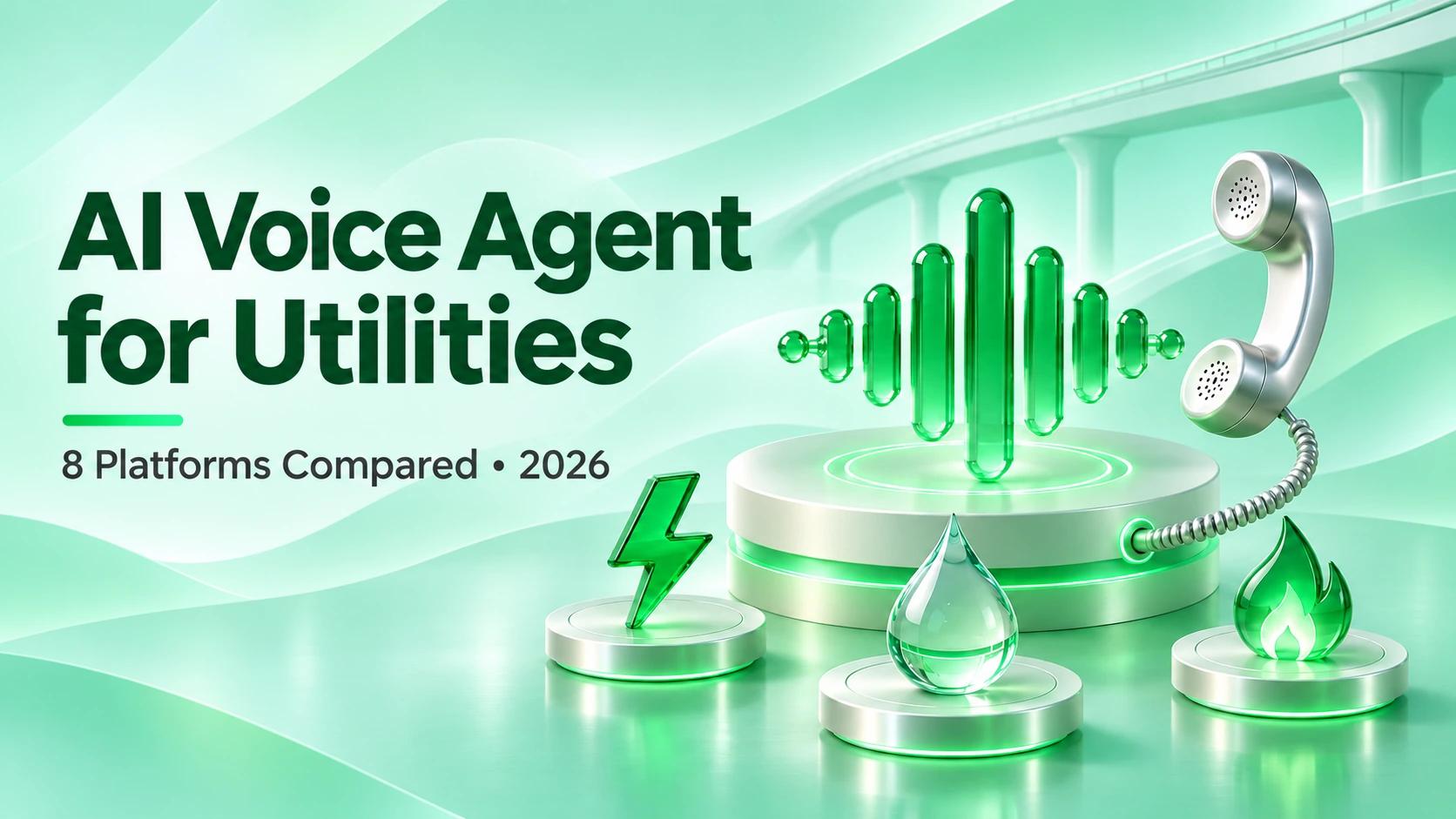
AI voice agent for utilities, with green voice waveform, telephone and electricity, water and gas icons
A utility contact center can be quiet at 9 a.m. and overwhelmed by 9:15 after a storm, a main break or a billing error. Hiring for the peak is expensive. Hiring for the average leaves customers on hold when they most need answers.
This guide compares 8 platforms that offer an AI voice agent for utilities serving electric, gas and water customers. It covers outage surges, billing and payment plans, system integration and safety calls.
➤ Quick answer: pick a platform load-tested for outage surges that reads and writes your customer information system (CIS) and outage management system (OMS) mid-call, plays fixed safety scripts for gas leaks and downed lines, and hands off with context.
What an AI voice agent for utilities handles
- Outages: takes reports, confirms known outages and gives restoration estimates.
- Billing: explains high bills, due dates and recent payments.
- Payments: sets up payment plans and extensions within your rules.
- Service orders: start, stop and move service.
- Account updates: contact details, paperless billing and autopay.
- Notifications: outbound outage and restoration updates.
PolyAI reports that its agent at Pacific Gas and Electric saved 35,000 labor hours, raised CSAT by 22% and reached 67% containment, 6 points above the legacy IVR. These are vendor-published figures for one deployment.
Safety calls that must go to a human
Some calls should never depend on a model’s judgement. A caller who smells gas or sees a downed line needs your approved safety message, at once, and a fast route to your emergency team.
- Play fixed, pre-approved safety wording before anything else.
- Transfer straight to your emergency line or dispatch.
- Log the call and location for follow-up.
- Test these paths on real phone calls in every pilot.
Dograh’s utility guide makes the same point: the safety instruction should play as fixed words before the model decides anything.
How we chose these 8 platforms
We included platforms that publish utility-specific pages or case studies. We compared each on what it says about four needs.
- Surge handling: concurrency and outage spikes.
- Integration: CIS, OMS, billing and payment systems.
- Utility workflows: outages, payment plans, service orders.
- Compliance support: scripts, audit and regulatory rules.
Research method
This comparison is based on the vendor and provider sources cited below. No hands-on product testing, paid engagement or provider interview was conducted. Features, integrations, pricing and vendor-reported results require confirmation with each provider before purchase.
Comparison table: 8 AI voice agent platforms for utilities
Disclosure: LuMay publishes this guide and sells a voice agent. It is not part of this list. The 8 platforms are listed alphabetically, not ranked.
Platform | Utility strengths on its page | Integration named | Best fit |
|---|---|---|---|
Caller identification, account lookup, after-hours calls | System of record | Mid-size utilities and water providers | |
Open source, self-hosted, fixed safety lines | Reads and writes accounts mid-call | Utilities that must keep calls on their own servers | |
Outage, high-bill and payment calls; audits all calls against state rules | Files outage reports into the OMS | Investor-owned utilities, co-ops, gas and water | |
Surge capacity, payment plans, start of service, outbound outage alerts | Utility payment and account systems | Large contact centers | |
PG&E case: authentication, outages, billing, Spanish | Cisco, Oracle, Nuance, Kubra, Mulesoft | Large utilities with complex stacks | |
Outage spikes, billing, safety routing, localization | CRM and OMS | Utilities comparing several options | |
Outage logging, restoration updates, plan suggestions | Oracle Utilities, SAP IS-U, Salesforce, custom CIS | Utilities on Oracle or SAP | |
Energy and water billing, payment plans, outages | Not detailed on page read | Smaller energy and water providers |
The 8 platforms, listed alphabetically
Dial AI
Best for: utilities that need strong after-hours coverage.
- Dial AI describes agents that identify callers, often by matching the calling number, read the account and complete the request.
- It stresses handling hundreds of concurrent conversations and after-hours events such as burst pipes.
- Ask about: which CIS platforms it supports out of the box.
Dograh
Best for: utilities that must run calls on their own infrastructure.
- Dograh is an open-source platform that can be self-hosted on a utility’s servers.
- It says it reads and writes customer accounts mid-call and recommends fixed safety wording for gas and downed-line calls.
- Ask about: the internal engineering effort needed to run it yourself.
Orvera
Best for: regulated utilities that need every call checked against state rules.
- Orvera handles outage, high-bill and payment-arrangement calls for investor-owned utilities, gas distributors, co-ops and water providers.
- It says it audits every conversation against state notice, eligibility and moratorium rules and files outage reports into the OMS.
- Ask about: how rules are updated when your commission changes them.
Parloa
Best for: large contact centers that face sharp grid-event spikes.
- Parloa says a grid event can spike volume 10 to 20 times within hours and that its agents absorb it.
- It names payment checks, extensions, installment plans, new service setup and outbound outage notices.
- Ask about: load-test results at your own peak volumes.
PolyAI
Best for: large utilities that want a published utility reference.
- Its PG&E case covers authentication, routing, outages, billing and questions in English and Spanish.
- Named technologies include Cisco, Oracle, Nuance, Kubra and Mulesoft.
- Ask about: which results apply to your size and call mix.
Seavoice
Best for: teams that want a utility-specific evaluation framework.
- Seavoice publishes a utilities guide that rates platforms on outage spikes, billing, safety routing, CRM and OMS links, and localization.
- It recommends starting with one high-value use case measured against a baseline.
- Ask about: its own utility references, since its guide also covers competitors.
SoundHound
Best for: utilities on Oracle Utilities or SAP IS-U.
- SoundHound says its OASYS platform integrates with Oracle Utilities, SAP IS-U, Salesforce and custom CIS systems.
- It logs outage reports, shares restoration updates, notifies affected customers and can suggest plans such as off-peak options.
- Ask about: how plan suggestions are reviewed for fairness and accuracy.
Trillet
Best for: smaller energy and water providers.
- Trillet describes voice AI for energy and water customer service, covering billing, payment plans, outages and service requests.
- It positions the service for organizations that need verification and payments at scale.
- Ask about: integrations and references specific to your size.
Storm and outage surges: load-testing before you sign
A demo with ten calls tells you little about a storm. Ask each vendor to prove surge capacity on your terms.
- Run a load test at two to three times your worst recorded hour.
- Measure answer time, error rate and transfer success under load.
- Confirm outage messages update from the OMS in near real time.
- Plan a fallback if the AI provider has an outage of its own.
Our guide to AI voice agent failover covers recovery when a provider goes down.
Billing, payment plans and assistance programs
Billing calls are where customers are most stressed and rules are most detailed. Payment plans, disconnection notices and assistance programs often follow state commission rules.
- Load your plan rules and eligibility limits into the agent’s workflow, not just its prompt.
- Log every offer made and accepted.
- Transfer hardship and medical-certificate cases to trained staff.
➤ Illustrative example: a customer calls about a high winter bill. The agent verifies identity, explains the usage change, offers a three-month payment plan within your rules, confirms it by text and logs the agreement in the CIS. Steps are placeholders.
Outbound notices and calling rules
Outbound outage and payment calls bring US calling rules into play. The Telephone Consumer Protection Act, 47 U.S.C. § 227, restricts automated and prerecorded calls. Review consent and call types with your legal team before launch.
Cost per call and rollout plan
Pricing varies by vendor: per minute, per call, per resolved call or platform fee. Most utility platforms quote privately, so compare on a standard call mix.
- Estimate monthly calls by type, average length and peak hour.
- Ask for pricing at normal and storm volumes.
- Add telephony, integration and testing costs.
➤ Illustrative example: a four-step rollout. Step 1: outage status after hours. Step 2: billing questions. Step 3: payment plans. Step 4: start, stop and move service. Timing is a placeholder.
For wider comparisons, see our guides to voice AI platforms for high-volume calls and tools for 24/7 automated phone support.
Checklist for your shortlist
- Load-test results at your peak, in writing.
- Live CIS and OMS read and write, shown on a test account.
- Fixed safety scripts and emergency transfer, tested on real calls.
- Payment-plan rules enforced in workflow, with logs.
- English and Spanish support at minimum, if your customers need it.
- A clear plan for handoff and fallback.
Limitations to plan for
- Vendor case figures come from single deployments and may not match yours.
- Older CIS platforms can make integration slow.
- Rules differ by state and change over time.
- Some callers will always want a person; make that easy.
Telecom and broadband providers face a different call mix. See our separate guide to AI voice agents for telecom.
Our own product: LuMay Voice Agent Disclosure: LuMay publishes this article and sells the product described in this box. It is shown separately and is not ranked against the 8 platforms above. LuMay Voice Agent handles inbound and outbound calls and is described as built for every industry, with templates for customer support and appointment booking. Its inbound voice agent page covers answering and routing calls. For costs, see pricing. |
|---|
➤ Want to test an outage or billing call flow? Book a demo.
Sources
- Vendor pages linked in the comparison table, read 26 Nov 2026.
- PolyAI: PG&E case study
- 47 U.S.C. § 227 (TCPA), Cornell LII
- U.S. Energy Information Administration
Frequently Asked Questions
Everything you need to know about Voice Agent
1. What is an AI voice agent for utilities?
It is AI that answers and makes utility customer calls in natural speech. It handles outages, billing, payment plans and service orders, and hands complex or urgent calls to staff.
2. Can an AI voice agent handle outage call surges?
That is a main reason utilities use them. Vendors such as Parloa and Dial AI stress surge capacity. Ask for load-test results at your own worst hour.
3. How should AI handle gas leak or downed line calls?
Play fixed, approved safety wording at once and transfer to your emergency line. Do not let the model improvise. Test these paths on real calls.
4. Does it connect to our CIS and OMS?
Several platforms name integrations, such as SoundHound with Oracle Utilities and SAP IS-U, and Orvera with OMS outage reports. Confirm read and write access on a test account.
5. Can AI voice agents set up payment plans?
Yes, within your rules. Parloa and Orvera describe payment arrangements and extensions. Keep hardship and medical cases with trained staff and log every offer.
6. What results have utilities reported?
PolyAI reports that PG&E saved 35,000 labor hours, raised CSAT by 22% and reached 67% containment. Treat vendor case figures as examples, not guarantees.
7. Do outbound outage calls need consent?
Automated and prerecorded calls in the US fall under the TCPA, 47 U.S.C. § 227. Review consent and call types with your legal team before sending outbound notices.
8. Can it serve Spanish-speaking customers?
Many platforms support several languages. PolyAI’s PG&E case includes Spanish. Test accuracy with real callers in each language you need.
9. How long does a utility voice AI rollout take?
A narrow first step, such as after-hours outage status, can launch in weeks. Billing and payment workflows take longer because of integration and rule testing.
10. How is utility voice AI priced?
Pricing may be per minute, per call, per resolved call or a platform fee. Most utility vendors quote privately, so compare on the same call mix and peak volume.
11. Will AI replace utility call center agents?
It takes routine and surge calls, so staff can focus on complex, sensitive and safety cases. Most utilities keep people for hardship, disputes and emergencies.
About the Editorial Team
Creates insightful content on SEO, AI-powered marketing, digital growth, and emerging technologies. He simplifies complex topics into practical, research-backed guidance.