


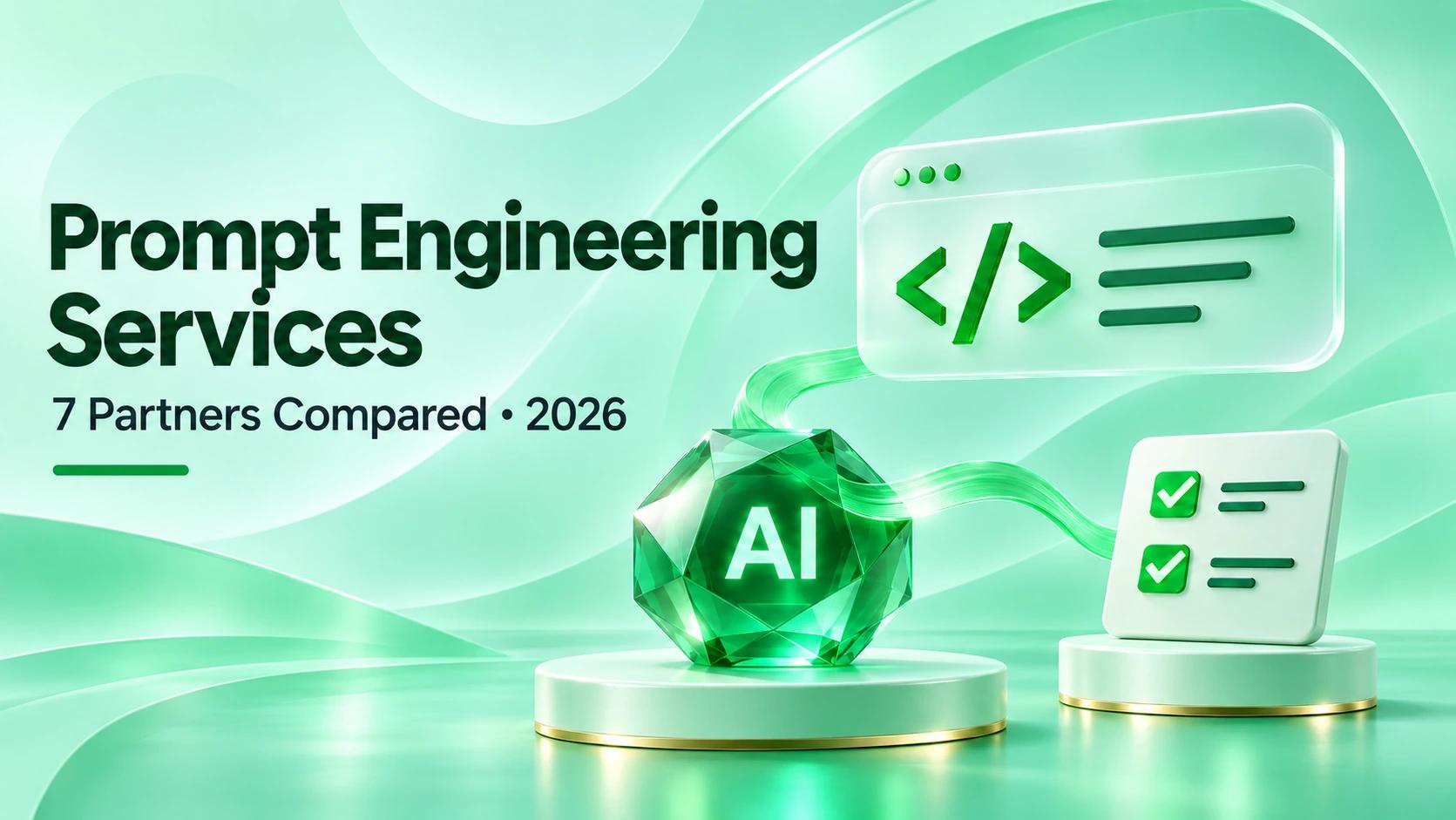
Prompt engineering services, with glass code window, green AI core and evaluation checklist
When an LLM feature gives uneven answers, the model is rarely the only problem. The instructions, examples, retrieved context and guardrails around it decide most of the result.
This guide compares 7 prompt engineering services partners on how they test prompts, what they hand over and where each fits. It also explains what a good engagement should deliver.
➤ Quick answer: hire for evaluation, not wordsmithing. A good partner builds a test set from your real inputs, scores prompt changes against it, versions every prompt, and hands over the tests so your team can keep improving after they leave.
What prompt engineering services include in 2026
Prompt engineering has grown from writing clever instructions into a small engineering discipline. Current services usually cover:
- System prompts and instructions: role, scope, tone and allowed actions.
- Context design: what retrieved text, examples and user data the model sees.
- Tool and agent prompts: how the model chooses and calls functions.
- Guardrails: handling of personal data, prompt injection and off-topic requests.
- Evaluation: test sets, scoring rubrics and regression checks.
- Optimization: fewer tokens, lower latency, stable formatting.
Both OpenAI’s prompt engineering guide and Anthropic’s prompt engineering overview stress the same first step: define success criteria and tests before you start editing prompts.
Prompt engineering vs RAG vs fine-tuning: which you are buying
Approach | What changes | Use it when |
|---|---|---|
Prompt engineering | Instructions, examples and context | Outputs are close but inconsistent |
RAG (retrieval) | What documents the model sees | Answers need your current internal data |
Fine-tuning | The model’s weights | You need a fixed style or format at scale |
Most projects start with prompts, add retrieval when facts are missing, and consider fine-tuning last. Our guide to LLM fine-tuning cost covers that last step.
How we chose these 7 partners
We looked for firms with a dedicated prompt engineering or prompt evaluation service page, then compared them on four points.
- Evaluation method: do they describe test sets, scoring or regression checks?
- Scope: prompts only, or prompts plus RAG, agents and integration?
- Model coverage: single model or several providers.
- Pricing signal: what the page says about cost.
Research method
This comparison is based on the vendor and provider sources cited below. No hands-on product testing, paid engagement or provider interview was conducted. Features, integrations, pricing and vendor-reported results require confirmation with each provider before purchase.
Comparison table: 7 prompt engineering services partners
Disclosure: LuMay publishes this guide and offers prompt and context engineering inside its LLM development service. It is not part of this list. The 7 partners are listed alphabetically, not ranked.
Partner | Evaluation method named on its page | Scope | Best fit |
|---|---|---|---|
Prompt evaluation and testing with established frameworks | Prompts, agents, multimodal, proprietary data | Teams wanting a focused prompt partner | |
A/B tests, evaluation datasets, rubric scoring, regression testing | Prompts, guardrails, RAG, agent prompts | Products already running LLM features | |
Internal R&D benchmarking of approaches | Full data and AI builds, including RAG and agents | Prompt work as part of a wider build | |
Not detailed on page read | Dedicated prompt engineers for generative models | Teams that want to add engineers to their own team | |
Human scoring, A/B tests, failure and edge-case analysis | Evaluation across models and 1,000+ language locales | Multilingual and evaluation-heavy work | |
Output testing, prompt debugging | Prompt strategy, templates, chatbot flows | Fast access to individual specialists | |
Evaluation and test data generation | Human data for model training (SFT, RLHF) | Teams training or tuning models |
The 7 partners, listed alphabetically
Concret.io
Best for: teams that want a dedicated prompt engineering company.
- Concret.io lists custom prompt development, prompt evaluation and testing, and prompting for automated LLM agents.
- It also names multimodal prompting and prompts that use your proprietary data.
- Ask about: the exact frameworks used for testing and what you keep at the end.
Geniusee
Best for: products with LLM features already in production that underperform.
- Geniusee names evaluation datasets, A/B tests, LLM-as-judge checks, rubric scoring and regression testing when prompts, models or sources change.
- It covers guardrails for personal data and prompt injection, and prompts for OpenAI, Claude, Gemini, Azure OpenAI and Bedrock.
- Ask about: who owns the evaluation set and how it is maintained.
InData Labs
Best for: companies where prompt work is one part of a bigger AI build.
- InData Labs describes full-stack data and AI work: LLMs, RAG systems, AI agents, machine learning and data engineering.
- It runs an internal R&D center that benchmarks emerging approaches and says it recommends tools without reselling them.
- Ask about: whether a prompt-only engagement is available.
LeewayHertz
Best for: teams that want prompt engineers working inside their own team.
- LeewayHertz offers dedicated prompt engineers for generative AI models.
- The model suits ongoing work more than a one-off audit.
- Ask about: how prompt changes are tested and documented under a staff model.
LXT
Best for: evaluation-heavy and multilingual programs.
- LXT focuses on testing prompts before scaling, with A/B comparisons, human scoring, few-shot and system-prompt evaluation, and edge-case analysis.
- It states coverage of more than 1,000 language locales.
- Ask about: how human scores are calibrated and turned into automated checks.
Toptal
Best for: quick access to individual prompt specialists.
- Toptal lists prompt strategy, multi-model prompting, prompt optimization, chatbot prompt design and API-ready templates.
- It also names output testing, context management and prompt debugging.
- Ask about: continuity if the specialist changes mid-project.
Turing
Best for: teams training or fine-tuning their own models.
- Turing focuses on human data for supervised fine-tuning and reinforcement learning from human feedback.
- It also generates evaluation and test data to probe model behavior.
- Ask about: fit, since this is model-level work rather than application prompt tuning.
What a good engagement hands over
The test of a prompt engineering partner is what you can run after they leave. Ask for these four deliverables in the contract.
- Evaluation set: real, anonymized inputs with expected outputs or scoring rubrics.
- Prompt registry: every prompt version, with owner, date and test score.
- Change log: what changed, why, and the before-and-after results.
- Runbook: how to rerun tests when you change model, data or tools.
➤ Illustrative example: a support assistant gives correct answers 70% of the time on a 200-question test set. After three prompt revisions and one retrieval fix, it scores 88%, and the registry shows which change gave which gain. Figures are placeholders.
Our guides to open-source LLM evaluation frameworks and evaluating RAG in production cover the tooling behind these deliverables.
How prompt engineering services are priced
None of the 7 partners publishes a price on the page we read. Engagements are usually sold in one of three ways.
- Audit: a fixed fee to review prompts and propose fixes.
- Project: a scoped build with evaluation set and handover.
- Staffing: hourly or monthly engineers working inside your team.
Ask for a written scope that names deliverables, test-set size and success targets before comparing quotes.
Questions to ask before hiring
- How will you build an evaluation set from our real data?
- Which metrics will you report, and how often?
- How do you guard against prompt injection and data leaks?
- Which models have you shipped prompts for in production?
- What happens when we switch models next year?
- Who owns the prompts, tests and documentation?
The NIST AI Risk Management Framework offers neutral language for the testing and monitoring part of this conversation.
Limitations to plan for
- Prompt gains can disappear when a provider updates a model; keep regression tests running.
- Prompts cannot fix missing or outdated source data.
- Very long prompts raise cost and latency.
- Learning prompt skills for your own staff is a separate goal; see our guide to choosing a prompt engineering course.
Our own product: LuMay prompt and context engineering Disclosure: LuMay publishes this article and sells the service described in this box. It is shown separately and is not ranked against the 7 partners above. LuMay’s LLM development service covers enterprise LLM integration and optimization, and lists prompt and context engineering as one of its capabilities. That work sits inside wider builds, alongside retrieval, integration and evaluation. Scope and costs are set per project; see pricing. |
|---|
For a wider view of build partners, see our list of LLM development companies in the USA.
➤ Want an outside view of your prompts and test coverage? Book a demo.
Sources
- Partner service pages linked in the comparison table, read 26 Nov 2026.
- OpenAI: Prompt engineering guide
- Anthropic: Prompt engineering overview
- NIST AI Risk Management Framework
Frequently Asked Questions
Everything you need to know about Engineering Services
1. What are prompt engineering services?
They are outside services that design, test and improve the instructions, examples and context an LLM receives, so an AI feature gives more accurate, consistent and safe outputs.
2. How much do prompt engineering services cost?
None of the 7 partners here publishes a price on its service page. Pricing is usually a fixed audit fee, a scoped project or hourly staffing. Ask for a written scope first.
3. What should a prompt engineering partner deliver?
An evaluation set, a versioned prompt registry, a change log with test results, and a runbook so your team can rerun tests after model or data changes.
4. Is prompt engineering still needed with newer models?
Yes. Newer models follow instructions better, but your context, tools, format rules and guardrails still need design and testing, especially in production systems.
5. What is the difference between prompt engineering and fine-tuning?
Prompt engineering changes what the model is told. Fine-tuning changes the model itself with training data. Most teams try prompts and retrieval before fine-tuning.
6. How do you measure prompt quality?
Score outputs against a fixed test set using rubrics, automated checks or human review. Track accuracy, format errors, refusals and cost per call across versions.
7. Can prompt engineering stop prompt injection?
It reduces risk but cannot remove it alone. Combine careful instructions with input filtering, tool permissions and output checks, and test with known attack examples.
8. How long does a prompt engineering engagement take?
A focused audit can take a few weeks. Projects that include an evaluation set, several revisions and handover usually take longer, depending on use cases and review cycles.
9. Should we hire a prompt engineer or a services firm?
Hire in-house if prompts are core to your product long term. Use a firm to set up evaluation and standards quickly, then train your team to run them.
10. Do prompts need to change when we switch models?
Often, yes. Different models respond differently to the same instructions. A regression test set lets you see what breaks and fix it before users notice.
11. What data do we need to share with a prompt partner?
Representative, anonymized inputs and good example outputs. Agree data handling, retention and access rules in the contract before sharing anything sensitive.
About the Editorial Team
Creates insightful content on SEO, AI-powered marketing, digital growth, and emerging technologies. He simplifies complex topics into practical, research-backed guidance.