The difficult part of enterprise AI is rarely the model demo. It is getting the model to participate safely in a workflow that already spans people, APIs, systems of record, permissions, exceptions and audit requirements.
That is why enterprise-grade AI integration services should be evaluated as systems engineering, not prompt engineering.
What are enterprise AI integration services?
Enterprise AI integration services connect AI capabilities to the organization’s existing applications, data, identity, APIs and workflows so AI can assist or automate real work under defined controls.
The deliverable is not “an AI chatbot connected to your data.” A production integration should define what the AI can read, what it can propose, what it can change, how failures are recovered, how humans intervene and how every important action is observed.
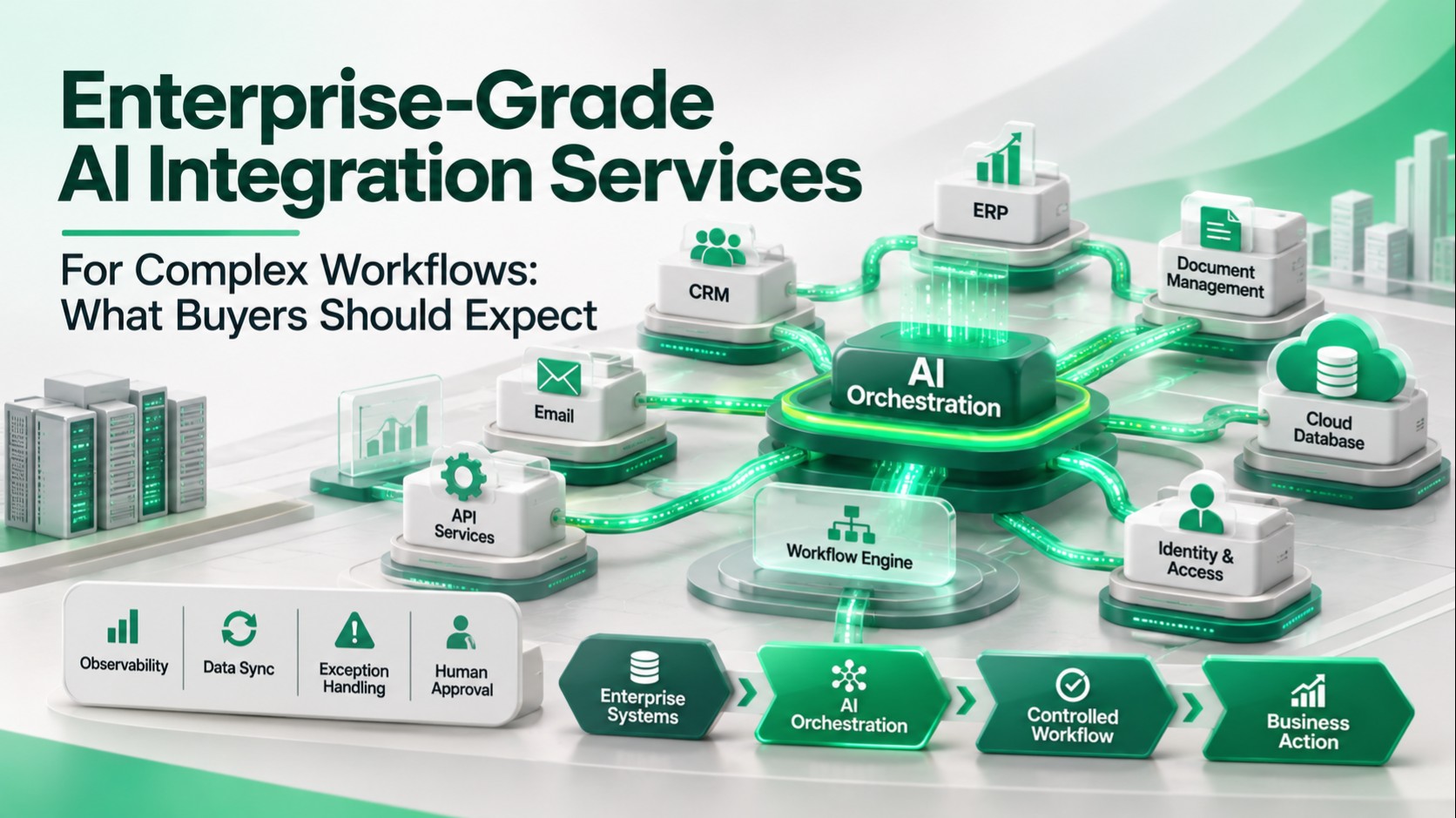
AWS Prescriptive Guidance treats enterprise AI integration as a combination of APIs, message queues, event-driven patterns, data pipelines and downstream system integration rather than a single chat interface. Microsoft’s enterprise integration reference architecture similarly separates API management, workflow orchestration, identity and back-end systems. See AWS guidance on generative AI integration and Microsoft’s enterprise integration reference architecture.
What makes a workflow complex?
Complexity usually comes from coordination, not from one difficult model call.
| Complexity source | Enterprise example |
|---|---|
| Multiple systems | CRM, ERP, document management, email and billing. |
| Identity boundaries | User, service, tenant and role-specific access. |
| Long-running state | Workflow may wait hours or days for documents or approval. |
| Exceptions | Missing data, conflicting records, unavailable systems. |
| Human judgment | Approval needed before high-risk actions. |
| Auditability | Need to reconstruct what data and rule produced an action. |
Seven deliverables buyers should expect
1. A workflow map before architecture
The provider should document the current process, actors, systems, handoffs, decisions, exceptions and measurable outcome before selecting models or frameworks.
Without this map, integration work tends to automate visible steps while missing the exception paths that dominate production support.
2. Explicit system-of-record ownership
AI should not quietly create a second source of truth. For each object—customer, contract, invoice, case, ticket or employee—define which enterprise system remains authoritative.
The AI layer can search, summarize, classify or propose updates, but final writes should return to the system that owns the record.
3. Contract-first tool integration
Instead of exposing broad APIs directly to the model, define narrow business tools with validated schemas. This gives policy and testing a stable boundary.
LuMay’s structured outputs guide explains why validated schemas matter before workflows act.
4. Identity propagation and least privilege
An integration should answer: whose authority is the agent using, what tenant is in scope, what fields may be read, and which actions are allowed?
Review AI Agent Permissions: How to Enforce Least Privilege for Tools for the control model.
5. Durable orchestration
Complex workflows should survive retries, restarts, human waiting periods and partial system failure. Ask how workflow state is persisted, how duplicate actions are prevented and how a failed step is resumed.
For retry safety, see AI Agent Idempotency.
6. Human approval at the right boundary
Human review belongs immediately before decisions where judgment changes the outcome or where the side effect is costly or irreversible. Avoid making people approve every low-risk step.
7. Production observability and handover
The provider should deliver traces, failure states, runbooks, dashboards, evaluation data, ownership and support procedures—not only application code.
A reference integration architecture
A robust pattern is:
Channel or event → identity/context → workflow orchestrator → model/retrieval layer → validated business tools → policy/approval → integration layer → system of record → observability and audit.
The important point is separation. The model should not simultaneously reason, authorize itself and write directly to a sensitive system.
API, event and batch integration all matter
| Pattern | Use when | Example |
|---|---|---|
| Synchronous API | User needs an immediate answer or action. | Look up account status. |
| Event-driven | A business change should start a workflow. | New invoice triggers validation. |
| Batch | Large volumes do not require immediate response. | Nightly classification or enrichment. |
| Human task | Workflow must pause for judgment. | Approve a high-value exception. |
A provider that treats every problem as a synchronous chatbot is not designing around the enterprise workflow.
Integration testing should include failure, not only success
Ask the delivery team to demonstrate:
- downstream API timeout;
- expired credentials;
- duplicate event delivery;
- partial write;
- changed schema;
- permission denial;
- missing source document;
- human rejection;
- model timeout;
- retry after restart.
These tests reveal whether the architecture can operate after the demo ends.
How to evaluate an AI integration partner
| Evaluation area | Evidence to request |
|---|---|
| Workflow discovery | Process map with exception paths and measurable outcome. |
| Architecture | System boundaries, data flows, identity and control points. |
| Integration engineering | API contracts, event design, idempotency and error handling. |
| AI evaluation | Representative test set and release criteria. |
| Security | Least privilege, secrets handling, audit and approval design. |
| Operations | Tracing, alerts, runbooks, ownership and recovery procedure. |
| Handover | Documentation, code ownership, environments and training. |
What buyers should not accept
- a prototype that writes directly to production with broad credentials;
- integration logic hidden inside prompts;
- no owner for system-of-record conflicts;
- no replay or duplicate-action protection;
- no representative evaluation set;
- no support model after launch;
- no way to trace an answer or action back through the workflow.
For the broader production foundation, see AI Platform Engineering Services: Build the Foundation for Production AI.
Final perspective
The best enterprise AI integration is almost invisible. Users experience a smoother workflow; systems of record remain authoritative; permissions still apply; exceptions are recoverable; and the model is only one controlled component in a much larger operating system.