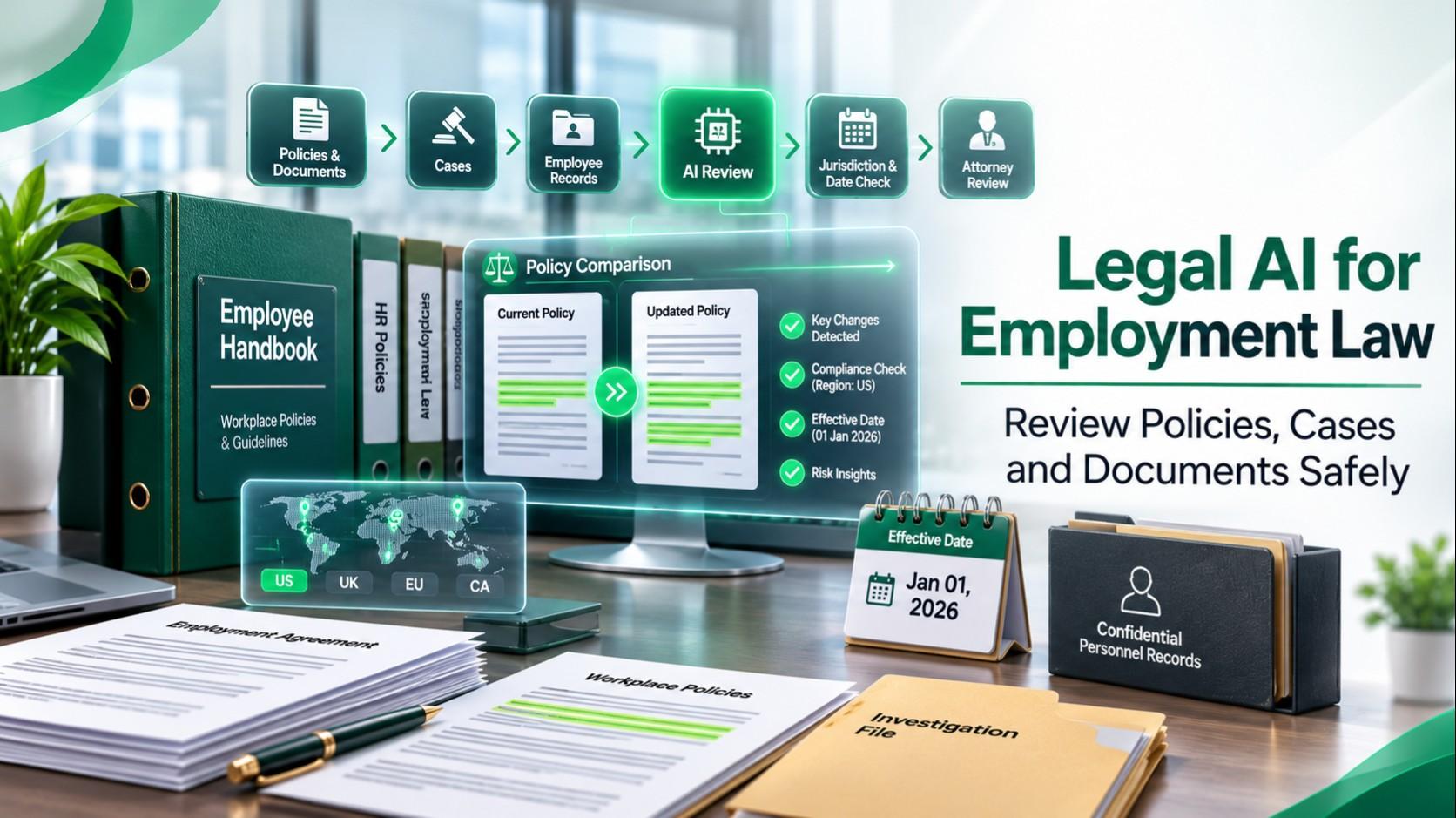
AI consultant for law firms, with green AI cube, scales of justice and strategy roadmap
Attorney review note: this article is general information, not legal advice. Hiring a consultant does not transfer a lawyer’s professional duties. Each firm remains responsible for its own compliance with the rules of professional conduct in its jurisdiction.
Most law firms already have AI in the building, often in tools staff found on their own. The question now is how to use it safely, what to buy, and who should help.
This guide compares 8 options for an AI consultant for law firms on legal focus, published prices, whether they build or only advise, and how they handle confidentiality. It ends with what a first engagement should deliver.
➤ Quick answer: small and mid-size firms should start with a fixed-price assessment that delivers a written AI policy, ranked use cases and a training plan. Pick a consultant who knows the ethics rules, publishes prices and has worked with similar firms.
What an AI consultant for law firms does
- Assessment: maps how work moves through the firm and where AI fits.
- Policy: writes an AI use policy covering confidentiality, verification and supervision.
- Tool selection: compares legal and general AI tools against your needs.
- Build: sets up workflows, automations or custom tools.
- Training: teaches lawyers and staff to use AI safely.
Ethics duties a consultant should help with
The ABA’s Formal Opinion 512 (July 2024) is the main national guidance on lawyers using generative AI tools. It ties AI use to existing duties.
- Competence: understand the tool’s capabilities and limits.
- Confidentiality: assess risks before putting client information into a tool.
- Communication: consider when to tell clients about AI use.
- Candor and verification: check outputs before relying on them.
- Supervision: set firm policies and train lawyers and staff.
- Fees: bill fairly for AI-assisted work.
State bars add their own guidance. The State Bar of California’s practical guidance on generative AI is one widely cited example. A good consultant works with your ethics counsel on these points; they do not replace them.
How we chose these 8 firms
We looked for consultants with a page aimed at law firms or legal teams, serving US firms. We compared them on four points.
- Legal focus: law firms only, or legal as one sector.
- Published price: whether the page states a figure.
- Builder or advisor: do they build tools, or advise and train?
- Firm size: who they say they serve.
Research method
This comparison is based on the vendor and provider sources cited below. No hands-on product testing, paid engagement or provider interview was conducted. Features, integrations, pricing and vendor-reported results require confirmation with each provider before purchase.
Comparison table: 8 AI consultants for law firms
Disclosure: LuMay publishes this guide and offers AI consulting and legal AI products. It is not part of this list. The 8 firms are listed alphabetically, not ranked.
Firm | Legal focus | Published price on its page | Builder or advisor | Who it serves |
|---|---|---|---|---|
Law firms among several sectors | $499 AI-Ready Audit; $6,000 Blueprint | Builder | Firms wanting systems they own | |
Law firms only | Not on page read | Setup and training | Firms with 10 or fewer attorneys, Central New York | |
Legal and compliance services | Not on page read | Advisory and implementation | Large firms and legal departments | |
Law firms and legal departments | Not on page read | Builder and advisor | Firms wanting strategy through support | |
Law firms page | $2,500 assessment; rollout from $4,500 | Setup and training | Firms of 10 to 200 people | |
Law firms only | $2,000 session; $6,000 Blueprint | Advisor and builder | Firms of 1 to 75 attorneys | |
Law firm marketing agency | Not on page read | AI, automation and software consulting | Firms already using it for marketing | |
Solo, small firm and in-house legal | $2,500 audit; programs $10,000–$30,000; $300/hr | Advisor and implementer | Firms wanting an attorney-led rollout |
The 8 firms, listed alphabetically
ColabContent
Best for: firms that want custom systems they own.
- ColabContent is a Boston AI consulting company that audits businesses and builds custom AI systems, with law firms among its clients.
- It prices an AI-Ready Audit at $499 and a fixed $6,000 Blueprint, with later work scoped from the Blueprint.
- Ask about: law-firm references and how client data is handled in builds.
DocketLight
Best for: very small firms in Central New York.
- DocketLight focuses on practical, supervised AI for law firms with 10 or fewer attorneys.
- It sets up tools safely, documents them with the ethics rules in mind, and trains the whole team.
- Ask about: price and whether it works outside its region.
Epiq
Best for: large firms and legal departments with complex operations.
- Epiq is a legal and compliance services provider whose offerings include contracts AI advisory and implementation.
- Its page also covers legal department and law firm operations and a data, AI and analytics platform.
- Ask about: scope for law firms versus corporate legal clients.
Jurvantis
Best for: firms that want one team from strategy to support.
- Jurvantis offers full-stack consulting for law firms and legal departments: strategy, compliance, custom builds, integrations, training and ongoing support.
- It positions itself against firms that only deliver “strategy calls”.
- Ask about: fixed-price options and team size.
Justin McKelvey
Best for: firms of 10 to 200 people that want published, modest prices.
- He offers a $2,500 AI Readiness Assessment over two weeks with a written roadmap, and rollouts from $4,500 with training and 30 days of support.
- The assessment fee is credited if the rollout starts within 90 days. He states that he is not a lawyer.
- Ask about: how ethics review is handled, given he is not an attorney.
Law Tech AI
Best for: solo, small and mid-size firms of up to 75 attorneys.
- Law Tech AI offers a $6,000 AI Opportunity Blueprint, a two-to-three-week study with a ranked plan, or a $2,000 Quick Win Session.
- It then writes policy, rolls out tools and trains staff, with a ninety-day coaching option.
- Ask about: what is included after the Blueprint.
PaperStreet
Best for: firms that already use PaperStreet for marketing.
- PaperStreet is a law firm web design and marketing agency that lists AI, automation and custom software consulting.
- It says it approaches AI with caution as ethics guidelines evolve.
- Ask about: depth beyond marketing workflows, such as practice or document work.
terms.law
Best for: firms that want an attorney-led rollout with flat fees.
- The founder states he is a California attorney since 2011 running ethics-focused AI rollouts.
- Most clients start with a $2,500 audit and written AI use policy, then a $10,000, $20,000 or $30,000 program; hourly advice is $300.
- Ask about: experience with your state’s rules if you are outside California.
What a first engagement should deliver
Whatever you spend, a first engagement should leave you with documents and decisions you can use without the consultant.
- Written AI use policy: approved tools, banned uses, verification and confidentiality rules.
- Use-case list: ranked by value and risk, with owners.
- Tool decisions: what to buy, what to stop using, and why.
- Training plan: sessions by role, with records.
- Review schedule: when the policy and tools will be revisited.
➤ Illustrative example: a 25-lawyer firm pays for a fixed-price assessment. In three weeks it gets a policy, a ban on two consumer tools, a pilot plan for intake summaries in one practice group and two training sessions. Figures are placeholders.
Questions to ask before you sign
- Have you worked with firms of our size and practice areas?
- Who on your team is a lawyer, if anyone?
- How will you handle our client data during the engagement?
- Will you write our AI policy or adapt a template?
- Do you sell or receive fees from any tool you recommend?
- What do we own at the end: documents, code, prompts?
- What is the fixed price, and what costs extra?
For the confidentiality and deployment side, see our guide to on-premise AI for law firms. For supervision, see how law firms supervise AI legal review.
Consultant, vendor or both?
Many firms meet consultants through tool vendors, and vendors through consultants. Neither is wrong, but know which you are talking to.
- Independent consultant: advises across tools; ask about referral fees.
- Tool vendor: knows its product deeply; expect a product recommendation.
- Hybrid: consults and builds; ask who owns the result.
If you are still choosing tools, our list of legal AI tools is a starting point. For enterprise-wide programs outside law firms, see AI consulting firms for enterprise strategy and AI governance consulting firms.
Limitations to plan for
- Prices change; confirm current quotes in writing.
- A policy is only useful if lawyers follow it; plan training and checks.
- Consultants cannot give your firm ethics opinions unless they are your counsel.
- No engagement guarantees compliance with professional conduct rules.
The Legal Information Institute’s overview of legal ethics explains how state rules of professional conduct are set and enforced.
Our own product: LuMay AI consulting and legal AI Disclosure: LuMay publishes this article and sells the services described in this box. It is shown separately and is not ranked against the 8 firms above. LuMay’s AI consulting services describe vendor-neutral strategy, readiness assessments with gap analysis, and support from discovery through implementation. Its legal solutions page covers legal AI agents for billing, guidelines and matter work. Scope and costs are set per project; see pricing. |
|---|
➤ Want to talk through an AI plan for your firm? Book a demo.
Sources
- Consultant pages linked in the comparison table, read 26 Nov 2026.
- ABA Formal Opinion 512: Generative Artificial Intelligence Tools
- State Bar of California: Practical guidance for the use of generative AI
- Legal Information Institute: Legal ethics
Frequently Asked Questions
Everything you need to know about Legal Agent
1. What does an AI consultant for law firms do?
They assess how the firm works, write an AI use policy, help choose tools, set up workflows and train lawyers and staff to use AI safely.
2. How much does an AI consultant for law firms cost?
Published prices in this guide range from a $499 audit (ColabContent) and $2,500 assessments to programs of $10,000 to $30,000 (terms.law). Always get a written scope.
3. Do we need a consultant who is a lawyer?
Not always, but someone must cover the ethics side. If the consultant is not a lawyer, involve your ethics counsel in policy and tool decisions.
4. What is ABA Formal Opinion 512?
It is the ABA’s July 2024 ethics opinion on generative AI. It links AI use to duties of competence, confidentiality, communication, candor, supervision and reasonable fees.
5. Should a small firm hire an AI consultant?
Often a short, fixed-price assessment is worth it, even for small firms. Several consultants here serve firms with fewer than 10 or 75 attorneys.
6. What should an AI use policy include?
Approved and banned tools, rules for client data, verification of outputs, supervision duties, client communication and a review schedule.
7. How long does a law firm AI engagement take?
Assessments in this guide run about two to three weeks. Rollouts and builds take longer, depending on tools, practice groups and training.
8. Can a consultant guarantee we comply with ethics rules?
No. Consultants can help design policies and controls, but each lawyer and firm remains responsible for compliance with their jurisdiction’s rules.
9. Should we let the consultant handle client data?
Only under a written agreement covering confidentiality, access, storage and deletion. Use anonymized samples wherever possible.
10. What is the difference between an AI consultant and a legal AI vendor?
A vendor sells a product. A consultant advises on choices and rollout, and may also build. Ask about referral fees and who owns the outputs.
11. How do we measure the value of an AI consultant?
Track adoption of approved tools, time saved on chosen tasks, policy compliance checks and whether risky tools were retired.
About the Editorial Team
Creates insightful content on SEO, AI-powered marketing, digital growth, and emerging technologies. He simplifies complex topics into practical, research-backed guidance.