


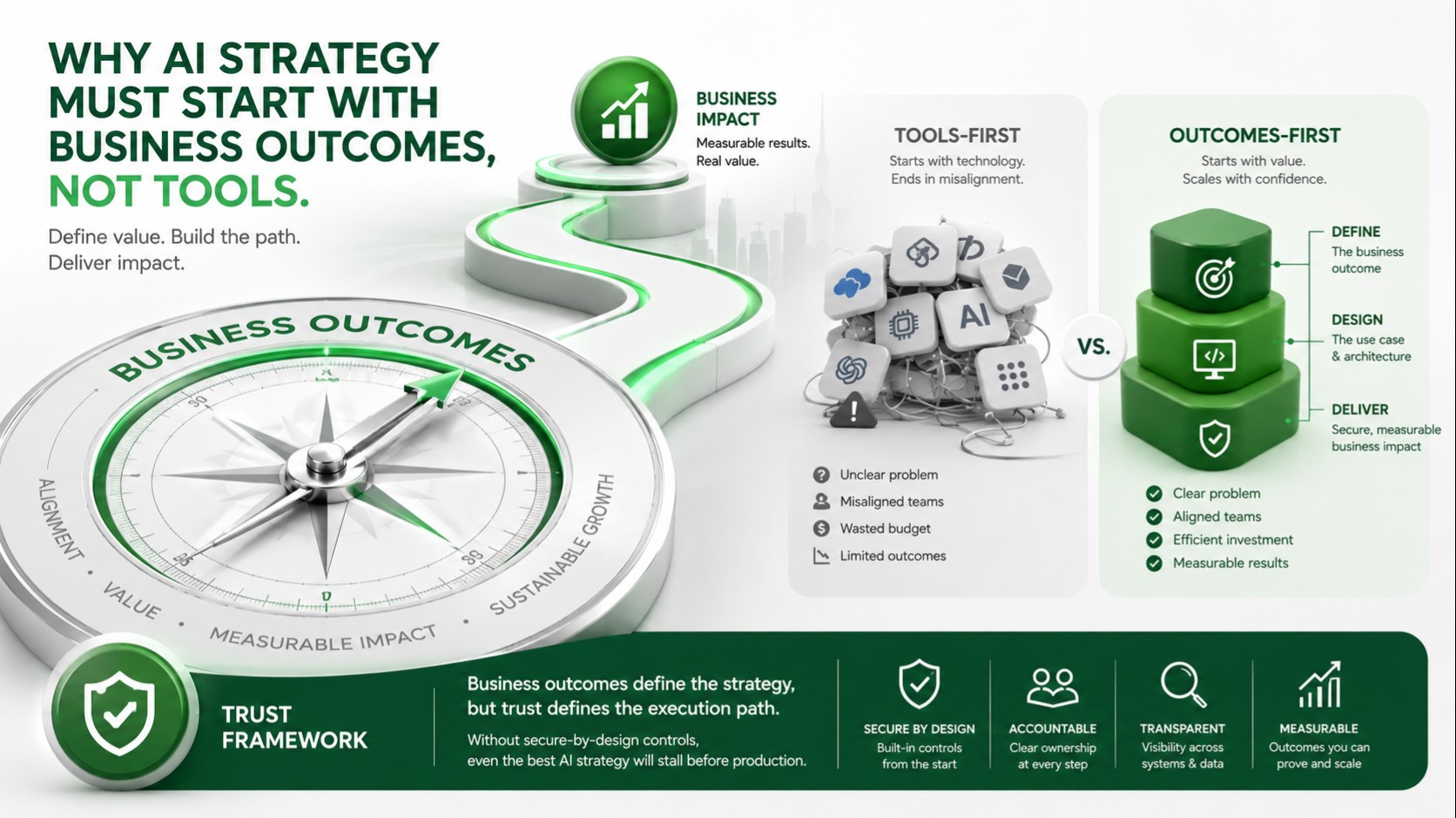
Why AI Strategy Must Start with Business Outcomes, Not Tools.
AI strategy fails when organizations start with tools instead of measurable business outcomes. The strongest programs begin with value, then build the execution model and governance needed to deliver it securely. onetrust+2
With the rush to AI adoption, this is a common pitfall. Relying on a proven deployment model with LuMay, your trusted implementation partner can make all the difference.
Tool selection often comes before the business problem is clear.
Too many AI initiatives begin with a platform, model, or vendor before the enterprise has defined the problem it is trying to solve. That sequence creates misalignment from the start. ewsolutions+1
Technical novelty can distract from measurable enterprise impact.
A system can be impressive without being useful. If leaders focus too heavily on capabilities instead of outcomes, they risk funding activity that never moves a real business metric. fortune+1
Business outcomes should define the use case and architecture.
The most effective AI programs start with a measurable result, then build the architecture around delivering it. That approach keeps the technology anchored to business value. onetrust+1
Strategy should translate into operational value, not just experimentation.
AI strategy should not stop at a pilot or a slide deck. It has to produce repeatable business impact that the enterprise can recognize, measure, and defend. cio+1
The right question is what business result AI must improve.
If the enterprise cannot name the outcome, it cannot design the system effectively. Outcome-led strategy is what turns AI from curiosity into capability. ewsolutions+1
Trust framework callout
Business outcomes define the strategy, but trust defines the execution path.
Without secure-by-design controls, even the best AI strategy will stall before production. cranium+2


