AI Contract Management Software for Legal Departments (2026)
World Commerce & Contracting research shows 8.6% average contract value erosion, and that 80% of organisations lack clarity on contract ownership. For a legal department, that is money lost after signature.
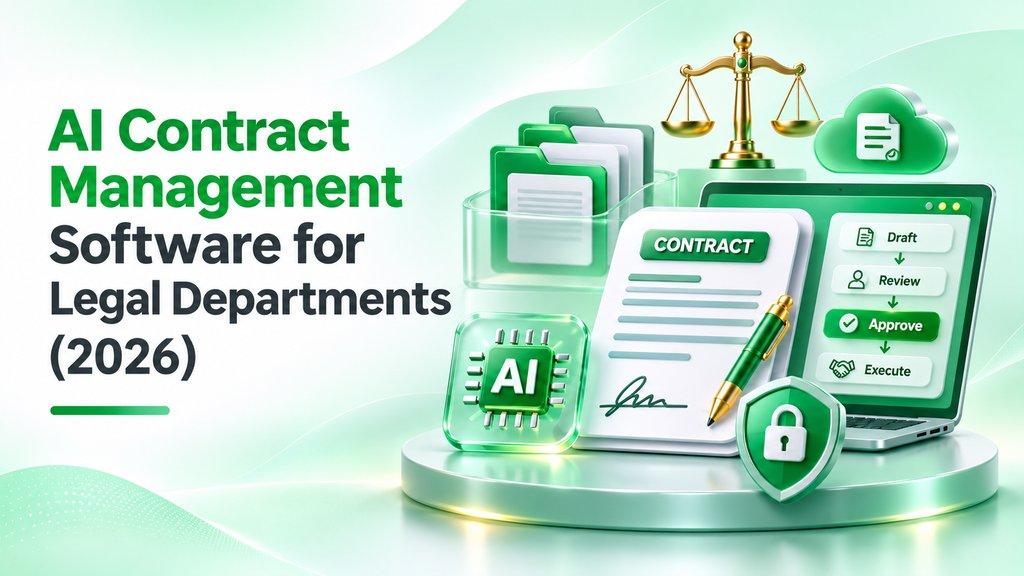
AI contract management software helps legal teams take in requests, find any contract fast, track obligations and renewals, and route approvals, across the full contract lifecycle. This guide compares 8 tools and shows how to test them on your own contracts.
➤ Quick answer: pick software that handles intake, a searchable repository, obligation and renewal tracking, and approvals in the tools your business already uses. Test each finalist on your own contracts, not the vendor’s samples.
What AI contract management software does
• Intake: business users request contracts through forms, Slack or email.
• Drafting from templates: pre-approved clauses and data from systems like Salesforce.
• Negotiation and approvals: routing, redlines and sign-off rules.
• Signature: built-in or connected e-signature.
• Repository: one searchable store for every signed contract.
• Obligations and renewals: dates, duties and alerts after signature.
• Reporting: dashboards on cycle time, risk and value.
Why legal departments are adopting it now
WorldCC also reports that 29% of the workforce is involved in contract management. Without one system, legal becomes the bottleneck and nobody owns the post-signature work.
AI adds speed at each stage: classifying intake, searching the repository in plain language and flagging upcoming obligations. Human lawyers still decide.
8 AI contract management tools compared
Disclosure: LuMay offers legal AI agents and is not included in this list. Tools are listed alphabetically, not ranked. Facts come from each vendor’s own page, read on 24 Nov 2026.
| Tool | What its site highlights | Integrations named | Pricing |
|---|---|---|---|
| Agiloft | Lifecycle from creation to obligation tracking and renewals; searchable contract knowledge base | Ask vendor | Quote-based |
| ContractSafe | Repository, custom intake forms, Edit in Word with sync back; unlimited users on all plans | MS Word | From $450/month |
| Docusign CLM | Pre-approved clause library; auto-populates agreements | Salesforce, Coupa, SAP Ariba | Quote-based |
| Icertis | Agent-driven drafting, playbook creation and audit-ready obligation tracking | Ask vendor | Quote-based |
| Ironclad | Central repository; Leader in Gartner’s 2025 CLM Magic Quadrant (vendor-reported) | Salesforce, Coupa, Ramp and more | Pricing page (quote) |
| Juro | AI intake, intelligent repository, auto-redline against playbooks | Slack, Google Drive; Salesforce, HubSpot, Workday at extra cost | Quote-based |
| Spellbook ACM | Automated intake, triage and routing; repository; renewal and risk alerts | Repository push after signature | See vendor |
| SpotDraft | AI grounded in your contracts and playbooks; works within Microsoft Word | MS Word | Pricing page (quote) |
Tool notes
Agiloft
• Says “most CLMs stop at the signature line”, and covers creation through obligation tracking and renewals.
• Its Astra AI surfaces patterns, obligations and opportunities across contracts.
• Reports being named a CLM leader six years in a row.
ContractSafe
• One of the few CLMs with a published starting price: $450 a month.
• Unlimited users on all plans, from read-only to admins.
• AI capture of custom fields comes with its Maximize plan, per its buyer’s guide.
Docusign CLM
• A clause library legal defines; business users build agreements from it.
• Named a leader in IDC’s Worldwide AI-Enabled Buy-Side CLM 2025 assessment, per Docusign.
Icertis
• Positions agent-driven drafting and playbook creation.
• Reports being named a Leader in the IDC MarketScape 2026–2027 CLM for Corporate Legal assessment.
Ironclad
• Reports Leader placements from Gartner (2025) and Forrester (Q4 2026).
• Reports passing $200 million in annual recurring revenue.
Juro
• Says it replaces Word, PDF, email and Docusign workflows.
• Deeper integrations such as Salesforce, HubSpot and Workday cost extra.
Spellbook ACM
• Intake that triages and routes requests the moment they land.
• Pushes signed contracts to the repository and notifies teams of renewals and new risks.
SpotDraft
• AI grounded in your business context, contracts and playbooks.
• Works inside Microsoft Word for business-side drafting.
How to test CLM software on your own contracts
Sandstone’s guide puts it simply: test the AI on your own paper, and run three real contracts through each tool. ContractSafe’s buyer’s guide also stresses human review of each captured value.
Build a test pack
• 10–20 signed contracts: NDAs, MSAs, SOWs, vendor agreements and one messy legacy scan.
• Include amendments, so you can see if the tool links them to the parent.
• A list of 10 questions legal is asked every week.
Score each finalist
| Test | What good looks like |
|---|---|
| Intake | A sales request reaches the right lawyer with the right template |
| Repository search | Plain-language questions return the right contract and clause |
| Obligations | Key dates and duties appear with alerts and owners |
| Renewals | Notice deadlines are flagged before auto-renewal |
| Approvals | Routing rules follow your delegation of authority |
| Adoption | Business users can self-serve without training sessions |
| Reporting | Cycle-time and volume dashboards without spreadsheet exports |
➤ Illustrative example: a legal team of six might weight intake and repository search at 30% each, obligations at 25% and reporting at 15%. Weights are placeholders for your own priorities.
What drives cost
• Number of users, and whether business users count as seats.
• Contract volume and storage.
• Integrations, especially CRM, ERP and procurement.
• AI features, which some vendors place in higher plans.
• Implementation and data migration of legacy contracts.
ContractSafe is one of the few that publishes a starting price ($450 a month). Most vendors, including Ironclad and SpotDraft, quote on request.
Questions to ask vendors
• How does the tool handle amendments and superseded terms?
• Who owns obligations after signature, and how are they assigned?
• Which integrations are included, and which cost extra?
• Where is contract data stored and processed, and is it used to train models?
• How long does a typical migration of 5,000 legacy contracts take?
• What does the AI do when it is unsure?
Common mistakes
• Choosing on a demo built with clean sample contracts.
• Ignoring post-signature obligations, where value erodes.
• Skipping business-user adoption; legal-only tools become shelfware.
• Migrating everything at once instead of active contracts first.
Related guides
• AI contract data capture for legal teams: key fields, clause evidence and CLM integration.
• Contract renewal management with AI: notice dates and auto-renewals.
• Testing AI contract tools and integrations.
• Best AI for general counsel.
How LuMay supports legal teams
LuMay Legal Agent provides governed AI agents for legal work, where attorneys retain full approval authority over generated actions. Agents such as Intake Flow and Virtual Paralegal can sit alongside an existing CLM.
➤ Want to see how legal AI agents fit with your CLM? Book a demo with LuMay. Pricing is on our pricing page.
Sources
• World Commerce & Contracting
• ContractSafe, AI CLM buyer’s guide
• Sandstone, best CLM software
• Adira Law, choosing a CLM for in-house legal teams
• Vendor pages linked in the comparison table, read 24 Nov 2026.
Tags:
Frequently Asked Questions
Everything you need to know about Legal AI
1. What is AI contract management software?
It is software that manages contracts across their lifecycle, from intake and drafting to approval, signature, storage, obligations and renewals, using AI to speed up classification, search and tracking.
2. How is CLM different from a contract repository?
A repository stores signed contracts. A CLM also manages the steps before and after signature: requests, templates, approvals, negotiation, obligations and renewals, with workflows and reporting.
3. How much does AI contract management software cost?
Most vendors quote privately. ContractSafe publishes a starting price of $450 a month with unlimited users. Enterprise CLMs usually price by users, volume, modules and integrations.
4. Which CLM is best for a legal department?
It depends on your volume, systems and who drafts contracts. Shortlist two or three tools and test them on your own contracts and questions before deciding.
5. Can AI contract management software track obligations?
Yes. Tools such as Agiloft, Icertis and Spellbook ACM highlight obligation or renewal tracking. Confirm each obligation gets an owner and alert, not just a date field.
6. Does CLM software integrate with Salesforce?
Many do. Docusign CLM, Ironclad and Juro name Salesforce integrations, though Juro charges extra for deeper ones. Ask what data syncs and in which direction.
7. How long does CLM implementation take?
It varies with migration size, integrations and workflow complexity. Start with active contracts and one or two workflows, then expand. Ask each vendor for a dated plan.
8. Is our contract data used to train AI models?
Ask every vendor in writing. Check where data is stored, whether it trains shared models and how long it is kept. Your security and privacy teams should review the answers.
9. Will AI replace in-house lawyers in contract management?
No. AI handles routine sorting, searching and tracking. Lawyers still decide on risk, negotiate and approve. Keep human approval on any change to legal terms.
10. How do we measure CLM success?
Track contract cycle time, requests handled by self-service, missed renewals, obligations met on time and user adoption across business teams. Compare against a baseline from before launch.
11. What is the first step in choosing CLM software?
Map your current process: who requests contracts, who approves, where they are stored and what is tracked after signature. That map becomes your requirements and test pack.
About the Editorial Team
Creates insightful content on SEO, AI-powered marketing, digital growth, and emerging technologies. He simplifies complex topics into practical, research-backed guidance.