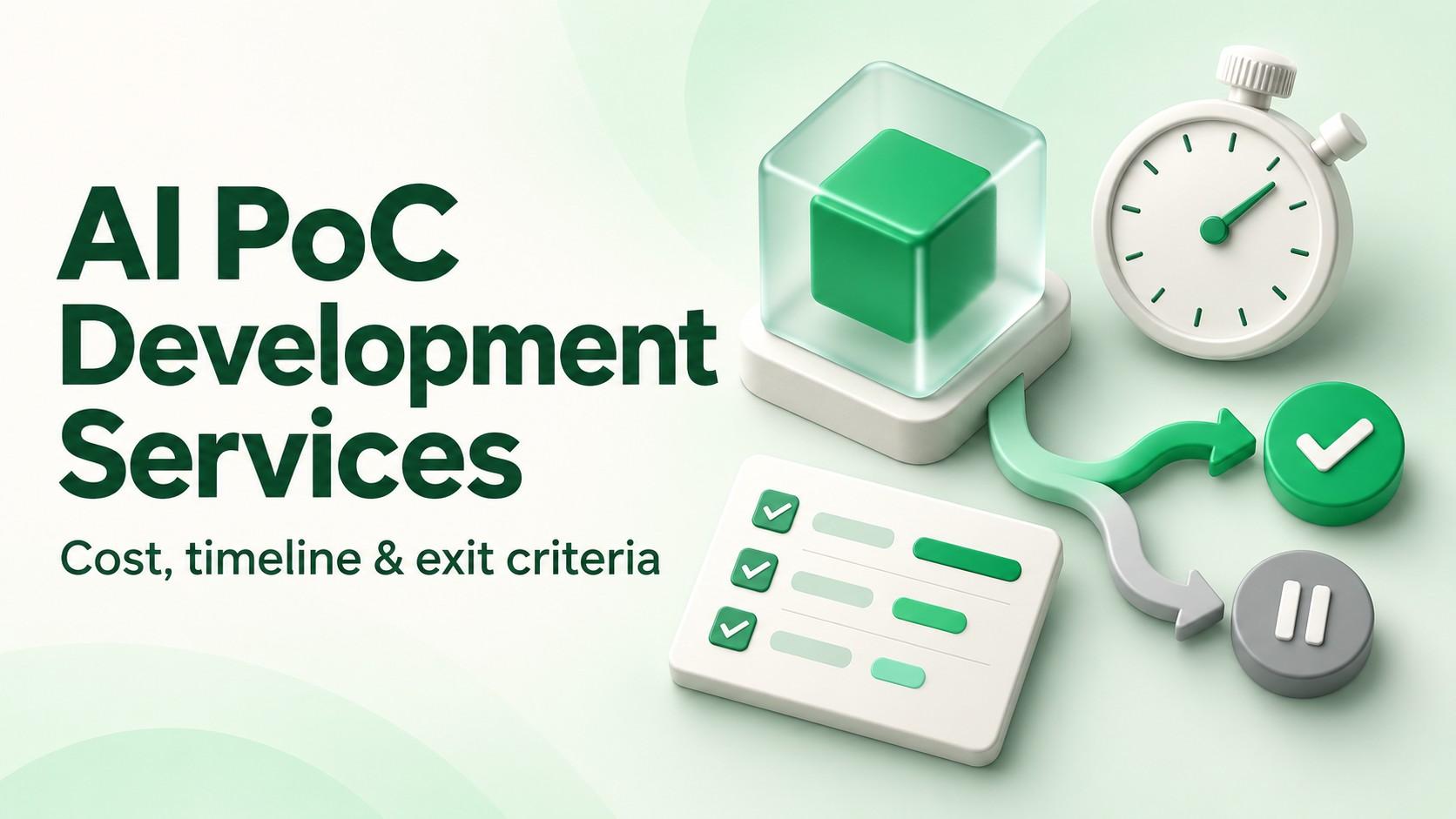
AI PoC Development Services: Cost, Timeline & Exit Criteria
A good AI proof of concept ends with a decision. A bad one ends with a demo everyone liked and nobody can ship. The difference is set in the first week, before any code is written.
This guide explains what AI PoC development services should deliver, what they cost according to published ranges, how long they take, and the exit criteria that turn a PoC into a clear go or no-go.
➤ Quick answer: a useful AI PoC tests one use case on your real data in roughly 2–8 weeks, against success thresholds agreed up front, and ends with an evaluation report, a cost-per-task estimate and a written go/no-go recommendation.
Why so many AI pilots stall
An MIT report covered by Tech.co found that just 5% of AI pilots earned their companies significant growth. It examined over 300 public AI implementations and surveyed 350 employees.
The report blamed a “learning gap”: tools that work for individuals but do not adapt to company workflows. A well-designed PoC tests exactly that fit, on your process and data, before you fund a full build.
PoC, prototype, pilot and MVP: what you are buying
Stage | Question it answers | Who uses it | Typical output |
|---|---|---|---|
Proof of concept (PoC) | Can this work on our data, at the quality and cost we need? | Project team only | Evaluation report, go/no-go |
Prototype | What should the experience look like? | Selected users | Clickable or working demo |
Pilot | Does it work in real operations? | A real user group | Usage and outcome data |
MVP | Will people adopt and pay for it? | Customers or the wider business | First production release |
Many vendors blur these terms. Ask which question the engagement answers and which output you will hold at the end.
What AI PoC development services should deliver
- A one-page scope: one use case, one user group, the data sources and what is out of scope.
- Success thresholds: accuracy, consistency, response time and cost per task, agreed before the build.
- An evaluation set: real cases from your business, including the awkward ones.
- A working build: model, retrieval or agent logic connected to sample data or a sandbox system.
- An evaluation report: scores against thresholds, failure patterns and risks.
- A production estimate: architecture, integration effort, run cost and timeline for the next phase.
- A go/no-go recommendation: in writing, with reasons.
How much does an AI PoC cost?
Published ranges vary by complexity. Treat these as planning bands from two sources, not quotes.
PoC type | Planning range | Typical timeline | Source |
|---|---|---|---|
Simple LLM or API test | $10,000–$25,000 | 2–4 weeks | Lucent Innovation |
RAG PoC on private documents | $20,000–$50,000 | 3–6 weeks | Lucent Innovation |
Agentic AI PoC (tools, permissions) | $30,000–$75,000 | 4–8 weeks | Lucent Innovation |
Complex enterprise PoC | $50,000–$100,000+ | 6–10 weeks | Lucent Innovation |
Simple PoC on clean data | $8,000–$15,000 | 1–3 weeks | GlobeSoft |
Sources: Lucent Innovation – AI proof of concept cost and GlobeSoft – AI proof of concept. Lucent notes its figures are planning bands, not its own pricing.
GlobeSoft offers a useful sanity check: expect a PoC to cost roughly 10–20% of the full production system. A PoC quoted close to the full build price deserves questions.
LuMay publishes its own engagement prices: a 2-week Discovery Sprint at $10K–$15K and a 4–8 week Production Pilot at $25K–$75K. See the LuMay pricing page for current details.
What drives PoC cost up
- Messy or scattered data that needs cleaning, labelling or access approvals.
- Integrations with ERP, CRM, document or ticketing systems.
- Regulated data that needs private hosting, masking or a security review.
- Agent behaviour that calls tools and needs permissions and approval steps.
- Evaluation depth: more test cases and repeated runs cost more, but give a defensible answer.
Typical timeline: a 6-week example
➤ Illustrative example: a six-week PoC for an invoice-matching assistant. Week counts are placeholders; your scope may be shorter or longer.
Week | Focus | Output |
|---|---|---|
1 | Scope, data access, success thresholds | Signed one-page scope and evaluation set |
2 | Baseline build on sample data | First scores against thresholds |
3–4 | Improve retrieval, prompts or agent logic | Scores per iteration, failure log |
5 | Security, cost and edge-case testing | Cost per task, risk list |
6 | Report and decision workshop | Go/no-go and production estimate |
Published timelines support a range like this. SolGuruz states 2 to 6 weeks; Code & Pepper states 4–8 weeks after a 1–2 week discovery sprint.
Exit criteria: the part most PoCs skip
Exit criteria are the thresholds that decide go or no-go. Write them before the build so the result cannot be reinterpreted later.
Criterion | Example threshold (illustrative) | Why it matters |
|---|---|---|
Task accuracy | At least 90% correct on the evaluation set | Proves the core capability |
Critical-field errors | Zero errors on payment amounts or IDs | Some mistakes cost far more than others |
Consistency | Same answer on repeated runs of a case | AI output can vary run to run |
Response time | Answer within an agreed number of seconds | Users abandon slow tools |
Cost per task | Below an agreed amount at expected volume | Protects the production business case |
Human review rate | Share of cases needing a person stays under target | Shows real time saved |
RaftLabs gives a good warning about averages: an overall 92% score can hide frequent errors on customer identifiers. Score critical fields separately. See RaftLabs on AI PoC development.
Red flags in AI PoC proposals
- No evaluation set, only “we will show you a demo”.
- Success defined as “stakeholders are impressed”.
- Synthetic data only, when your real data is available.
- No estimate of run cost or production effort.
- The vendor keeps the code or prompts after the PoC.
- A PoC priced almost like the full production build.
From PoC to production
A PoC that passes is not production-ready. The next phase usually adds security review, full integrations, monitoring, user training and support. Plan for that gap in budget and time.
Our PoC-to-production handover checklist and 7 ways to validate an AI proof of concept cover that step in detail.
How LuMay runs AI PoCs
LuMay’s custom AI development work starts with a scoped discovery, then a pilot that is built, integrated, tested and validated with user acceptance testing and a pilot dashboard. You agree the thresholds before we build.
➤ Have a use case in mind? Book a scoping session with LuMay and leave with a draft one-page scope and exit criteria.
How to pick the right PoC use case
Score each candidate use case from 1 to 5 on these factors, and start with the highest total.
Factor | High score means |
|---|---|
Business value | Saves meaningful time or money, or unlocks revenue |
Data readiness | Real examples exist and can be accessed safely |
Measurability | Success can be scored objectively on a test set |
Contained scope | One workflow, one user group, few systems |
Risk level | Mistakes are caught before they reach customers |
Sponsor | A named business owner will act on the result |
➤ Illustrative example: a logistics company scores “classify inbound customs emails” at 26 of 30 and “fully automate pricing negotiations” at 13. It starts with the email classifier.
Who you need on the PoC team
- Business owner: sets the goal and makes the go/no-go call.
- Subject-matter expert: labels test cases and judges output quality.
- Data or IT contact: grants access and explains systems.
- Security reviewer: approves data handling early, not at the end.
- Vendor team: usually an architect or lead engineer, an AI engineer and QA.
What the final PoC report should contain
- The use case, scope and thresholds agreed in week one.
- Scores on the evaluation set, including critical-field errors and consistency.
- A failure analysis: which cases failed and why.
- Measured cost per task and response time.
- Security and data-handling findings.
- A production architecture, effort estimate and run-cost forecast.
- A clear recommendation: go, go with changes, or stop.
Contract terms for AI PoC development services
- Fixed price and fixed duration, with any change requests priced separately.
- Ownership of code, prompts and the evaluation set by the client.
- No use of client data to train shared models.
- The right to continue with another vendor or in-house team after the PoC.
Sources
Frequently Asked Questions
Everything you need to know about Engineering Services
1. What is an AI PoC?
An AI proof of concept is a small, time-boxed test that checks whether an AI approach works on your data at the quality and cost you need, and ends with a go or no-go decision.
2. How much does an AI proof of concept cost?
Published planning bands run from about $8,000–$15,000 for a simple PoC on clean data to $50,000–$100,000 or more for complex enterprise PoCs with several systems and sensitive data.
3. How long does an AI PoC take?
Most published ranges fall between 2 and 8 weeks. Simple tests can be shorter; agent, multi-system and regulated-data PoCs sit at the top of the range or beyond.
4. What is the difference between a PoC and a pilot?
A PoC proves feasibility with the project team on real data. A pilot puts a working system in front of real users in real operations to measure adoption and outcomes.
5. What should be included in an AI PoC deliverable?
A scope, agreed thresholds, an evaluation set, a working build, an evaluation report, a production estimate with run costs, and a written go/no-go recommendation.
6. What are good exit criteria for an AI PoC?
Measurable thresholds for accuracy, critical-field errors, consistency across repeated runs, response time, cost per task and human review rate, all agreed before the build starts.
7. How much data do I need for an AI PoC?
Enough real examples to test the use case fairly, including difficult cases. Many PoCs use a few dozen to a few hundred labelled examples; your vendor should justify the number.
8. Why do AI PoCs fail to reach production?
Common reasons are vague success criteria, demo data instead of real data, missing integration plans, unknown run costs and no owner for the next phase.
9. Should the PoC use our real data?
Yes, where security rules allow. Synthetic data rarely shows the messy cases that decide production success. Use masking or private hosting if data is sensitive.
10. Who owns the code from an AI PoC?
Agree this in the contract. You should own the code, prompts and evaluation set so you can continue with the same vendor, another vendor or your own team.
11. What happens after a successful AI PoC?
A production plan: security review, full integrations, monitoring, training and support, with a budget and timeline. LuMay’s published Production Pilot covers this step in 4–8 weeks.
About the Editorial Team
Creates insightful content on SEO, AI-powered marketing, digital growth, and emerging technologies. He simplifies complex topics into practical, research-backed guidance.