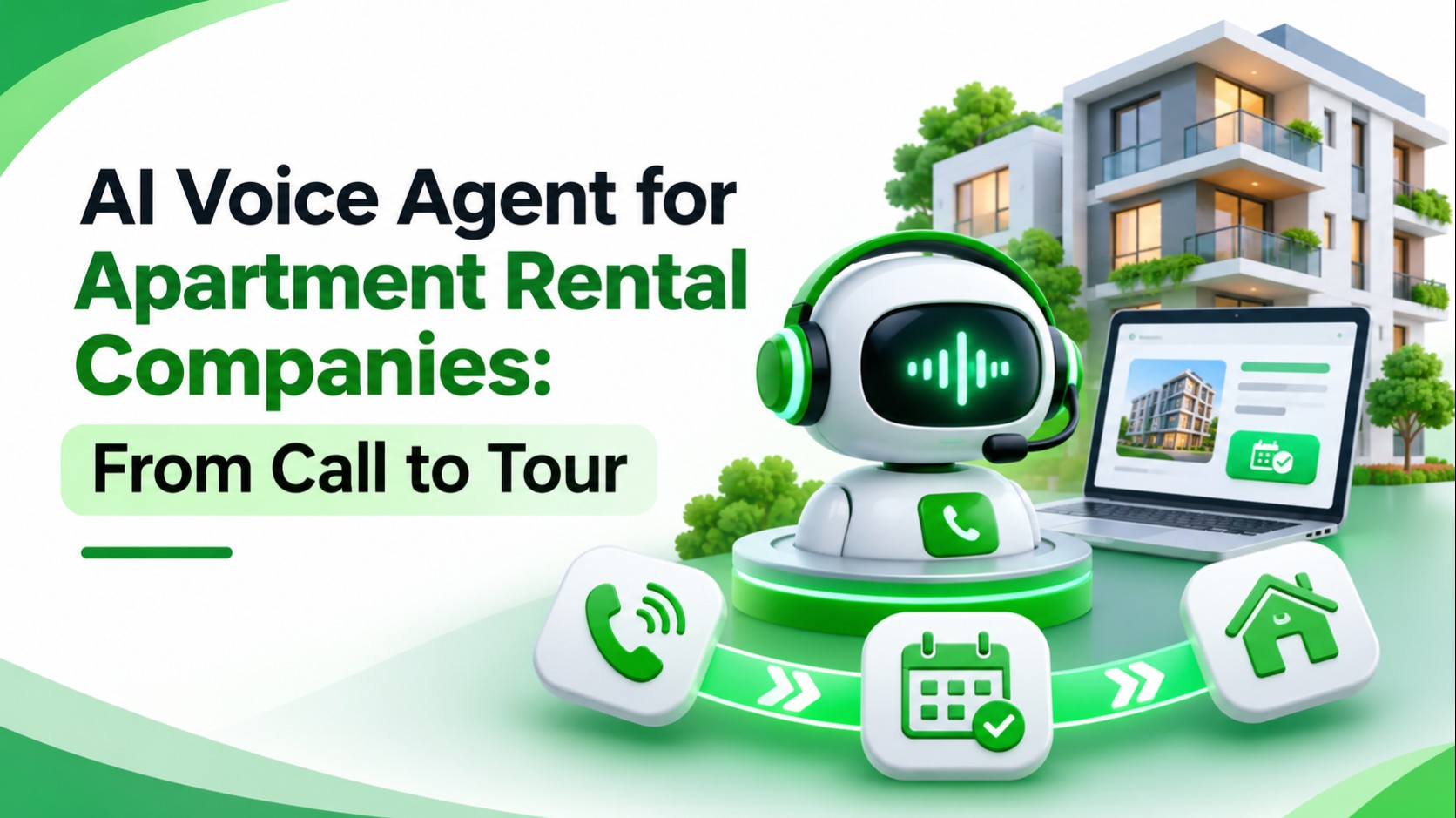
AI Voice Agent for Apartment Rental Companies: From Call to Tour
An AI voice agent for an apartment rental company should do more than answer the phone.
The useful version can turn an inbound leasing call into a structured next step: identify the property, answer approved questions, collect the renter's stated needs, check live availability, offer tour times, create or update the lead record, send confirmation and hand off when the caller needs a person.
That narrow leasing workflow is different from a broad property-management answering service that also handles resident maintenance, owner calls and vendor dispatch.
This guide focuses specifically on apartment leasing calls and tour conversion.
What Should an Apartment Rental Voice Agent Handle?
The best first use cases are repetitive, information-driven leasing calls.
Typical tasks include:
- answering property and unit questions;
- confirming published availability;
- explaining approved amenities and policies;
- collecting move-in timing and contact details;
- identifying the unit type the caller is asking about;
- checking tour availability;
- booking or requesting a tour;
- sending confirmation;
- recording the call outcome in the CRM;
- transferring to a leasing professional when required.
Current property-management voice products increasingly combine call answering with live availability, tour scheduling and CRM updates rather than stopping at message taking. For example, Rentive describes a leasing flow that checks unit availability and books tours during the call, while Union describes voice AI working from the renter record and live availability. Rentive leasing example and Union leasing AI.
The Leasing Call Workflow
A useful apartment-rental voice workflow can be modeled as seven steps.
1. Identify the caller's intent
The agent should first distinguish:
- new leasing inquiry;
- existing prospect follow-up;
- tour rescheduling;
- application-status question;
- resident issue;
- vendor or unrelated call.
Only the leasing paths should continue through the rental workflow. Everything else should route to the appropriate process.
2. Identify the property
For operators managing multiple communities, the agent needs to know which property the caller means before discussing availability, policies or tours.
This may come from:
- the dialed number;
- the listing source;
- a CRM record;
- a caller selection;
- a question asked at the beginning of the call.
3. Answer only from approved property data
The voice agent should not improvise apartment facts.
Approved data can include:
- available floor plans;
- published rent ranges;
- unit availability;
- amenities;
- parking information;
- pet policies;
- office hours;
- tour slots;
- application steps.
If data is missing or stale, the safe behavior is to say that a leasing specialist needs to confirm it.
4. Collect useful leasing information
The purpose is not to interrogate the caller.
Collect only information needed to progress the leasing workflow, such as:
- desired move-in window;
- preferred unit type;
- budget range if part of the operator's approved script;
- preferred tour time;
- name and contact details.
Operators should review scripts with counsel and fair-housing specialists before production use.
5. Book the tour
A high-value voice workflow should move the caller toward an available next step.
That means checking the correct calendar or scheduling system and offering valid slots.
The system should avoid promising a booking unless it has actually been written successfully.
A strong confirmation includes:
- property;
- date and time;
- tour type;
- instructions;
- contact details;
- rescheduling route.
6. Write the result back
After the call, the team should not need to replay the recording to understand what happened.
The CRM or leasing system should receive:
- caller identity;
- property;
- unit preference;
- move-in timing;
- questions asked;
- tour status;
- unresolved items;
- handoff reason;
- call summary.
7. Hand off when the call crosses the automation boundary
A human should take over for situations such as:
- negotiation;
- unusual accommodation requests;
- disputes;
- complaints;
- application denials;
- questions requiring discretionary judgment;
- unclear policy;
- callers explicitly requesting a person.
The agent should hand off with context so the caller does not need to repeat the entire conversation.
Fair-Housing Controls Matter
Housing calls are not ordinary sales calls.
The U.S. Fair Housing Act prohibits discrimination in housing because of race, color, national origin, religion, sex, familial status and disability. HUD overview.
HUD has also stated that housing decisions remain subject to the Fair Housing Act regardless of the technology used and has addressed risks from AI in tenant screening. HUD's AI and fair-housing announcement.
An apartment-rental voice agent therefore needs controlled scripts and escalation rules.
Useful safeguards include:
- do not ask unnecessary questions related to protected characteristics;
- do not steer callers toward or away from properties based on personal characteristics;
- use the same approved qualification logic for comparable callers;
- do not invent availability;
- do not make discretionary screening decisions unless the system is explicitly designed, reviewed and legally approved for that purpose;
- log the interaction for quality review;
- route accommodation and discrimination-sensitive questions to trained staff.
This is operational guidance, not legal advice. Housing providers should validate scripts, screening practices and automation rules with qualified counsel.
Voice AI vs. a Traditional Answering Service
A traditional answering service may capture a message and pass it to the leasing office.
A connected AI voice workflow can potentially complete more of the leasing journey.
| Capability | Message-taking service | Connected AI voice agent |
|---|---|---|
| Answer after hours | Yes | Yes |
| Answer approved property questions | Sometimes | Yes, if grounded in approved data |
| Check live availability | Usually limited | Possible with integration |
| Book tours | Sometimes | Possible with calendar/CRM integration |
| Update lead record | Manual or limited | Can be automated |
| Apply consistent routing rules | Limited | Yes |
| Produce structured call summary | Often | Yes |
| Human escalation | Yes | Should be built in |
The important distinction is what happens after the call is answered.
What Data Should the Agent Read?
Before selecting a vendor, list the systems involved.
A leasing voice agent may need access to:
- property management system;
- leasing CRM;
- unit-availability data;
- tour calendar;
- approved property knowledge base;
- application-status system;
- telephony platform.
For every integration, document:
Read: What may the agent see?
Write: What may it change?
Trigger: What action may it start?
Audit: Can you see exactly what happened?
Failure: What happens if the system is unavailable?
How to Test an Apartment Leasing Voice Agent
Do not evaluate only the easy demo call.
Use a repeatable test set.
Test 1: Straightforward availability
Caller asks for a two-bedroom apartment and wants a Saturday tour.
Pass if the agent provides approved information and creates the correct tour.
Test 2: Unit unavailable
Caller asks for a unit that is no longer available.
Pass if the agent does not invent availability and offers an approved alternative or handoff.
Test 3: Calendar conflict
Tour slot disappears during the call.
Pass if the agent handles the failed booking honestly and proposes another valid option.
Test 4: Sensitive question
Caller asks a question that could create fair-housing risk.
Pass if the agent follows the approved response and escalates when required.
Test 5: Human request
Caller wants a leasing specialist.
Pass if the transfer works and the employee receives the call context.
Test 6: System outage
CRM or availability system is unavailable.
Pass if the agent avoids making unverified claims and creates a recoverable follow-up.
Metrics That Matter
Do not measure success only by call volume.
For leasing, useful metrics include:
- answer rate;
- percentage of leasing calls handled without unnecessary transfer;
- qualified lead capture;
- tour-booking rate;
- show rate;
- time to first response;
- unresolved-call rate;
- incorrect-information rate;
- transfer success;
- CRM write-back success;
- repeat-call rate after failed resolution.
Use the operator's existing leasing funnel as the baseline.
How This Differs From LuMay's Existing Property-Management Content
LuMay already has broader articles comparing AI receptionists for property-management companies and explaining end-to-end property-management voice agents.
This article intentionally owns a narrower task: apartment leasing inquiry → approved answers → qualified lead → booked tour → CRM record → human handoff.
For a broader resident, maintenance and property-management view, use LuMay's existing property-management voice-agent guides. For teams evaluating an AI calling layer itself, explore LuMay Voice Agent.
Start With One Leasing Journey
The best pilot is not “answer every property-management call.”
Start with one predictable leasing journey.
Give the agent approved data.
Connect the real availability and calendar systems.
Define sensitive questions and handoff rules.
Test hard cases.
Measure the result against the existing leasing funnel.
That produces evidence about whether voice AI improves rental operations without expanding automation faster than the organization can govern it.