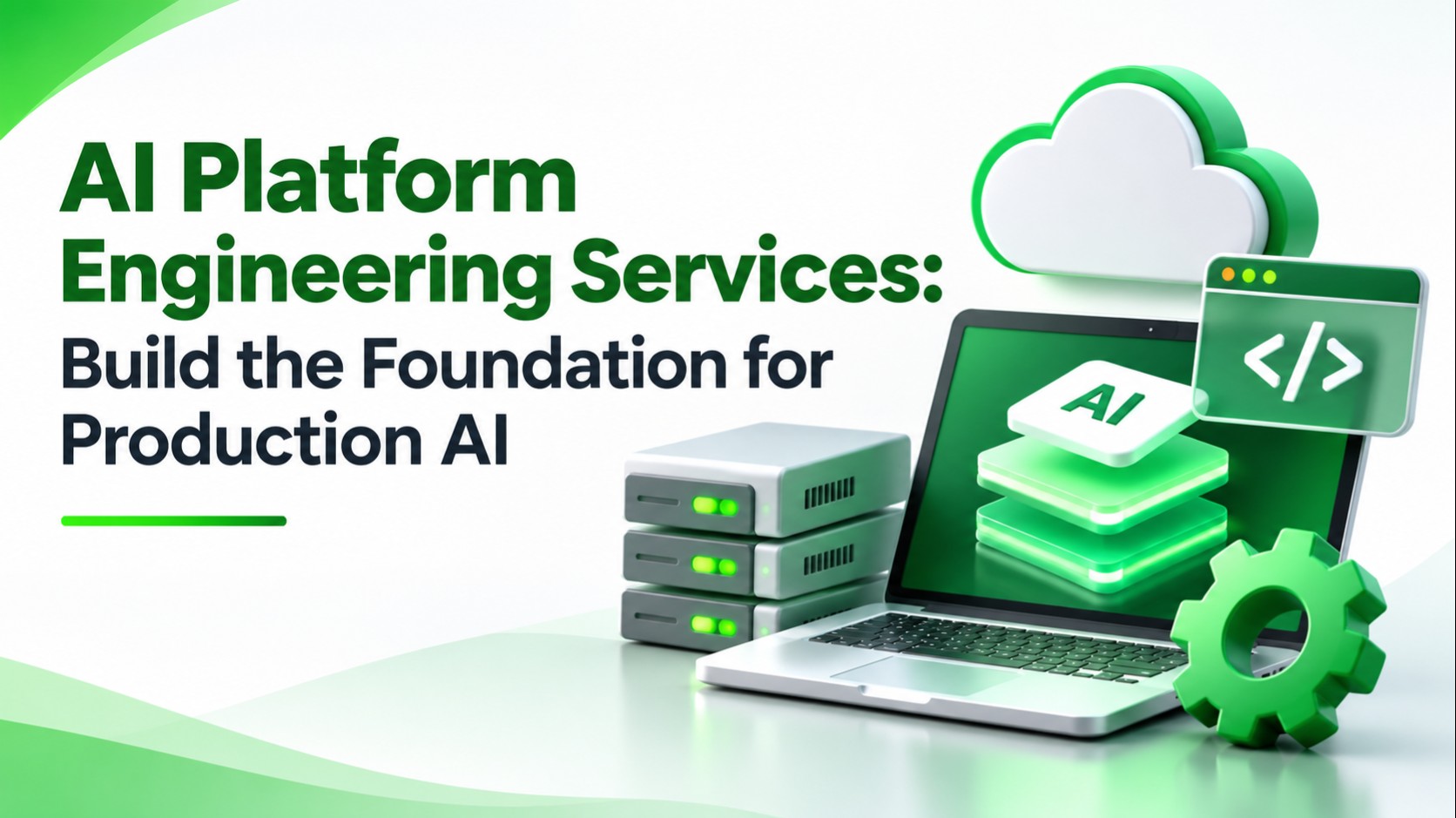
AI Platform Engineering Services: Build the Foundation for Production AI
AI projects often begin as separate applications.
One team builds a retrieval assistant.
Another creates an agent.
A third integrates a model into customer support.
Each project may work independently, but the enterprise eventually inherits duplicated model gateways, disconnected evaluation methods, inconsistent permissions, separate logging and different release processes.
AI platform engineering solves that problem.
The goal is to create a reusable production foundation for building, deploying, governing and operating AI applications across teams.
What Are AI Platform Engineering Services?
AI platform engineering services design and implement the shared capabilities enterprise teams need to move AI applications from isolated experiments into repeatable production delivery.
A platform may include:
- model access and routing;
- prompt and configuration management;
- retrieval infrastructure;
- vector and search services;
- agent orchestration;
- tool access;
- identity and permissions;
- evaluation;
- observability;
- cost controls;
- deployment pipelines;
- audit logging;
- reusable application templates;
- developer self-service.
The platform should reduce repeated engineering work without forcing every AI application into the same architecture.
AI Platform Engineering vs. AI Application Development
These are related but different services.
AI application development builds a specific product or workflow.
AI platform engineering builds the shared capabilities multiple products can reuse.
For example:
A legal research assistant is an AI application.
The model gateway, retrieval service, evaluation harness, permissions layer and observability stack behind multiple legal assistants form part of the AI platform.
This distinction matters because enterprises often scale AI by building many applications, then discover that each one has recreated the same production controls.
The 8 Core Platform Layers
1. Model access layer
The platform should provide a controlled way for applications to access models.
Useful capabilities include:
- approved model catalog;
- provider abstraction;
- model routing;
- fallback;
- token and cost tracking;
- rate limits;
- environment separation;
- version control.
Teams should be able to change models without rewriting every application.
2. Retrieval and knowledge layer
Production AI often needs enterprise data.
A shared retrieval layer may include:
- connectors;
- ingestion;
- parsing;
- chunking;
- metadata;
- hybrid search;
- vector search;
- reranking;
- source citation;
- permission filtering.
The important requirement is not simply “RAG.”
It is reliable, permission-aware retrieval from approved sources.
3. Agent and tool layer
AI agents need controlled access to actions.
A platform should define:
- available tools;
- tool permissions;
- input validation;
- output validation;
- timeout;
- retry;
- idempotency;
- human approval;
- audit history.
Tools should not be exposed to every agent by default.
4. Evaluation layer
Every production release should be testable.
A reusable evaluation layer can support:
- benchmark datasets;
- task-level assertions;
- retrieval quality;
- groundedness;
- safety checks;
- regression testing;
- human review;
- release gates.
LuMay's existing AI Agent Regression Testing guide covers release comparison in more detail.
5. Security and governance layer
Enterprise AI must inherit enterprise controls.
This includes:
- SSO;
- RBAC;
- secrets management;
- data boundaries;
- encryption;
- audit logs;
- model/provider policies;
- retention controls;
- human approval for sensitive actions.
The platform should make compliant behavior easier than bypassing the platform.
6. Observability layer
The operations team needs to understand what happened inside an AI request.
Capture:
- trace;
- prompt/config version;
- model;
- retrieval sources;
- tool calls;
- latency;
- token cost;
- failures;
- retries;
- user feedback;
- business outcome where possible.
Traditional application logs are not enough for multi-step AI workflows.
7. Delivery layer
AI applications need repeatable release processes.
Platform engineering can standardize:
- CI/CD;
- environment promotion;
- configuration management;
- evaluation gates;
- rollback;
- feature flags;
- canary deployment;
- incident response.
The result should be predictable deployment, not manual notebook-to-production handoff.
8. Developer experience
The platform succeeds only if engineering teams use it.
Give developers:
- templates;
- SDKs;
- approved components;
- documentation;
- local test patterns;
- sandbox environments;
- dashboards;
- self-service provisioning.
A platform that requires a central platform team for every small change becomes a bottleneck.
When Does an Enterprise Need AI Platform Engineering?
You probably need a shared platform when several of these are true:
- multiple teams are building AI applications;
- the same model integrations are being recreated;
- security reviews repeat for every project;
- evaluation methods are inconsistent;
- application teams build separate RAG stacks;
- model costs are difficult to track;
- permissions differ between projects;
- there is no common observability;
- agent tools are exposed differently by every team;
- production incidents are hard to reconstruct.
If the organization has only one small AI application, a large platform may be unnecessary.
Platform engineering should follow real reuse demand.
A Practical Platform Roadmap
Phase 1: Standardize the minimum
Start with the capabilities every production application needs:
- identity;
- model access;
- logging;
- cost tracking;
- secrets;
- environment separation;
- basic evaluation.
Phase 2: Add reusable AI services
Introduce:
- retrieval;
- tool gateway;
- agent orchestration;
- evaluation framework;
- prompt/config registry.
Phase 3: Add developer self-service
Provide:
- templates;
- automated provisioning;
- deployment pipelines;
- testing environments;
- documentation.
Phase 4: Operate as a product
Treat the platform as an internal product.
Track:
- adoption;
- reuse;
- developer lead time;
- platform reliability;
- release frequency;
- cost;
- incidents;
- user satisfaction.
The platform team should have a roadmap and service-level objectives.
Platform Engineering vs. GenAI Engineering Services
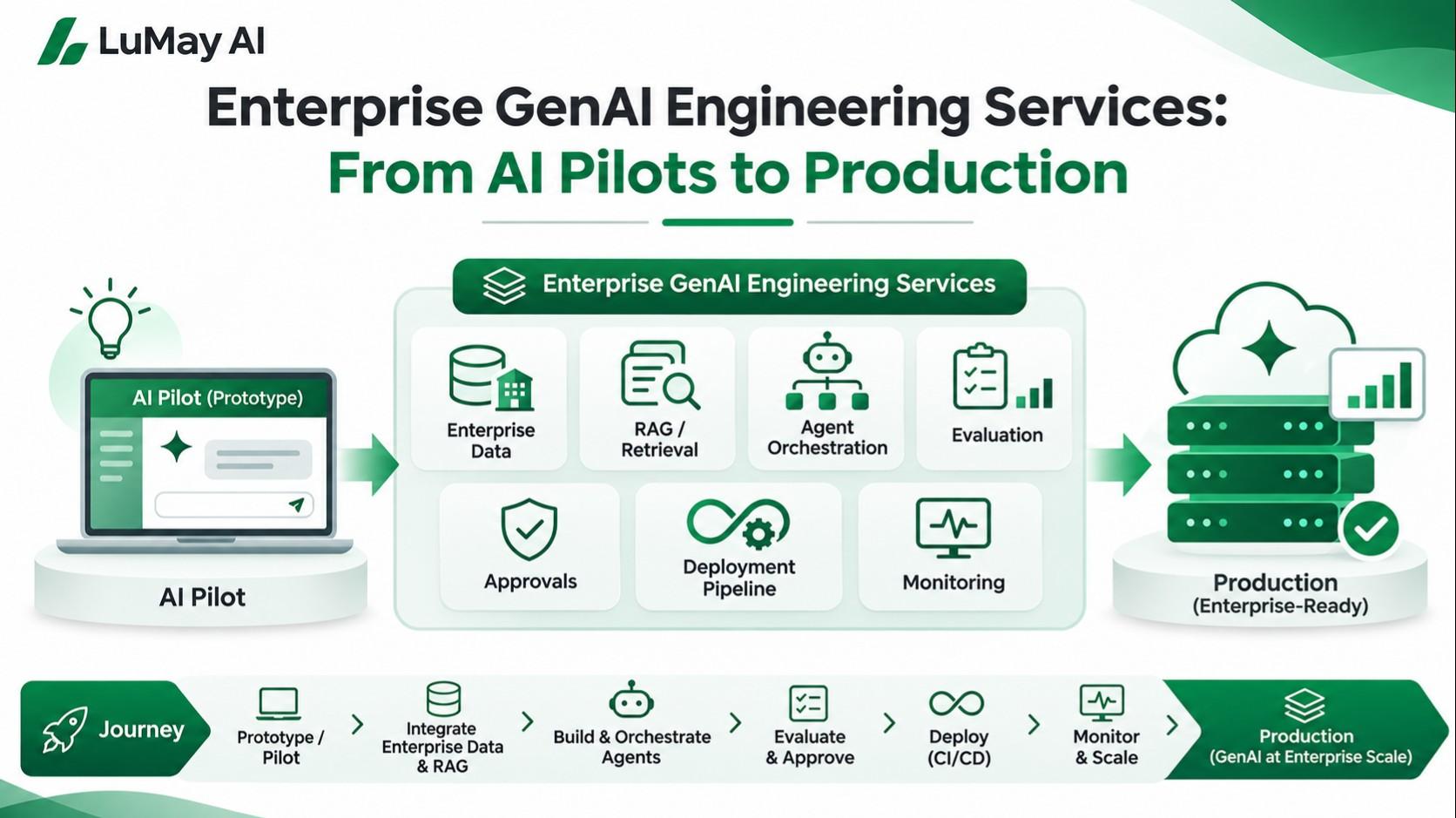
LuMay already has an article on Enterprise GenAI Engineering Services: From AI Pilots to Production.
That article focuses on delivering GenAI systems from pilot into production.
This article is deliberately narrower:
How do you build the reusable internal platform that many AI applications can use?
That separation avoids creating two pages for the same search task.
What to Ask an AI Platform Engineering Partner
Ask whether the service can deliver:
- a target platform architecture;
- model-provider abstraction;
- permission-aware enterprise retrieval;
- agent/tool governance;
- repeatable evaluation;
- production observability;
- cost management;
- CI/CD and release gates;
- developer self-service;
- operational handover.
Also ask what should not be centralized.
Good platform design leaves application-specific logic with the product team.
Measure the Platform Itself
An AI platform should improve engineering performance.
Useful metrics include:
- time to provision a new AI application;
- time from prototype to controlled environment;
- percentage of applications using shared services;
- duplicated components retired;
- release lead time;
- evaluation coverage;
- incident resolution time;
- model cost visibility;
- number of security exceptions;
- developer satisfaction.
The platform should create leverage.
If it only adds another layer of approval, it has failed.
The Goal Is Reusable Production Capability
AI platform engineering is not about building a large internal portal because “platform engineering” is fashionable.
It is about removing repeated work while strengthening controls.
A useful platform makes it easier to:
build → test → deploy → observe → govern → improve
across many AI applications.
For enterprises that already have several pilots but lack a shared production foundation, platform engineering is often the step that turns isolated AI projects into a repeatable engineering capability.