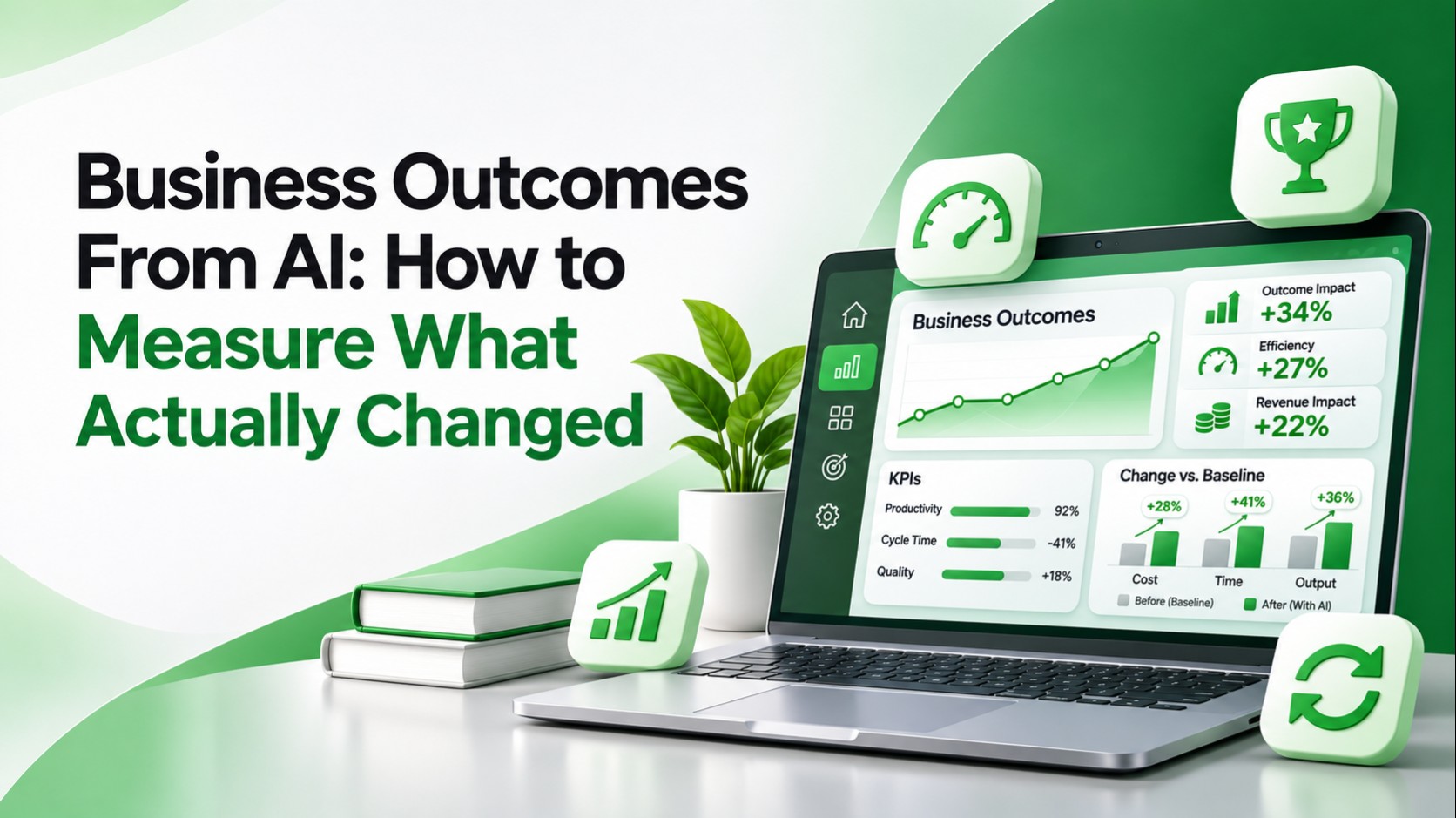
Business Outcomes From AI: How to Measure What Actually Changed
AI programs often report activity before they report value.
Teams can usually tell you how many users logged in, how many prompts were submitted, how many copilots were deployed or how many pilots were launched.
Those numbers describe adoption.
They do not prove a business outcome.
A credible AI measurement system should answer a more important question:
What changed in the business because this AI workflow exists?
What Counts as a Business Outcome From AI?
A business outcome is a measurable change in organizational performance that can be linked to an AI-enabled workflow.
Common outcome categories include:
- revenue improvement;
- lower cost to serve;
- faster cycle time;
- better conversion;
- lower rework;
- higher first-pass completion;
- reduced risk exposure;
- improved customer experience;
- improved employee capacity;
- faster time to market.
The exact outcome depends on the workflow.
A customer-service assistant should not be measured with the same scorecard as an AI coding workflow, a finance reconciliation tool or a legal document-review system.
The measurement architecture should follow the business process.
Start With Strategy, Not the Model
A useful sequence is:
Business priority → Workflow → Expected change → Metric → AI capability
Not:
AI capability → Find a use case → Invent a metric
This principle is supported by research on AI business-value frameworks, which argues that business strategy should drive desired outcomes and measurements before implementation decisions are made. AI decision-making framework for business value.
For example, suppose the business priority is faster revenue realization.
The relevant workflow might be invoice review.
The expected change might be fewer rejected invoices and shorter review cycles.
Only then should the team decide where AI can assist.
The Five Measurement Layers
A strong AI scorecard should connect technical performance to financial value.
McKinsey's 2026 AI-value framework separates measurement into multiple layers, moving from infrastructure and technical enablers through adoption and strategic outcomes to financial impact. McKinsey: From promise to impact.
A practical version for enterprise teams is:
1. Technical quality
Is the AI system functioning correctly?
Examples:
- response quality;
- latency;
- tool-call success;
- retrieval accuracy;
- failure rate;
- security events;
- cost per run.
These metrics are necessary, but they are not business outcomes.
2. Adoption
Are the intended users actually using the workflow?
Examples:
- eligible users activated;
- repeat usage;
- workflow completion rate;
- percentage of work handled through the approved path;
- time to first successful use.
Usage alone still does not prove value.
3. Workflow performance
Did the process improve?
Examples:
- cycle time;
- manual touches;
- backlog;
- rework;
- exception rate;
- first-pass completion;
- escalation rate;
- handoffs.
This is where most operational value becomes visible first.
4. Strategic outcome
Did the workflow improvement move a business KPI?
Examples:
- first-contact resolution;
- on-time delivery;
- conversion;
- retention;
- days sales outstanding;
- claim settlement speed;
- matter turnaround time.
5. Financial impact
Did the strategic improvement create measurable enterprise value?
Examples:
- revenue uplift;
- cost avoided;
- margin improvement;
- capacity redeployed;
- lower total cost of ownership;
- reduced loss or leakage.
Finance should validate this layer whenever the result is used for investment decisions.
Baselines Matter More Than AI Benchmarks
A team should compare the new workflow with its own prior performance before comparing itself with an industry benchmark.
The most useful baseline answers:
- How was the work performed before AI?
- How much time did it take?
- How many people touched it?
- How often did it require correction?
- What did it cost?
- What quality or risk issues occurred?
Then compare the AI-enabled workflow against that state.
A baseline makes the business case auditable.
Avoid Vanity Metrics
Some AI metrics are useful for operations but weak for value measurement.
Examples include:
- prompts submitted;
- total tokens;
- number of generated summaries;
- number of bots created;
- chatbot conversations;
- percentage of employees with access.
These can help explain adoption or cost.
They should not be presented as proof of business value.
Deloitte's 2026 AI transformation research similarly notes that many organizations can measure AI cost but struggle to measure what AI is worth because business reporting systems are not designed to capture workflow performance, decision quality and role-level productivity. Deloitte 2026 AI transformation trends.
Build a Value Chain
For every AI initiative, create a simple value chain.
AI capability → Workflow change → Operational metric → Business KPI → Financial impact
Example:
AI-assisted invoice review
→ fewer manual checks and earlier exception detection
→ lower correction rate and faster cycle time
→ fewer rejected invoices
→ faster cash realization.
This chain helps executives see how a technical capability connects to business value.
Separate Capacity From Savings
One of the most common AI ROI mistakes is to treat every hour saved as money saved.
Suppose a workflow saves 500 employee hours per month.
That does not automatically mean the organization saved the cost of 500 hours.
Ask what happened to the released capacity.
Was it:
- used to process more work;
- used to reduce backlog;
- used to improve quality;
- redeployed to higher-value tasks;
- converted into reduced staffing cost;
- left unused?
Only the actual organizational consequence should appear in the financial case.
Use Finance-Validated Value
A business-unit estimate can start the conversation.
Finance should validate the final value.
For example:
Claim: AI reduced support cost by 20%.
Finance should ask:
- Which costs were included?
- What period was measured?
- Did volume change?
- Did staffing change?
- Did vendor cost increase?
- Did customer quality decline?
- Is the value recurring?
That turns AI ROI into a business metric rather than a project-team claim.
Example Scorecard
| Layer | Metric | Baseline | Current | Owner |
|---|---|---|---|---|
| Technical | Task success rate | — | Current | Engineering |
| Adoption | Approved workflow usage | Baseline | Current | Function lead |
| Workflow | Median cycle time | Baseline | Current | Operations |
| Strategic | Conversion / resolution / realization | Baseline | Current | Business owner |
| Financial | Value created / cost avoided | Baseline | Current | Finance |
This table should be built with actual company data.
Measure Before, During and After the Pilot
Before
Define:
- business owner;
- baseline;
- target metric;
- quality guardrail;
- risk limit;
- expected cost;
- review period.
During
Track:
- adoption;
- execution quality;
- workflow movement;
- operating cost;
- exceptions;
- user feedback.
After
Compare:
- baseline vs current state;
- expected vs actual value;
- value vs operating cost;
- quality vs speed;
- adoption vs benefit.
Then decide whether to scale, redesign or stop.
Infosys' 2026 AI ROI research found that organizations often struggle to prove value because they lack centralized KPI frameworks and clear ROI targets before scaling. Infosys: The AI ROI Gap.
What Executives Need to See
Executive AI reporting should be short.
For each initiative, show:
- business outcome;
- baseline;
- current performance;
- financial impact;
- total operating cost;
- major risk/quality metric;
- decision.
The decision should be explicit:
Scale | Hold | Redesign | Stop
A dashboard without a decision is only monitoring.
Business Outcomes and Agentic Automation Are Different Topics
This article is about the enterprise measurement architecture across AI initiatives.
If the use case specifically involves agents that take actions across tools and workflows, use LuMay's companion guide on Agentic Automation With Measurable Outcomes for autonomy boundaries, stop rules and workflow-level instrumentation.
AI Value Starts Before Deployment
The strongest AI business case begins before the model is selected.
Define the business outcome.
Measure the current process.
Choose the workflow.
Set the target.
Identify the quality and risk guardrails.
Then decide where AI belongs.
When measurement is designed this way, leaders can answer the question that matters most:
Did AI improve the business enough to justify the investment?